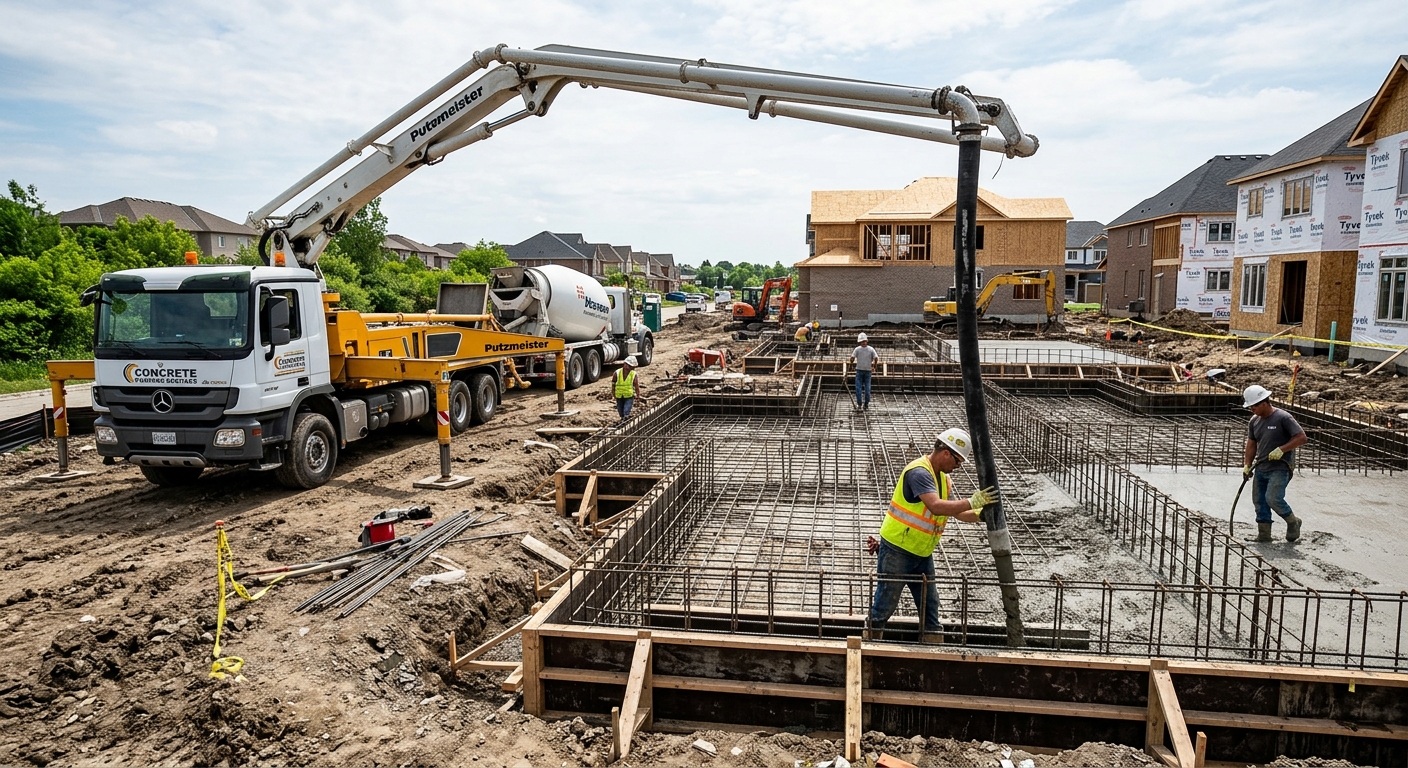
Concrete work options and costs in Cleveland
Cleveland, British Columbia is a small community (population 2,930) where most concrete flatwork is tied to single-detached and family homes, and that means driveways, patios, and front steps see real day-to-day use. With the Lower Mainland–Southwest market, there’s also steady demand in and around the more established residential pockets near local arterial routes, where homeowners often refresh tired slabs and improve drainage. (Statistics Canada, 2021 Census.)
In this region, mild winters can sound “easy,” but the shallow frost line still shapes costs. Local practice typically assumes a frost depth around 450 mm / 18", so footings and thickened edges need to sit below frost to protect slabs from freeze–thaw damage. Coastal-wet conditions add another layer: frequent moisture, cool nights, and ongoing rain can slow scheduling and extend curing time, which affects labour availability and overall pricing. On top of that, exterior flatwork in Cleveland is usually priced around air-entrained concrete with control joints and careful drainage—non-negotiable specs for preventing cracking and scaling.
Below are typical cost ranges you’ll see for common concrete jobs in Cleveland. Use them as a sanity check when you compare itemized quotes, then we’ll break down what’s really driving the differences in price.
| Application |
Typical Size |
Key Spec |
Finish Option |
Price Range |
| Concrete driveway (standard broom finish) |
24 m² (approx. 12' x 20') |
Air-entrained mix, compacted granular base, joints |
Broom finish |
$18,000–$28,000 |
| Exposed aggregate driveway |
24 m² (approx. 12' x 20') |
Air-entrained mix, proper curing and joint layout |
Exposed aggregate |
$21,000–$34,000 |
| Stamped concrete driveway or patio |
20 m² (approx. 10' x 20') |
Air-entrained mix, sealant for wet climate exposure |
Stamped pattern + sealer |
$22,000–$36,000 |
| Plain concrete patio or walkway |
16 m² (approx. 8' x 20') |
Compacted base, joints where needed |
Float + broom/wood-float |
$16,000–$26,000 |
| Garage floor (interior slab) |
28 m² (approx. 12' x 24') |
Vapour barrier, reinforcement as required, proper thickness |
Standard trowel finish |
$18,000–$32,000 |
| Foundation footings (structural, below frost) |
Per linear metre equivalent |
Below-frost excavation, rebar, controlled placement |
Structural formwork |
$200–$350 |
Prices are estimates only and vary by project scope, site access and material selection.
What affects the price of concrete work in Cleveland
In the Lower Mainland–Southwest, you can see the same concrete scope swing by 30–50% across British Columbia because the drivers aren’t just “concrete cost”—they’re excavation depth, base build-up, mix design, and how weather changes scheduling and curing. Even with mild winters, concrete in Cleveland still has to be detailed for freeze–thaw performance: footings must extend below the design frost depth (locally practice commonly around 450 mm / 18"), and exterior slabs should be made with air-entrained concrete to resist surface scaling and cracking. When temperatures dip, contractors may also need cold-weather curing precautions (blankets, temporary heating), which raises labour and equipment time.
Two common examples: (1) A driveway poured on a well-drained, compactable subgrade can land closer to the lower end of typical driveway pricing, while the same driveway on saturated or poorly draining soil often costs closer to the upper end because extra granular, drainage work, and longer curing days are included. (2) A stamped or exposed aggregate look can add cost—often justified when the contractor includes the right base profile and a proper sealing plan—versus a broom finish that’s simpler to place and finish. In practice, you’ll often see standard driveway options land closer to the $18–$28 band for concrete flatwork, while stamped styles frequently align with the $22–$36 band.
Cost can also reflect housing age and site constraints. Older neighbourhood properties in the Cleveland area frequently have mature trees, tighter access, and existing slabs or drains that need removal—meaning higher disposal and labour time. If your garage or approach is at a low spot where water pools, expect added site drainage and base depth to avoid future slab movement.
| Price Factor |
Why It Matters |
Cost Impact |
| Frost line depth — determines footing depth and form height |
Footings and thickened edges must sit below frost to prevent heave |
Can add major excavation/formwork time depending on bearing and depth |
| Site preparation — excavation, grading, compacted granular base |
Correct base depth and compaction prevent settlement and cracking |
Higher when soil is soft, wet, or requires import/haul |
| Reinforcement — rebar or wire mesh requirement |
Controls cracking and improves slab performance under load |
Moderate increase; biggest impact when tied into structural requirements |
| Mix design — air-entrainment and compressive strength spec |
Exterior durability depends on air entrainment against freeze–thaw |
Small to moderate material increase; large savings vs failed repairs |
| Finish type — broom vs. stamped vs. exposed aggregate |
Finishing labour and materials (stamps, toppings, tooling) differ |
Stamped/exposed typically move you to the upper end of bands |
| Pour size and concrete truck access to site |
Long pulls, tight access, and multiple pours increase labour and cost |
Can raise costs quickly with pump/extra crews or more staging time |
| Cold-weather curing precautions — heating and blankets |
Strength gain must reach design requirements in cool, damp conditions |
Higher during shoulder-season cold snaps; longer protection time |
| Control joint pattern and sealing cost |
Joints manage shrinkage; sealing helps repel de-icing salts and moisture |
Added line item, but typically less than the cost of cosmetic failure |
Permits & regulations in British Columbia
In British Columbia, structural concrete work generally needs municipal review. That includes footings, foundation walls, grade beams, and other load-bearing structural concrete elements—typically requiring a building permit and, in many cases, engineered drawings reviewed by the municipality. For concrete flatwork (patios, walkways, driveways), permits are often not required by default, but they can be required if your work affects lot grading, drainage, impervious surface coverage limits, or the municipal right-of-way. Because rules can differ by situation, confirm with the local authority before breaking ground, especially if you’re changing elevations, adding catch basins, or altering runoff paths.
Regardless of permit requirements, protect yourself by verifying contractor credentials. First, ask for their liability insurance certificate with coverage appropriate for the job size. Second, confirm workers’ coverage (WSIB/WCB coverage as applicable). If the contractor uses subcontractors, they should still be accountable for ensuring the crew is properly covered. Finally, ask for references on similar-scale jobs in coastal-wet conditions—driveways and exterior slabs are where air-entrainment and curing details show.
How to verify in Cleveland (BC) step-by-step: (1) Look up the contractor in relevant online business/registry resources available in BC; (2) request a certificate of insurance and confirm the policy is active and matches the work address; (3) request proof of workers’ coverage and read the effective dates; (4) request a clear clearance letter where applicable, and ensure the name on the insurance matches the quoting entity; (5) only then compare scope and pricing.
Getting concrete right in Cleveland's freeze-thaw climate
Concrete commonly fails in Cleveland’s climate when one of the “durability” basics is skipped: base preparation, air-entrainment, control joints, curing, or sealing. Freeze–thaw cycles and saturated soils drive water into pores and microcracks; when that water freezes, it expands and can lead to scaling and spalling. The lower frost line doesn’t remove the risk—it changes where failures show up (more surface scaling and joint-related cracking than massive frost-heave, assuming footings are properly placed below frost).
To spec the job correctly, start with base prep: the slab needs a compacted granular sub-base to the right depth for your soil and design loads, not just “fill and pour.” Next, require an air-entrained exterior mix—typically 5–7% air for exterior flatwork—and a minimum 32 MPa compressive strength so the concrete reaches durability performance. Then, control joints: spacing should limit random cracking, especially on driveways that get freeze–thaw movement and thermal cycling. Curing matters too: plan for a minimum 7-day curing period under proper conditions, and in cool wet weather use curing blankets or sealers as needed to protect strength gain. Finally, specify penetrating sealer after cure—commonly applied 28 days post-pour—to repel moisture and help resist de-icing salt damage in the future.
Where the price difference is justified: upgrading from a broom-finish driveway to stamped concrete isn’t just aesthetics. If the contractor also builds a flatter base profile, uses the correct mix, and includes sealant, you’re paying for performance. That’s why stamped driveways typically sit around the $22–$36 band, while a standard broom driveway often falls closer to $18–$28.
| Spec |
Why It Matters in Cleveland |
What to Ask For |
Impact if Skipped |
| Compacted granular base (depth?) |
Reduces settlement and keeps slab supported during wet seasons |
State required base depth and compaction testing method |
Uneven slabs, cracking, and early joint failure |
| Air-entrained concrete mix (target air %?) |
Helps resist freeze–thaw scaling and surface deterioration |
Target air content (typically 5–7% for exterior flatwork) |
Spalling risk increases sharply during repeated cold/wet cycles |
| Compressive strength (MPa rating) |
Ensures durability and performance after curing |
Minimum 32 MPa and confirmation of mix design |
Lower strength, higher cracking and permeability |
| Control joints (spacing per ACI guidelines) |
Manages shrinkage cracking where it’s planned |
Joint spacing and whether joints will be saw-cut or tooled |
Random cracking that’s harder to seal and cosmetically repair |
| Minimum 7-day curing period |
Cold nights and humidity slow strength gain |
What curing protection is used during cool/rainy periods |
Weak surface, increased cracking, reduced long-term durability |
| Penetrating sealer (when applied after cure) |
Repels moisture and reduces salt/meltwater damage |
Application date after cure (commonly 28 days post-pour) |
Faster deterioration and stains, especially on exterior slabs |
How to choose a concrete work contractor in Cleveland
Choosing a contractor in Cleveland, British Columbia is mostly about verifying details that protect the concrete in our coastal-wet freeze–thaw climate. Start with licensing and insurance: ask for proof of liability insurance and confirm it’s current for the work address. Then request workers’ coverage (WSIB/WCB as applicable) and look for an up-to-date clearance letter or certificate. If subcontractors are involved, the certificate should still align to the project and dates. When you check, make sure the legal name on the quote matches the entity on the insurance and coverage paperwork.
Next, get 2–3 itemised written quotes—not lump-sum only. You want a breakdown that separates excavation/site prep, forms, reinforcement, concrete supply, finish work, joint cutting, sealing, and disposal. Ask whether a permit is included if required, and what’s excluded (for example: removal of old concrete, hauling away, tree root remediation, or drainage modifications). A quote that won’t clearly state these items is a red flag in concrete jobs where “scope creep” is common.
Warranty should be in writing. Confirm the workmanship warranty length, whether it includes labour for repairs, and whether product/manufacturer warranties apply to the materials used. Payment schedules matter too: never pay more than 10–15% upfront, and hold back money until the job is complete and cleaned. Finally, ask for a written start date and a completion estimate that accounts for rain/cure time.
- Provide written confirmation of air-entrained mix and minimum strength (e.g., 32 MPa).
- State footing/slab thickness and reinforcement approach for your application.
- Describe base depth and how the contractor compacts it.
- List joint spacing and whether joints are saw-cut/tooled as planned.
- Confirm curing plan for cool wet periods (blankets/sealers as required).
- Include sealing requirements and application timing (often 28 days post-pour).
- Identify whether concrete truck access/pumping is included in pricing.
- Clarify removal/disposal of existing concrete and prep of subgrade.
- Ask about protection during curing (no early foot/vehicle traffic).
- Ensure the quote includes backfill and grading tie-ins at edges.
- Get warranty terms and what they cover in plain language.
- Confirm insurance and workers’ coverage effective dates before work begins.
Red flags in Cleveland: contractors who won’t discuss air-entrainment or provide mix details, quotes that omit base depth/compaction and joint layout, “we can pour anytime” promises without curing protection in cool/rainy stretches, payment schedules asking for large upfront deposits, and vague warranty wording (no start/end dates or defined scope).
Frequently asked questions — concrete work in Cleveland
Concrete vs pavers for a patio in Cleveland?
For a patio in Cleveland, concrete is usually the better value when you want a long, low-maintenance surface and a clean finish that handles moisture and freeze–thaw cycles. A basic plain patio or walkway typically fits the $16–$26 band, especially when the base prep and joints are done correctly. Pavers can be attractive if you want easy localized repairs (replace individual units) and more flexibility for curves, but you still need proper drainage and a compacted base. In our coastal-wet conditions, the “winning” choice usually depends on whether the installer builds the right sub-base, uses correct elevations for runoff, and maintains gaps and bedding. If you’re seeing pooling water around the patio area, prioritize drainage design regardless of whether you choose concrete or pavers.
How long does a concrete driveway last?
A well-built concrete driveway in British Columbia commonly lasts decades, but lifespan depends on details that manage water and freezing. If the contractor uses air-entrained concrete for exterior durability, installs proper control joints, and cures/seals the slab correctly, it can hold up very well through Cleveland’s wet-cool seasons. Real-world wear often shows up first at edges and joints—especially where water is directed toward the slab or where de-icing salt contacts an unsealed surface. Typical driveway pricing in the region is guided by the $18–$28 band for standard broom-finish projects, and homeowners who choose better specs (base depth, correct mix, sealing) often avoid the early repair cycle. If you’re planning to keep the driveway long-term, ask about sealing timing and how they protect joints during curing.
What is air-entrained concrete and why does it matter here?
Air-entrained concrete is mixed with tiny, evenly distributed air bubbles that give expanding water a place to go during freeze–thaw cycles. That reduces surface scaling and spalling, which is a real risk in coastal-wet areas of British Columbia where slabs can get saturated and then experience temperature swings. Even in Cleveland, where frost depth is typically planned around roughly 450 mm / 18", the water inside the concrete still expands when it freezes. That’s why reputable contractors specify air-entrainment for exterior slabs, not just “regular” concrete. When air-entrainment and joint design are correct, the surface can better survive repeated wetting and cooling. It also helps explain quote differences: a contractor can only produce durable exterior concrete when the mix design is right and the crew understands curing and timing.
How do I prepare the base for a concrete slab?
Base preparation is where most durability problems are prevented. For a concrete slab or driveway approach in Cleveland, the contractor should remove unsuitable topsoil, then grade and compact a compacted granular sub-base to the specified depth. You want a stable subgrade, good drainage away from the slab, and enough granular thickness to distribute loads without allowing settlement. If the site is consistently wet, the quote should explain drainage measures (subgrade conditioning, granular type, and how water will move away). Ask for the contractor’s plan for compaction and whether they’ll confirm base conditions before forming. If you’re comparing quotes, don’t accept vague wording like “we’ll prep the base”—you want the depth, materials, and compaction method described. Great base work supports both plain broom finishes and decorative options within the regional bands (like the $22–$36 range for stamped concrete).
How do I compare concrete quotes?
To compare concrete quotes in Cleveland, start by making sure the scope is identical. Ask each contractor for an itemized breakdown: excavation and disposal, base preparation and compaction, reinforcement type, concrete mix specs (including air-entrainment), slab thickness, finish type, joint pattern, curing method, and sealing. Check whether their price includes permit handling if it’s needed for structural work, and whether drainage changes are included or excluded. Don’t compare only total dollars; compare what you’re getting for that money—especially around weather-sensitive steps like curing blankets, curing/sealer timing, and joint cutting. A driveway quoted near the lower end of the $18–$28 band might still be a good value if the base and mix are specified, but it can become expensive later if the details are missing. The best quotes read like a plan, not a guess.
Can concrete be poured in cold weather in Cleveland?
Yes, concrete can be poured in cold weather in Cleveland, but it must be protected so it reaches the required strength and durability. Cool nights and damp conditions affect strength gain and can increase the risk of surface damage if the concrete isn’t held at the right conditions early on. Contractors typically use cold-weather curing precautions such as insulating blankets, temperature management, and protection from wind/rain while strength develops. Ask how they plan to protect the slab during the first critical days, what temperatures trigger additional measures, and how they ensure the concrete still meets the mix spec (including air-entrainment for exterior durability). Cold-weather handling can raise labour and equipment costs, which is one reason quotes can vary even when the driveway or patio size looks the same. In short: pouring is possible—rushed or unprotected pouring is the real problem.