Concrete work options and costs in Chase River
In Chase River, concrete work is a practical part of everyday home improvement—especially for driveways and patios that need to handle Lower Mainland–Southwest weather swings. The local housing stock is largely family-oriented: of the 2,900 residents in the area, most households are supported by single-detached homes, which typically demand regular “flatwork” upgrades like driveway replacements, walkway pours, and garage slab repairs (Statistics Canada, 2021 Census). In the Lower Mainland–Southwest, pricing is shaped by mild winters on paper, but a frost-protection mindset in practice: our codes and local construction practice assume a frost depth around 450 mm / 18", so footings and thickened edges are placed below that line to avoid freeze–thaw damage and frost heave.
Concrete contractors around the Chase River area also price for site logistics. Heavy coastal rainfall and frequent freeze–thaw cycles mean base prep, drainage, air-entrained mix design, and longer curing planning often cost more than homeowners expect from “standard” summer work. Availability can tighten when rain delays pours, because crews and finishing time get rescheduled across neighbourhoods.
Flatwork demand is especially noticeable in well-established pockets with older driveways and landscaping—common around the residential areas closest to Highway 1 corridors—where replacement and repairs are frequent. If you’re comparing options, the table below will help you map finishes to realistic ranges for Chase River projects.
| Application |
Typical Size |
Key Spec |
Finish Option |
Price Range |
| Concrete driveway (standard broom finish) |
400–600 sq. ft. |
Compacted granular base, air-entrained mix for exterior exposure, control joints |
Broom finish |
$18,000–$28,000 |
| Exposed aggregate driveway |
400–600 sq. ft. |
Air-entrained mix, delayed wash/finish control, sealed for wet climates |
Exposed aggregate |
$22,000–$34,000 |
| Stamped concrete driveway or patio |
300–500 sq. ft. |
Air-entrained mix, proper jointing to reduce random cracking, release and curing plan |
Stamped pattern + sealer |
$18,000–$40,000 |
| Plain concrete patio or walkway |
200–350 sq. ft. |
Compacted base, air-entrained exterior mix, edge restraints |
Float + light broom |
$3,200–$9,000 |
| Garage floor (interior slab) |
400–550 sq. ft. |
Vapour barrier (if required), reinforcement per design, proper jointing |
Broom or smooth trowel with sealer |
$14,000–$26,000 |
| Foundation footings (structural, below frost) |
Per project / per footing |
Excavation to below design frost depth, rebar cage, concrete placement below frost line |
Structural (not decorative) |
$7,000–$14,000 |
Prices are estimates only and vary by project scope, site access and material selection.
What affects the price of concrete work in Chase River
In Chase River and across the Lower Mainland–Southwest, two quotes for the “same” concrete area can differ by 30–50% because the real cost drivers aren’t just the concrete—they’re the foundation of the job: excavation quality, drainage, frost protection, mix design, and the time needed to finish and cure properly in cool, wet conditions. In British Columbia’s coastal-wet climate, schedules also shift more often when rain hits mid-prep or when finishing crews need protected curing conditions.
Every spec is driven by freeze–thaw cycles and the local frost depth practice (about 450 mm / 18"). Exterior work typically needs air-entrained concrete to resist scaling and spalling through repeated wetting and freezing. The “when” matters too: cold nights and higher humidity can slow curing, so contractors may use curing blankets or insulated protection to protect strength gain. De-icing salt later accelerates surface breakdown if the slab isn’t properly sealed, which is why sealing is usually budgeted for driveways and steps.
Here are a few concrete examples of what moves the needle in Chase River. A standard broom-finished driveway tends to stay closer to the regional flatwork backbone of roughly $18–$28 per sq. ft., but going to exposed aggregate or stamped can rise into the $22–$36 per sq. ft. range because of additional labour, finish materials, and careful curing. If your subgrade is soft or drainage is poor, the “base prep” line item can become the largest cost—sometimes outweighing the difference between finishes—because you may need extra compacted granular depth and improved drainage. For homes built on older site grades (often with less consistent runoff control), the additional earthwork can push a plain walkway closer to patio pricing simply due to base thickness and access constraints.
| Price Factor |
Why It Matters |
Cost Impact |
| Frost line depth |
Determines footing depth and form height for frost protection (exterior work needs thickened edges and footings below design frost) |
Higher excavation and more concrete volume; can meaningfully increase foundation-related scopes |
| Site preparation |
Excavation, grading, and compacted granular base control settlement and pump-out from saturated soils |
More base material and machine time; can push totals up significantly after site discovery |
| Reinforcement |
Rebar or wire mesh reduces slab movement and cracking for driveways, garage slabs, and structural elements |
Additional material plus labour tying/placing steel |
| Mix design |
Air-entrainment and compressive strength spec improve durability through freeze–thaw exposure |
Higher material cost and stricter scheduling to maintain quality |
| Finish type |
Broom is straightforward; exposed aggregate/stamped adds steps, tooling, and curing discipline |
Labour and materials typically raise price into the higher flatwork band |
| Pour size and concrete truck access to site |
Access affects how quickly and efficiently the crew can place and strike concrete |
Smaller pours, handwork, or longer carry times increase labour and risk |
| Cold-weather curing precautions |
Heating and insulated blankets help reach strength without damage during cool, damp periods |
Adds labour and equipment rental, especially during shoulder seasons |
| Control joint pattern and sealing cost |
Jointing manages cracking; sealing reduces moisture and chloride impacts on the surface |
Often a “small per-sq.-ft.” add-on that prevents premature spalling |
Permits & regulations in British Columbia
In British Columbia, structural concrete work typically requires a building permit, especially when it forms part of a foundation system. That includes footings, foundation walls, grade beams, and other structural elements designed to carry loads. Municipalities often expect engineered drawings for structural concrete, and they may review plans before construction starts. For concrete flatwork—like patios, walkways, and standard driveways—permits often aren’t required unless the work changes lot grading, affects impervious surface coverage limits, or impacts municipal right-of-way areas. Because requirements can vary by location and site conditions, confirm with the local authority before breaking ground.
For homeowners in Chase River, start with contractor proof and documentation:
- Ask for their certificate of insurance (liability) and ensure it’s active for the work timeframe.
- Request confirmation of WCB coverage (workers’ compensation) for their crews.
- Verify contractor licensing/registration through the provincial online resources for trades and companies (use the contractor’s legal name).
- Ask for references on similar-size jobs—driveways, stamped patios, or foundation work where applicable.
Step-by-step, you’re aiming for a complete file: licence/registration, liability insurance certificate, WCB clearance or coverage proof, and a clear, written scope showing whether any permit responsibilities fall on the contractor or remain with you.
Getting concrete right in Chase River's freeze-thaw climate
Concrete fails in Chase River mainly when it can’t handle repeated wetting and freezing. In the Lower Mainland–Southwest, the risk isn’t only deep cold—it’s the cycle: saturated soils, rain exposure, and temperature swings that pull moisture into the slab and along edges. The most common, expensive failure homeowners see is spalling: surface scaling and flaking driven by insufficient air-entrainment, poor base drainage, and curing that doesn’t reach strength safely.
To spec the job correctly, focus on five areas. First is base preparation: a compacted granular sub-base at the right depth for your soil and frost exposure, with proper drainage so water doesn’t stay trapped under or beside the slab. Second is mix design: for exterior flatwork, use air-entrained concrete (typically 5–7% air content) and specify a minimum 32 MPa compressive strength. Third is control joints: they need a spacing plan to limit random cracking, especially on driveways where shrinkage stresses build as slabs cool and dry. Fourth is curing: plan for at least 7 days of proper curing under protective conditions—cool nights and high humidity can require blankets or seal timing discipline. Fifth is sealing: apply a penetrating sealer after curing (commonly around 28 days) to repel de-icing salts and reduce moisture intrusion.
When comparing options, remember that finishing upgrades are worthwhile only if the base and mix are right. For example, a stamped patio might cost more than plain broom finish, but the price difference is justified if the contractor also includes correct air-entrainment and jointing. If those fundamentals are cut, even a beautiful finish won’t last through freeze–thaw.
| Spec |
Why It Matters in Chase River |
What to Ask For |
Impact if Skipped |
| Compacted granular base (depth?) |
Water management and frost protection; supports slab to resist settlement and pump-out |
Granular thickness based on site soil and design grade; confirm compaction testing method |
Uneven settlement, cracking, and faster edge deterioration |
| Air-entrained concrete mix (target air %?) |
Resists freeze–thaw scaling and spalling in wet coastal cycles |
Confirm air content targets (typically 5–7% for exterior flatwork) and that mix is properly ordered |
Surface scaling and early spalling within a few seasons |
| Compressive strength (MPa rating) |
Affects whether the slab reaches adequate durability through cool, damp curing |
Minimum 32 MPa at specified age; confirm mix design on the quote |
Reduced wear resistance and higher risk of premature cracking |
| Control joints (spacing per ACI guidelines) |
Limits shrinkage cracks to planned locations rather than random fractures |
Joint layout drawing or written spacing plan; confirm saw-cut timing |
Uncontrolled cracking and water pathways into slab edges |
| Minimum 7-day curing period |
Strength gain is critical when nights are cool and humidity stays high |
Protection plan for cold nights (blankets/insulation if required) and curing method |
Weak surfaces, dusting, and higher long-term deterioration |
| Penetrating sealer (when applied after cure) |
Repels chloride exposure from de-icing salts and reduces moisture absorption |
Penetrating sealer after cure (commonly around 28 days); confirm product and coverage |
Faster spalling and staining; shortened lifespan for exterior slabs |
How to choose a concrete work contractor in Chase River
Choosing the right concrete contractor in Chase River starts with checking credentials and documentation in plain language. In British Columbia, verify the contractor’s licensing/registration through the provincial trade/company lookup using their legal name, then request a current certificate of liability insurance (with coverage amounts appropriate for the work). For crew safety and compliance, ask for proof of WCB coverage (or confirmation of clearance/coverage for their workers). If they can’t provide documents quickly, treat that as a risk signal.
Next, get 2–3 itemised written quotes instead of one lump sum. The quote should separate labour and materials (excavation/base prep, forms, rebar/wire mesh, air-entrained concrete, finishing, curing protection, saw cuts, and sealing). Read the scope carefully: what’s excluded (tree roots, soil hauling, over-excavation for unsuitable subgrade, removal of existing slab, traffic control)? Is permit pulling included where required for structural work? Is disposal included? Clarify the truck access plan and any cutting/wall removal if needed.
Warranty matters too. Ask for workmanship warranty length (not just product warranty), whether it covers cracking and spalling, and whether it’s transferable if you sell the home. Payment schedule should be conservative: avoid paying more than 10–15% upfront and use a holdback until the job is complete and cured. Finally, require a start date and an estimated completion timeline in writing—especially in our coastal-wet climate where rain can interrupt curing.
- Confirm licensing/registration using the contractor’s legal business name.
- Request liability insurance certificate and verify dates match your project.
- Confirm WCB coverage for their employees (documentation on request).
- Ask for at least 3 references from similar Chase River projects (driveways/patios or structural work).
- Use itemised quotes: labour, materials, base prep, reinforcement, concrete supply, finishing, sealing.
- Confirm whether excavation includes over-excavation if subgrade is soft.
- Clarify drainage: edge drains, slope away from foundation, and any subgrade improvement.
- Make sure the quote specifies air-entrained concrete and target compressive strength (e.g., minimum 32 MPa).
- Confirm control joint spacing and saw-cut timing.
- Ask about curing protection for cool nights (blankets/insulating methods if needed).
- Verify sealing scope for exterior flatwork and timing after cure (around 28 days).
- Review payment terms: maximum 10–15% upfront; holdback until cured/complete.
Concrete red flags in Chase River include: quotes that omit air-entrainment and curing protection, “cheap” pricing that doesn’t include proper base compaction or drainage, vague scopes that don’t mention joints or sealing, contractors who want large upfront payments, and crews who can’t show similar finished work or proof of insurance/WCB before starting.
Frequently asked questions — concrete work in Chase River
How much does concrete work cost in Chase River?
In Chase River, concrete pricing usually lands within the regional flatwork backbone for the Lower Mainland–Southwest. For example, a typical concrete driveway tends to price around the $18–$28 band for standard broom-finish work, while stamped or decorative options commonly land closer to the $22–$36 band because of extra labour, materials, and curing discipline. Plain patios and walkways often follow a lower per-area budget than driveways, but the total can still rise if base prep is more involved (poor drainage, soft subgrade, or limited truck access). Foundation footing-related pricing is a different category and is often quoted by project scope because excavation and rebar placement vary a lot. For context, Chase River’s area has a smaller population base (2,900 residents per Statistics Canada’s 2021 Census), so crew availability and scheduling can be tight during rain delays, which can slightly affect totals even for similar scopes.
How deep must footings be for Chase River's frost line?
In coastal parts of British Columbia, frost protection practice typically uses a relatively shallow design frost depth compared with interior provinces, but it’s still enough to matter. Local construction practice commonly assumes a frost depth around 450 mm / 18", meaning structural footings and thickened edges should extend below that frost line to reduce the risk of freeze–thaw heave. Your exact footing depth must be confirmed by your engineered foundation drawings (or stamped design) for your soil conditions and exposure. If you’re comparing quotes, don’t accept a number that’s only “approximate”—ask how the contractor will confirm excavation depth on site and what happens if they encounter unsuitable soils. In wet coastal conditions near Chase River, drainage and subgrade conditions are just as important as depth, because trapped moisture can worsen freeze–thaw movement.
Why does concrete crack in Chase River and how is it prevented?
Cracking is normal in concrete, and in Chase River it often shows up as shrinkage cracks or settlement-related cracks—especially if joints aren’t planned or if the slab base isn’t built correctly. Lower Mainland–Southwest weather adds stress through frequent freeze–thaw cycles and saturation. Prevention is about controlling where cracks can happen: correct compaction of a compacted granular base, proper reinforcement (when specified), and a planned control joint layout with saw-cut timing to limit random cracking. Exterior slabs also need air-entrained concrete so freeze–thaw exposure doesn’t turn small cracks into surface scaling and spalling. Finally, sealing and keeping water directed away from the slab edges helps reduce moisture pathways. If you’re reviewing quotes, ask for the joint spacing plan and confirm the contractor uses air-entrained mix—not just “standard” concrete.
Stamped vs broom-finish concrete — cost difference?
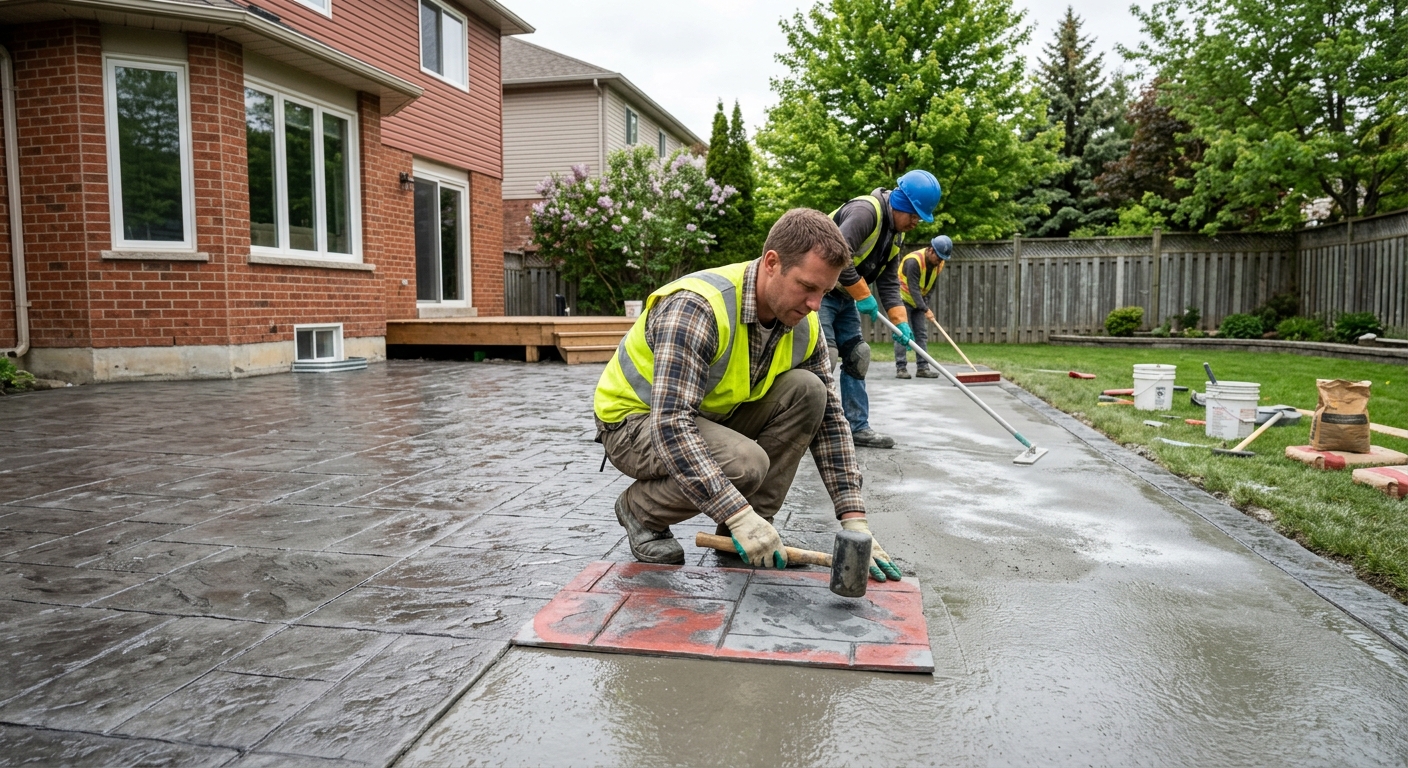
Stamped concrete costs more than broom-finish because it requires additional labour and materials—form liners or stamp patterns, release agents, more precise finishing, and tighter curing and joint control. In the Lower Mainland–Southwest pricing backbone, broom-finish driveway work commonly falls around the $18–$28 band, while stamped decorative concrete often aligns with the $22–$36 band depending on area, pattern complexity, and site conditions. The important point is that paying extra for stamping doesn’t replace the fundamentals: correct air-entrainment, base prep, control joints, and curing are still what protect the slab in Chase River’s freeze–thaw and coastal rainfall. A well-built broom-finish driveway can last longer than a poorly prepared stamped one. Ask your contractor to itemise the difference so you can see exactly what you’re paying for besides the surface look.
When is the best time to pour concrete in Chase River?
The best time is when you can manage curing and rain exposure. In Chase River and the broader Lower Mainland–Southwest, crews typically prefer stretches of dry weather with milder temperatures so the contractor can place, finish, and protect the slab without prolonged soaking or cold-night strength losses. That said, concrete can be poured outside perfect weather windows if the contractor uses proper curing blankets, sealing timing discipline, and protection for cool nights. The key is planning: a pour scheduled right before extended rain can create surface issues even if the concrete mix is correct. Ask the contractor how they schedule around weather and what curing protection they’ll use during shoulder-season cool snaps. A contractor who explains the cure plan clearly is usually more reliable than one who simply says “we can pour anytime.”
How long does concrete take to cure?
Concrete gains strength over time, but for practical purposes you should plan around both curing duration and conditions. A common baseline for workmanship is a minimum 7-day curing period under suitable conditions; in cool, humid weather common in Chase River, contractors may need to protect the slab longer to ensure strength development. Even after it has cured enough to walk or lightly work, exterior durability improves as the concrete continues to gain strength. For sealing, many contractors apply penetrating sealer after the main cure window—often around 28 days—so the concrete surface can properly receive the sealer and repel moisture and chlorides from de-icing. When you’re reviewing quotes, ask what curing method is included (curing compound vs blankets vs protection) and whether sealing is included for driveways and steps, especially in freeze–thaw conditions.