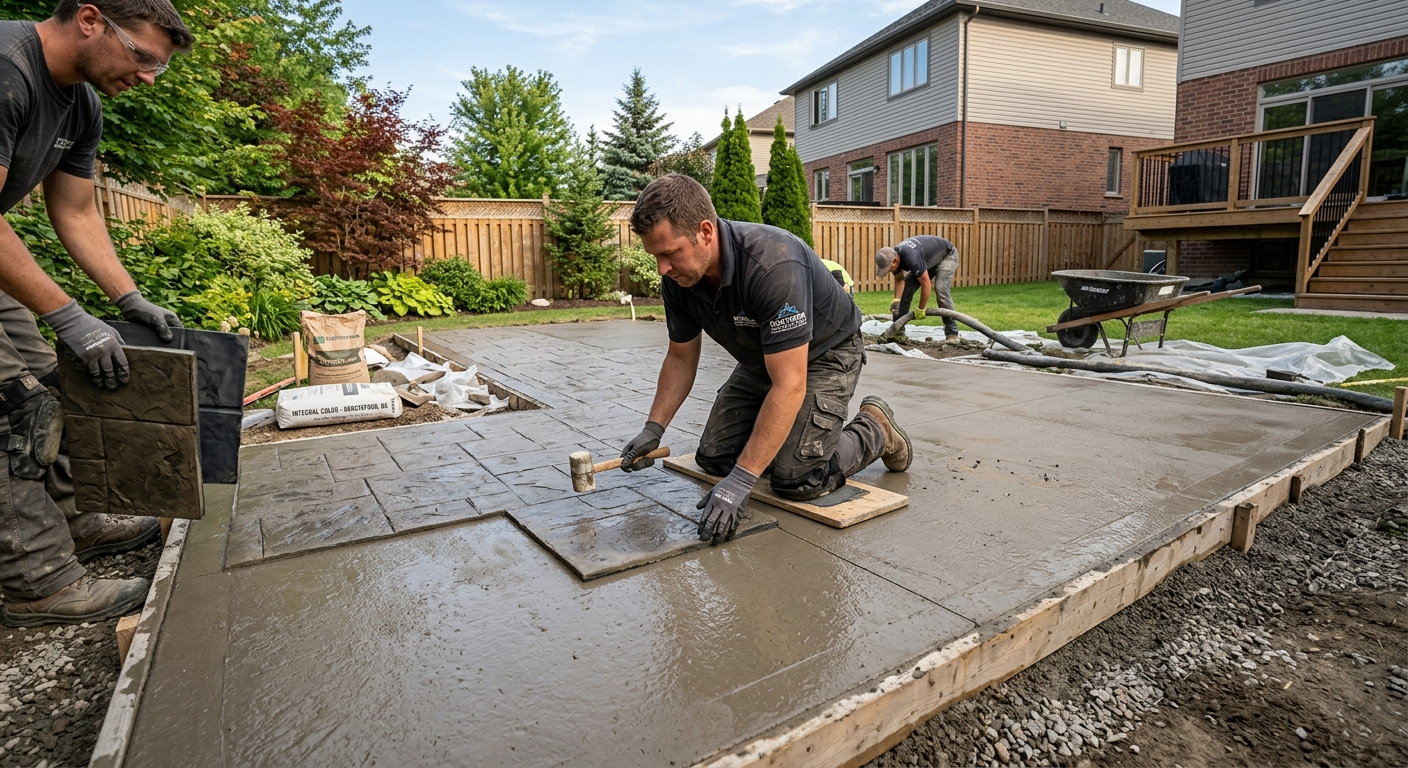
Concrete work options and costs in 100 Mile House
Concrete work is a common home upgrade in 100 Mile House, and the “right” option usually comes down to how much traffic, weather exposure, and appearance you want to handle over the long winter. With a 2021 population of 1,980 (Statistics Canada, 2021 Census), the local market is smaller and contractor availability can tighten in peak pour months. That said, most homeowners still need practical, durable flatwork—especially since much of the housing stock is built as single-detached properties that typically bring driveways, patios and walkways into every renovation or new build plan. (Statistics Canada, 2021 Census)
In the Cariboo, long cold stretches and frequent freeze-thaw cycles drive both material and labour choices. Driveways and exterior slabs need air-entrained mixes and well-drained, compacted bases to reduce scaling and spalling. Curing is also a cost driver: cold temperatures slow strength gain, so crews often add insulating blankets or use temperature protection to hit proper strength. You’ll also see longer scheduling and sometimes more mobilization costs when trucks, pumps, and finishing crews can only work during suitable weather windows.
For many homeowners, the busiest demand shows up around the more active residential areas where families build and replace flatwork regularly—often along central-access corridors and neighbourhoods near daily services. If you’re getting bids for the same scope, it helps to compare like-for-like finishes and specs; the table below is a realistic starting point for 100 Mile House.
| Application |
Typical Size |
Key Spec |
Finish Option |
Price Range |
| Concrete driveway (standard broom finish) |
480–720 sq. ft. |
4" slab, granular base, air-entrained mix, joints |
Broom finish, trowel edges, saw-cut control joints |
$16,000–$25,000 |
| Exposed aggregate driveway |
480–720 sq. ft. |
4" slab, air-entrained mix, proper curing protection |
Exposed aggregate (washed) with densifier/finish |
$20,000–$30,000 |
| Stamped concrete driveway or patio |
300–600 sq. ft. |
4" slab, air-entrained mix, stamp release system |
Stamp + colour hardener + sealer |
$26,000–$40,000 |
| Plain concrete patio or walkway |
200–500 sq. ft. |
4" slab, granular base, air-entrained mix |
Float/finish with light broom or smooth finish |
$14,000–$22,000 |
| Garage floor (interior slab) |
400–700 sq. ft. |
4" slab, vapour barrier, edge protection |
Smooth trowel or light broom finish |
$15,000–$24,000 |
| Foundation footings (structural, below frost) |
Varies (typical 2–3' wide continuous footing) |
Excavation, rebar, concrete below design frost depth |
Structural concrete with formwork and inspection-ready prep |
$90,000–$160,000 |
Prices are estimates only and vary by project scope, site access and material selection.
What affects the price of concrete work in 100 Mile House
In Cariboo and across British Columbia, quotes for the “same” concrete job can vary by 30–50% because the real drivers aren’t just concrete volume—they’re excavation depth, base design, reinforcement requirements, finish complexity, and weather-related curing protection. Even when homeowners compare the same square footage, one site may need deeper frost-safe excavation and a thicker granular base, while another may have easy access and minimal demo. That’s why two driveways can land in different budget tiers (for example, standard exterior flatwork commonly aligns with the $16–$25 per sq. ft. band, while stamped work is typically higher due to labour-intensive finishing).
In cold-weather markets like 100 Mile House, the frost line and freeze-thaw cycling dictate nearly every spec. Footings must be designed to extend below the design frost depth to prevent frost heave and cracking. Exterior slabs also need air-entrained concrete mixes to survive repeated freezing and thawing. On top of that, the viable pour season is shorter in winter and shoulder months, and cold-weather curing precautions (insulating blankets, form insulation, sometimes accelerators) increase labour time and equipment use.
Two real ways local conditions raise costs here: (1) a sloped or poorly drained lot often means more grading and drainage work before concrete goes down; (2) higher de-icing salt use means sealing becomes more important to reduce surface damage. Conversely, costs can be lower when truck access is straightforward, sub-base is already well-prepared, and the finish is a simple broom rather than stamped or exposed aggregate. As a rule of thumb, older properties and thaw-softened soils can increase excavation time, and that added labour can swing a project’s total cost by thousands of dollars—especially when foundation work pushes into the $90–$160 band for structural footing scopes.
| Price Factor |
Why It Matters |
Cost Impact |
| Frost line depth — determines footing depth and form height |
Controls how deep concrete must go to avoid frost heave |
Higher depth typically increases excavation, formwork, and concrete volume |
| Site preparation — excavation, grading, compacted granular base |
Ensures stable support and drainage under freeze-thaw cycles |
More hauling/compaction can add significant labour and equipment hours |
| Reinforcement — rebar or wire mesh requirement |
Reduces cracking and controls movement under loads |
Material and placement labour can raise cost; omission risks premature cracking |
| Mix design — air-entrainment and compressive strength spec |
Air content and strength affect scaling/spalling resistance |
Air-entrained exterior mixes and controlled strength specs add per-cubic-yard cost |
| Finish type — broom vs. stamped vs. exposed aggregate |
Complex finishing increases labour time and materials (colours/sealers) |
Stamped/exposed aggregate typically costs more than standard broom |
| Pour size and concrete truck access to site |
Access affects pumping, staging, and total labour time |
Tight access or small approaches can increase mobilization and finishing time |
| Cold-weather curing precautions — heating and blankets |
Cold slows strength gain and raises risk of early-age damage |
Insulated blankets/heaters can add labour and rental/equipment costs |
| Control joint pattern and sealing cost |
Joints manage shrinkage and sealing protects against salt scaling |
Proper saw-cut scheduling and sealer add cost but reduce long-term repairs |
Permits & regulations in British Columbia
In British Columbia, structural concrete work generally requires a building permit—especially when the work supports the foundation and structure (for example, concrete footings, foundation walls, and grade beams). Municipalities often review engineered drawings, and inspections are commonly required before the next stage of construction proceeds. Concrete flatwork (driveways, patios, and walkways) usually does not require a permit, unless it changes grading/drainage, affects lot coverage or impervious surface limits, or impacts the municipal right-of-way (such as work tied into the boulevard approach).
For a homeowner in 100 Mile House, the easiest way to reduce risk is to confirm permit requirements before any forms or excavations start. Then verify the contractor’s credentials and coverage. Start by asking for a current certificate of liability insurance—your contractor should list you or the project as an additional insured if required for your project type. Next, confirm they have WCB coverage (WorkSafeBC) and that their account is in good standing. For licencing, check the provincial public registry for the appropriate contractor category relevant to the work they’re performing; if your contractor can’t provide their registration details, treat it as a red flag.
Finally, ask for references on similar cold-weather concrete jobs and request photos showing finished surfaces, joints, and curing protection. That’s where BC’s freeze-thaw realities show up.
Getting concrete right in 100 Mile House's freeze-thaw climate
Concrete fails in 100 Mile House most often for three reasons: inadequate support, wrong mix for freezing conditions, and poor curing. Freeze-thaw cycles pull water into small voids; when that water freezes, it expands and can break surface paste, leading to scaling and spalling. The fix starts before the truck arrives. Your base needs to be compacted granular material placed to the correct depth and shape so water drains away from the slab. Then the mix must be properly air-entrained—typically for exterior flatwork, target about 5–7% air—so the concrete can tolerate repeated freezing without surface breakdown. For structural work, minimum compressive strength requirements also matter; for flatwork, we generally plan for at least a 32 MPa class specification to meet performance expectations.
Control joints are another common failure point. They must be laid out to manage shrinkage and thermal movement—then cut on schedule so the cracks form where you intend, not randomly. Curing is the silent cost driver in cold weather: even a “good” mix can underperform if it’s too cold for too long. We plan minimum 7-day curing under proper conditions, using insulated blankets and temperature protection when shoulder-season temps threaten early strength gain.
Finally, sealing is your protection against de-icing salt. A penetrating sealer applied after the concrete has cured (often around 28 days) helps repel moisture and reduces salt-driven deterioration.
For pricing, note how options justify themselves: a stamped patio might sit in the $26–$40 band because finishing labour and materials are higher. If your goal is durability for winter use, a broom-finish patio in the $14–$22 band often gives better life-per-dollar—provided the base, joints, and curing are done correctly. Ask contractors how they’ll handle curing temperatures and joint timing, not just what finish they can stamp.
| Spec |
Why It Matters in 100 Mile House |
What to Ask For |
Impact if Skipped |
| Compacted granular base (depth?) |
Stable support reduces pumping and settlement through freeze-thaw cycles |
“What base depth will you compact to, and how will you verify compaction?” |
Uneven settling and early cracking; drainage issues lead to scaling and spalling |
| Air-entrained concrete mix (target air %?) |
Air voids help concrete resist freeze-thaw damage in exterior slabs |
“Will the mix be air-entrained? What air content target will you place?” |
Higher risk of surface scaling/spalling and faster winter deterioration |
| Compressive strength (MPa rating) |
Ensures the slab reaches design strength under local curing conditions |
“What MPa rating are you supplying and how do you protect strength gain in cold?” |
Understrength concrete can crack, wear, and fail to perform under load |
| Control joints (spacing per ACI guidelines) |
Manages shrinkage cracking and limits random crack paths |
“What is your joint spacing plan and when will you cut them?” |
Random cracking through the slab surface and difficult-to-repair damage |
| Minimum 7-day curing period |
Cold weather slows strength gain and increases vulnerability at early age |
“How will you maintain curing conditions, especially near freezing?” |
Higher early-age cracking and reduced long-term durability |
| Penetrating sealer (when applied after cure) |
Salt exposure is a real winter issue in BC; sealer helps repel moisture |
“When will you apply sealer and what product type are you using?” |
More salt-driven surface deterioration and quicker maintenance cycles |
How to choose a concrete work contractor in 100 Mile House
Choosing the right contractor in 100 Mile House comes down to verified coverage and clear, itemised scopes. First, confirm British Columbia licencing for the work they’re doing. Next, obtain their certificate of liability insurance and make sure coverage is current for the term of your project. For WorkSafeBC, ask for confirmation that they carry WCB coverage and that they’re registered appropriately—this is especially important on excavation and structural pours.
Then request 2–3 itemised written quotes. The best estimates show labour and materials separately (concrete, rebar/wire mesh, forms, compacted base, drainage, saw-cutting, sealing, and any curing blankets/heaters if applicable). Avoid “all-in” pricing that doesn’t explain what’s included, because in this climate the exclusions are where problems start. Clarify whether a permit is included (for structural work, it often must be coordinated), whether disposal/hauling is included, and whether you’re responsible for protecting nearby landscaping and driveways during construction.
On warranty, look for a workmanship warranty length and whether it applies to cracking, joint performance, and surface scaling. Product/manufacturer warranties should be explained separately (and note whether they’re transferable). For payment scheduling, never approve more than 10–15% upfront; hold back a portion until completion and clean-up, especially after final sealer timing and joint review.
Lastly, get a start date and completion estimate in writing. In cold-weather concrete, weather protection equipment and curing time affect timelines—so if they won’t discuss curing conditions, you’re taking on the risk.
- Provide their BC contractor registration/licence number for the specific work.
- Share a current certificate of liability insurance.
- Confirm WorkSafeBC coverage (WCB) is active for their crew.
- Use itemised quotes: labour, materials, excavation/base, reinforcement, finish, curing protection, and sealer (if included).
- Ask whether disposal/hauling and site clean-up are included.
- Confirm frost-depth spec for footings on structural work.
- Ask how they will handle curing if the forecast is near freezing.
- Require a joint plan (spacing) and when saw cuts will be done.
- Ask what air-entrainment target they use for exterior slabs and how they verify it.
- Request proof of past similar cold-weather projects (photos near winter conditions).
- Check warranty terms in writing—what’s covered, for how long, and exclusions.
- Set a payment schedule with a final holdback until acceptance and cure/finish steps are complete.
Concrete red flags in 100 Mile House: contractors who can’t explain frost-depth/joint/cure details, vague quotes with no breakdown of base depth or reinforcement, promise “we’ll pour anytime” without cold-weather curing plans, no written scope for sealing timing, or demanding large upfront payments before excavation and formwork begin.
Frequently asked questions — concrete work in 100 Mile House
What is the difference between concrete and cement?
In everyday conversation, people say “cement” when they mean the full concrete product, but technically they’re different. Cement is one ingredient inside concrete—think of it as the binder. Concrete is cement combined with aggregates (sand and stone), water, and often additives like air-entrainment for freeze-thaw durability. In British Columbia (including 100 Mile House), this distinction matters because air-entrainment and proper water/cement ratios are what help exterior slabs resist scaling and spalling during winter freeze-thaw cycles. When you get quotes, ask what the contractor is specifying for the mix (air content for exterior work and compressive strength rating), not just the finish. A broom-finish driveway budget can fit the $16–$25 range, but the “cheap option” without the right mix is where premature surface damage starts.
How much does concrete work cost in 100 Mile House?
Concrete pricing in 100 Mile House depends heavily on site prep, base depth, reinforcement, and—because of the cold-weather climate—curing protection. For exterior flatwork, typical driveway or slab budgets commonly align with the $16–$25 band, while patios and walkways often sit in the $14–$22 range. Stamped decorative work typically costs more due to additional labour and materials, commonly landing in the $26–$40 band. Foundation footings are a separate structural category; they’re usually scoped based on below-frost excavation and rebar, and budgets often fall in the $90–$160 range for typical footing projects. If you’re comparing quotes, make sure they include similar base design, air-entrained mix requirements, and joint/sealing provisions—those line items are where totals can swing significantly.
How deep must footings be for 100 Mile House's frost line?
Footing depth in 100 Mile House needs to be based on the local design frost depth used in your engineered foundation plan. In general terms for cold interior British Columbia, frost depth can be in the range where frost heave risk is real, so footings must be installed below that design level. Practically, that means deeper excavation, thicker formwork, and more granular base and drainage detailing than many homeowners expect. The exact depth should come from the building design/engineering for your soil conditions and the frost-protected depth requirements. Never treat frost depth as a “rule of thumb.” Ask your contractor for the footing spec they’re building to and confirm the excavation and rebar placement match the approved plan before you pour.
Why does concrete crack in 100 Mile House and how is it prevented?
Concrete cracks in 100 Mile House mainly due to shrinkage and thermal movement, then freeze-thaw exposure amplifies surface deterioration if the concrete isn’t properly built. Temperature changes create expansion and contraction; if the slab can’t move safely where it should, random cracking can happen. Shrinkage during curing is normal, which is why control joints are critical. Prevention is a spec-and-process issue: a properly prepared, compacted base; correct air-entrainment for exterior durability; correct joint spacing and timing for saw cuts; and protected curing long enough to reach adequate early strength. Sealing also helps reduce moisture and salt intrusion that worsens deterioration. If you compare quotes, prioritize joint plan and curing protection over decorative finish—those are the biggest differences between “minor cosmetic cracks” and early repairs.
Stamped vs broom-finish concrete — cost difference?
Stamped and broom-finish concrete differ mostly in labour intensity and materials. Broom-finish concrete is straightforward: the crew places, screeds, finishes with a broom texture, and saw-cuts joints according to the plan—great for durability and budget. Stamped concrete requires extra steps: stamp mats, release agent, careful finishing timing, and typically colour hardeners and more specialized sealing. In cold-weather British Columbia, both still require air-entrained concrete and correct curing, but stamped adds more time and materials. That’s why broom-finish driveway/slab budgets often align with the $16–$25 range, while stamped decorative projects commonly fall into the $26–$40 band. If you want durability first and appearance second, broom-finish usually gives the best life-per-dollar; if you want a specific look, stamped is worth it when joints and curing are still done properly.
When is the best time to pour concrete in 100 Mile House?
The best time to pour concrete in 100 Mile House is when temperatures are stable enough for proper curing—ideally daytime conditions that stay above the early-age risk threshold and don’t swing hard toward freezing overnight. Because Cariboo winters are tough and freeze-thaw cycles start even during shoulder seasons, cold-weather curing protection often becomes necessary: insulated blankets, heated enclosures for smaller pours, or other temperature maintenance methods. Pouring during a cold snap without a curing plan can lead to weak early strength and increased cracking risk. If your project timeline allows, scheduling for late spring through summer generally reduces curing complexity and can control costs. If you must pour in cooler weather, ask your contractor how they’ll protect the slab and what their curing minimums are—proper curing is where many “low bids” quietly fail, even if the finish looks good on day one.