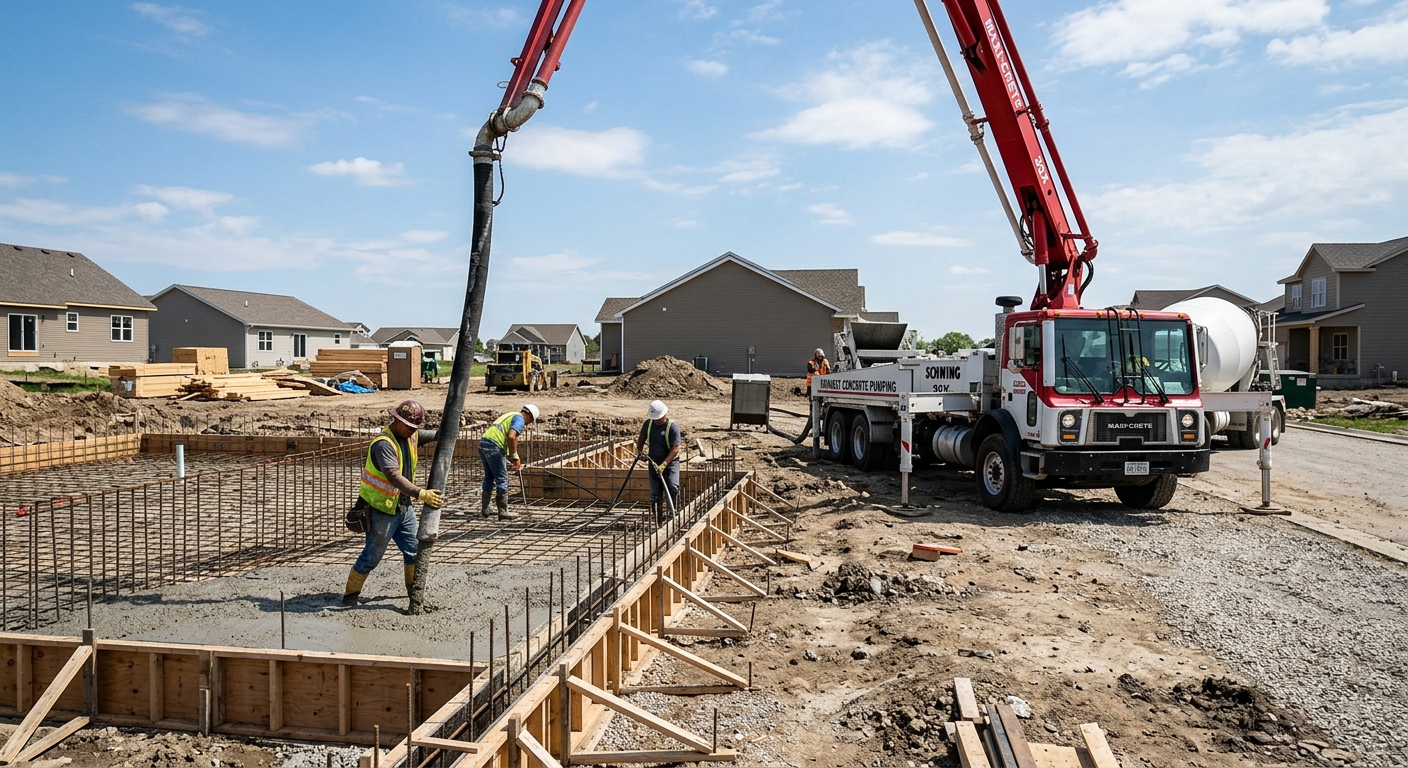
Concrete work options and costs in Townline
Townline homeowners typically think about concrete because it’s durable, easy to maintain, and well-suited to the Lower Mainland–Southwest climate. With a population of 21,095 (Statistics Canada, 2021 Census), there’s consistent year-round demand for driveways, patios, and foundation support—especially where infill and multi-phase neighbourhood development keep trades busy. In this area, many projects are tied to existing single-family homes and small lots, where access and drainage details can make or break the final price.
Concrete costs here are shaped by the mild-looking winters and the reality of coastal-wet weather: shallow frost depth still matters, and we design for freeze–thaw cycles by setting footings and thickened edges below the local design frost depth (commonly around 450 mm / 18"). At the same time, prolonged rain, cool nights, and high humidity can slow curing and scheduling, so contractors often plan pours around weather windows and add curing blankets, sealers, and longer set times when needed. That’s why you may see quotes that differ even when you’re choosing the same “broom finish” look.
In Townline’s South Fraser area and nearby residential corridors, concrete flatwork is particularly in demand during spring and early fall, when contractors can manage excavation, base prep, and curing without fighting standing water. Below are realistic budget ranges for common options, so you can compare apples-to-apples before you request itemised quotes.
| Application |
Typical Size |
Key Spec |
Finish Option |
Price Range |
| Concrete driveway (standard broom finish) |
24 ft x 10 ft (240 sq ft) |
Air-entrained exterior mix, compacted granular base |
Broom finish + control joints |
$4,320–$6,720 |
| Exposed aggregate driveway |
24 ft x 10 ft (240 sq ft) |
Proper base drainage and finish curing control |
Exposed aggregate with sealer |
$5,280–$7,920 |
| Stamped concrete driveway or patio |
20 ft x 12 ft (240 sq ft) |
Air-entrained mix + integral/ground release system |
Stamp pattern + color hardener/sealer |
$5,280–$8,640 |
| Plain concrete patio or walkway |
12 ft x 12 ft (144 sq ft) |
Compact base, joints planned for shrinkage |
Broom or light trowel + joints |
$2,304–$3,744 |
| Garage floor (interior slab) |
20 ft x 22 ft (440 sq ft) |
Vapour barrier and proper reinforcement per design |
Float + cure and seal (optional) |
$7,040–$12,320 |
| Foundation footings (structural, below frost) |
Typical house perimeter (approx. 80–140 linear ft) |
Excavation, rebar, engineered depth below frost |
Structural grade concrete |
$16,000–$48,000 |
Prices are estimates only and vary by project scope, site access and material selection.
What affects the price of concrete work in Townline
It’s common to see the same concrete project come in 30–50% apart across the Lower Mainland–Southwest and the broader province of British Columbia. In our region, even though winters are generally mild, we still must manage freeze–thaw cycles and saturated soils. That drives consistent costs in base prep (granular, grading, drainage), mix design (air-entrainment), and detailing like control joints and sealing. Contractors also price seasonality differently: when rain lingers, we’re forced into weather-dependent scheduling and longer curing support, which increases labour hours and standby time.
Frost depth and freeze–thaw cycles dictate every spec. Footings and thickened edges must extend below the design frost depth to prevent frost heave; local practice often assumes a frost depth around 450 mm / 18", but we set the excavation and forms accordingly. Exterior slabs need air-entrained concrete, because freeze–thaw exposure is what causes scaling and spalling when air content or curing conditions are wrong. Colder regions generally face shorter pour seasons and higher cold-weather curing costs (heating and insulating blankets). In Townline, colder snap periods and high humidity can still trigger those precautions, just not as often as further north.
Two quick examples of how local conditions change the quote: first, a driveway over saturated or poorly draining soil may require deeper granular base and improved drainage before you pour—often the difference between a straightforward broom finish and a higher-budget exposed aggregate. Second, a stamped driveway that needs careful curing control and longer protection can cost more than a standard driveway; for context, standard flatwork often lands around the $18–$28 per sq ft range, while decorative options commonly sit in the $22–$36 band. If your home is older (or has had past patching), there may be additional demo and disposal that pushes labour and equipment time upward.
| Price Factor |
Why It Matters |
Cost Impact |
| Frost line depth — determines footing depth and form height |
Footings must be set below the design frost to prevent heave |
Higher excavation and more rebar/formwork; can add hundreds to thousands depending on linear footage |
| Site preparation — excavation, grading, compacted granular base |
Saturated subgrade and poor drainage accelerate settlement and cracking |
Often the largest labour driver; deeper base and drainage can increase cost significantly |
| Reinforcement — rebar or wire mesh requirement |
Controls shrinkage cracking and supports structural load paths |
More steel, tying time, and lift/placement costs |
| Mix design — air-entrainment and compressive strength spec |
Air entrainment protects against freeze–thaw scaling; strength supports durability |
Materials cost increase versus non-air-entrained mix; protects against premature surface failure |
| Finish type — broom vs. stamped vs. exposed aggregate |
Decorative finishes require extra materials, labour and curing control |
Usually shifts you from the $16–$28 range into higher decorative pricing bands |
| Pour size and concrete truck access to site |
Access affects pumping/placing time and the number of loads |
Hard access can add equipment and labour; smaller pours can still cost disproportionately |
| Cold-weather curing precautions — heating and blankets |
Cold nights and damp conditions can delay strength gain |
Blankets/heaters and longer protection time add labour and material costs |
| Control joint pattern and sealing cost |
Joints reduce random cracking; sealers help repel salts and moisture |
May add a few hundred dollars but prevents costly surface breakdown |
Permits & regulations in British Columbia
In British Columbia, the key split is between structural concrete and cosmetic/flatwork. Structural concrete work—such as footings, foundation walls, and grade beams—typically requires a building permit, and many cases involve engineered drawings that the municipality reviews as part of the permit process. Concrete flatwork like patios, walkways, and driveways usually does not require a permit unless it affects lot grading, drainage, or impervious surface coverage limits, or involves work within or near municipal right-of-way.
For a Townline homeowner, the safest approach is to confirm before breaking ground. Step-by-step: (1) ask the contractor whether the job is “structural” or “flatwork only,” and whether they expect a permit; (2) verify liability insurance is current—request a certificate of insurance that lists the worksite address; (3) confirm coverage for workers through WSBC (WorkSafeBC) and keep documentation that the contractor is in good standing; and (4) request references with similar-scale concrete jobs in the Lower Mainland–Southwest so you can confirm the contractor actually follows the local build sequence.
Where to look: check the contractor’s licence details via the appropriate provincial contractor licensing/registry resources (and don’t rely on a verbal claim), and always ask for copies of the insurance and WSBC/clearance paperwork before scheduling excavation. If any contractor can’t provide these documents, consider it a major warning sign.
Getting concrete right in Townline's freeze-thaw climate
Concrete fails in Townline’s climate for a few repeat reasons: water gets in, freeze–thaw cycles expand and contract it, and the surface starts scaling or spalling. The fix isn’t just “better concrete”—it’s a complete spec: base preparation, correct mix, joints, curing, and sealing. That’s why your driveway or patio quote should reference how the contractor will build the base to the correct depth for local soils and frost protection, not just how they’ll pour.
1) Base preparation. Use compacted granular sub-base sized and graded to manage runoff and avoid soft pockets. If you skip proper base compaction or drainage, you’ll get settlement and cracking even with good finishing.
2) Mix design. For exterior flatwork, we target air-entrainment around 5–7% and a minimum 32 MPa compressive strength so the concrete can handle freeze–thaw. Incorrect air content is a common root cause of spalling, especially when de-icing salts and winter moisture combine.
3) Control joints. Planned joint spacing controls where shrinkage cracks occur.
4) Curing. Plan on minimum 7 days of proper curing conditions; in cool, humid weather that often means added curing blankets and careful protection from rain.
5) Sealing. Apply a penetrating sealer after cure (often at about 28 days post-pour) to help repel salt and moisture.
Example: a standard broom-finished driveway budget might sit in the $18–$28 range, while stamped decorative concrete can land higher (often $22–$36). The premium is justified when the contractor uses the right air-entrained mix, controls curing, and follows through with sealing—otherwise the decorative surface can wear faster.
| Spec |
Why It Matters in Townline |
What to Ask For |
Impact if Skipped |
| Compacted granular base (depth?) |
Helps resist settlement and manages water near the slab in wet coastal conditions |
Ask for the base depth and compaction method specific to your site |
Settlement, cracking, pumping of fines, and early edge deterioration |
| Air-entrained concrete mix (target air %?) |
Protects against freeze–thaw scaling/spalling in a shallow-frost coastal climate |
Ask for air content target (typically 5–7% for exterior flatwork) and confirmation on the ticket |
Surface scaling and spalling, especially after winter salts |
| Compressive strength (MPa rating) |
Ensures durability and strength gain under Townline curing conditions |
Ask for minimum 32 MPa and how curing will be protected during cool snaps |
Surface wear, reduced long-term performance |
| Control joints (spacing per ACI guidelines) |
Controls crack locations during shrinkage |
Ask for the joint layout plan and spacing for your slab dimensions |
Random cracking and moisture paths under the slab |
| Minimum 7-day curing period |
Cold nights and humidity can slow strength development if curing is rushed |
Ask how long the concrete will be kept moist/protected before traffic |
Low strength, poor surface durability, higher cracking risk |
| Penetrating sealer (when applied after cure) |
Repels de-icing salts and limits water absorption |
Ask for sealer application timing (commonly around 28 days post-pour) and product type |
Faster staining, scaling, and deterioration of the top surface |
How to choose a concrete work contractor in Townline
To choose the right contractor in Townline, verify three things up front: licensing/registration (where applicable), liability insurance, and WSBC coverage. Start by asking for a copy of their insurance certificate; it should include the jobsite address and show active coverage for the policy term. Next, confirm WSBC coverage—contractors should be able to provide evidence of their account status and coverage for workers. Finally, check their credentials through the relevant provincial registry/online resources before you sign anything. A good crew won’t treat this as an obstacle; they’ll treat it as normal paperwork.
Then get 2–3 itemised written quotes. Avoid lump-sum numbers with no breakdown. Request separate line items for excavation/base prep, reinforcement, concrete supply, forming and finishing, curing/protection, and sealing (if included). Ask whether disposal and site restoration are included, and whether a permit is required (structural concrete usually needs permits; typical patios/driveways generally don’t unless grading/right-of-way or drainage rules are affected).
Read the scope carefully for exclusions: rain delays, cold-weather coverage, subgrade replacement, and what happens if you discover unsuitable soil after demo. Warranty should be in writing, including workmanship coverage duration and what it does and doesn’t cover. Clarify whether the warranty is transferable to future owners.
Payment should be scheduled so you never pay more than 10–15% upfront. Hold back a meaningful portion until completion and walk-through. Also insist on a start date and a completion estimate in writing, because weather-driven curing impacts schedules in the Lower Mainland–Southwest.
- Request proof of current liability insurance before work starts
- Confirm WSBC coverage and ask for documentation
- Ask if the job needs a permit (structural vs flatwork distinction)
- Get itemised quotes (base prep, rebar/mesh, concrete, labour, curing, sealing)
- Verify they spec air-entrainment and provide mix ticket details on request
- Ask about the base depth and drainage approach for your soil
- Confirm joint layout and expected crack control method
- Ask how they protect curing in cool/wet conditions (blankets, sealing timing)
- Clarify truck access, pumping (if needed), and load count
- Confirm disposal of concrete and spoil removal is included or quoted separately
- Review warranty terms in writing (workmanship vs product warranty)
- Use a payment schedule with limited upfront deposit and holdback until completion
Concrete red flags in Townline include vague quoting (“we’ll figure it out”), no discussion of drainage/base compaction, missing documentation for insurance/WSBC, skipping air-entrainment for exterior work, and rushing curing so the slab is exposed before strength gain.
Frequently asked questions — concrete work in Townline
What is a concrete overlay and is it suited to Townline?
A concrete overlay is a new layer of concrete placed over an existing slab or surface after preparation (usually grinding/scarification and repair of spalls or voids). In Townline and the Lower Mainland–Southwest, overlays can be a practical option when your existing driveway is mostly sound but looks worn or uneven. It’s especially helpful if you want to avoid the cost and disruption of full demo and replacement.
That said, overlays are not ideal when the underlying slab is severely cracked, has major settlement, or has drainage issues that keep water against the concrete. Because freeze–thaw cycles and coastal rainfall drive water movement, any persistent moisture problem can cause debonding or faster deterioration. If you’re comparing budgets, a replacement driveway often falls around the $18–$28 per sq ft band for standard broom finishes, while overlay pricing can be competitive only if the prep and bonding steps are done correctly and the substrate is stable. Always ask for a method statement and patch/repair plan before paying.
How do I seal concrete to protect it in Townline?
Sealing in Townline is about keeping moisture and de-icing salts out of the surface pores. For most exterior concrete—driveways, patios, and walkways—the best results come from a penetrating sealer applied after the concrete has fully cured. A typical approach is to wait about 28 days post-pour (or longer if the weather slows cure), then clean the surface and apply the sealer in accordance with the product instructions.
In our climate, prolonged rain and cool nights can affect cure time, so don’t rush sealing. Also confirm whether your contractor will prep the surface properly (cleaning, removing laitance, and ensuring it’s dry enough). Proper joint sealing and edge detailing matter too: sealed surfaces perform better, but they’re not a substitute for good base drainage and air-entrained concrete.
If you’re budgeting, sealing is often a relatively small line item compared to replacing a damaged slab—especially since exterior decorative options (often $22–$36) can cost more to repair later.
What is the difference between concrete and cement?
Concrete is the final construction material you see and touch—it's a mix of cement, water, fine and coarse aggregates (sand and stone), and in many exterior applications, additives such as air-entrainment. Cement is only one component of concrete; it’s the binding ingredient that reacts with water and hardens to form the paste that holds everything together.
Homeowners sometimes hear “cement” used as a shortcut for “concrete,” but for choosing a driveway or patio in British Columbia, what matters is the concrete specification: the air-entrainment for freeze–thaw durability, the compressive strength (often a minimum 32 MPa for exterior work), the curing and protection plan, and the control joint layout. Those are the items that determine how the slab performs through Townline’s wet winters and cold snaps.
So when you compare quotes, ask for the concrete mix spec details rather than focusing only on “cement amount.” That’s where the real performance difference—and true value—shows up.
How much does concrete work cost in Townline?
In Townline, typical pricing depends on thickness, base preparation, access, drainage requirements, reinforcement, and finish type. For concrete driveways and slabs, many projects fall around the $18–$28 per sq ft backbone range for standard and plain finishes. If you choose decorative work—like stamped concrete—pricing often increases into the $22–$36 band, mainly due to labour time, extra materials, and finish/curing control.
For a quick realistic reference: a standard broom-finished driveway might land in the mid lower thousands for a typical sized residential pour, while stamped work is commonly higher for the same square footage. Patios and walkways generally come in somewhat lower, with pricing often reflecting the $16–$26 range depending on site conditions.
Foundations and footings are priced differently from flatwork. Structural footings are often quoted per project with excavation and engineered requirements—so the total can vary widely based on linear footage and soil conditions. If you want accurate budgeting, request itemised quotes that separate base prep and reinforcement from concrete and finishing.
How deep must footings be for Townline's frost line?
For Townline’s frost protection, footings must be placed below the local design frost depth to prevent frost heave. In the Lower Mainland–Southwest, local practice commonly assumes a frost depth around 450 mm / 18", but the actual required depth can vary based on soil conditions, drainage, and engineered design requirements for your foundation system.
Because freeze–thaw cycles and saturated soils can move moisture toward the foundation, footings also rely on proper excavation, consistent bearing, and good site drainage—not just depth. Your structural engineer or foundation design should specify footing elevations relative to finished grade, and the contractor should follow that engineered drawing.
If you’re comparing quotes, don’t just ask “how deep is it?” Ask for the footing depth/elevation to be shown against the plan, and confirm how the contractor will handle any unsuitable soil discovered during excavation. Small differences in excavation depth can mean large changes in labour and formwork cost—especially when dewatering or trucking spoil becomes necessary.
Why does concrete crack in Townline and how is it prevented?
Concrete cracks are usually caused by shrinkage, temperature change, and restraint—not necessarily by poor “quality” concrete. In Townline, exterior cracking risk is higher when moisture enters the slab edges or when the base isn’t properly compacted and drained. Freeze–thaw cycles can worsen the problem by expanding water in tiny pathways, especially if de-icing salts are used.
Prevention starts with correct specifications: use air-entrained concrete for freeze–thaw durability; plan control joints to guide where cracks occur; and ensure proper base preparation with compacted granular and drainage so the slab doesn’t settle unevenly. Curing is equally important—minimum 7-day curing under the right conditions helps the concrete reach design strength and reduces early-age issues.
Finally, sealing helps protect the surface from salts and water absorption. For homeowners deciding between finishes, it’s worth noting that decorative concrete (often $22–$36) can still crack if joints and base prep are wrong. The finish affects appearance; the engineering and curing affect performance.