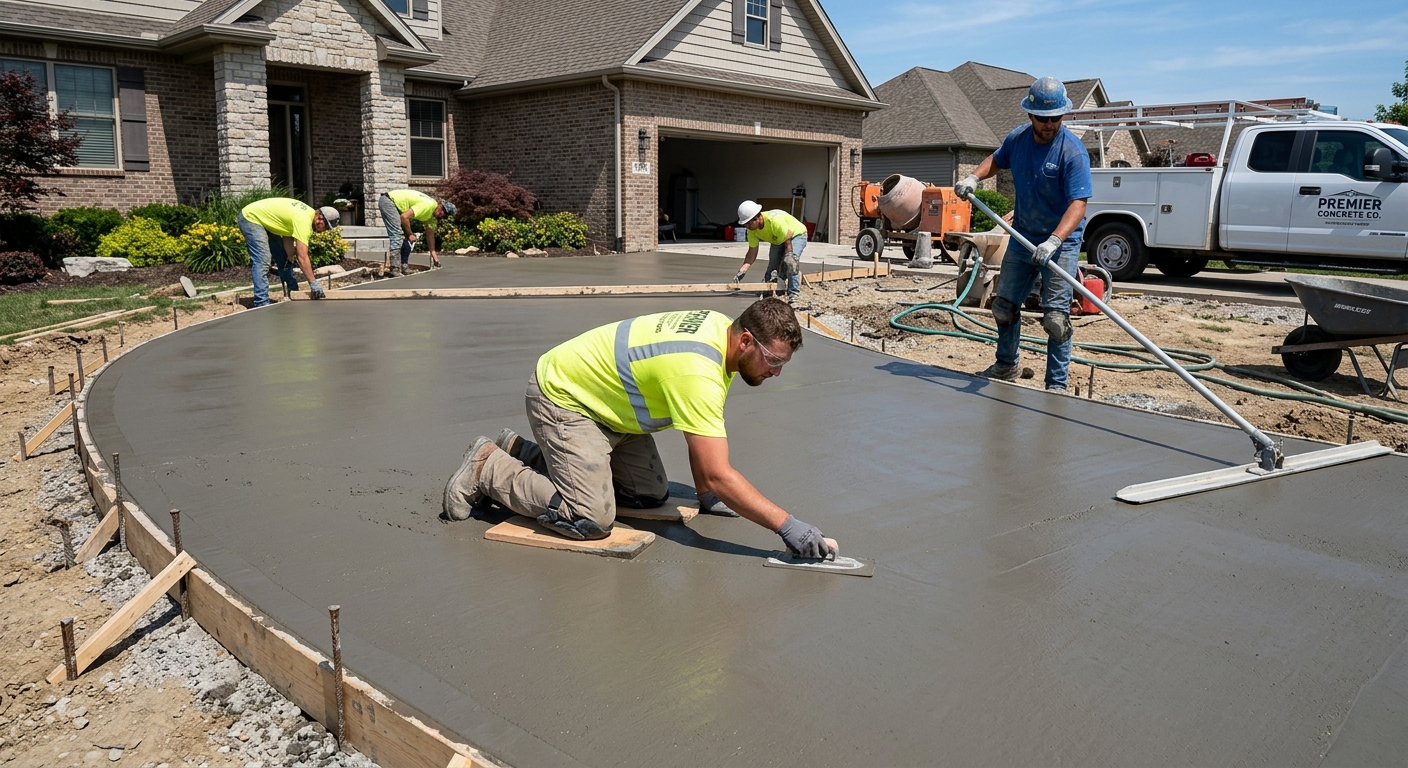
Concrete work options and costs in Abbotsford
Concrete work in Abbotsford is in high demand because the region’s housing stock is dominated by single-detached homes—37.1% of dwellings—plus a large share of residents live in owner households (68.8% of households own) (Statistics Canada, 2021 Census). That mix drives steady need for driveways, patios, walkways, and foundation-related work. In the Lower Mainland–Southwest, mild winters and a shallow frost line help keep some concrete pricing competitive, but our cost model still has to protect slabs and footings from freeze–thaw cycles and heavy coastal rainfall. In practice, local specifications assume a frost depth around 450 mm / 18", so footings, piers, and thickened edges are set below that design frost level to reduce frost heave risk. Contractors also plan around frequent wet weather, cool nights, and high humidity: we often use curing blankets, surface curing compounds, or sealers and schedule pours to achieve proper strength and durability.
Neighbourhoods with lots of retrofit projects and accessibility constraints—like central Abbotsford and Sumas Mountain—tend to see faster turnaround on driveway and walkway work, because homeowners frequently upgrade curb appeal before listing or after renovations. Availability can also affect cost: when rain days compress the pour window, crews are booked tighter and forming/excavation time can rise. For the same “concrete slab” on different sites, a quote can shift meaningfully based on base prep, mix selection, and finish complexity. Use the ranges below to compare common options and transition into a more detailed breakdown of what moves the final number.
| Application |
Typical Size |
Key Spec |
Finish Option |
Price Range |
| Concrete driveway (standard broom finish) |
400–600 sq ft |
Compacted granular base; air-entrained concrete for exterior exposure; control joints; proper drainage |
Broom finish + optional sealer |
$18,000–$28,000 |
| Exposed aggregate driveway |
400–600 sq ft |
Air-entrained mix; compatible aggregate; curing plan to protect surface texture |
Exposed aggregate (wash or retarder method) |
$22,000–$34,000 |
| Stamped concrete driveway or patio |
300–600 sq ft |
Air-entrained mix; stamped pattern; integral or hardener colour; joint layout to manage cracking |
Stamped + sealed finish |
$22,000–$36,000 |
| Plain concrete patio or walkway |
200–400 sq ft |
Compacted base; air-entrained concrete; saw-cut control joints; edge forms |
Float-trowel or broom; optional sealer |
$16,000–$26,000 |
| Garage floor (interior slab) |
400–650 sq ft |
Vapour barrier (where required); mesh/welded wire depending on spec; proper thickness for vehicles |
Standard smooth trowel or lightly broomed |
$14,000–$24,000 |
| Foundation footings (structural, below frost) |
Per project; often 40–120 lin ft |
Concrete designed for structural loads; excavation to below design frost; rebar cages; formwork |
Structural concrete (not decorative) |
$8,000–$20,000 |
Prices are estimates only and vary by project scope, site access and material selection.
What affects the price of concrete work in Abbotsford
In Abbotsford and the broader Lower Mainland–Southwest, quotes for what sounds like the “same” concrete job can vary by 30–50% because the real drivers are site conditions and performance specs, not just the cubic yards. The region’s shallow frost line doesn’t eliminate frost risk—concrete still has to survive repeated freeze–thaw cycles and saturated soils from coastal rainfall. That means exterior slabs and footings still need air-entrained concrete and correct jointing, and footings must extend below the local design frost depth (practice often targets about 450 mm / 18"). When compared with interior or northern BC, labour and materials pricing can differ due to longer cold-weather protection needs in colder regions; in those areas, cold-weather curing precautions (heating and insulated blankets) add cost. In the Lower Mainland–Southwest, those precautions may be less frequent than in colder provinces, but rain days and high humidity still affect scheduling, curing supervision, and surface durability work (like sealing timing).
Concrete scope creep also changes costs quickly. A broom-finish driveway may land around the $18,000–$28,000 band, while stamped or exposed options can push into $22,000–$36,000 territory because of extra prep, pattern setting, colouring, and tighter finish control. A 1970s–pre-1981 neighbourhood lot (29.0% of homes built before 1981) often has older drainage paths, mature landscaping, and sometimes uneven base materials; that can mean more excavation and regrading, which raises price. On the other hand, a newer, flatter subdivision lot with good access may keep excavation and forming time lower, making standard slabs closer to the base price range.
Two practical Abbotsford examples: (1) driveways over soft, poorly drained subgrade may require deeper granular replacement and more attention to drainage, which increases base prep cost; (2) cold mornings plus late-week rain can require extended curing coverage and rescheduling, increasing labour hours. These are the same reasons we stress air-entrainment, base compaction, and joint patterns in every exterior pour.
| Price Factor |
Why It Matters |
Cost Impact |
| Frost line depth |
Footings and thickened edges must sit below the design frost level to limit frost heave. |
Higher excavation/form height can add significant labour and disposal costs. |
| Site preparation |
Proper grading and compacted granular base prevent settlement and water migration. |
More removal/replacement raises trucking, labour, and compaction time. |
| Reinforcement |
Rebar or wire mesh helps control cracking and supports structural demands. |
Rebar cages and tie/wire labour increase material and manpower. |
| Mix design |
Air-entrainment and strength targets are critical for exterior freeze–thaw and durability. |
Specified mixes cost more and may require more careful batching/placement. |
| Finish type |
Broom is faster; stamped/exposed needs more steps and tighter timing. |
Stamped and decorative typically increase labour and overhead. |
| Pour size and concrete truck access to site |
Long pours and limited access add placement time and may require pumping. |
Pumping/more labour can raise price quickly on narrow lanes or slopes. |
| Cold-weather curing precautions |
Cool nights and early frost require blankets/heating to reach design strength. |
Extra labour, rental equipment, and delayed scheduling add cost. |
| Control joint pattern and sealing cost |
Joints reduce random cracking; sealing improves surface resistance to salts and water. |
More saw cuts and a proper sealer schedule add line-item cost. |
Permits & regulations in British Columbia
In British Columbia, the rule of thumb is: structural concrete work requires municipal involvement, while typical decorative flatwork often does not. In Abbotsford, structural concrete such as footings, foundation walls, grade beams, and structural slabs generally requires a building permit, and engineered drawings are often reviewed as part of the permitting process. For concrete flatwork—driveways, patios, and walkways—a permit is usually not required unless the project affects lot grading, impacts impervious surface coverage limits, or involves municipal right-of-way or drainage/sidewalk connections. Even when a permit isn’t required, codes still apply; your contractor should build to the applicable standards and document the mix, thickness, and reinforcement.
Step-by-step, here’s how a homeowner can verify a contractor in British Columbia before excavation begins. First, ask for a current certificate of liability insurance and review the effective dates and limits—your contractor should have coverage appropriate to the scope (including general liability and, if applicable, additional insured status). Second, check for WSIB/WCB coverage documentation; in BC, the equivalent coverage is required for workers on site—request the clearance letter or proof of account status. Third, confirm the contractor’s business information through the relevant online public registry and request their operating name matches the quote. If they’re doing structural work, request details of how engineered drawings and inspections are handled.
Finally, ask for references on similar-scale Abbotsford jobs—especially exterior slabs in wet, freeze–thaw conditions—so you can confirm they understand curing and drainage responsibilities.
Getting concrete right in Abbotsford's freeze-thaw climate
Concrete can fail in Abbotsford when water gets into the surface or base and then repeatedly freezes, expanding and weakening the concrete. The most common issues we see are scaling/spalling from inadequate air-entrainment, random cracking from poor joint spacing, and settlement from insufficient or poorly compacted base. The fix is in the spec—especially in the Lower Mainland–Southwest, where heavy rainfall saturates soils and freeze–thaw cycles still occur.
Start with base preparation: we remove topsoil, then place and compact granular sub-base to the right depth for local soil and drainage, with attention to how water will leave the site. Next, mix design: for exterior flatwork, specify air-entrainment (commonly 5–7% target air content for freeze–thaw durability) and a minimum 32 MPa compressive strength. Third, control joints: plan saw-cut joint spacing so cracks happen where they can be managed—not randomly across the slab. Fourth, curing: you need at least 7 days of curing under proper conditions. In cool, rainy Abbotsford weather, that often means curing blankets or surface protection and sometimes tighter scheduling to avoid early freezing of young concrete. Fifth, sealing: apply a penetrating sealer after cure (commonly 28 days post-pour) to repel de-icing salts and shed water.
If you’re comparing options, the pricing usually makes sense. For example, upgrading from a broom-finish driveway to stamped concrete can cost roughly the difference between the basic exterior band (around $18,000–$28,000) and decorative bands (often $22,000–$36,000)—and that premium is justified when the contractor also budgets for correct base, air-entrainment, and joint layout. If they cut corners on those performance steps, the “saving” won’t last through Abbotsford’s wet winters and spring melt cycles.
| Spec |
Why It Matters in Abbotsford |
What to Ask For |
Impact if Skipped |
| Compacted granular base (depth?) |
Helps prevent settlement and keeps water from pumping upward into the slab. |
Granular replacement depth, compaction method, and drainage plan. |
Cracking, uneven surfaces, and accelerated deterioration in wet seasons. |
| Air-entrained concrete mix (target air %?) |
Air voids provide freeze–thaw resistance when the slab gets wet and cycles freeze. |
Documented target air content and mix design for exterior exposure. |
Spalling/scaling, surface loss, and early repairs. |
| Compressive strength (MPa rating) |
Strength affects durability and how the slab handles loads and curing conditions. |
Minimum 32 MPa for exterior flatwork, with test documentation if required. |
Lower performance, increased risk of damage from traffic and weather. |
| Control joints (spacing per ACI guidelines) |
Controls where shrinkage and thermal movement cracks occur. |
Joint spacing plan and whether joints are saw-cut or formed. |
Random cracking and difficult-to-repair slab defects. |
| Minimum 7-day curing period |
Curing allows concrete to reach strength and reduces early moisture/temperature stress. |
How curing blankets/sealers or coverings will be used in cool nights. |
Weak surface, increased cracking, and reduced durability. |
| Penetrating sealer (when applied after cure) |
Sealer helps repel water and de-icing salt intrusion common in winter maintenance. |
Application timing (after cure, commonly around 28 days) and product type. |
More moisture ingress and faster surface scaling/spalling. |
How to choose a concrete work contractor in Abbotsford
Choosing the right concrete contractor in Abbotsford means verifying coverage and comparing quotes that are written for how the job will perform—especially in our freeze–thaw, wet-weather conditions. Start by confirming British Columbia licensing and credentials: ask for the contractor’s business information and check their public listing. Next, request certificate of liability insurance and verify it’s current and matches the job address and scope. Finally, confirm workers are covered with WSIB/WCB coverage (request a clearance letter or proof of account status). If a contractor can’t provide documents promptly, that’s a red flag.
Then get 2–3 itemised written quotes rather than lump sums. You want line items for excavation and disposal, granular base and compaction, reinforcement (if included), concrete supply/mix, finishing (broom vs stamped/exposed), saw-cutting/control joints, and curing/sealing. Ask what’s excluded: drainage works, permit coordination, tree root removal, repairs to existing concrete, or grinding/levelling.
Warranty matters too. Ask for a workmanship warranty length and whether it covers cracking, surface scaling, or joint leaks—and whether the warranty is tied to maintenance like sealing. Product/manufacturer warranties should be clear and separate.
For payment schedule, don’t hand over the majority upfront: keep deposits typically around 10–15% max, and hold back a portion until the slab is complete, cleaned, and cured to the agreed standard. Get a start date and completion estimate in writing so rain or cool nights don’t become budget surprises.
- Confirm liability insurance is current and adequate for the job size.
- Verify WSIB/WCB clearance or proof of coverage before work starts.
- Ask for at least two Abbotsford references with similar exterior flatwork specs.
- Require mix design details: air-entrainment and target strength for exterior exposure.
- Make sure the quote lists base prep depth and compaction method (not “allowance only”).
- Confirm reinforcement plan: mesh vs rebar and where it applies.
- Get a written jointing plan (spacing, saw-cut vs formed) for crack control.
- Ask how curing will be protected in cool nights or rainy weeks.
- Clarify sealing: product type and the timing (after cure, commonly around 28 days).
- Check disposal/trucking and any hauling fees are included or clearly excluded.
- Confirm whether permit coordination is included if grading/coverage limits are affected.
- Review the schedule for weather contingencies and how delays affect the contract.
Common Abbotsford concrete contractor red flags: vague quotes that omit air-entrainment, no mention of control joints, promising “quick cure” without blankets or curing steps, excluding drainage/base preparation while still charging premium prices, and refusing to provide insurance/WCB clearance documents in advance.
Frequently asked questions — concrete work in Abbotsford
Why does concrete crack in Abbotsford and how is it prevented?
Concrete cracks in Abbotsford mainly because of shrinkage, temperature movement, and water. In the Lower Mainland–Southwest, slabs are exposed to wetting from rainfall and seasonal freeze–thaw cycles, which stresses the surface and can widen existing micro-cracks. The prevention approach is spec-driven: use proper compacted granular base to reduce settlement, specify exterior air-entrained concrete for freeze–thaw durability, and include correctly spaced control joints so cracking happens where it’s planned. A good joint plan matters as much as the mix. Also, allow enough curing time—at least 7 days under reasonable conditions—because rushing early strength development can increase surface cracking. If you’re doing a driveway, ensure the contractor budgets for drainage and joint layout, not just the pour day.
Stamped vs broom-finish concrete — cost difference?
In Abbotsford, broom-finish concrete is typically the most affordable option because it’s fewer labour steps and less timing-sensitive than decorative finishing. You’ll commonly see exterior broom-finish driveways priced around $18,000–$28,000, while stamped driveway or patio work often falls into the decorative band around $22,000–$36,000. That extra cost covers pattern layout, colouring/hardener work, release agents, and more careful finishing coordination to get consistent lines and texture. However, the price premium should not replace performance basics: air-entrainment, correct base preparation, and control joints still must be included. If a quote for stamped concrete doesn’t clearly list those specs, it’s not a “discount”—it’s an avoidable risk.
When is the best time to pour concrete in Abbotsford?
The best time to pour concrete in Abbotsford is when temperatures will support proper curing and when rainfall can be managed. Even with a shallow frost line, cool nights and wet conditions are common, so contractors plan for curing protection (like blankets or covers) and avoid pouring right before heavy rain or when frost could occur early. Practically, late spring through early fall often gives the best working window for exterior flatwork because days are warmer and scheduling is steadier. That said, experienced crews can pour in shoulder seasons with the right cold-weather curing precautions and a tight weather plan. The key question to ask your contractor is how they protect young concrete to ensure it reaches design strength and surface durability—especially for driveways and patios exposed to freeze–thaw cycles.
How long does concrete take to cure?
Concrete curing has two timelines: initial cure (enough to protect and resist minor damage) and full strength development. For most exterior concrete work in British Columbia, plan for at least 7 days of curing with protection under proper conditions to reduce early cracking and ensure strength gain. Full design strength is reached over time, but many durability steps reference a longer schedule. For example, penetrating sealer is typically applied after cure—commonly around 28 days post-pour—so the concrete has dried appropriately and can absorb the sealer effectively. In Abbotsford’s cool, damp periods, the contractor should explain how they’ll manage moisture and temperature (curing blankets, coverings, and rescheduling if needed). If they can’t describe curing protection, that’s a sign to ask more questions before signing.
Do I need a permit for concrete work in British Columbia?
In British Columbia, it depends on the scope. Structural concrete like footings, foundation walls, and grade beams generally requires a building permit and often engineered drawings reviewed by the municipality. For typical concrete flatwork—driveways, patios, and walkways—a permit often isn’t required unless the work affects lot grading, impervious surface coverage limits, or ties into municipal right-of-way/drainage. In Abbotsford, the safest approach is to confirm with the local authority before breaking ground, especially if you’re changing drainage patterns or raising/adjusting the grade. A reputable contractor should ask whether the project impacts grading or drainage and should provide clarity on what permit responsibility belongs to the homeowner versus the contractor.
Concrete vs pavers for a patio in Abbotsford?
Concrete and pavers can both perform well, but they differ in cost, repair style, and timing. Concrete patios are often simpler to build and can be cost-effective; plain concrete patios/walkways commonly land around $16,000–$26,000 depending on size and base prep requirements. Pavers can offer easy “section replacement” if a portion heaves or fails, but installation relies heavily on correct base grading, compaction, and jointing—and those details are crucial in Abbotsford’s wet climate and freeze–thaw cycles. Decorative concrete (like stamped) can mimic the look of higher-end pavers while maintaining a monolithic slab system. The better choice usually comes down to your budget, desired appearance, and how much site regrading/drainage work your contractor says is needed. Ask both contractors to explain drainage and base prep in writing.