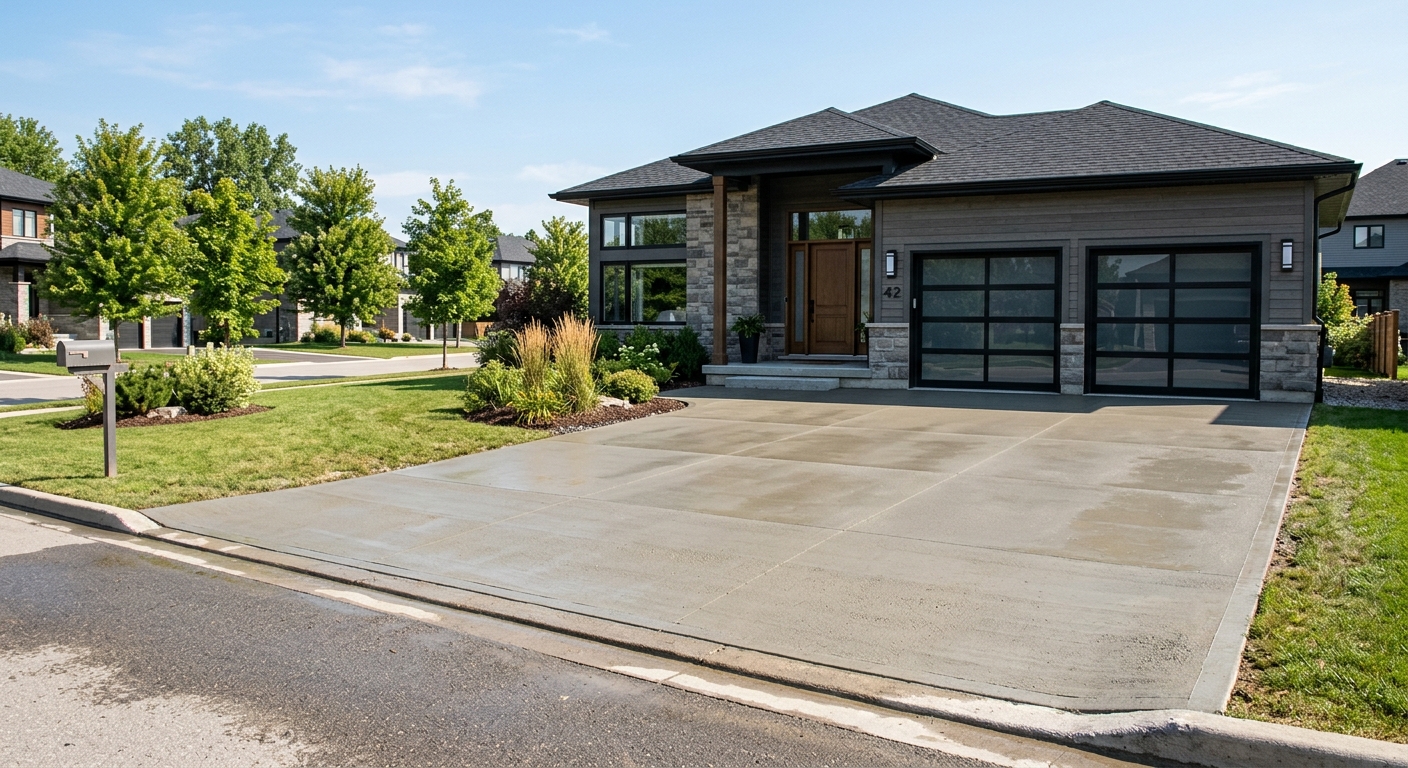
Concrete work options and costs in Aldergrove
Aldergrove homeowners typically use concrete for the big-ticket outdoor surfaces—driveways, patios and walkways—because they’re durable, low-maintenance and handle the daily wet weather of the Lower Mainland–Southwest. With a 2021 population of 12,363 (Statistics Canada, 2021 Census), the Abbotsford–Aldergrove corridor also has steady demand for trades like concrete flatwork, which helps keep turnaround reasonable but makes scheduling sensitive during rainy weeks. In this market, most residential concrete work is aimed at single-detached family homes, where a new driveway or patio is often part of curb appeal upgrades and drainage improvements around older lots.
Our local climate shapes both design and price. Even with mild winters, the region’s shallow frost depth (often assumed around 450 mm / 18") and frequent freeze–thaw cycles mean exterior slabs need properly placed footings, compacted base, air-entrained concrete, and control joints to reduce random cracking and scaling. Coastal rainfall can also slow curing after a pour, so crews plan around cool nights and high humidity—sometimes using blankets or sealers—adding labour and material time.
In Aldergrove, projects are especially common around commercial and residential pockets along 56 Avenue and the surrounding neighbourhoods where driveways connect directly to busy arterials and need tight forms, quick access, and careful cleanup. With that in mind, below is a practical comparison of typical options and cost ranges you can expect from local contractors in the Aldergrove area.
| Application |
Typical Size |
Key Spec |
Finish Option |
Price Range |
| Concrete driveway (standard broom finish) |
400 sq. ft. |
Compacted granular base, air-entrained mix, control joints |
Broom finish |
$18,000–$28,000 |
| Exposed aggregate driveway |
400 sq. ft. |
Compacted base, air-entrained mix, proper jointing |
Exposed aggregate (wash finish) |
$22,000–$34,000 |
| Stamped concrete driveway or patio |
300 sq. ft. |
Compacted base, air-entrained mix, release, seal-ready surface |
Stamped patterns |
$20,000–$36,000 |
| Plain concrete patio or walkway |
250 sq. ft. |
Compacted granular base, air-entrained mix |
Float-and-trowel with light broom texture |
$16,000–$26,000 |
| Garage floor (interior slab) |
500 sq. ft. |
Vapour control considerations, mesh/rebar as required |
Standard trowel finish |
$15,000–$26,000 |
| Foundation footings (structural, below frost) |
Approx. 40 linear ft. (project dependent) |
Below frost depth placement, engineered reinforcement |
Structural concrete |
$8,000–$14,000 |
Prices are estimates only and vary by project scope, site access and material selection.
What affects the price of concrete work in Aldergrove
In Aldergrove and across the Lower Mainland–Southwest, the same concrete job can quote 30–50% differently because pricing is driven by what’s happening underneath the surface. A “standard” driveway in one lot may involve extensive excavation, extra drainage, and more steel because of soil conditions; another may be mostly re-using a stable subgrade with straightforward access. Labour and scheduling also swing with rain and cold nights, and those timing realities are more noticeable in coastal BC than in drier inland areas.
Frost and freeze–thaw cycles dictate the design. Exterior slabs and footings must resist movement: footings are typically placed below the design frost depth (in coastal BC, often around 0.5–1.2 m depending on design assumptions) to prevent frost heave. That same durability requirement is why exterior flatwork needs air-entrained concrete and well-planned control joints to manage cracking and scaling. When cold weather arrives, crews may need cold-weather precautions—insulating blankets, curing protection, and in some cases temporary heating—so the concrete reaches required strength instead of slowing down.
Local soil moisture and drainage are big cost levers. For example, if your property has saturated soils after heavy rainfall, base prep may require additional granular thickness and improved subgrade drainage, which can add material and excavation time. Conversely, a simpler replacement on a well-drained lot can land closer to driveway pricing like the typical $18–$28 band for standard broom-finished work. If you upgrade to stamped or exposed aggregate, you’re usually paying extra labour for form lining, finishing labour, and specialized seal-ready work—often moving toward the $22–$36 range for stamped & decorative concrete.
Home age matters, too. Older homes often have legacy grading that directs water toward foundations; correcting that drainage can increase upfront costs but reduces future failure risk and rework. When you’re choosing between options, a modest price increase is often justified if it buys you better base prep, proper mix design, and correct jointing—not just cosmetics.
| Price Factor |
Why It Matters |
Cost Impact |
| Frost line depth — determines footing depth and form height |
Below-frost placement prevents frost heave and movement of supports |
Higher excavation and taller forms increase labour and material |
| Site preparation — excavation, grading, compacted granular base |
Stability and drainage control reduce settling and cracking |
More truckloads and compaction time add cost |
| Reinforcement — rebar or wire mesh requirement |
Controls cracking and improves slab performance under loads |
Steel supply and labour for placement raise the quote |
| Mix design — air-entrainment and compressive strength spec |
Air entrainment helps survive freeze–thaw; strength supports durability |
Higher-performance mix can cost more per cubic metre |
| Finish type — broom vs. stamped vs. exposed aggregate |
Finish complexity changes labour and material consumption |
Stamped/exposed finishes usually increase labour and sealing steps |
| Pour size and concrete truck access to site |
Access constraints affect pump needs, hose runs, and crew time |
Limited access can add equipment costs and labour hours |
| Cold-weather curing precautions — heating and blankets |
Protects strength gain when nights are cool or rain is frequent |
Additional materials and time extend the work window |
| Control joint pattern and sealing cost |
Joints manage cracking and sealer reduces water and de-icer damage |
More joints and scheduled sealing add line-item costs |
Permits & regulations in British Columbia
In British Columbia, structural concrete work—such as footings, foundation walls, and grade beams—typically requires a building permit and often needs engineered drawings reviewed through municipal processes. Concrete flatwork like patios, walkways, and driveways usually does not require a permit by default, but it can trigger requirements if it impacts lot grading, drainage, or impervious surface coverage limits, or if work affects any municipal right-of-way (for example, curb/sidewalk interfaces). Always confirm with the local authority before breaking ground.
Before your contractor starts in Aldergrove, ask for proof they’re set up to do both the work and the paperwork correctly. Start with the contractor’s business profile and any applicable provincial licensing or registration (where required for their contracting activities). Then request a current Certificate of Insurance showing liability coverage and the job address, plus proof they have Workers’ Compensation coverage for their workers (commonly handled through WCB coverage). For larger residential builds or work that touches foundations, ask whether permits and engineered requirements are being handled as part of the scope.
Step-by-step for verification:
- Look up the contractor’s standing using the relevant BC registry/online business search.
- Request an up-to-date certificate of liability insurance; verify the insurer, policy dates, and that the certificate lists the correct project address.
- Confirm WCB/WCB coverage by requesting clearance documentation or a certificate showing active coverage.
- Ask for references from similar Aldergrove-scale projects and pictures of finish work in comparable freeze–thaw conditions.
If anything is missing, pause and clarify—on-site concrete failures are expensive, and paperwork gaps can create delays when inspections are required.
Getting concrete right in Aldergrove's freeze-thaw climate
Concrete fails in Aldergrove most often because water moves into the slab and freezes, expands, and causes surface scaling or spalling—especially when the base isn’t properly built or the mix isn’t air-entrained. The Lower Mainland–Southwest climate is wet, with frequent freeze–thaw cycles that stress the top layers. The fix is not just “better concrete”; it’s a correct system: base preparation, mix design, joints, curing, and sealing.
First, base preparation: build a compacted granular sub-base to the thickness needed for local soil and frost performance, then compact it to reduce settlement. Second, mix design: specify air-entrainment for exterior flatwork—commonly in the 5–7% air content range for durability—and set a minimum 32 MPa compressive strength so the slab reaches design performance during cool, damp periods. Third, control joints: plan joint spacing so the slab cracks where you want it, not randomly. Fourth, curing: protect the pour for at least 7 days under proper conditions; in cold or rainy stretches, curing blankets and careful scheduling matter. Finally, sealing: apply a penetrating sealer after the concrete has cured (typically around 28 days) to help repel de-icing salts and water movement.
Ask targeted questions to avoid the classic spalling problem from inadequate air entrainment. A simple way to compare options: a broom-finished driveway may sit nearer the $18–$28 range, while a decorative stamped option can approach the $22–$36 range. The price difference is often justified only when the contractor also proves they’re doing the fundamentals—correct base, correct air-entrainment, timely curing and scheduled sealing—not when it’s purely aesthetic work.
| Spec |
Why It Matters in Aldergrove |
What to Ask For |
Impact if Skipped |
| Compacted granular base (depth?) |
Controls settlement and supports frost-resistance under wet soils |
Granular thickness, compaction method, and drainage notes |
Cracking, uneven settling, and early wear from water pooling |
| Air-entrained concrete mix (target air %?) |
Helps concrete survive freeze–thaw scaling and surface damage |
Target air content (commonly 5–7% for exterior flatwork) |
Spalling/scaling, especially where de-icing salts reach the surface |
| Compressive strength (MPa rating) |
Ensures durability even with cool, humid curing conditions |
Minimum 32 MPa and how curing will be protected |
Surface deterioration and reduced long-term performance |
| Control joints (spacing per ACI guidelines) |
Reduces random cracking from shrinkage and temperature swings |
Joint spacing plan and saw-cut vs. formed approach |
Random cracks and water ingress into vulnerable edges |
| Minimum 7-day curing period |
Cold nights and rain can slow strength gain |
How they maintain curing conditions during storms or cool spells |
Weak surface, increased cracking risk, and poor surface integrity |
| Penetrating sealer (when applied after cure) |
Repels water and de-icing salt exposure from coastal-wet cycles |
Schedule (often around 28 days post-pour), product type, coverage rate |
Faster water absorption, staining, and more freeze–thaw damage |
How to choose a concrete work contractor in Aldergrove
Choosing the right concrete contractor in Aldergrove is mostly about verification: licensing/registration (where applicable), insurance, and proper coverage—then clear documentation. Start by confirming liability insurance with an up-to-date Certificate of Insurance showing the jobsite address and policy dates. Next, verify Workers’ Compensation coverage (WCB/WCB clearance documentation if they provide it). Finally, ask for proof of any relevant registrations or licensing that apply to their type of contracting activity in BC. If they can’t provide documents quickly, that’s a red flag.
For pricing, get 2–3 itemised written quotes—not just a single number. Ask for a breakdown that separates labour, excavation/base prep, reinforcement, concrete supply, and finish work. Confirm what’s included and what’s excluded: permit pulls, disposal of excess soil, saw-cutting, waterproofing/edge details, and sealing. A “cheap” driveway quote often excludes critical steps like proper drainage base prep or sealing schedule.
Warranty matters. Ask for two things: a workmanship warranty length (how long they stand behind installation) and product/manufacturer warranties (if applicable). Clarify whether warranties are transferable to you if the property is sold.
On payments, avoid large upfront deposits. A common safe approach is keeping deposits to no more than 10–15%, with a holdback until the job is complete and key items are finished (including final cleanup and finish quality verification). Get a timeline in writing: start date, concrete pour date, and practical completion estimate based on weather.
- Ask for itemised quotes (labour + materials), not a lump sum.
- Verify liability insurance and that it covers the Aldergrove address you’re building at.
- Confirm WCB/WCB coverage and request clearance proof if available.
- Review the scope for excavation, base thickness, and disposal of removed material.
- Confirm air-entrained mix and minimum compressive strength for exterior work.
- Ask how control joints will be laid out and when they’ll be cut/specified.
- Check curing plan for cool nights and rainy periods (blankets or protection).
- Ask whether sealing is included and when it will be applied (after cure, typically ~28 days).
- Confirm reinforcement approach (mesh/rebar) based on slab use and design.
- Ensure permit responsibility is clearly stated: who pulls permits if required.
- Get a schedule that considers weather windows and drying/curing time.
- Clarify cleanup and protection of landscaping, fences, and property access.
Concrete contractor red flags in Aldergrove: they won’t provide insurance/WCB proof; they promise “no joints” or skip air-entrainment; they quote a wide area without discussing base depth or drainage; they’re vague on curing/sealing timelines; or they pressure you into paying the majority upfront before any prep work starts.
Frequently asked questions — concrete work in Aldergrove
How do I maintain concrete in Aldergrove's freeze-thaw climate?
In Aldergrove, maintenance is mostly about reducing how much water and de-icing chemicals reach the slab surface during freeze–thaw cycles. First, keep your driveway and walkways drained—if water pools at edges, it finds its way under or into joints over time. Sweep off debris regularly and use the correct de-icer (and keep application light) because repeated salt exposure accelerates scaling. If you had exterior concrete installed, confirm whether a penetrating sealer was applied after cure (often around 28 days). Reseal timelines vary by product, but many homeowners re-check sealer performance every few years based on wear. If you notice small surface scaling, address it early rather than waiting for deeper spalling. For best results, follow the contractor’s care instructions for your specific finish and sealer type, especially if you chose broom or stamped surfaces in the Lower Mainland–Southwest’s wet weather.
What causes concrete to spall in Aldergrove winters?
Spalling in Aldergrove is usually a freeze–thaw durability problem, meaning water got into the concrete and expanded when temperatures dropped. The biggest technical causes are inadequate air entrainment in the mix and poor base drainage that lets water sit. If the concrete doesn’t have the correct air content (commonly targeted around 5–7% for exterior flatwork) and isn’t protected during curing, the surface can be more vulnerable to scaling. Another contributor is poor jointing—without a proper control joint pattern, cracking becomes random, allowing water to enter through hairline cracks. De-icing salt adds chemical stress; in coastal-wet conditions, that combination can show damage sooner. If you’re comparing quotes, confirm the contractor’s mix spec and curing/blanket plan—this is often the difference between standard broom work near the $18–$28 driveway band and lower-cost offers that later fail due to skipped durability steps.
What is rebar and when is it required in British Columbia?
Rebar (reinforcing steel) is a metal bar used to strengthen concrete and help control cracking under load. In British Columbia, when rebar is required depends on the structural design and the intended use. For interior slabs like garage floors, reinforcement may be needed to support vehicle loads; for exterior slabs, it may be required for thickness, spans, or heavy traffic areas. For structural foundations and footings, reinforcement is determined by engineered drawings and building code requirements, and footings are typically placed below frost depth. For plain patios or light walkways, some designs use wire mesh or rely on thickened edges and proper base rather than full rebar layouts, but the specification is still based on design. The best way to confirm for your Aldergrove project is to ask for the slab thickness, intended load, and reinforcement plan in writing—so you know whether rebar, mesh, or both are included and why.
How long does a concrete project take in Aldergrove?
Timelines in Aldergrove depend heavily on weather and the scope. Typical steps include site prep (excavation and compacted base), reinforcing placement (if included), forms, pour day, finishing, then curing and protection. Even when the pour itself is fast, you can’t treat curing like “instant strength.” For exterior flatwork, many contractors aim for practical completion within about 1–3 days on-site for standard driveway or patio projects, but the full curing timeline is longer. You should plan around wet or cool periods in Lower Mainland–Southwest, because rain and humidity can slow surface drying and increase protection needs (curing blankets and careful scheduling). Also consider curing/handling restrictions—contractors often limit traffic and equipment access early on. Decorative work (stamping or exposed aggregate) can add 1–2 extra days due to extra finishing steps and careful curing/cleanup. Ask your contractor for a written start date, pour date, and a weather contingency plan.
What is a concrete overlay and is it suited to Aldergrove?
A concrete overlay is a new layer of concrete placed on top of an existing slab, typically after surface preparation like grinding, patching, and installing a bonding system. It can be suited to Aldergrove when the existing slab is structurally sound and the issue is mainly surface deterioration or minor cracking—because overlays won’t fix major settlement, deep structural movement, or widespread base failure. The freeze–thaw environment makes surface water management critical, so the preparation and bonding steps must be done correctly for longevity. In practice, many Aldergrove homeowners consider overlays to reduce demolition and disposal costs compared with full replacement, but only if the base is stable. If the old slab is spalling badly, has failing edges, or has drainage issues, a full removal and rebuild is often the safer long-term solution. When discussing options, ask for a clear assessment of the existing slab condition and whether sealing and joint plans will match the Lower Mainland’s freeze–thaw durability expectations.
How do I seal concrete to protect it in Aldergrove?
Sealing helps protect concrete from water absorption and reduces damage from de-icing salts—both important in Aldergrove’s wet, freeze–thaw climate. Timing is key: most homeowners and reputable contractors wait until the concrete has cured—often around 28 days—so the sealer can penetrate properly and not trap excess moisture. Before sealing, the slab must be clean, dry, and free of dust, curing compounds, and any contamination that would block penetration. For exterior driveways and patios, choose a penetrating sealer designed for concrete and apply at the recommended coverage rate. If your contractor offered the driveway near the $18–$28 standard band, ask whether sealing is included; if the quote is for decorative work closer to the $22–$36 range, they may include sealing to protect the finish. After sealing, keep traffic off until the sealer cures per the product instructions, and re-check performance in a few years based on wear patterns around joints and edges.