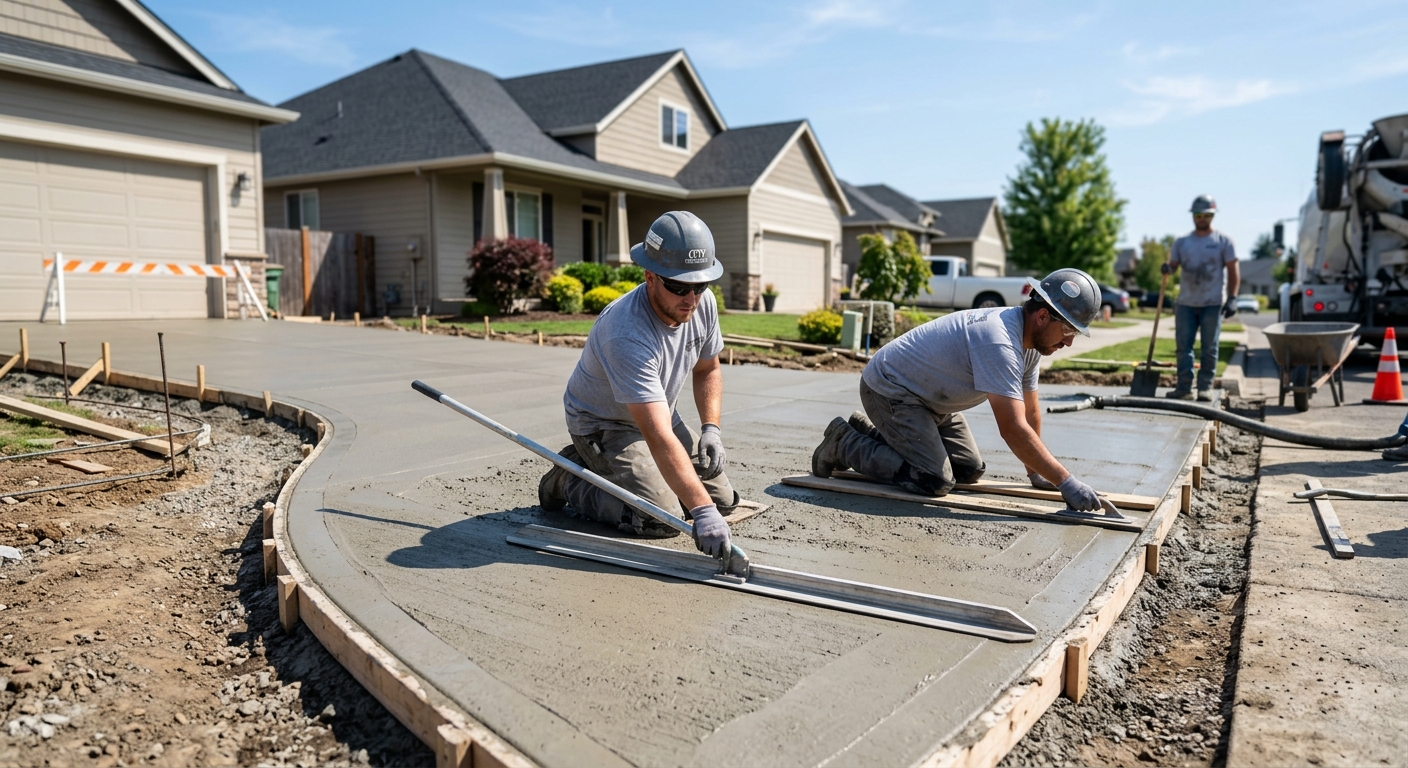
Concrete work options and costs in Okanagan Falls
Concrete work in Okanagan Falls is most often driven by the need for durable, well-drained flatwork—driveways, patios, walkways, and occasional slab upgrades on existing homes. With a population of 2,266 (Statistics Canada, 2021 Census), the local market is smaller than the big Vancouver suburbs, so scheduling can tighten during dry, stable weather windows. A large portion of housing is single-detached, which typically translates into steady demand for exterior concrete that can handle Lower Mainland–Southwest conditions: mild winters paired with a shallow frost depth and frequent freeze–thaw cycling that punishes poorly designed slabs and footings.
In this region, concrete pricing is shaped by the practical reality of a frost depth around 450 mm (18") used for design and detailing. That means footings, thickened edges, and piers are placed below frost, and the base prep for exterior slabs must be compacted granular with careful attention to subgrade drainage. Add to that coastal-wet rainfall, cool nights, and high humidity, and you get longer curing attention (blankets, sealers, and longer hold times to reach surface durability). Contractor availability can also affect cost—fewer crews in a smaller community means more travel time from nearby service areas, particularly when multiple homeowners want the same spring/early-summer pour window.
If you’re comparing options, the table below uses typical local scopes for Okanagan Falls. It’s designed to help you see where the premium dollars usually go—especially on stamped and exposed aggregate finishes—before you request itemised quotes.
| Application |
Typical Size |
Key Spec |
Finish Option |
Price Range |
| Concrete driveway (standard broom finish) |
18 ft x 10 ft (180 sq. ft.) |
4" slab, reinforced as needed, air-entrained |
Broom finish, saw-cut joints |
$3,240–$5,040 |
| Exposed aggregate driveway |
18 ft x 10 ft (180 sq. ft.) |
4" slab, proper curing + wash exposure |
Exposed aggregate, densifier/finisher |
$4,140–$6,480 |
| Stamped concrete driveway or patio |
12 ft x 20 ft (240 sq. ft.) |
4" slab, reinforcement, integral colour |
Stamp pattern + release + seal |
$5,280–$8,640 |
| Plain concrete patio or walkway |
10 ft x 12 ft (120 sq. ft.) |
4" slab, compacted base, joints |
Float/ broom, light edging |
$1,920–$3,120 |
| Garage floor (interior slab) |
20 ft x 22 ft (440 sq. ft.) |
Slab on grade, reinforcement as specified |
Concrete finish trowel/broom, sealer optional |
$7,040–$12,320 |
| Foundation footings (structural, below frost) |
Per project (allowance) |
Below frost depth, rebar/cage, engineered layout |
Structural concrete only |
$2,000–$3,500 |
Prices are estimates only and vary by project scope, site access and material selection.
What affects the price of concrete work in Okanagan Falls
In Okanagan Falls and across the Lower Mainland–Southwest region, it’s common to see the same concrete scope priced 30–50% differently. The spread usually comes down to whether contractors are building for durability under Lower Mainland–Southwest freeze–thaw cycles (base thickness, drainage, air-entrained mix, and proper jointing) or just meeting the minimum “looks good” standard. In British Columbia, mild winters can mislead people into thinking timing and curing don’t matter—but cool, damp weather still slows finishing and can affect how quickly concrete reaches usable strength on the surface.
Frost depth and freeze–thaw cycles dictate the foundation details and exterior slab design. Footings must extend below the design frost depth (the design assumptions here often land around 450 mm/18" practice for exterior support, with deeper requirements depending on soil and engineering), and all exterior slabs need air-entrained concrete to manage damage from repeated thawing and freezing. Colder regions have shorter pour seasons and require heating/insulating blankets for consistent curing; even here in coastal-wet BC, we still plan for rain, cool nights, and high humidity. That impacts labour scheduling, curing management, and sometimes the need for additional sealing and longer protection times against de-icing salts.
In Okanagan Falls specifically, saturated soils and drainage issues can raise costs fast: if the contractor needs extra granular, upgraded base, or improved edge drainage, you’ll see the driveway move from a standard broom-finish cost band to the higher end. For example, a standard broom driveway may land around the lower to mid range (e.g., $18–$28 per sq. ft.), while stamped concrete typically carries a premium because you’re paying for colour hardeners, stamps, and a higher labour intensity—often lining up with the $22–$36 per sq. ft. band for stamped and decorative work. Conversely, a simple plain patio on well-drained soil with good access can come in nearer the lower patio band ($16–$26 per sq. ft.). Older homes in town often have uneven approaches or failing step-ups; levelling and removal of old material adds excavation and disposal—small changes that show up in the final numbers.
| Price Factor |
Why It Matters |
Cost Impact |
| Frost line depth — determines footing depth and form height |
Helps prevent frost heave and keeps structural supports stable |
More excavation and forming; increases foundation/edge thickness costs |
| Site preparation — excavation, grading, compacted granular base |
Strong base controls settlement, reduces cracking, and manages water |
Can add significant labour and dump fees if soil is poor or wet |
| Reinforcement — rebar or wire mesh requirement |
Improves slab performance and reduces risk of widespread cracking |
Material + tie-in labour; varies by slab thickness and design |
| Mix design — air-entrainment and compressive strength spec |
Air-entrainment is critical for freeze–thaw durability of exterior slabs |
Higher mix costs but fewer long-term repairs; often required |
| Finish type — broom vs. stamped vs. exposed aggregate |
Finishes change labour hours, materials, and curing/finishing workflow |
Stamped/exposed aggregate typically increases total cost noticeably |
| Pour size and concrete truck access to site |
Access affects how quickly concrete can be placed and levelled |
Limited access may require extra labour, pumps, or smaller loads |
| Cold-weather curing precautions — heating and blankets |
Ensures consistent strength gain even during cool nights |
Added rentals and labour during marginal temps |
| Control joint pattern and sealing cost |
Controls cracking and protects against water and de-icing salts |
Sealer and more layout work; often worthwhile in this climate |
Permits & regulations in British Columbia
In British Columbia, structural concrete work such as footings, foundation walls, and grade beams typically requires a building permit and often benefits from engineered drawings that the municipality reviews. For concrete flatwork—driveways, patios, and walkways—permits usually aren’t required unless the project affects lot grading, impervious surface coverage limits, or municipal right-of-way considerations (for example, work that touches a boulevard, sidewalk interface, or drainage patterns). Always confirm with the local authority before excavation, especially if you’re changing elevations, adding a new driveway cut, or redirecting drainage.
Before you book a contractor in Okanagan Falls, verify three things: (1) proper contractor credentials for the work, (2) liability insurance, and (3) coverage for workers. Step-by-step, do this: ask the contractor for their certificate of insurance naming you/your property as applicable (or at least showing current general liability). For labour coverage, request proof of workers’ compensation coverage (commonly WCB). Next, confirm they can legally perform the type of concrete construction being quoted—don’t rely on verbal assurances. Finally, ask for references with similar-scope jobs (like exterior slabs in wet, freeze–thaw conditions) so you can compare finishing quality and jointing detail.
Where to look: check the contractor’s online registry listing for status, and request updated clearance documentation if they provide it. If anything is missing or outdated, that’s a reason to slow down and re-check.
Getting concrete right in Okanagan Falls's freeze-thaw climate
Concrete fails in Okanagan Falls when the slab or footing doesn’t perform through repeated wetting, freezing, thawing, and traffic load. The biggest culprits are insufficient base preparation, poor drainage, and—most important in this climate—missing or incorrect air-entrainment. When water gets trapped in the concrete and cycles through freeze–thaw, it can scale the surface, then progress to spalling and rapid surface deterioration, especially where de-icing salts are used. The fix isn’t just “stronger concrete”—it’s the full system: base, mix, joints, curing, and sealing.
Spec the job around five practical requirements. First, base preparation: compacted granular sub-base to the right depth for local soil and frost detailing, with drainage attention at edges and transitions. Second, mix design: air-entrainment typically in the 5–7% range for exterior flatwork, with minimum 32 MPa compressive strength to reach durable performance. Third, control joints: spacing set to limit random cracking—especially important on driveways and wider patios. Fourth, curing: plan for at least 7 days of proper curing conditions; in cool, damp BC weather, protection (curing blankets and careful temperature management) keeps strength gain on track. Fifth, sealing: apply a penetrating sealer after full cure (often around 28 days) to help repel water and reduce the impact of salts.
Asking the right questions helps you avoid the most expensive mistake: surface failure due to inadequate air-entrainment. For example, replacing a broom-finished driveway after premature spalling can cost roughly a full redo—often meaning you lose the value of what you saved initially. In contrast, spending the proper amount to reach the right finish and mix specification is usually far less than repairing or replacing later; even stamped work (frequently in the $22–$36 per sq. ft. range) can be justified when the contractor’s base, joints, curing, and sealing are properly done.
| Spec |
Why It Matters in Okanagan Falls |
What to Ask For |
Impact if Skipped |
| Compacted granular base (depth?) |
Limits settlement and helps prevent water accumulation under the slab |
Documented base depth and compaction testing/verification |
Cracking, dip/uneven surfaces, and faster freeze–thaw damage |
| Air-entrained concrete mix (target air %?) |
Air voids provide freeze–thaw resistance in exterior exposure |
Target air content (typically 5–7% for exterior flatwork) |
Scaling/spalling within a few seasons, especially near salted areas |
| Compressive strength (MPa rating) |
Ensures strength gain for load performance and durability |
Minimum 32 MPa and how strength gain is protected in cool weather |
Surface wear, reduced durability, and potential early deterioration |
| Control joints (spacing per ACI guidelines) |
Manages where cracks occur so they stay predictable and controlled |
Joint layout plan and saw-cut timing |
Random cracking pattern and water intrusion into cracks |
| Minimum 7-day curing period |
Cold, wet conditions can slow strength development |
How curing will be maintained (blankets/sealers timing where needed) |
Weaker surface, poor abrasion resistance, and reduced long-term performance |
| Penetrating sealer (when applied after cure) |
Helps repel water and salts that accelerate freeze–thaw scaling |
Confirm sealer type and application timing (commonly after full cure) |
Higher moisture uptake, faster scaling, and more frequent maintenance |
How to choose a concrete work contractor in Okanagan Falls
Choosing a concrete contractor in Okanagan Falls starts with verification. In British Columbia, confirm the contractor’s licensing/credential status for the type of construction they’re proposing (and whether any municipal permits are needed). Then verify insurance: ask for a current certificate of general liability. Next, request proof of workers’ compensation coverage (often WCB), so you’re not exposed if someone is injured on your property. If the contractor can’t provide documentation quickly, that’s a red flag.
Get 2–3 itemised written quotes rather than a single lump sum. The best quotes separate labour and materials (excavation/grading, granular supply/compaction, reinforcement, concrete mix type, forms, finish work, joints, and sealing), and they clearly list what’s included in site access and disposal. Read the exclusions: is concrete truck time included? Is permit pull included (where needed)? Is saw-cutting and joint timing included? Is demolition/disposal included for an existing driveway or steps? A quote that’s vague about base depth or reinforcement is where problems start later.
Warranty matters too. Ask for a clear workmanship warranty length and whether it covers cracking caused by movement versus only defects in finishing/material handling. Confirm product/manufacturer warranties separately. Payment schedule should protect you: never pay more than 10–15% upfront, and hold back until key milestones are complete (final inspection, cure/protection, and sealing if included). Finally, insist on a start date and completion estimate in writing, because Okanagan Falls concrete work is heavily dependent on weather windows.
- Ask who supplies and verifies the air-entrained mix and strength spec for exterior work.
- Confirm base depth, granular type, and how it will be compacted.
- Ensure reinforcement plan is stated (mesh vs rebar, and slab thickness rationale).
- Check joint layout: spacing, saw-cut timing, and whether joints match the slab geometry.
- Require curing protection details for cool nights and wet weather.
- Ask when sealing is applied and whether it’s included in the price.
- Get itemised labour/materials and disposal costs spelled out.
- Clarify concrete truck access limits and whether pumping or multiple placements are allowed.
- Confirm all protection measures for lawns, fences, and landscaping are included.
- Verify warranty terms in writing and what triggers coverage.
- Set a payment schedule: small deposit, then milestone holdbacks.
- Request references from similar exterior flatwork projects in wet, freeze–thaw conditions.
Concrete red flags I watch for in Okanagan Falls: quotes that don’t specify air-entrained concrete for exterior slabs, promises of “no joints” or no joint layout, vague base prep (no depth/compaction detail), no written curing plan for cool/rainy periods, and contractors who ask for large upfront payments before formwork/base inspection.
Frequently asked questions — concrete work in Okanagan Falls
How long does concrete take to cure?
In Okanagan Falls, cure time depends on temperature and weather, but you can plan around a practical minimum. Concrete needs at least 7 days of proper curing under suitable conditions to build enough strength for typical residential flatwork use, and many contractors protect slabs longer in damp, cool BC conditions. If it’s a cold or rainy stretch, curing blankets and careful temperature protection help maintain consistent strength gain. Surface durability is also tied to finishing and timing, not just calendar days. For sealing, we typically recommend waiting until the concrete is fully cured (often around 28 days) so the penetrating sealer can actually work. If you’re comparing quotes, ask what the contractor includes for curing and whether weather protection is part of the scope.
Do I need a permit for concrete work in British Columbia?
In British Columbia, permit needs depend on what concrete work you’re doing. Structural concrete like footings, foundation walls, and grade beams typically requires a building permit and may involve engineered drawings reviewed by the municipality. For concrete flatwork such as driveways, patios, and walkways, permits usually aren’t required unless the work affects lot grading, impervious surface limits, drainage patterns, or involves changes near municipal right-of-way elements (for example, boulevards or sidewalks). In Okanagan Falls, elevation changes and drainage adjustments are the usual triggers for extra checks. Before you break ground, confirm requirements with the local authority and ask your contractor whether permit pulling is included (where applicable) so you’re not surprised later. Always verify insurance and coverage before excavation starts.
Concrete vs pavers for a patio in Okanagan Falls?
Concrete and pavers can both perform well in British Columbia when installed correctly, but the trade-offs are different in Okanagan Falls’ freeze–thaw, wet-season conditions. Concrete patio costs often land in the $16–$26 per sq. ft. range for plain slabs, while pavers usually cost more once you include excavation, base, and joint sand. Concrete is monolithic, so if the base is compacted and drainage is correct, it can be very consistent with less routine maintenance than individual units. However, if you don’t get the mix and joints right, concrete can scale or crack. Pavers can allow partial replacement of damaged sections, but a weak base can lead to shifting or settling. For best results, compare the contractor’s base spec and drainage plan as closely as you compare the price per square foot.
How long does a concrete driveway last?
A properly built concrete driveway in Okanagan Falls commonly lasts 20+ years, sometimes longer, but performance depends heavily on freeze–thaw durability and water management. Exterior slabs must use air-entrained concrete and correct jointing so cracking is controlled and water doesn’t penetrate randomly. Good base prep—compacted granular with drainage attention—helps prevent settlement that creates ponding. Curing and surface protection also matter; in wet BC weather, rushing curing can reduce durability, and sealing after full cure helps repel moisture and de-icing salt exposure. If you’re budgeting, a broom-finish driveway often falls in the $18–$28 per sq. ft. range, and paying for the right mix and base usually protects your investment better than cutting corners on materials or joints.
What is air-entrained concrete and why does it matter here?
Air-entrained concrete is a concrete mix designed with tiny, evenly distributed air bubbles that give water somewhere to expand when it freezes. That’s crucial in British Columbia because exterior concrete is repeatedly exposed to moisture, cool nights, and freeze–thaw cycles—conditions that can occur even with milder winter temperatures. In Okanagan Falls, the risk shows up as scaling and spalling when water gets into the concrete and then freezes, stressing the surface. That’s why exterior work needs air-entrainment (commonly targeted around 5–7% air content for flatwork) and careful control joints. If a contractor can’t clearly state the air-entrainment and the reason for the joint plan, ask directly. It’s one of the most important technical details to avoid expensive premature repairs.
How do I prepare the base for a concrete slab?
Base preparation is where most long-term driveway and patio problems begin, so in Okanagan Falls you should insist on a documented base plan before any concrete is poured. The typical approach is excavation to the correct depth, then placing compacted granular base in lifts, with attention to grading so water drains away from the slab. The contractor should specify base depth and the granular type, then verify compaction (often by method and on-site checks). For freeze–thaw performance, the base needs to reduce water saturation under the slab; trapped moisture plus freezing is a recipe for deterioration. Ask what reinforcement is included, how thick the slab will be, and whether drainage is addressed at edges and transitions. A good base is often more important than minor finish upgrades for longevity.