Concrete work options and costs in Peachland
Concrete work in Peachland matters because local homeowners rely on durable flatwork for driveways, patios and walkways—especially given the Thompson–Okanagan’s freeze–thaw cycles. In Peachland, single-detached homes make up about 69.0% of dwellings, so there’s a steady need for driveway and patio concrete for many different property sizes (Statistics Canada, 2021 Census). With 2,200 homeowner households and an 81.8% homeownership rate, many of these projects are upgrades or replacements rather than new builds (Statistics Canada, 2021 Census).
In the Thompson–Okanagan, pricing is shaped by frost depth and how often temperatures swing around freezing. Local practice assumes frost in the 45–60 cm range, and crews plan footings and exterior slabs to sit below design frost, not just the “minimum” depths you sometimes hear about online. That means more excavation and better subgrade prep. At the same time, interior pockets around Kelowna and nearby communities experience frequent freeze–thaw—so contractors use air-entrained mixes, well-compacted granular bases, and control joints designed to reduce cracking and scaling.
Concrete contractors are especially busy servicing older neighbourhoods and lake-view upgrade areas where driveways and retaining edges get replaced as properties settle—often around the Okanagan Landing / Sunset Drive corridor and higher-slope areas with drainage challenges. If your property is on a tight access lane or has a steep grade, forming, excavation, and equipment time can quickly become the biggest drivers of your quote.
Use the table below as a realistic starting point for comparing options.
| Application |
Typical Size |
Key Spec |
Finish Option |
Price Range |
| Concrete driveway (standard broom finish) |
400–600 sq ft |
Air-entrained exterior mix, compacted granular base |
Broom finish, edges + control joints |
$8,000–$13,000 |
| Exposed aggregate driveway |
400–600 sq ft |
Proper curing + surface retard or wash schedule |
Exposed aggregate with slip-resistant finish |
$10,500–$16,500 |
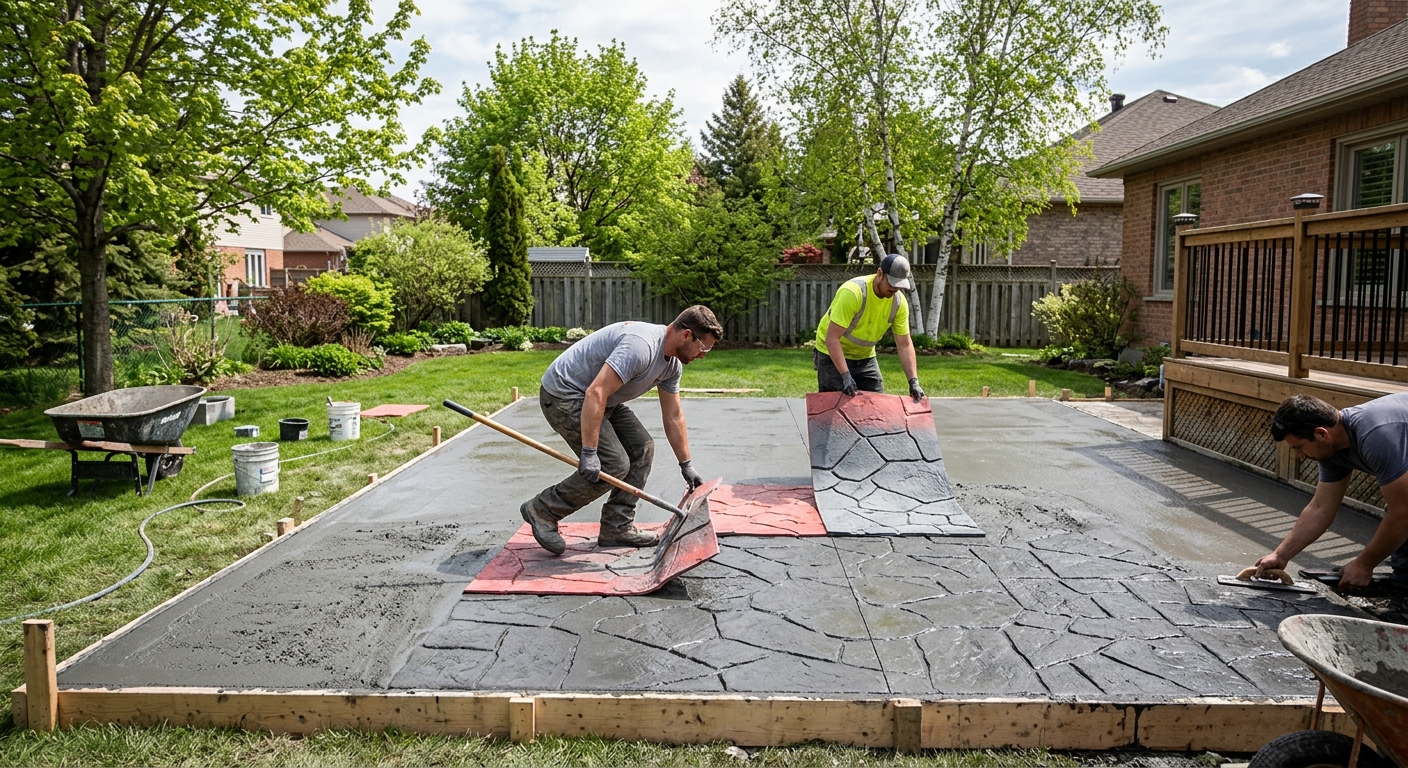
| Stamped concrete driveway or patio |
300–500 sq ft |
Air-entrained mix, release + stamping coordination |
Stamped pattern with color hardener/sealer |
$12,000–$20,000 |
| Plain concrete patio or walkway |
200–400 sq ft |
Exterior slab thickness + base prep |
Float + broom or light textured finish |
$3,000–$7,500 |
| Garage floor (interior slab) |
300–520 sq ft |
Vapour barrier (if required), mesh or fibres |
Light broom/steel-trowel depending on use |
$4,500–$9,500 |
| Foundation footings (structural, below frost) |
Per linear foot |
Excavate to frost level, reinforced footing concrete |
Engineered footing spec (typical) |
$220–$350 |
Prices are estimates only and vary by project scope, site access and material selection.
What affects the price of concrete work in Peachland
In Peachland and across the Thompson–Okanagan, it’s common to see quotes for the “same” concrete job swing by 30–50%. The biggest reason isn’t the concrete itself—it’s the spec required to survive the local climate and the real labour time needed to do proper base prep. Two crews can price a driveway the same way on paper (say, “400–600 sq ft”), but one may excavate deeper, use a properly compacted granular base, and specify air-entrained concrete and jointing for freeze–thaw. The other might cut corners and price closer to the lower end of the regional bands.
Frost line depth dictates footing depth and form height. In interior BC, exterior footings and foundations are designed to sit below the local design frost to prevent frost heave and cracking. In addition, all exterior slabs need air-entrainment so the concrete can expand slightly during freeze–thaw rather than spalling or scaling. Cold shoulder-season pours also add cost: crews may need curing blankets, protection, and sometimes slow/controlled hydration to hit the minimum strength targets. Finally, de-icing salt accelerates surface damage, so sealing becomes more important for long-term appearance and reduced scaling. That’s why even within BC, local interior pricing tends to sit above “generic” numbers.
In Peachland, a driveway replacement on a sloped lot can cost more because drainage improvements and thicker base layers are often needed to stabilize the subgrade. Conversely, a flat, easy-access backyard patio can come in closer to the plain patio band (often matching the $14–$24/sq ft style of regional expectations), while a stamped or exposed aggregate driveway can justify the higher spend because it uses extra materials and labour coordination for finishing. As a rough example, shifting from a broom-finish driveway into exposed aggregate can add material/time on the order of several thousand dollars—money that’s usually spent on durability-focused mix and curing as much as it is on the look.
| Price Factor |
Why It Matters |
Cost Impact |
| Frost line depth — determines footing depth and form height |
Footings must extend below design frost to limit heaving |
Can add significant excavation + concrete volume |
| Site preparation — excavation, grading, compacted granular base |
Proper base reduces settlement and keeps slab flat |
More base thickness/compaction increases labour and rock |
| Reinforcement — rebar or wire mesh requirement |
Controls cracking under loads and shrinkage |
Material + placement time; varies with engineered spec |
| Mix design — air-entrainment and compressive strength spec |
Freeze–thaw survival and durability in exterior exposure |
Higher-grade concrete and air testing/QA adds cost |
| Finish type — broom vs. stamped vs. exposed aggregate |
Finishing method affects labour hours and curing steps |
Stamped/exposed typically lifts price bands |
| Pour size and concrete truck access to site |
Access constraints affect forming time and pumping/scheduling |
Limited access can increase crew hours |
| Cold-weather curing precautions — heating and blankets |
Protects concrete from rapid cooling and strength loss |
Blankets/heaters raise costs in shoulder months |
| Control joint pattern and sealing cost |
Joints guide cracking; sealing helps resist salt scaling |
Added saw-cut + sealer improves long-term performance |
Permits & regulations in British Columbia
In British Columbia, structural concrete work typically requires a building permit and may involve engineered drawings that the municipality reviews before approval. That usually includes footings, foundation walls, grade beams, and any other load-bearing structural elements. For homeowners in Peachland, the key point is that “concrete” isn’t automatically permit-free—if the concrete is part of the structural system, you should expect permitting.
Concrete flatwork like patios, walkways, and driveways typically does not require a permit. However, permits can become relevant if your work affects lot grading, changes drainage patterns, increases impervious surface coverage beyond municipal limits, or alters the municipal right-of-way (for example, driveway approach work). When in doubt, confirm with the local authority before breaking ground.
Before work starts, verify the contractor carries liability insurance and has the proper coverage for workers. In BC, you should also ask for proof of coverage through their applicable workers’ compensation arrangements and request references for similar-scale projects. Then check the contractor’s credentials using public online resources for contractor licensing/registration, and match the certificate of insurance to the legal company name. A thorough contractor can also provide clearance documentation upon request and answer exactly what’s included in the scope (excavation, disposal, forming, sealing, curing protection).
Always verify these items in writing so there’s no mismatch between who you hire, who is insured, and what gets inspected.
Getting concrete right in Peachland's freeze-thaw climate
Concrete failure in Peachland is usually tied to freeze–thaw expansion, poor drainage, and insufficient surface protection. When water saturates the base and can’t drain properly, it freezes, expands, and pushes up the slab—leading to cracking, scaling, and spalling. The fix starts before the first truck arrives: (1) base preparation with a well-compacted granular sub-base to the depth required for your soil and local frost requirements; (2) a mix design with air-entrainment tailored for exterior exposure—typically targeting 5–7% air content for exterior flatwork—and a minimum 32 MPa compressive strength so the concrete reaches design performance; (3) control joints placed to manage cracking; (4) curing that protects concrete for at least 7 days under favourable conditions, with cold-weather protection like insulating blankets or controlled heating when temperatures drop; and (5) sealing, ideally with a penetrating sealer applied after full cure (commonly around 28 days) to help repel de-icing salt.
Here’s where homeowners often save money the wrong way: if a contractor doesn’t spec air-entrainment correctly, you can get early surface breakdown—especially in the Thompson–Okanagan where freeze–thaw cycles are frequent. A standard broom-finish patio might fall near the simpler patio band, but if it’s missing proper air entrainment and jointing, the repairs will cost far more than the original difference.
Example: moving from a plain broom patio toward stamped concrete typically increases cost because of stamping labour and materials, but it can still be justified if the contractor maintains the same durability-focused foundation: correct granular base, proper air-entrainment, disciplined curing, and an appropriate joint layout. The “look” matters—yet in Peachland, durability specs are what protect your investment.
| Spec | Why It Matters in Peachland |
What to Ask For |
Impact if Skipped |
| Compacted granular base (depth?) |
Reduces water under slab and resists frost-related movement |
Settlement, cracking, and faster freeze–thaw damage |
| Air-entrained concrete mix (target air %?) |
Helps concrete tolerate freeze–thaw without spalling |
Scaling/spalling, especially with de-icing salt use |
| Compressive strength (MPa rating) |
Ensures long-term strength and surface durability |
Lower performance and increased risk under traffic and weather stress |
| Control joints (spacing per ACI guidelines) |
Directs natural cracking to predictable locations |
Random cracks that are more visible and harder to manage |
| Minimum 7-day curing period |
Strength development is critical in cool or variable conditions |
Weaker slab, surface dusting, and long-term durability loss |
| Penetrating sealer (when applied after cure) |
Helps resist salt and water penetration during winters |
Faster staining, scaling, and surface degradation |
How to choose a concrete work contractor in Peachland
Choosing the right contractor in Peachland starts with verifying three things: credentials, insurance, and a scope you can understand. In British Columbia, confirm the contractor’s licence/registration status using the province’s public contractor resources (by name, not just a web storefront). Next, request a certificate of insurance showing liability coverage with the correct legal business name, and ask how they handle worker coverage (workers’ compensation). If a contractor can’t provide documentation promptly—or provides it only verbally—treat that as a red flag.
Then get 2–3 itemised written quotes. “Itemised” matters: you want a breakdown for excavation and granular base, forming, reinforcement, concrete supply, finishing, saw-cut joints, curing/protection, and sealing (where included). Ask whether a permit is required for your scope and whether they include permit pull support if it’s structural work. Also confirm whether disposal, haul-away, and any required site restoration are included.
Warranty should be specific: workmanship warranty length, what product/manufacturer warranty applies (if any), and whether it’s transferable if you sell the home. For payment, never pay the full amount up front—keep early deposits to around 10–15% and use progress payments tied to milestones. Hold back the remainder until punch-list items are complete. Finally, get a written start date and completion timeline, including the expected curing/protection period—because shoulder-season weather can extend schedules.
- Request proof of liability insurance with matching legal business name.
- Confirm worker coverage documentation (workers’ compensation) before scheduling.
- Ask for references from recent Peachland or Thompson–Okanagan projects with similar exposure.
- Get at least 2–3 itemised quotes (not a single lump-sum).
- Confirm frost-depth design approach for footings and adequate base for slabs.
- Require written details on air-entrainment and minimum strength targets.
- Ask who supplies reinforcement and how it’s placed (chairs/tie-wire for mesh or rebar).
- Clarify control joint layout and whether joints are cut/sawed at the right time.
- Confirm curing protection plan for cool nights (blankets/heaters if needed).
- Ask about sealing: product type and when it will be applied after cure (commonly around 28 days).
- Review exclusions: disposal/haul-away, drainage work, and any required permits.
- Set payment schedule and holdback tied to completion and punch-list.
Concrete red flags in Peachland: (1) no discussion of air-entrainment or curing protection, (2) vague “we’ll excavate what’s needed” without base depth details, (3) control joints mentioned casually without a layout plan, (4) large deposits or no clear holdback, and (5) rushing finishing or refusing to allow curing time—especially during cool shoulder-season weather.
Frequently asked questions — concrete work in Peachland
How long does a concrete driveway last?
In Peachland, a properly built concrete driveway commonly lasts 25–40 years, but the real-life range depends on how well it’s designed for Thompson–Okanagan freeze–thaw cycles. The biggest durability factor is whether the contractor used air-entrained exterior concrete and built on a compacted granular base with correct drainage and jointing. If de-icing salts are used, sealing after full cure (often around 28 days) helps reduce surface scaling. Concrete flatwork poured too shallow for frost risk or without adequate air can deteriorate much faster—visible scaling and spalling can show up in just a few winters. If you’re budgeting, broom-finish driveway options typically fall within the local band of about $18–$28 per sq ft equivalent project totals, while higher-detail options cost more but should still be built to the same frost and curing specs.
What is air-entrained concrete and why does it matter here?
Air-entrained concrete is formulated with microscopic air bubbles that give the freezing water somewhere to expand. In Peachland and the broader Thompson–Okanagan region, that’s critical because exterior slabs experience repeated freeze–thaw cycles. Without proper air content, water in the concrete paste and near-surface pores can freeze and expand in a way that breaks down the surface, leading to scaling and spalling. That’s why credible exterior flatwork quotes should explicitly reference air-entrainment and the expected air percentage range (typically 5–7% for exterior work), plus a minimum compressive strength (commonly 32 MPa for many residential specifications). The cheapest concrete on day one isn’t the cheapest after several winters—especially where homeowners use de-icing salts.
How do I prepare the base for a concrete slab?
Base preparation is where many concrete projects succeed or fail in British Columbia’s interior climate. For Peachland, the contractor should excavate to the required depth for frost considerations and soil conditions, then place a well-graded granular base in lifts. Each lift should be compacted properly so you don’t get settlement later. Drainage matters too—water should have a path to move away from the slab rather than sit under it. You should also confirm whether reinforcement is required (mesh or rebar) and how it will be supported (so it sits in the correct position within the slab thickness). If you’re comparing quotes, ask for base thickness details and how they’ll compact and verify it. The goal is a stable, uniform subgrade before any formwork goes up.
How do I compare concrete quotes?
When comparing quotes for Peachland concrete, don’t compare only the total price—compare the spec. Ask for an itemised breakdown: excavation, granular base depth and compaction, reinforcement, concrete supply (including air-entrainment and strength), forming, finishing method, joints, curing protection, and sealing (if included). Make sure you understand what’s excluded, such as disposal/haul-away and any drainage work. For typical options, look for consistency with local pricing bands: broom-finish driveway projects often land around the $18–$28 range per sq ft style expectations, while stamped/decorative jobs often run higher, commonly about $24–$38 per sq ft equivalent depending on complexity. A quote that’s significantly lower usually omits something—often air-entrainment, joint discipline, or curing/blanket protection in cool conditions.
Can concrete be poured in cold weather in Peachland?
Yes, concrete can be poured in Peachland during cold weather, but it has to be protected properly. The issue isn’t just the day’s temperature—it’s night cooling and how quickly the concrete loses heat. A reputable contractor will plan curing and protection: insulating blankets, controlled warming if needed, and careful scheduling so the slab doesn’t freeze before it gains strength. They should also follow a curing plan for shoulder-season variability common in the Thompson–Okanagan. Ask what temperature thresholds trigger extra protection and how long the curing protection stays on. A proper approach protects long-term strength and surface durability, which is especially important because freeze–thaw cycles will later test the slab. If a contractor suggests “pour it no matter what” without discussing curing protection, that’s a major concern.
How do I maintain concrete in Peachland's freeze-thaw climate?
Maintenance is mostly about reducing water intrusion and salt-driven wear. After the concrete cures (sealers are commonly applied around 28 days), use a penetrating sealer to help repel water and de-icing chemicals. Re-seal schedules depend on traffic and exposure, but keeping up with sealing in freeze–thaw seasons can reduce surface scaling. Sweep off grit and sand, and avoid overusing aggressive salt blends; if you must use de-icers, spread them in moderation. Inspect your driveway and walkways each spring for early signs of spalling, pop-outs, or widening cracks—small repairs are cheaper than full replacement. Also keep drainage pathways clear so water doesn’t pool at slab edges. In Peachland’s housing stock—where many homes are older (33.1% built before 1981)—upgrading drainage and sealing is often the difference between “serviceable” and “needs replacement.”