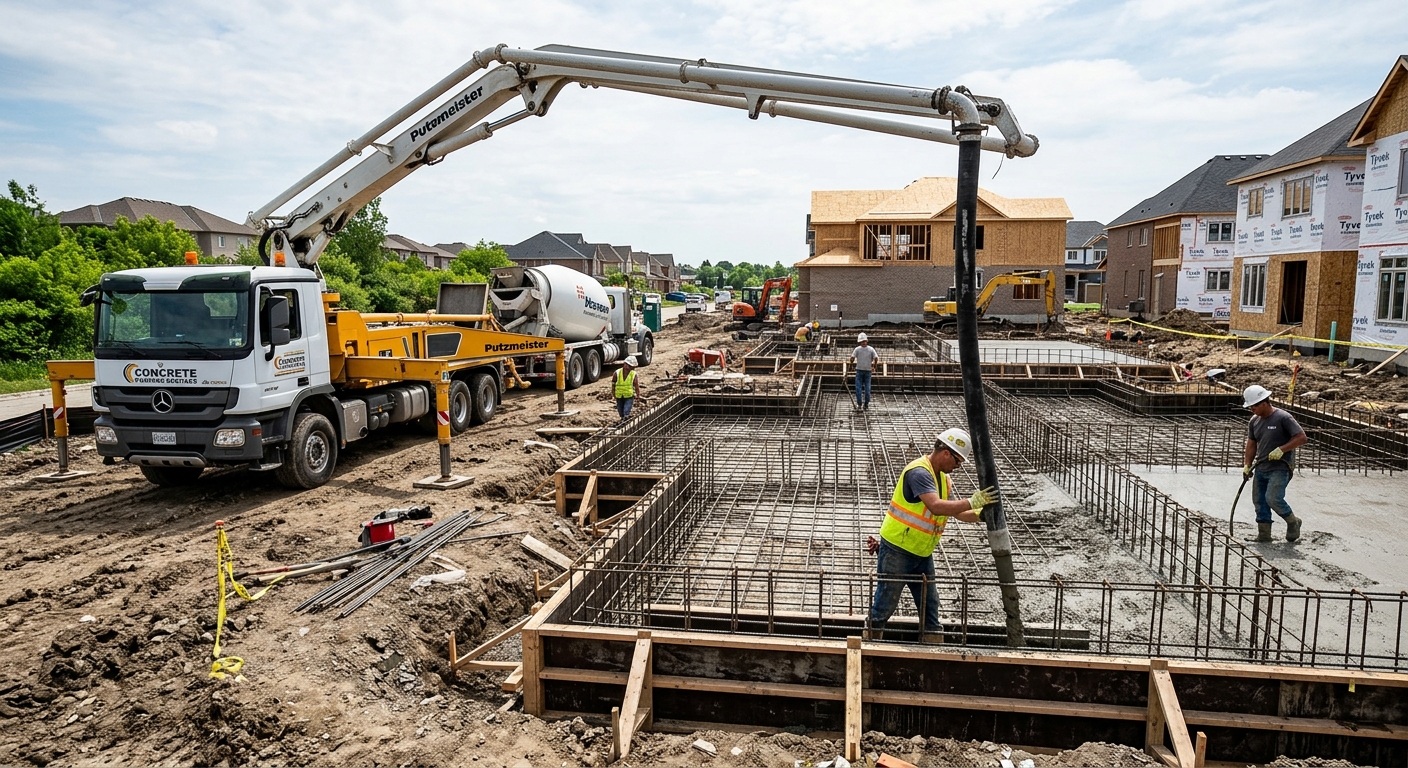
Concrete work options and costs in Kirkstone
Kirkstone has a smaller but steady base of homeowners who need durable concrete flatwork—especially driveways, patios, and steps—because the local soil and climate constantly test slabs. With a population of 1,185 in Kirkstone (Statistics Canada, 2021 Census), demand is concentrated among established residential streets, and most projects are tied to single-detached homes and cottage-style renovations that need solid, low-maintenance concrete. In the Lower Mainland–Southwest (including the Kirkstone area), mild winters and a shallow frost line still mean frost heave can happen during freeze–thaw swings, so footings and thickened edges must be set below the design frost depth (commonly around 450 mm / 18" in local practice). That requirement directly affects excavation, forming, and material volume. Coastal-wet weather also drives scheduling and curing costs: prolonged rain, cool nights, and high humidity can slow strength gain, so contractors often plan around weather windows and use curing blankets or sealers for exterior surfaces to protect against scaling and surface deterioration.
Labour availability is generally better than in colder parts of BC, but seasonal strain still shows up when trucks and finishing crews are booked for driveways and patios across the broader Vancouver–Surrey–Abbotsford corridor. If your property is near the denser residential pockets around downtown Kirkstone (where access and staging are tighter), you may see higher labour for logistics and careful traffic control. Use the cost ranges below as a planning starting point, then we’ll break down what moves the price up or down.
| Application |
Typical Size |
Key Spec |
Finish Option |
Price Range |
| Concrete driveway (standard broom finish) |
400–600 sq. ft. |
Air-entrained exterior mix; control joints; granular base |
Broom finish + sealer (optional) |
$18,000–$28,000 |
| Exposed aggregate driveway |
400–600 sq. ft. |
Air-entrained mix; proper curing to support surface durability |
Exposed aggregate finish |
$22,000–$34,000 |
| Stamped concrete driveway or patio |
300–500 sq. ft. |
Air-entrained mix; integral color; thickened edges as needed |
Stamped pattern + release + optional sealer |
$22,000–$36,000 |
| Plain concrete patio or walkway |
200–400 sq. ft. |
Air-entrained exterior mix; compacted base; jointing |
Smooth steel + light broom or trowel-sponge |
$16,000–$26,000 |
| Garage floor (interior slab) |
400–500 sq. ft. |
Vapour barrier (as applicable); fibre or mesh; proper sub-base |
Steel-trowel finish + curing compound (if specified) |
$14,000–$21,000 |
| Foundation footings (structural, below frost) |
Per linear foot allowance |
Structural concrete; excavation below design frost depth; reinforcement |
Typically formed/steel-reinforced |
$200–$350 |
Prices are estimates only and vary by project scope, site access and material selection.
What affects the price of concrete work in Kirkstone
In the Lower Mainland–Southwest, two quotes for what looks like the same concrete job can differ by 30–50% because the hidden items—excavation depth, drainage detailing, reinforcement, concrete mix requirements, and curing controls—change with site conditions and specs. Even though Kirkstone’s frost depth is often planned around a shallow design value (about 450 mm / 18" in local practice), the freeze–thaw cycles and saturated soils still demand reliable base preparation and air-entrained concrete. If your foundation or exterior slab is exposed and subject to wetting and drying, the contractor typically increases attention to subgrade drainage, uses air-entrained mixes, and adds proper control joint patterns to reduce cracking and scaling.
Colder regions of BC generally face deeper excavations and stricter cold-weather curing precautions, which raises costs; in Kirkstone, winters are milder, but you still get cool nights and wet spells that can stall curing. That’s why exterior projects often need longer curing windows and sometimes curing blankets—costs that show up in both labour scheduling and material handling. De-icing salts (common on driveways and entry paths) also accelerate surface spalling when the finish isn’t protected, so sealing becomes more than cosmetic.
Here’s how local conditions move the number: if your driveway needs thickerened edges below frost, expect the job to align with the concrete driveway / slab range of about $18,000–$28,000. If you choose stamped or more complex exposed finishes, labour time and finishing discipline push you toward the stamped & decorative range of $22,000–$36,000. For older housing stock in the Kirkstone area—where re-grading or tying into existing walks/curbs is common—mobilization and cut-out work can add thousands even when square footage stays similar. On rain-affected sites, crews may also have to pace the work differently to maintain proper curing conditions.
| Price Factor |
Why It Matters |
Cost Impact |
| Frost line depth — determines footing depth and form height |
Footings must extend below the design frost depth to prevent frost heave and cracking. |
Higher excavation and forming; can add thousands on footing-heavy scopes. |
| Site preparation — excavation, grading, compacted granular base |
Proper drainage and compaction control settlement and reduce freeze–thaw damage. |
Extra hauling, granular and labour if soil is wet, soft, or over-excavation is needed. |
| Reinforcement — rebar or wire mesh requirement |
Rebar improves crack control for structural and larger slabs. |
Materials + labour; cost increases with thicker slabs and heavier loading. |
| Mix design — air-entrainment and compressive strength spec |
Air entrainment helps concrete resist freeze–thaw scaling and spalling. |
Air-entrained exterior mixes and higher-spec mixes can raise per-cubic-yard material costs. |
| Finish type — broom vs. stamped vs. exposed aggregate |
Finish complexity affects labour time, curing discipline, and sealant requirements. |
Stamped and exposed finishes typically increase labour by more than plain broomwork. |
| Pour size and concrete truck access to site |
Truck distance, staging, and equipment needs affect labour and productivity. |
Tight access can add extra crew time and equipment rental. |
| Cold-weather curing precautions — heating and blankets |
Cool nights slow hydration and can weaken early-age performance. |
Heaters/blankets and more controlled scheduling can add direct costs. |
| Control joint pattern and sealing cost |
Jointing limits random cracking; sealing protects against salts and moisture ingress. |
Sealer and saw-cut schedule may add cost, but reduces long-term surface failures. |
Permits & regulations in British Columbia
In British Columbia, structural concrete work typically requires permits because it affects the building’s load path. That means footings, foundation walls, grade beams, and other structural concrete elements generally need a building permit, and engineered drawings are commonly reviewed before construction begins. For concrete flatwork—driveways, patios, sidewalks, and walkways—a permit is often not required by default, unless the work changes lot grading, impacts stormwater management, increases impervious surface beyond municipal thresholds, or affects municipal right-of-way.
For Kirkstone homeowners, the safest approach is to confirm the specific scope with your local authority before breaking ground—especially if you’re replacing existing concrete with a thicker slab, changing drainage, lowering/raising a driveway approach, or tying into foundations. Also verify contractor readiness: ask for a current certificate of insurance (liability), and ensure they have WSIB/WCB coverage where applicable for the workers on your site.
How to verify a contractor in BC (step-by-step): (1) Ask for their proof of liability insurance—confirm the certificate is current and lists coverage for the specific project address. (2) Request confirmation of WSIB/WCB account coverage for their workers. (3) Ask for references on similar-scale concrete jobs in the Lower Mainland–Southwest area. (4) Look up licensing/credentials through the relevant BC online registry before scheduling any formwork or excavation. If anything doesn’t match your scope—no engineered sign-off for structural work, no insurance, no coverage proof—assume it’s a red flag and ask for corrections before you sign.
Getting concrete right in Kirkstone's freeze-thaw climate
Concrete failure in Kirkstone’s Lower Mainland–Southwest conditions is usually tied to moisture movement and freeze–thaw damage, not just the slab’s age. If the base isn’t compacted correctly or drainage is poor, water sits under the slab. When temperatures swing, freeze–thaw cycles can trigger surface scaling, curling, and cracking—especially where de-icing salts splash on driveways and entry paths. The cure is to spec the job like a durability project: compacted granular base to suit local soil and frost conditions, air-entrained exterior concrete, correctly spaced control joints, and enough curing time for strength development.
Spec the mix: for exterior flatwork, air-entrainment is typically targeted around 5–7% air for freeze–thaw resistance, with a minimum 32 MPa compressive strength. Spec the jointing: control joints are your best defence against random cracking—too wide or too infrequent, and cracks will choose their own locations. Spec the cure: plan for at least 7 days of proper curing conditions, and use curing blankets when nights are cool or rain is persistent.
Spec the finish protection: apply a penetrating sealer after the slab has fully cured—commonly around 28 days post-pour—so moisture and salts don’t keep feeding the surface.
To put cost into perspective: if a plain broom-finish driveway is in the $18,000–$28,000 band, spending toward stamped work in the $22,000–$36,000 band can be justified when you want a decorative pattern that also hides minor colour variation. But the best “value” is durable specs—air entrainment and jointing—because skipping those drives premature scaling and expensive replacement.
| Spec |
Why It Matters in Kirkstone |
What to Ask For |
Impact if Skipped |
| Compacted granular base (depth?) |
Establishes drainage and stiffness to resist settlement and freeze–thaw heave. |
Confirm base thickness and compacted depth to suit soil condition; ask how they handle wet subgrade. |
Uneven support leads to cracking, pumping, and faster deterioration. |
| Air-entrained concrete mix (target air %?) |
Air bubbles relieve internal pressure during freeze–thaw cycles. |
Ask for exterior air-entrainment target (typically 5–7%) and proof of mix design. |
Higher risk of spalling and surface scaling in British Columbia winters. |
| Compressive strength (MPa rating) |
Determines early and long-term durability and resistance to wear. |
Ask for minimum 32 MPa spec and how cold weather is managed for strength gain. |
Lower durability increases cracking and wear around traffic zones. |
| Control joints (spacing per ACI guidelines) |
Controls where cracks happen during shrinkage and temperature change. |
Ask for joint spacing and layout plan for your driveway/patio dimensions. |
Random cracking and appearance issues that reduce service life. |
| Minimum 7-day curing period |
Cold nights and rain can slow hydration in the Lower Mainland–Southwest climate. |
Confirm curing method and schedule; ask about blankets/heaters when needed. |
Weak early-age concrete leads to surface dusting and long-term strength loss. |
| Penetrating sealer (when applied after cure) |
Repels moisture and reduces salt-driven surface damage. |
Ask when the sealer is applied (commonly ~28 days) and what product is used. |
Faster scaling around edges and high-traffic/salt exposure areas. |
How to choose a concrete work contractor in Kirkstone
Choosing the right concrete contractor in Kirkstone is mostly about verifying three things: (1) they’re properly set up to do concrete in British Columbia, (2) they can deliver the durability specs your climate needs, and (3) their quote matches your scope with no surprises. Start by verifying licensing/credentials through the appropriate BC online registry, then request and confirm a certificate of liability insurance that names your address and is current. Next, ask for WSIB/WCB coverage proof for their workers (or their applicable coverage approach) before excavation and forming begin. If they can’t provide clear documentation, pause the decision—insurance gaps are one of the fastest ways homeowners get stuck with risk.
Get 2–3 itemised written quotes that break out labour and materials, not just a lump sum. Make sure the quote lists what’s included: excavation and disposal, granular base thickness, reinforcement type, concrete mix specification (including air entrainment for exterior), jointing plan, finish, and whether sealing is included and when it’s applied. Confirm whether a permit is part of the package if your scope touches structural concrete or grading impacts. Read exclusions closely—missing “site prep” line items are a common cause of budget blowouts.
Warranty matters: ask for the workmanship warranty length, whether it covers joints/finishes, and whether any product/manufacturer warranty applies to sealers or admixtures. On payment, never pay more than 10–15% upfront; use a holdback until cleanup and final inspection are complete. Also request a written start date and completion estimate, because prolonged rain in the Lower Mainland can shift schedules.
- Documentation: current liability insurance certificate and confirmed WSIB/WCB coverage.
- Clear mix spec for exterior work (air-entrained) and minimum strength requirement.
- Base prep included with granular type, thickness, and compaction approach.
- Joint layout plan (spacing and cutting/saw timing) included in the scope.
- Curing method stated (blankets/heaters if cold nights occur).
- Protection plan for rain and traffic during early curing period.
- Reinforcement type listed (mesh vs rebar, thickness allowances).
- Sealer included or clearly excluded, with application timing (after cure).
- Disposal/hauling of excess soil and concrete washout included or specified.
- Truck access plan and pour-day logistics included (who provides equipment).
- Warranty details in writing and what voids coverage.
- Payment schedule with holdback until final grade, cleanup, and touch-ups.
Concrete red flags in the Kirkstone area: crews that won’t discuss air-entrainment for exterior slabs, quotes that omit control joints or curing time, contractors who ask for large upfront payments, vague “we’ll do whatever it takes” wording with no line items for base prep, and no proof of insurance/coverage. If you see any of those, treat it as a risk to your slab’s long-term durability in freeze–thaw weather.
Frequently asked questions — concrete work in Kirkstone
When is the best time to pour concrete in Kirkstone?
In Kirkstone and across British Columbia’s Lower Mainland–Southwest, the best results usually come from late spring through early fall—when you’re less likely to get persistent cool nights and long rain periods. The challenge isn’t that it never gets cold; it’s that freeze–thaw cycles plus saturation can stress early-age concrete. Contractors plan around weather windows because curing needs reliable conditions to reach the required strength. Even in “mild winter” periods, you may need curing blankets or controlled measures, which can add cost and scheduling time. For budgeting, seasonal timing is one reason exterior flatwork may land toward the higher end of the patio/walkway band ($16,000–$26,000) if rain forces extra protection.
How long does concrete take to cure?
Concrete cures in stages. You’ll see surface set relatively quickly, but the durability you care about depends on reaching design strength during proper curing. For exterior projects in Kirkstone, plan for at least 7 days of proper curing conditions before heavy stress, traffic, or more aggressive exposure. Full strength development and best sealer readiness typically align around 28 days. That timing matters because the freeze–thaw environment in the Lower Mainland–Southwest can continue stressing the slab if the surface hasn’t matured—especially if de-icing salts are used. If you want a penetrating sealer, most contractors apply it after the slab has cured sufficiently (often around 28 days) to improve water and salt resistance.
Do I need a permit for concrete work in British Columbia?
In British Columbia, structural concrete work generally requires a building permit—this includes footings, foundation walls, and grade beams—because it affects the building’s structural system. Concrete flatwork such as patios, walkways, and most driveways typically doesn’t require a permit unless it changes lot grading, impacts impervious surface coverage limits, or affects drainage/right-of-way considerations. In Kirkstone, confirm with the local authority before you dig if you’re changing drainage patterns, lowering/raising approaches, or modifying anything near foundation tie-ins. A good contractor should help you determine whether your specific scope is “structural” or “flatwork,” and they should be willing to coordinate documentation. Always request proof of liability insurance and appropriate worker coverage before starting excavation.
Concrete vs pavers for a patio in Kirkstone?
For a patio in Kirkstone’s coastal-wet, freeze–thaw environment, concrete often wins on long-term durability and predictable maintenance—especially when it’s air-entrained and jointed correctly. Pavers can look great, but they’re more sensitive to base settlement and drainage; if water moves under pavers and freezes, you can get uneven surfaces over time. Concrete patios are also typically faster to install for larger areas, and you can control the finish (broom-smooth, stamped patterns, or exposed textures). In the Kirkstone area, a plain concrete patio or walkway typically aligns with the $16,000–$26,000 band for common project sizes, while decorative stamped work generally sits higher within the $22,000–$36,000 range due to labour and finishing time. The best choice depends on your budget and whether you want the “one continuous surface” durability concrete provides.
How long does a concrete driveway last?
A well-built concrete driveway in British Columbia can last decades, but “it depends” is real—mainly on base preparation, air-entrainment, control joints, curing, and surface protection. In Kirkstone’s Lower Mainland–Southwest climate, freeze–thaw cycles and moisture are the big drivers of deterioration, particularly if the slab was poured without proper air entrainment or if drainage was overlooked. If you add a penetrating sealer after cure (often around 28 days) and maintain joints, many driveways perform very well. Budget-wise, you’ll usually see standard broom-finished driveways in the $18,000–$28,000 band, with decorative options costing more. Spending on the durability specs (base compaction, drainage attention, air-entrained mix, correct jointing) is usually the difference between “good appearance for years” and “replacement sooner than expected.”
What is air-entrained concrete and why does it matter here?
Air-entrained concrete includes tiny, intentionally created air bubbles that help the hardened paste handle freeze–thaw stress. In Kirkstone and across British Columbia’s Lower Mainland–Southwest, exterior slabs are exposed to wetting and cooling, and freeze–thaw cycles can cause scaling and spalling if the mix isn’t designed for it. Air entrainment is one of the most important specs for exterior work because it reduces damage from expanding ice in the concrete pores. That’s why reputable contractors insist on an air-entrained mix for driveways, patios, and walkways. If you’re comparing quotes for a driveway in the $18,000–$28,000 range, ask each bidder to state the mix design and exterior air content target. The cheapest quote that skips this is often the most expensive over time in a coastal-wet climate.