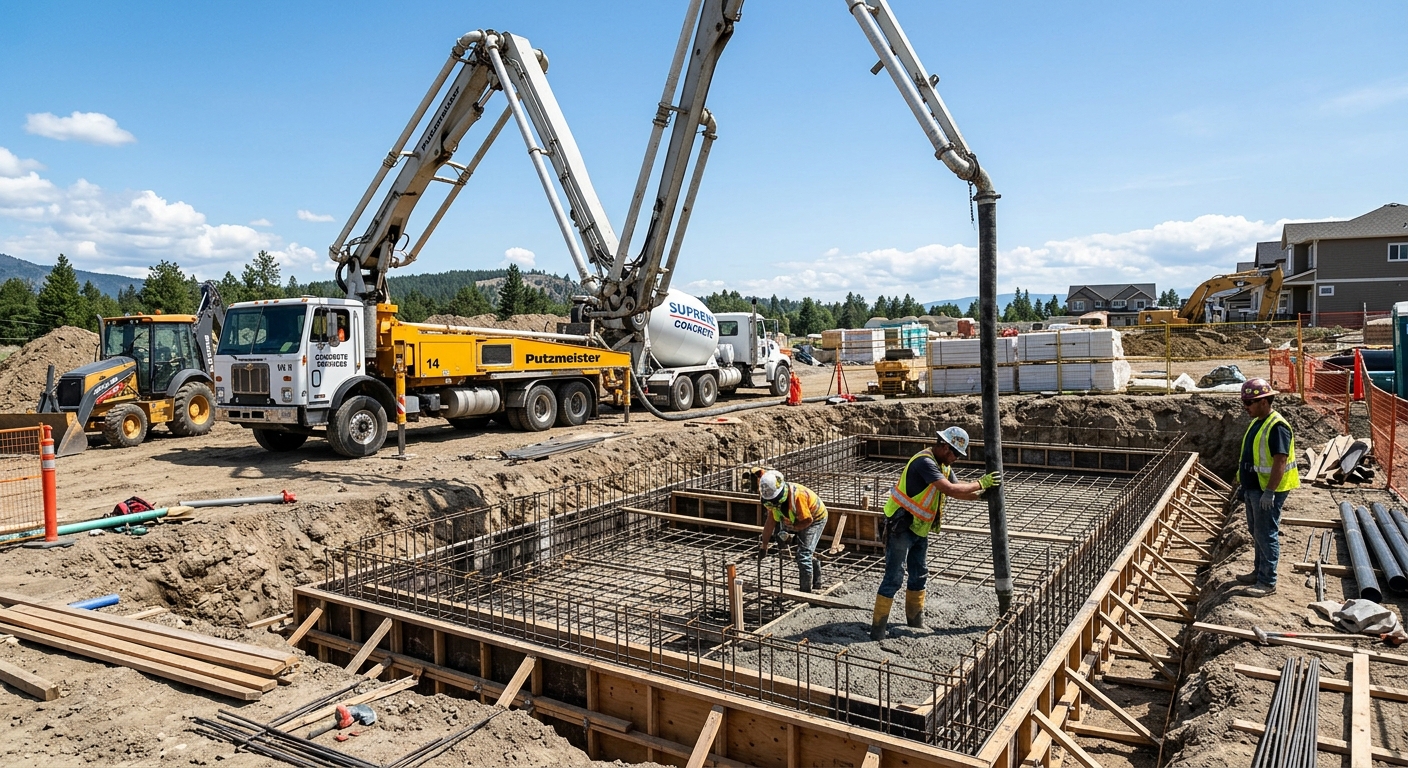
Concrete work options and costs in Tumbler Ridge
Tumbler Ridge homeowners typically choose concrete for driveways, patios and walkways because it holds up well against the Northeast BC freeze–thaw grind. In a town of 2,399 people (Statistics Canada, 2021 Census), the housing stock leans strongly single-detached—about 69.4% of dwellings—so flatwork demand stays steady, especially around private drive accesses and front entries. With 750 homeowner households (68.5% of households own) (Statistics Canada, 2021 Census), many projects are mid-life upgrades or replacement pours rather than brand-new builds.
In the Northeast market, pricing is shaped by deep frost penetration and frequent temperature swings. That means exterior concrete often needs deeper excavation and a properly compacted granular base, plus air-entrained mix designs to resist freeze–thaw damage. The short pour season also compresses schedules, and concrete crews may apply winter protection (curing blankets, insulation or controlled set approaches) to hit strength targets before early cold weather. On top of that, de-icing salt is common in January and February, so finishing quality and sealing choices directly affect how long slabs stay smooth and chip-resistant.
Where you’ll notice the trade the most is the Greater Tumbler Ridge area around the central residential blocks and the local highway-access entries where driveways see heavy ploughing and vehicle turning. If you’re comparing options, start with the size and finish you want—then use the table below to benchmark a realistic budget before you book site measurements.
| Application |
Typical Size |
Key Spec |
Finish Option |
Price Range |
| Concrete driveway (standard broom finish) |
400–600 sq ft |
Air-entrained exterior mix; compacted granular base; control joints |
Broom finish + basic edge forms |
$18,000–$28,000 |
| Exposed aggregate driveway |
400–600 sq ft |
Air-entrained mix; consistent aggregate exposure; proper curing window |
Exposed aggregate (bush-hammered or retarder wash depending on system) |
$22,000–$34,000 |
| Stamped concrete driveway or patio |
250–500 sq ft |
Air-entrained exterior mix; release agent; color hardener (as applicable) |
Stamped pattern + color finish |
$15,000–$30,000 |
| Plain concrete patio or walkway |
200–350 sq ft |
Air-entrained exterior mix; compacted sub-base; slope to drainage |
Broom or light trowel finish |
$4,000–$9,000 |
| Garage floor (interior slab) |
400–700 sq ft |
6–5 in. slab typical; vapour barrier recommended; proper base compaction |
Steel-trowelled or broom (depending on use) |
$9,000–$18,000 |
| Foundation footings (structural, below frost) |
Per project (often 1,000–1,800 sq ft house footprint) |
Excavation below design frost depth; reinforced footings; forms and backfill |
Structural concrete (no decorative finish) |
$55,000–$90,000 |
Prices are estimates only and vary by project scope, site access and material selection.
What affects the price of concrete work in Tumbler Ridge
In Tumbler Ridge and the Northeast region, the same concrete scope can come in 30–50% apart across Northeast BC simply because frost depth, soil conditions, access constraints, and the need for cold-weather protection all change the build plan. A driveway quote isn’t just “pour and finish”—it’s excavation depth, granular base prep, reinforcement decisions, mix design, and curing control. When those variables shift, labour hours and equipment time shift with them, and the mix itself becomes more specialized (air content, strength targets, and set control).
Here’s the big drivers. Frost line depth and freeze–thaw cycles dictate every exterior spec: footings must extend below the design frost depth to prevent frost heave and slab cracking. Cold regions also rely on air-entrained concrete mixes to survive repeated freezing and thawing, and when the schedule slips into cooler shoulder periods, you may need heating, insulated curing blankets, or admixtures to protect strength gain. Lastly, de-icing salt accelerates surface wear and can cause spalling if the concrete isn’t properly air-entrained and cured—so sealing and finishing details matter.
Two quick examples from the Tumbler Ridge market: (1) A driveway on frost-susceptible or poorly draining soil often needs more excavation and thicker granular base, pushing the budget toward the upper end of the concrete driveway band (for instance, closer to $18,000–$28,000 rather than the lower figure). (2) If you add a decorative finish, the work changes—materials like color hardener and extra finishing labour can move you toward the stamped & decorative concrete band ($25,000–$40,000 for the decorative scope), but you’re paying for pattern layout time and surface curing discipline rather than “just aesthetics.” In older homes built before 1981 (18.3% of homes) (Statistics Canada, 2021 Census), repours often include additional subgrade correction, which can add a noticeable line-item.
| Price Factor |
Why It Matters |
Cost Impact |
| Frost line depth — determines footing depth and form height |
Deeper excavation increases time, backfill volume, and labour. |
Can be the largest variable on foundation and new slabs. |
| Site preparation — excavation, grading, compacted granular base |
Sub-base thickness and compaction control settlement and cracking. |
More trucking, more machine time, higher totals. |
| Reinforcement — rebar or wire mesh requirement |
Rebar/wire supports crack control for thicker slabs and footings. |
Extra materials + placing labour. |
| Mix design — air-entrainment and compressive strength spec |
Air content and strength help exterior durability in freeze–thaw. |
Higher material cost and sometimes longer curing protection. |
| Finish type — broom vs. stamped vs. exposed aggregate |
Decorative systems require more steps and careful timing. |
Typically increases labour and finishing materials. |
| Pour size and concrete truck access to site |
Narrow access can require smaller loads, pumps, or more handling. |
Truck fees, pumping, and extra crew time. |
| Cold-weather curing precautions — heating and blankets |
Protecting early strength prevents freeze damage. |
Adds labour for setup and material for insulation/blankets. |
| Control joint pattern and sealing cost |
Joints manage shrinkage; sealing protects from salt and moisture. |
Small per-unit cost, but missed details reduce lifespan. |
Permits & regulations in British Columbia
In British Columbia, structural concrete work—things like footings, foundation walls, and grade beams—typically requires a building permit, and engineered drawings are often reviewed before the foundation stage proceeds. For concrete flatwork (driveways, patios, and walkways), permits are usually not required unless the project affects lot grading, impervious surface coverage limits, or municipal right-of-way considerations. Even when a permit isn’t usually required, it’s smart to confirm with the local authority before you break ground.
For your Tumbler Ridge project, a practical way to verify a contractor is to check three items in this order:
- Licensing/registration (BC): Use the relevant online registry search for their business name to confirm the contractor is properly registered for the work scope.
- Liability insurance: Ask for a current certificate of insurance that matches your project address and includes adequate general liability limits.
- WSIB/WCB coverage: Request proof of coverage for workers (or the equivalent clearance letter if they operate under a coverage structure that provides clearance). This protects you if there’s an on-site injury.
Then, ask for references on comparable Northeast BC pours—especially exterior work where freeze–thaw durability is critical. Step-by-step, that verification process helps ensure the quote you’re comparing is built by a contractor who can actually do the job safely and to spec.
Getting concrete right in Tumbler Ridge's freeze-thaw climate
Concrete failures in Tumbler Ridge usually come down to the combination of moisture, salt, and repeated freeze–thaw. If the base isn’t properly prepared, if the mix lacks the right air-entrainment, or if curing is interrupted by early cold, you can end up with scaling, spalling, and random cracking. To get the job specified correctly, you want to control four things: (1) base preparation—use a compacted granular sub-base to the correct thickness and depth for the site’s frost-susceptible soils; (2) mix design—air-entrainment at about 5–7% air content for exterior flatwork and a minimum 32 MPa compressive strength; (3) control joints—tight, planned joint spacing so cracks form where you want them; and (4) curing—protect for strength gain, especially when nights are getting colder.
Sealing is also important. For exterior driveways and patios, use a penetrating sealer applied about 28 days post-pour after the concrete has fully cured, so de-icing salts and water stay out of the surface pores.
If you’re comparing finishes, the cost difference can be justified. For example, a stamped driveway or patio typically costs more than plain broom-finish work because it requires additional colour and forming steps (often closer to the stamped & decorative band, while broom-finish driveway work generally fits the driveway band). That said, spending on “looks” doesn’t help if air content, curing protection, and drainage aren’t right—those specs are what make the finish last through Northeast BC winters.
| Spec |
Why It Matters in Tumbler Ridge |
What to Ask For |
Impact if Skipped |
| Compacted granular base (depth?) |
Controls settlement and reduces freeze-related movement. |
Base depth, compaction method, and frost-susceptible soil handling plan. |
More cracking and uneven surfaces within a few winters. |
| Air-entrained concrete mix (target air %?) |
Allows freeze–thaw stress relief in exterior exposure. |
Air content target (about 5–7% for exterior flatwork) and mix confirmation. |
Scaling and spalling (surface “popping” under salt). |
| Compressive strength (MPa rating) |
Strength gain helps resist early winter damage. |
Minimum 32 MPa rating and curing protection plan if temperatures drop. |
Weak concrete that can fail before it ever “catches up.” |
| Control joints (spacing per ACI guidelines) |
Directs shrinkage cracking away from random locations. |
Joint spacing, saw-cut timing, and sealing plan for joints. |
Random cracks that allow moisture into the slab. |
| Minimum 7-day curing period |
Short curing increases the chance of freeze damage. |
What curing method will be used and how the slab is protected. |
Reduced durability and surface weakness in winter. |
| Penetrating sealer (when applied after cure) |
Repels de-icing water and reduces salt-driven deterioration. |
Sealer type and timing (around 28 days after pour). |
Faster erosion and increased risk of spalling. |
How to choose a concrete work contractor in Tumbler Ridge
Choosing the right contractor matters more in Tumbler Ridge than most places because freeze–thaw exposure punishes shortcuts. Start by confirming they’re properly covered for BC work: verify their BC registration/licensing for the type of concrete work they’re proposing, then request a certificate of insurance showing liability coverage that matches your project scope. Finally, ask for proof of WSIB/WCB coverage (or an appropriate clearance letter), and make sure the coverage is current.
Next, demand 2–3 itemised written quotes. You want a labour/materials breakdown rather than a single lump sum—especially for excavation, base prep, reinforcement, concrete supply, finishing steps, and curing/sealing. Review the scope carefully: what is included for disposal, do they handle removal and hauling, is permit pulling included (if needed for structural work), and who supplies rebar, chairs, vapour barrier (for slabs), and joint sealant?
For quality, ask about warranty terms. Get the workmanship warranty length, whether product warranties apply, and whether any manufacturer warranty is transferable if you sell the home. Also, agree on a sensible payment schedule: never pay more than about 10–15% upfront, and use a holdback until the work is fully complete and inspected. In a short pour season, timeline matters too—ask for a written start date and completion estimate, including curing and protection time.
- Ask for their planned frost-related base and joint plan for your site.
- Confirm air-entrained mix spec and minimum compressive strength in writing.
- Require itemized pricing for excavation, base, reinforcement and finishing.
- Clarify concrete truck access plan (direct dump vs. pump vs. other method).
- Ask when saw-cut control joints will be installed and what spacing they use.
- Request their cold-weather curing approach (blankets/heating if needed).
- Confirm whether sealing is included and the intended timing (after cure).
- Verify liability insurance limits and match certificate to your address.
- Get WSIB/WCB clearance/proof for all workers on site.
- Check warranty coverage and what constitutes a “defect” vs normal shrinkage.
- Ensure they list exclusions (old slab removal, grading changes, disposal fees).
- Look for clear start/finish dates that include curing/protection time.
Concrete red flags I commonly see in the Tumbler Ridge area include: refusing to put the air-entrainment and joint/cure schedule in writing, pricing only the “pour” without detailed base prep, missing or vague responsibility for hauling/disposal, and crews starting late fall without a documented curing plan—because that’s when freeze damage shows up quickly.
Frequently asked questions — concrete work in Tumbler Ridge
What is a concrete overlay and is it suited to Tumbler Ridge?
A concrete overlay is a resurfacing layer applied over an existing concrete surface to restore appearance and extend service life—often used when the slab is still structurally sound but the surface is worn or uneven. In Tumbler Ridge, overlays can work, but only if moisture issues are addressed and the underlying slab isn’t actively failing (for example, heavy spalling, widespread settlement, or through-cracks). Freeze–thaw and de-icing salt are unforgiving; if water is trapped under an overlay, the deterioration can continue underneath. In terms of budgeting, overlay work is commonly priced differently than full replacement, but if you’re comparing to new plain patio/walkway work, replacement may be closer to the $15,000–$25,000 range for decorative options—while overlays can be less than full replacement for smaller areas. The key is an inspection and prep plan, including surface profiling, crack treatment, and drainage.
How do I seal concrete to protect it in Tumbler Ridge?
For Tumbler Ridge winters, sealing is best used as a moisture and salt barrier rather than a cosmetic step. The usual approach is to let the concrete cure fully—often about 28 days—then apply a penetrating sealer designed for exterior use. Penetrating sealers work by reducing water and salt absorption into the surface pores, which helps slow scaling and spalling when freeze–thaw cycles repeat. Timing matters: if you seal too early, you can trap moisture and reduce performance. Also, sealing isn’t a substitute for correct air-entrainment, proper curing, and well-installed control joints. If your driveway is already older, ask contractors about surface cleaning, stain removal, and whether there are active cracks that should be sealed first.
What is the difference between concrete and cement?
Concrete is the final material you see and walk on. Cement is one component inside concrete. In simple terms, cement is the binder that reacts with water to help the mix harden; concrete combines cement with aggregates (sand and stone), water, and often admixtures—such as air-entrainment for exterior durability. In Northeast BC conditions like Tumbler Ridge, the difference is important because you’re not just buying “cement”—you’re paying for a properly designed concrete mix with the right air content and strength. That’s why a sealed, well-finished exterior slab depends on the mix spec (including air-entrainment) and curing, not on appearances alone.
How much does concrete work cost in Tumbler Ridge?
Concrete costs in Tumbler Ridge generally land higher than milder parts of BC due to deeper frost-related excavation, stronger freeze–thaw durability specs, and seasonal scheduling. As a practical benchmark, standard concrete driveway work often fits the driveway band around $18,000–$28,000 depending on size, base prep, and access. Decorative finishes run higher; stamped concrete driveway or patio projects frequently trend into the stamped & decorative band of roughly $25,000–$40,000 when patterning, colour work, and extra finishing steps are included. Foundation footings are typically priced separately and can fall in the $55,000–$90,000 range depending on excavation below frost and reinforcement needs. The best way to pin this down is an itemised quote that shows excavation, base thickness, rebar/wire, mix spec, finishing, and curing/protection.
How deep must footings be for Tumbler Ridge's frost line?
Footing depth is determined by the design frost depth for the specific site and building design, not by a one-size number. In Northeast BC, frost penetration can be significant, and footings must extend below the design frost depth to reduce the risk of frost heave and cracking. A contractor should confirm the required depth using engineering drawings or code-based frost depth requirements for your area, then plan excavation accordingly. In practice, that often means deeper excavation than in milder regions, which drives cost because it increases equipment time, backfill volume, and granular prep. For your quote, ask for the specified footing depth “below grade” and confirm that they’re planning drainage and backfill compaction, not just pouring concrete at shallow levels.
Why does concrete crack in Tumbler Ridge and how is it prevented?
Concrete cracks in Tumbler Ridge mainly due to shrinkage and movement during freeze–thaw cycles, plus moisture expansion. Even properly mixed slabs will crack naturally as they cure, but the goal is to control where those cracks form. Prevention starts with a well-compacted granular base, correct exterior air-entrainment (about 5–7% for exterior flatwork), and timely installation of control joints. Joint spacing and saw-cut timing are critical—joints should be installed so shrinkage cracks follow the planned lines instead of splitting randomly. Curing protection in cold weather is also key; freezing early can weaken the slab and increase cracking and scaling risk. Finally, sealing and managing drainage helps limit water entry into cracks, which otherwise accelerates deterioration over repeated Northeast winters.