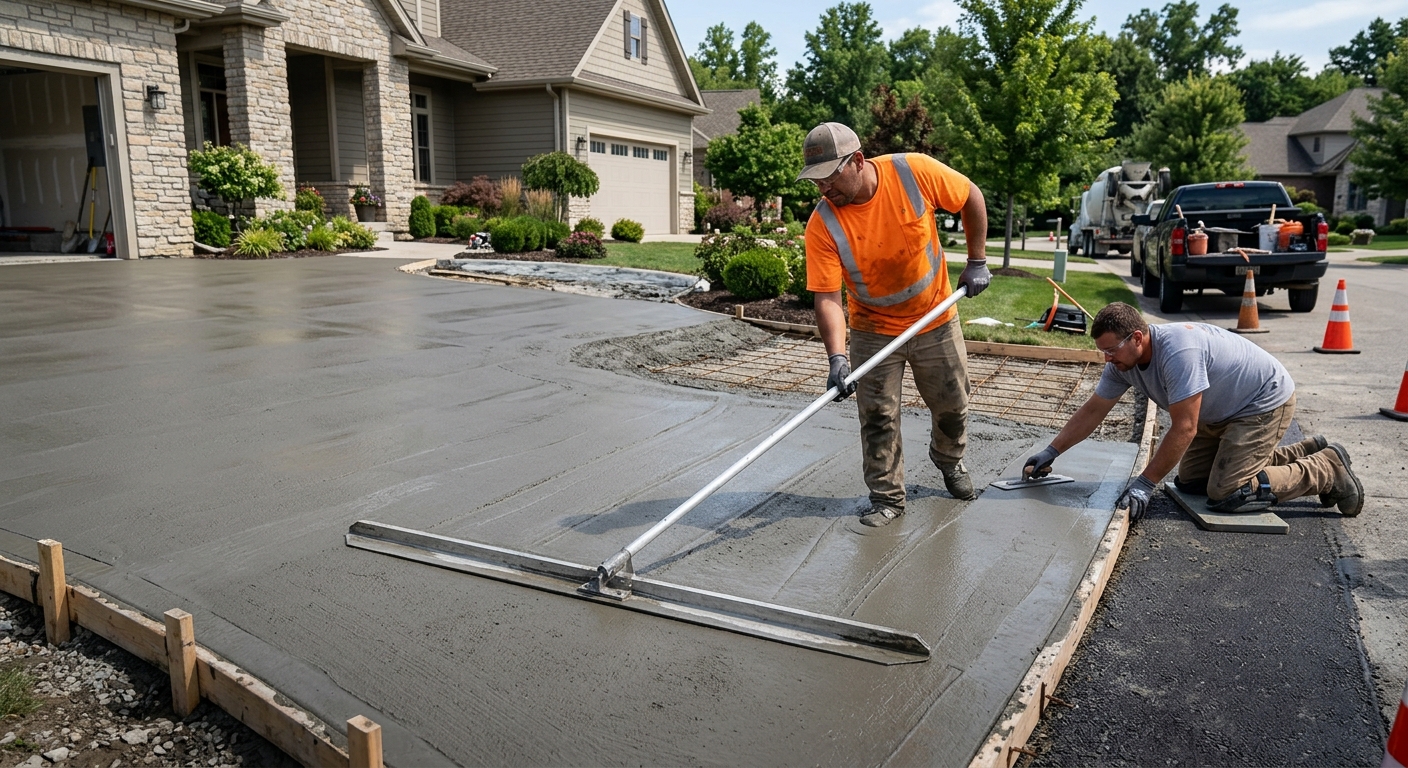
Concrete work options and costs in Indian River
In Indian River, concrete is a practical choice for driveways, patios, walkways and foundation elements because the Lower Mainland–Southwest market has learned to build for a shallow but still damaging frost environment. Indian River’s population is 3,684 (Statistics Canada, 2021 Census), and the area’s housing mix tends to favour single-detached and cottage-style properties that rely on durable exterior flatwork. In this corridor, contractor demand is especially strong in the neighbourhoods off the main connectors and rural lots where properties periodically upgrade driveways, add garage slabs, or replace ageing porch landings.
Pricing in Indian River is shaped by climate and scheduling. Even with mild winters compared to the interior, we still design around freeze–thaw cycles, saturated soils after heavy coastal rainfall, and a common practice target of roughly 450 mm / 18" design frost depth. That means footings, thickened edges and some slab details are placed below the frost line, and exterior slabs typically use air-entrained mixes plus proper drainage and control joints. Because wet weather can interrupt prep and curing, crews plan longer curing windows and use blankets, sealers, and longer set-up time to reach design strength—so “same size” projects can land in different price bands depending on access, base thickness and finish.
Below is a practical comparison of typical options to help you budget before you request itemised quotes.
| Application |
Typical Size |
Key Spec |
Finish Option |
Price Range |
| Concrete driveway (standard broom finish) |
400–600 sq. ft. |
Compacted granular base + air-entrained mix for exterior exposure |
Broom finish |
$10,000–$16,500 |
| Exposed aggregate driveway |
400–600 sq. ft. |
Proper base, drainage, and finishing window to expose stone evenly |
Exposed aggregate |
$12,000–$20,000 |
| Stamped concrete driveway or patio |
300–500 sq. ft. |
Air-entrained exterior mix + colour hardeners/colour release as specified |
Stamped + coloured |
$9,500–$18,000 |
| Plain concrete patio or walkway |
200–400 sq. ft. |
Graded base with compacted granular and control joints |
Float + broom/brush finish |
$3,500–$10,500 |
| Garage floor (interior slab) |
500–650 sq. ft. |
Vapour barrier (if required), reinforcing/welded mesh per design |
Steel-trowel or light broom |
$9,000–$17,000 |
| Foundation footings (structural, below frost) |
Typical 1–2 storey footing run length |
Excavation to frost depth + rebar cage + formwork + engineered dimensions |
Structural concrete |
$6,000–$12,000 |
Prices are estimates only and vary by project scope, site access and material selection.
What affects the price of concrete work in Indian River
In the Lower Mainland–Southwest region, quotes for the same concrete job can vary by 30–50% because scope can subtly change once you price the “invisible” parts: excavation depth, base preparation, reinforcing, mix design, and curing time. Even though frost depth is shallower here than in colder provinces, crews still have to protect slabs and footings from freeze–thaw cycling, saturated soils, and wet curing conditions. That pushes up labour and scheduling, especially for exterior flatwork where air-entrainment and control joints are non-negotiable.
When builders quote foundations and thickened edges, the frost-line requirement drives geometry and cost. In colder climates, footing depths can reach about 0.5–1.2 m in coastal BC, and exterior slabs still need air-entrained concrete to handle repeated freeze–thaw exposure. In addition, surface scaling risk rises when de-icing salts meet a porous surface; that’s why sealing becomes part of a “complete” durability spec. If you’re pouring outside the best weather windows, colder nights mean cold-weather curing precautions (insulating blankets and sometimes heat) which increase material and labour. Those factors also affect availability: when crews are busy during wet stretches, scheduling gaps can change your total costs.
For example, a plain broom-finished patio often lands in the patio/walkway band (roughly $16–$26 per sq. ft.), while stamped work can move into the higher decorative band (often $22–$36 per sq. ft.) because it requires extra colour systems, forms for stamping, and more skilled finishing. A driveway replacement might look “similar” to an upgrade, but if the base needs deep re-grading for drainage, the excavation and granular costs can jump more than the surface finish itself—especially on older properties.
| Price Factor |
Why It Matters |
Cost Impact |
| Frost line depth — determines footing depth and form height |
Footings and thickened edges must sit below the design frost depth to prevent heave |
Higher excavation and formwork; can materially increase foundation scope |
| Site preparation — excavation, grading, compacted granular base |
Drainage and base thickness control settlement and cracking |
More haul, granular, compaction passes and labour on uneven lots |
| Reinforcement — rebar or wire mesh requirement |
Controls shrinkage cracking and improves slab performance |
Material cost + extra labour for placement/chairs |
| Mix design — air-entrainment and compressive strength spec |
Exterior durability in freeze–thaw requires proper air content and strength |
Specialty mix and QC testing/ordering can raise material line items |
| Finish type — broom vs. stamped vs. exposed aggregate |
Complex finishes need colour systems and tighter finishing control windows |
Higher labour skill + more materials; increases project time |
| Pour size and concrete truck access to site |
Access affects whether we can place efficiently or need pump/extra labour |
Pumping, extra labour, and scheduling premium for difficult access |
| Cold-weather curing precautions — heating and blankets |
Cool nights can slow strength gain and increase surface defects |
Added blankets/heaters and longer supervision time |
| Control joint pattern and sealing cost |
Joints manage cracking; sealers reduce salt-driven spalling risk |
More layout labour and a separate material line item for sealing |
Permits & regulations in British Columbia
In British Columbia, many concrete projects involve municipal review, especially when the work is structural or changes building loads. Structural concrete work—such as foundation footings, foundation walls, grade beams, and any engineered foundation element—generally requires a building permit, and it’s common to have engineered drawings reviewed by the municipality. For exterior flatwork (patios, walkways and driveways), a permit is often not required on its own, but it may be triggered if the work affects lot grading, changes surface runoff, increases impervious surface coverage beyond local limits, or impacts municipal right-of-way areas. Because rules can vary by site and by how the work interfaces with drainage and existing services, it’s wise to confirm with the local authority before breaking ground.
For contractor accountability in Indian River, ask for proof before any excavation. Step one: verify the contractor’s business licence/registration and eligibility in BC using the appropriate provincial/online registries available to homeowners and the company’s own documentation. Step two: request a certificate of insurance that shows liability coverage and includes you as a named insured if your contract requires it; make sure the coverage is active for the project dates. Step three: confirm worker coverage (WSIB/WCB) for the crew performing the work. Step four: get references on similar-scale jobs in BC—driveways and slabs completed in wet-season conditions are a good sign you can meet curing expectations.
If the contractor can’t clearly explain which permit path applies to your scope, that’s a red flag—concrete timelines depend on getting it right from the start.
Getting concrete right in Indian River's freeze-thaw climate
Concrete failures in Indian River aren’t usually caused by “bad concrete”—they’re caused by one weak link: base preparation, mix design, joints, or curing. In our Lower Mainland–Southwest climate, you still get freeze–thaw cycling, periods of saturation, and cool nights with high humidity. If the slab or footing doesn’t have adequate base support and drainage, it can settle; if it doesn’t have proper air entrainment, water can expand during freezing and cause scaling and spalling. If control joints and sealing are skipped, random cracking and salt-driven surface deterioration show up sooner.
To spec the job correctly, start with a properly compacted granular sub-base sized to the local soil conditions and frost-protection needs (your contractor should state the excavation depth and the granular thickness they’re compacting). Next, specify an exterior air-entrained mix with a typical target of about 5–7% air content for freeze–thaw durability, and confirm a minimum 32 MPa compressive strength for the intended exterior exposure. Then plan control joints: spacing should limit random cracking and keep repairs small and manageable. Curing matters here—aim for at least 7 days under proper conditions, and when it’s cool or damp, the crew may need blankets to protect strength gain. Finally, include penetrating sealer applied after the cure period (often around 28 days post-pour) to repel de-icing salt and water intrusion.
Ask your contractor directly about spalling prevention. If an exterior slab is quoted without air-entrainment and without a joint plan, you may save up front but pay later. For a budget example, moving from a plain broom-finished patio to stamped concrete might add roughly the decorative premium—commonly around $22–$36 per sq. ft. versus a more basic $16–$26 per sq. ft. finish—but that extra cost is justified when the base prep, air content, jointing and curing are done to spec. Decorative work only “looks good” when the durability spec is right.
| Spec |
Why It Matters in Indian River |
What to Ask For |
Impact if Skipped |
| Compacted granular base (depth?) |
Supports the slab and improves drainage under freeze–thaw cycling |
Granular thickness and compaction method; stated excavation depth |
Settlement, cracking, and premature surface breakdown |
| Air-entrained concrete mix (target air %?) |
Traps freeze–thaw water expansion so scaling and spalling don’t accelerate |
Target 5–7% air content for exterior flatwork |
Spalling and surface scaling within a few winters |
| Compressive strength (MPa rating) |
Ensures adequate strength gain in cool, wet conditions |
Minimum 32 MPa (or higher if engineering requires) |
Lower durability and higher risk of surface defects |
| Control joints (spacing per ACI guidelines) |
Controls where cracks form as the slab shrinks |
Joint spacing plan and sawcut/formed timing |
Random cracking that’s harder and more expensive to repair |
| Minimum 7-day curing period |
Strength and resistance develop during cure, especially in cool nights |
How curing will be protected if rain/cool weather delays occur |
Reduced strength, increased cracking, and weaker edges |
| Penetrating sealer (when applied after cure) |
Reduces water and salt intrusion on exterior slabs in winter |
Sealer type and application timing (after full cure, often ~28 days) |
Faster deterioration from de-icing salts and moisture ingress |
How to choose a concrete work contractor in Indian River
Choosing the right contractor in Indian River starts with verifying the essentials. In British Columbia, ask for proof of current business registration/licensing, then request a certificate of liability insurance that covers your property for the project period. Next, confirm worker coverage (WSIB/WCB) for the crew doing the work—if they can’t clearly provide it, walk away. For additional confidence, ask for 2–3 references from similar concrete scopes in BC (driveways/patios with exterior exposure are a strong match). You want a contractor who talks about freeze–thaw durability, not just colour and finishing.
When you request quotes, get itemised written estimates instead of one lump-sum number. You should see labour and materials breakdowns, including excavation/haul, formwork, granular base, reinforcement (if required), concrete mix design, finishing, control joints, and sealing. Confirm what’s excluded: permit fees, disposal, temporary protection, landscape reinstatement, power washing, and any required cold-weather precautions. Also ask whether the quote includes pump placement, sawcut timing, and whether curing blankets are included if the forecast turns cool.
Warranty and payment matter. Look for a workmanship warranty length that’s clearly stated, understand whether product/manufacturer warranties apply to sealers or admixtures, and ask if the warranty is transferable to a future homeowner. Payment schedules should be conservative: never pay more than 10–15% upfront, and hold back until key milestones are complete. Finally, require a start date and a realistic completion estimate in writing, because rain and cure windows can affect timelines in the Lower Mainland–Southwest.
- Ask for proof of BC registration/licensing and confirm it matches the company name on the quote.
- Request a current certificate of liability insurance and verify it covers the job dates.
- Confirm WSIB/WCB coverage for all workers (ask for documentation, not just verbal assurance).
- Get 2–3 itemised quotes showing excavation, base, reinforcement, concrete supply, finish, joints, and sealer.
- Require a written scope with allowances and clear exclusions (disposal, permits, reinstatement, drainage tie-ins).
- Ask whether they will use an air-entrained mix for exterior flatwork and who controls the batch specs.
- Confirm control joint spacing and when joints will be cut/formed.
- Ask about curing plan for cool nights and rainy stretches (blankets/sealer timing).
- Check whether their plan includes proper drainage and compacted granular base thickness.
- Get details on reinforcement: when rebar or mesh is included and how it will be supported.
- Review warranty terms: workmanship duration, what it covers, and any exclusions.
- Use a milestone-based payment schedule; avoid large upfront payments.
Red flags in Indian River include: quotes that don’t mention air-entrainment for exterior slabs, no written curing plan for cool/wet weather, vague joint and sealing details, payment requests above 10–15% upfront, and contractors who can’t show insurance/coverage or references for similar freeze–thaw-exposed work.
Frequently asked questions — concrete work in Indian River
How do I compare concrete quotes?
To compare quotes in Indian River (BC), don’t just line up the total price—compare the scope. Look for itemised line items for excavation/haul, compacted granular base thickness, reinforcement (if required), concrete mix specs (especially air-entrainment for exterior exposure), forming, finishing, sawcut/formed control joints, and sealing. The Lower Mainland–Southwest climate means curing and weather protection can affect cost, so ask what happens if rain or cool nights delay the pour; good contractors state blankets/curing timing in the written scope. If one quote mentions air-entrained concrete and a sealing step, and another doesn’t, that can explain major differences. For budget context, a plain patio/walkway might come in around $16–$26 per sq. ft., while stamped work often sits closer to $22–$36 per sq. ft.—finish differences matter, but durability specs matter more.
Can concrete be poured in cold weather in Indian River?
Yes, concrete can be poured in cold weather in Indian River, but it needs the right cold-weather precautions. In BC’s Lower Mainland–Southwest, winters are typically milder than the interior, yet cool nights and damp conditions still slow strength gain and can increase surface defects if curing isn’t protected. A contractor should plan around temperature and forecast, then protect the pour with curing blankets and/or temporary heat as needed to maintain suitable curing conditions for strength development. Ask what their minimum temperature threshold is and how they monitor it during the first 24–48 hours. Also confirm they’re using the correct mix design for exterior exposure (air-entrainment) and that they’ll maintain cure time—commonly a minimum 7 days under proper conditions. A good quote will address weather protection explicitly, not just rely on a “we’ll pour anyway” approach.
How do I maintain concrete in Indian River's freeze-thaw climate?
Maintenance in Indian River should focus on water and salt control—two main triggers for freeze–thaw damage. Keep edges clear of trapped water by ensuring drainage routes work as intended. For exterior slabs, sealing matters: penetrating sealer applied after curing (often around 28 days post-pour) helps repel moisture and de-icing salts. Re-application schedules depend on product and traffic, but the key is to use a sealer intended for freeze–thaw environments and to follow the manufacturer’s prep requirements. Avoid aggressive scraping that chips the surface; use plastic shovels where possible. If you see early scaling or small surface spalls, address it sooner—patching is easier before water gets deeper. The biggest durability driver remains the original spec (air-entrainment, correct joints and curing), but good maintenance can extend service life and reduce recurring repairs.
What causes concrete to spall in Indian River winters?
Spalling in Indian River winters is most commonly caused by freeze–thaw damage when water enters the concrete and expands during freezing. That often traces back to one or more design/build issues: inadequate air-entrainment, poor curing, and lack of proper drainage/base preparation. When the slab is exposed to saturated conditions—common after coastal rainfall—and then freezes, water-laden pores can break the surface, leading to scaling and spalling. De-icing salts accelerate the problem by increasing chemical and moisture attack at the surface. That’s why exterior flatwork should use an air-entrained mix (with a typical target of about 5–7% air content) and should include a control joint plan and penetrating sealer after cure. If a quote doesn’t clearly cover air-entrainment and sealing, you’re taking on risk in a freeze–thaw climate like BC’s Lower Mainland–Southwest.
What is rebar and when is it required in British Columbia?
Rebar is reinforcing steel used in concrete to help control cracking and improve structural performance. In British Columbia, whether rebar is required depends on the engineering and on the slab or foundation design—not the finish style. Structural elements like foundation footings and walls are typically engineered and will specify the reinforcement. For slabs, a design may call for welded wire mesh, rebar, or both depending on thickness, soil conditions, loading (like a garage floor), and crack-control requirements. Your contractor should explain what reinforcement is being used and where it sits in the slab (on chairs/spacers—not on the ground). In freeze–thaw regions, reinforcement works alongside proper base preparation, air-entrained exterior mixes and correctly spaced control joints; it doesn’t replace those durability specs. Ask for the engineering drawing references for footings and a clear reinforcement plan for driveways, patios, and garage floors.
How long does a concrete project take in Indian River?
Project duration in Indian River depends on size, access, weather, and curing requirements. For typical exterior flatwork like a patio or walkway, the physical placement and finishing often takes 1–3 days, but total timeline usually includes excavation and base prep, which can add time—especially on wet or uneven lots. Concrete placement might be quick, yet curing is the limiter: strength continues to develop over time, and reputable contractors plan for at least a 7-day curing period under proper conditions. Sealing is typically planned after the cure window (often around 28 days post-pour), which can affect when the surface is ready for long-term salt exposure and durability expectations. For larger driveways or any job with difficult truck access, expect additional scheduling for delivery, formwork and finishing crew coordination. Always ask for start date and completion estimate in writing so rain and cure windows are accounted for.