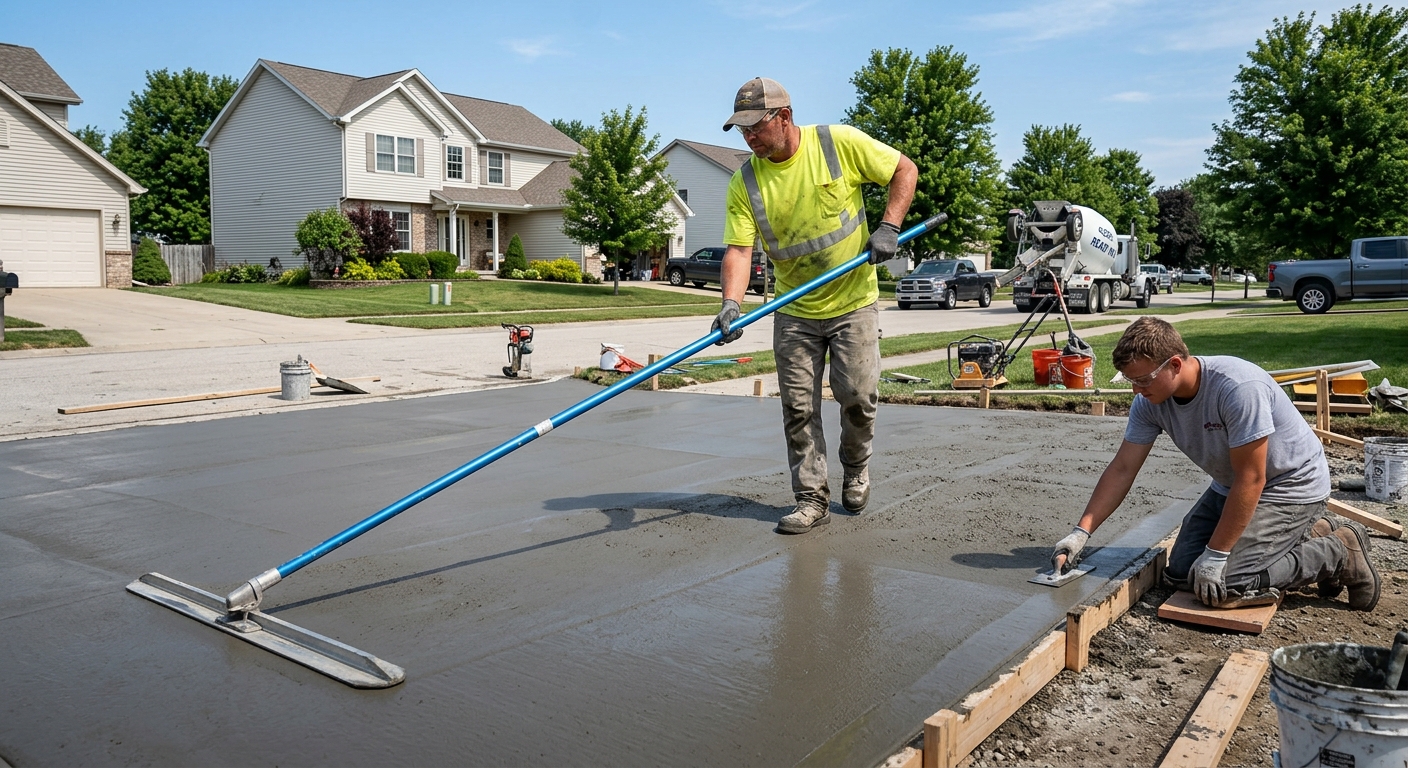
Concrete work options and costs in Davie Village
In Davie Village, concrete is a practical choice for homeowners who want low-maintenance flatwork that can handle Vancouver’s coastal rainfall and the freeze–thaw swings along the edges of winter. With a population of 13,768 (Statistics Canada, 2021 Census), the Lower Mainland–Southwest market stays busy year-round, especially around multi-family and older single-family neighbourhood pockets where driveways and sidewalks see frequent upgrades. While newer subdivisions exist, Davie Village’s housing stock includes a lot of mature streets where slabs get replaced due to settlement, drainage issues, or surface scaling—so concrete contractors are in steady demand in the immediate corridor around Davie Street and the nearby residential lanes.
Costs here reflect the Lower Mainland–Southwest climate realities: even with a relatively shallow design frost depth (locally practiced around 450 mm / 18"), exterior concrete still needs deeper, frost-protected footings for foundations and thickened edges, plus air-entrained mixes and proper jointing to manage cracking and scaling. Rain delays scheduling, and curing needs attention during cool, humid stretches—often requiring curing blankets or sealers to reach reliable performance.
On pricing, you’ll typically see options spread between budget broom-finish work and higher-cost decorative systems like stamped concrete, because labour time, forming complexity, and material selection change. Below is a side-by-side comparison to help you translate a quote into scope—then we’ll break down what drives variations in price in the next section.
| Application |
Typical Size |
Key Spec |
Finish Option |
Price Range |
| Concrete driveway (standard broom finish) |
10 m x 3 m (approx. 30 m²) |
4"–5" slab with compacted granular base, air-entrained mix, control joints |
Broom finish |
$18,000–$28,000 |
| Exposed aggregate driveway |
10 m x 3 m (approx. 30 m²) |
Air-entrained mix, proper curing and wash process, sealed surface recommended |
Exposed aggregate |
$22,000–$33,000 |
| Stamped concrete driveway or patio |
8 m x 4 m (approx. 32 m²) |
4" slab with reinforcement as required, air-entrained mix, stamped pattern and release |
Stamped |
$25,000–$45,000 |
| Plain concrete patio or walkway |
3 m x 5 m (approx. 15 m²) |
3.5"–4" slab, granular base, air-entrained mix, joints for shrinkage |
Broom or light trowel |
$16,000–$26,000 |
| Garage floor (interior slab) |
20 m² (typical double garage) |
Vapour barrier (if required), reinforcement as per design, air-entrained generally not required for interior but mix spec still matters |
Light trowel / burnished |
$18,000–$30,000 |
| Foundation footings (structural, below frost) |
Per typical footing scope for a small addition/rebuild |
Excavation to below design frost depth, formed footings, reinforcement, concrete placement and inspection |
Structural concrete |
$200–$350 |
Prices are estimates only and vary by project scope, site access and material selection.
What affects the price of concrete work in Davie Village
In the Lower Mainland–Southwest, quotes for the “same” concrete job can differ by 30–50% because concrete pricing isn’t just about volume—it’s about excavation conditions, drainage, reinforcement requirements, and how much time the crew needs to protect the pour during rain and cool nights. That variability is common across British Columbia because other regions can have higher labour and delivery premiums, different frost-protection rules, and shorter pour seasons. In Davie Village, the season isn’t as punishing as colder parts of BC, but freeze–thaw cycling and saturated soils still affect base prep and curing, which directly changes cost.
Practically, frost depth and freeze–thaw cycles dictate your specs: exterior footings and thickened edges must be placed below the design frost depth (locally practised around 450 mm / 18") to prevent frost heave. Exterior slabs need an air-entrained mix to survive cycles that can crack and scale the surface. When it’s colder or wet, contractors may add cold-weather curing precautions—blankets, temperature control, and longer scheduling—so the concrete reaches design strength instead of “looking fine” early and failing later. De-icing salt also accelerates surface spalling, so sealing and a durable surface finish become part of the cost equation.
Two examples from Davie Village: (1) a backyard patio tied into existing grades often costs more than a plain walkway because excavation and disposal are bigger, even if the square footage is similar—pushing you toward the higher end of the $16–$26 band for patios/walkways; (2) for driveways, switching from broom finish to exposed aggregate or stamped can be worth it when you’re also adding proper drainage and sealers—otherwise the added decorative cost won’t address the root cause. As housing ages and drainage becomes less forgiving, repairs and foundation-related work also raise your baseline; some structural footing scopes commonly land in the $200–$350 range per the specific footing scope line item used in estimates.
| Price Factor |
Why It Matters |
Cost Impact |
| Frost line depth — determines footing depth and form height |
Footings must extend below design frost depth to prevent heave and settlement movements |
Higher excavation depth increases forming, labour time, and concrete volume |
| Site preparation — excavation, grading, compacted granular base |
Proper subgrade drainage and compaction reduce future settlement and pumping |
Wet/saturated soils can add dewatering and extra granular, compacting, and labour |
| Reinforcement — rebar or wire mesh requirement |
Controls cracking for slabs subject to loads, thickness changes, or weak subgrade |
More steel and tie-in labour raises material and installation cost |
| Mix design — air-entrainment and compressive strength spec |
Air-entrainment helps resist freeze–thaw scaling and spalling on exterior surfaces |
Higher-spec mix and QC can add cost, especially with tight pour windows |
| Finish type — broom vs. stamped vs. exposed aggregate |
Finish affects labour hours, finishing materials, and complexity of forming |
Stamped/exposed typically costs more than plain broom finish |
| Pour size and concrete truck access to site |
Access impacts how far concrete must be carried and whether pumping is needed |
Poor access can add labour and pump/extra equipment charges |
| Cold-weather curing precautions — heating and blankets |
Cool, humid conditions need controlled curing to reach strength without damage |
Blankets, heaters, and longer schedules increase overhead and labour |
| Control joint pattern and sealing cost |
Joints manage shrinkage cracking; sealing helps protect against salt scaling |
Proper joint layout plus sealer adds line-item cost but improves durability |
Permits & regulations in British Columbia
In British Columbia, how you classify the concrete work matters. Structural concrete work—such as footings, foundation walls, grade beams, and any concrete that supports a building load—typically requires a building permit and is often supported by engineered drawings that municipalities review. For concrete flatwork like driveways, patios, and walkways, a permit often isn’t required, unless the work impacts lot grading, affects stormwater/impervious surface limits, or touches municipal right-of-way requirements (for example, curb tie-ins or sidewalk interfaces). Because rules can vary by street and by how your project changes drainage, always confirm with your local authority before digging.
For contractor due diligence in Davie Village, treat it as a step-by-step verification:
- Confirm the contractor’s British Columbia registration/licence through the appropriate provincial online registry for construction trades.
- Request a certificate of insurance and verify it includes liability coverage relevant to concrete work.
- Ask for proof of coverage for workers (WSIB/WCB coverage, as applicable) and confirm it’s active for the crew who will be on-site.
- Request references and photos from similar-scale projects in the Lower Mainland–Southwest—ideally work completed in wet-season conditions.
- Get clarity in writing on what permit/engineering coordination is included (if any).
If you can’t get documentation quickly, that’s a red flag—concrete projects depend on inspections, correct specs, and proper scheduling, not handshakes.
Getting concrete right in Davie Village's freeze-thaw climate
Concrete can fail quickly in Davie Village when the base isn’t built to drain, the mix isn’t designed for exterior exposure, and the slab is finished without controlling shrinkage cracking. The most common problem we see with older driveways and walkways is spalling and scaling—surface deterioration that worsens under coastal rain, followed by freeze–thaw cycles at the edges. To spec the job correctly for the Lower Mainland–Southwest, focus on five items. First is base preparation: a compacted granular sub-base to the correct depth for local soils and the design slab/thickness, with attention to drainage away from the slab so water doesn’t saturate the base. Second is mix design: exterior flatwork should use air-entrained concrete (commonly 5–7% air content) and a minimum 32 MPa compressive strength, with proper curing timing. Third is control joints: spacing should limit random cracking so water can’t migrate into the slab layers. Fourth is curing: aim for at least 7 days of proper curing, especially when cool nights or damp weather slow early strength gain. Fifth is sealing: apply a penetrating sealer after the recommended cure period (often after about 28 days) to repel de-icing salts and reduce surface uptake.
Ask your contractor specific questions: “What is your target air content for the pour?”, “What joint spacing are you using and where are the cut lines?”, and “How will you protect curing during rain and cool nights?” If you’re choosing between a basic broom finish versus stamped or exposed aggregate, the price difference can be justified only if the durability basics are already included. For instance, upgrading a driveway from a standard finish (often within the $18–$28 band) to an exposed aggregate look can add cost, but it’s only a good investment when drainage, air-entrainment, joints, and sealing are properly addressed—otherwise you’re paying extra for a surface that can still scale.
| Spec |
Why It Matters in Davie Village |
What to Ask For |
Impact if Skipped |
| Compacted granular base (depth?) |
Prevents pumping and helps manage saturated soils common along the edges of winter weather |
Granular base depth and type, compaction method, and drainage plan away from the slab |
Settlement, uneven cracking, and faster surface breakdown |
| Air-entrained concrete mix (target air %?) |
Improves freeze–thaw resistance in exterior slabs exposed to cycling and coastal moisture |
Target air content (commonly 5–7% for exterior flatwork) and batch ticket confirmation |
Spalling and scaling, especially after de-icing salt exposure |
| Compressive strength (MPa rating) |
Ensures the slab reaches design performance before traffic, snow, and seasonal stress |
Minimum 32 MPa (or higher per design) and curing conditions during cool periods |
Lower strength, surface wear, and cracking under load |
| Control joints (spacing per ACI guidelines) |
Controls shrinkage cracking so water doesn’t find paths into the slab and sub-base |
Joint spacing, jointing method, and plan for matching existing slabs/edges |
Random cracks that widen and allow water migration |
| Minimum 7-day curing period |
Curing is critical in Davie Village due to cool nights, high humidity, and rain variability |
Curing plan (blankets/sealer curing methods if needed) and when the slab can be walked/used |
Surface weakness and reduced durability even if it looks “set” |
| Penetrating sealer (when applied after cure) |
Helps repel salts and reduces scaling risk in winter conditions |
Sealer type and application timing after cure (often around 28 days) |
More scaling, greater staining, and faster surface deterioration |
How to choose a concrete work contractor in Davie Village
Choosing the right contractor in British Columbia starts with verification. First, confirm licence/registration for the relevant construction trade through the appropriate provincial online registry. Next, ask for a current certificate of liability insurance—you want coverage that matches the scale and nature of the concrete work (driveways, flatwork, and/or structural foundations). Finally, verify WSIB/WCB coverage for workers assigned to your site, and ensure the documentation lists the active coverage period.
Then, get 2–3 itemised written quotes that separate labour and materials rather than only providing a single lump sum. Look for line items such as excavation, disposal, granular base, reinforcement, air-entrained mix, forming, concrete placement, finishing, curing, and (if included) sealing. Read the scope carefully: is demolition included? Is disposal included? Are permit costs included for the structural portion if your foundation needs engineered changes? For warranty, ask for the workmanship warranty length (and what it covers), plus any product/manufacturer warranty that applies to sealers or admixtures. Clarify whether warranties are transferable if you sell your home.
On payments, avoid big early deposits: never pay more than 10–15% upfront. Hold back the remainder until completion and cleanup. Also insist on a written timeline with a start date and completion estimate—concrete in Davie Village can be impacted by rain windows, so the schedule should reflect curing and weather contingency.
- Provides licence/registration number and insurance certificate before signing.
- Uses air-entrained mix for exterior slabs and can explain target air content.
- Shows a clear base prep plan (depth, material, compaction expectations).
- Includes control joint plan and locations—not just “broom finish”.
- States curing method and minimum curing period (often 7 days for early strength).
- Specifies reinforcement approach (mesh/rebar and where required).
- Includes drainage notes (especially where water is likely to pool).
- Separates demolition and disposal as line items if existing concrete is removed.
- Clarifies whether sealing is included and when it will be applied.
- States concrete truck access method (direct chute vs. pump vs. carry distance).
- Includes protection of landscaping and site protection during curing.
- Provides photos and references for similar Davie Village/Lower Mainland work.
Concrete red flags in Davie Village: vague specs (“we use good concrete” without air/mix targets), missing insurance documentation, no mention of joints or curing, no drainage plan for a wet site, and quotes that ignore access/disposal but assume the same price regardless of excavation conditions.
Frequently asked questions — concrete work in Davie Village
How long does a concrete driveway last?
A properly built concrete driveway in Davie Village can last 20–30 years, and sometimes longer, when the job includes a compacted granular base, air-entrained concrete for exterior exposure, correct jointing, and curing that reaches design strength. The Lower Mainland–Southwest climate adds stress from coastal rainfall and freeze–thaw cycles, especially at slab edges and where water concentrates. In practice, sealing and surface protection help manage salt scaling and moisture uptake; many homeowners also choose sealing around the time the slab reaches full cure (commonly around 28 days). If your driveway failed early, it’s often not “bad concrete”—it’s usually base drainage, missing or poorly spaced control joints, or inadequate air-entrainment. If you’re budgeting, plain driveway work often falls in the $18,000–$28,000 band depending on size and site access.
What is air-entrained concrete and why does it matter here?
Air-entrained concrete has tiny, evenly distributed air bubbles in the mix that give water a place to expand when temperatures drop and freeze–thaw cycles occur. In British Columbia, especially in the Lower Mainland–Southwest, exterior slabs still experience freeze–thaw stress during cold snaps—even though the frost line is relatively shallow compared with northern regions. Without air entrainment, you’re more likely to see scaling and spalling at the surface after wetting and freezing, particularly where de-icing salt or retained water is present. For Davie Village homeowners, this is one of the most important durability specs because coastal moisture and seasonal temperature swings repeat every year. When you compare quotes, confirm the contractor is specifying an exterior-appropriate air-entrained mix (commonly around 5–7% air content) and not treating all concrete as identical.
How do I prepare the base for a concrete slab?
Base prep is where you win or lose a concrete slab’s lifespan. In Davie Village, preparation usually includes excavating to the required depth, removing unsuitable material, then placing and compacting a granular base designed to drain and resist frost-related movement. The goal is consistent support under the slab so it doesn’t settle, rock, or pump water upward. Contractors should also account for site grading so water sheds away from the concrete, not into it. For exterior work, a proper base plus air-entrained mix is essential; for slabs tied into existing grades, drainage details matter even more. When reviewing a quote, ask for the base depth, the material type, compaction expectations, and how they will handle wet excavation conditions before the pour.
How do I compare concrete quotes?
Start by comparing like-for-like scope, not just total price. For Davie Village projects, the biggest differences often come from excavation depth, disposal, granular base quantity and compaction, reinforcement (mesh or rebar where required), and whether the contractor is providing an exterior-rated air-entrained mix and a curing plan. Ask each contractor to provide itemised labour and materials, including: demolition and haul-off, formwork, concrete supply, finishing, curing method, control joints, and sealing if included. Also confirm truck access: narrow lanes and limited reach can require pumps or extra labour time. If one quote is closer to the lower end (for example, plain patio/walkway work often sits around $16,000–$26,000), verify it still includes the durability specs—especially base prep, air-entrainment, and jointing. Don’t choose a bid that cuts those essentials to save money.
Can concrete be poured in cold weather in Davie Village?
Yes, concrete can be poured in cold weather in Davie Village, but it must be managed correctly. The key is curing and temperature control: cool nights and damp conditions can slow strength gain, and if concrete freezes before it reaches adequate strength, performance can drop. Contractors typically use cold-weather curing precautions such as insulating blankets and, when needed, heating strategies to maintain proper curing conditions. They also plan pour timing around rain and low temperatures because humidity and precipitation affect surface finishing and curing conditions. Ask your contractor what they do for cold-weather curing, how long they plan to keep blankets/heating in place, and what the minimum curing and protection period is before traffic and exposure. A reliable contractor will document the method, not just say “we can pour whenever.”
How do I maintain concrete in Davie Village's freeze-thaw climate?
Maintenance is mostly about keeping water and salts from breaking down the surface. In Davie Village and across the Lower Mainland–Southwest, start by sealing concrete after proper cure (often around 28 days) so moisture and de-icing salt don’t penetrate easily. Sweep debris off before it holds moisture and inspect joints for gaps—if joints fail, cracking can worsen as water migrates. Avoid harsh treatments that can damage the surface finish, and use the lowest-salt or salt alternatives when possible if you’re clearing snow. In winter, keep runoff directed away from the slab so the base doesn’t saturate and re-freeze at the edges. If you notice early scaling or spalling, address it sooner—repairs are cheaper when limited to surface issues rather than progressing into deeper layers.