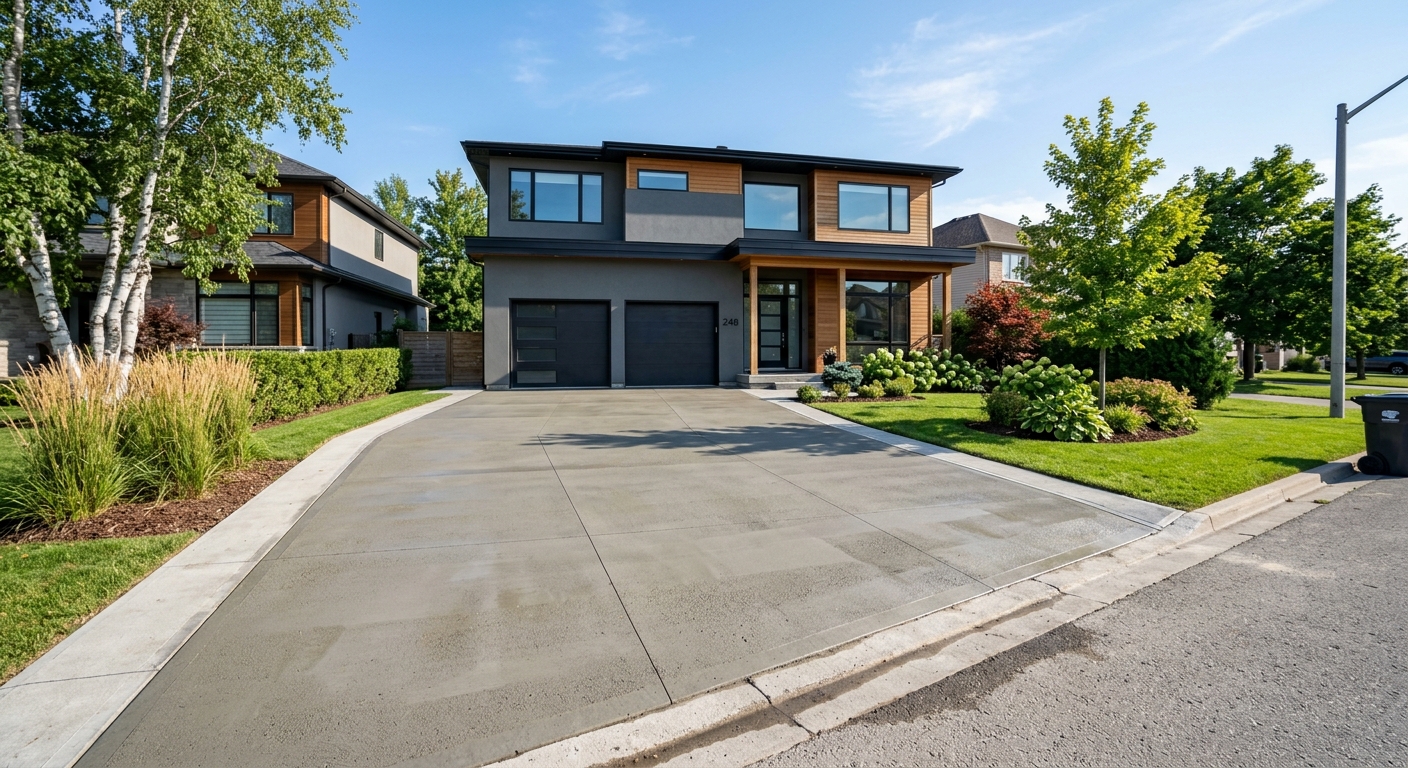
Concrete work options and costs in Canyon Springs
Canyon Springs is a growing community in the Lower Mainland–Southwest, and most homeowners here eventually need some kind of concrete work—whether it’s a driveway, patio, walkway, or foundation-related pours. In a market where many households live in single-detached homes (Statistics Canada, 2021 Census), concrete flatwork tends to be a frequent improvement: it’s practical, durable, and—when done with the right base, mix, and drainage—built for our coastal-wet, freeze–thaw swings.
Pricing in Canyon Springs is strongly influenced by the region’s mild winters paired with a frost depth that’s still deep enough to require below-frost excavation. In Lower Mainland–Southwest, local practice typically assumes frost depth around 450 mm / 18", so structural footings, thickened edges, and piers are set below that line to reduce frost heave risk. Contractor availability and scheduling also matter: prolonged rain, cool nights, and high humidity can slow curing, requiring blankets, sealers, and longer wait times to reach design strength and durability.
Because of these conditions, two jobs that look identical can land far apart on cost once you account for engineered base prep, air-entrained concrete, reinforcement, and finishing complexity. If you’re comparing options, the table below breaks down typical sizes, specifications, finishes, and realistic price bands for common Canyon Springs projects—so you can budget with confidence before you request your itemised quotes.
| Application |
Typical Size |
Key Spec |
Finish Option |
Price Range |
| Concrete driveway (standard broom finish) |
400–600 sq ft |
Air-entrained mix, compacted granular base, control joints |
Broom finish, saw-cut joints |
$18,000–$28,000 |
| Exposed aggregate driveway |
400–600 sq ft |
Air-entrained mix, correct cure timing for wash exposure |
Exposed aggregate surface, sealed |
$22,000–$34,000 |
| Stamped concrete driveway or patio |
300–500 sq ft |
Air-entrained mix, integral color, base prep for stability |
Stamp pattern + release + seal |
$22,000–$36,000 |
| Plain concrete patio or walkway |
200–400 sq ft |
Proper slope/drainage, compacted base, control joints |
Float/trowel then broom or light texture |
$16,000–$26,000 |
| Garage floor (interior slab) |
400–600 sq ft |
Vapour barrier where needed, reinforced slab, flatness finish |
Steel trowel or light broom, optional sealer |
$16,000–$30,000 |
| Foundation footings (structural, below frost) |
Per lineal/engineered scope |
Excavation below design frost, engineered rebar + forms |
Structural concrete only (not decorative) |
$200–$350 |
Prices are estimates only and vary by project scope, site access and material selection.
What affects the price of concrete work in Canyon Springs
In Canyon Springs and across the Lower Mainland–Southwest, you’ll often hear the same job described with very different numbers—and it’s not unusual for quotes to vary by 30–50% for the “same” concrete driveway or patio. That spread comes from real-world differences in site prep, frost protection details, drainage, reinforcement, and finish complexity, plus scheduling constraints when rain and cool nights interfere with curing. Labour rates in the Vancouver–Surrey–Abbotsford corridor, equipment availability, and how efficiently a contractor can stage materials on your lot also affect total cost.
Two technical drivers dominate pricing here: frost line requirements and freeze–thaw cycles. Even with a frost depth around 450 mm / 18" (typical Lower Mainland practice), footings and thickened edges still need to extend below design frost to limit frost heave. For exterior slabs, contractors specify air-entrained concrete—proper air content helps the surface resist scaling and spalling when saturated soils and freeze–thaw cycles repeat. Colder regions (and colder seasons within our coastal climate) also shorten pour windows and can trigger cold-weather curing precautions—blankets, curing compounds, and sometimes heated enclosures—which increases cost. Finally, de-icing salts can accelerate surface damage, so sealing timing and product choice matter.
In Canyon Springs, cost can rise when the driveway area requires extensive removal of old asphalt, regrading, and drainage improvements—especially on sloped lots or where we discover poor subgrade. Cost can also drop when your base is already well-compacted and site access is straightforward. For a typical driveway, choosing a standard broom finish may align more closely to the $18–$28 band, while stamped or decorative work often moves closer to the $22–$36 range once colour, stamp tools, and extra finishing time are included. Housing-stock age plays a role too: older properties often need heavier excavation and drainage corrections before any new slab can perform.
| Price Factor |
Why It Matters |
Cost Impact |
| Frost line depth — determines footing depth and form height |
Footings must sit below design frost to reduce frost heave |
More excavation + taller forms can add material and labour time |
| Site preparation — excavation, grading, compacted granular base |
Freeze–thaw and surface performance depend on drainage and base stability |
Extra haul-away, regrading, and granular replacement increases cost |
| Reinforcement — rebar or wire mesh requirement |
Helps control cracking and supports loads for driveways/garage slabs |
Rebar tie-in, chairs, and labour can materially raise totals |
| Mix design — air-entrainment and compressive strength spec |
Air entrainment protects from scaling in freeze–thaw cycles |
Higher-spec mix and QA testing can add $ and reduce scheduling flexibility |
| Finish type — broom vs. stamped vs. exposed aggregate |
Complex finishes require extra steps, tools, and curing control |
Stamped/decorative typically costs more than plain broom-finished slabs |
| Pour size and concrete truck access to site |
Small access issues can force pumping, extra labour, or multiple batches |
Pump/hosing time and slower placement can increase labour |
| Cold-weather curing precautions — heating and blankets |
Cool nights and humidity can delay strength gain |
Blankets, timers, and materials add direct cost |
| Control joint pattern and sealing cost |
Joints manage shrinkage cracking; sealing protects from moisture/salts |
More saw cuts and proper sealer application add line-item expense |
Permits & regulations in British Columbia
In British Columbia, structural concrete work typically needs a building permit and often engineered drawings that the municipality reviews. This includes footings, foundation walls, and grade beams—essentially any concrete element supporting the structure or affecting the building envelope’s performance. Concrete flatwork (like patios, walkways, and driveways) usually does not require a permit by itself, but it can change depending on the situation: if your project affects lot grading, drainage, or impervious surface coverage limits, or if it ties into municipal right-of-way conditions, you may need approval first.
Before breaking ground in Canyon Springs, confirm requirements with your local authority and don’t rely on assumptions from only a contractor’s “typical process.” Also verify the contractor carries liability insurance and has the right WCB coverage for workers. A reputable crew should provide proof during your quote process.
Step-by-step checklist for homeowners (BC):
- Ask for the contractor’s licence/registration details and company contact information.
- Look up the contractor’s standing using the provincial online registry (the exact portal can vary by trade designation).
- Request a current certificate of insurance (liability) with coverage dates.
- Ask for proof of WCB coverage for workers (or clearance letter where applicable).
- Request references for similar concrete flatwork or foundation work and confirm they matched site conditions in the Lower Mainland.
Getting concrete right in Canyon Springs's freeze-thaw climate
Concrete failures in Canyon Springs usually aren’t “mystery concrete problems”—they’re predictable results of base drainage issues, wrong mix design, weak curing, or missing joint/seal details. In our Lower Mainland–Southwest conditions, saturated ground and repeated freeze–thaw cycles put constant stress on exterior slabs and the edges of foundations. If the mix isn’t air-entrained to the correct range, water expands as it freezes inside the paste, leading to surface spalling and scaling over time.
To spec the job correctly, start with (1) base preparation: compacted granular sub-base to the right depth for your soils and the local frost-protection intent (and with drainage addressed). (2) mix design: for exterior flatwork, contractors typically aim for about 5–7% air content and a minimum 32 MPa compressive strength for durability performance. (3) control joints: use a plan for joint spacing that limits random cracking; let joints do the cracking. (4) curing: plan for at least 7 days of proper curing, and when it’s cool/wet, use blankets/curing compounds and schedule timing carefully. (5) sealing: apply a penetrating sealer after adequate cure—often at 28 days—so the surface resists moisture and de-icing salt impacts.
Where price differences are justified: upgrading from a basic broom-finished patio to a sealed, well-jointed air-entrained slab typically costs more upfront, but it’s cheaper than replacing a spalled surface later. As a rough example, a plain patio/walkway in the $16–$26 band can be money well spent when the base and air-entrainment are correct; jumping to stamped work (often in the $22–$36 range) is justified mainly when you want the decorative look—not to “fix” durability problems.
| Spec |
Why It Matters in Canyon Springs |
What to Ask For |
Impact if Skipped |
| Compacted granular base (depth?) |
Controls drainage and supports slab during freeze–thaw |
Granular type and target compacted depth based on site soils |
Settlement, pumping of fines, premature cracking |
| Air-entrained concrete mix (target air %?) |
Air voids help protect against scaling and spalling |
Confirm air target around 5–7% for exterior flatwork |
Surface scaling/spalling in wet, freeze–thaw seasons |
| Compressive strength (MPa rating) |
Ensures durability and long-term performance |
Minimum 32 MPa for exterior durability requirements |
Lower strength gain and higher risk of deterioration |
| Control joints (spacing per ACI guidelines) |
Manages shrinkage cracking away from appearance and edges |
Joint layout and saw-cut timing plan |
Random cracking and water infiltration at cracks |
| Minimum 7-day curing period |
Cold/wet weather delays strength if curing is inadequate |
Curing method and schedule (blankets/compound as needed) |
Weaker surface, reduced abrasion resistance |
| Penetrating sealer (when applied after cure) |
Repels moisture and helps with de-icing salt protection |
Apply after adequate cure—often around 28 days |
Faster moisture penetration and salt-related surface damage |
How to choose a concrete work contractor in Canyon Springs
Choosing the right contractor in Canyon Springs is mostly about verification and clarity. In British Columbia, structural concrete work needs the right permits and competent execution, and you should confirm your contractor is properly licensed/registered for their trade. Start by checking the contractor’s online registration/standing in the provincial registry for the relevant category, then request a current certificate of liability insurance (with coverage dates and your job address/name listed if possible). Next, ask for proof of WCB coverage for workers (or a clearance letter where applicable). If a contractor can’t provide these documents during the quoting stage, that’s a major red flag.
Then get 2–3 itemised written quotes instead of a single lump sum. You want line items that reflect what you’re actually paying for: excavation and disposal, granular base and compaction, reinforcement, concrete supply and air-entrainment spec, finishing, saw-cut joints, and sealing. Confirm what’s excluded—for example, permit pull responsibility, whether old slab/asphalt removal is included, and whether they manage haul-away and site restoration.
For warranty, ask for the workmanship warranty length (in writing), whether it covers cracking/spalling issues related to curing/mix/base prep, and whether product warranties from sealer or admixture manufacturers are transferable. Payment should follow a sensible schedule: typically never more than 10–15% upfront. Hold back part of the payment until the final inspection and close-out materials are complete. Finally, insist on a start date and completion estimate in writing—particularly important in our rain- and cool-night cycles—so you’re not exposed to extended downtime.
- Provide licence/registration details you can verify online (BC registry).
- Show a current liability insurance certificate.
- Confirm WCB coverage (or clearance letter) before work begins.
- Use itemised quotes (labour + materials breakdown), not just one total.
- State concrete mix requirements: air-entrainment target and minimum compressive strength.
- Include base prep scope: excavation depth, granular type, and compaction.
- Specify reinforcement: wire mesh vs rebar and placement on chairs/spacers.
- Confirm joint pattern and saw-cut timing plan.
- List curing method and what happens if temperatures drop or it rains.
- Clarify sealing: product type and when it will be applied (after cure).
- Define disposal and haul-away responsibilities for demo/removal.
- Use a written payment schedule with a final holdback until completion.
Concrete red flags I see in Canyon Springs include: vague quotes with no mix spec or air-entrainment details, skipping compacted granular base depth, no plan for drainage around the slab edges, refusing to provide insurance/WCB proof, and offering decorative finishes without discussing curing/blanket strategy for our cool, wet conditions.
Frequently asked questions — concrete work in Canyon Springs
What is a concrete overlay and is it suited to Canyon Springs?
A concrete overlay is a new bonded layer placed over an existing concrete surface to restore appearance and smoothness without fully removing the slab. In Canyon Springs and across British Columbia’s Lower Mainland–Southwest, overlays can be a good option when the original concrete is structurally sound—no major heaving, deep spalling, or widespread settlement. The key is surface preparation: grinding, cleaning, crack repair, and correct bonding system selection. If the old slab already has serious base failure or water drainage issues, the overlay can fail because the movement continues under the new layer. A practical way to decide is to ask for an assessment of cracking pattern and edge drainage. If you’re comparing costs, overlays are often cheaper than full replacement, but if your surface issues are driven by freeze–thaw scaling, doing base + mix correctly (even at higher cost) can be the better long-term value.
How do I seal concrete to protect it in Canyon Springs?
Sealing helps protect exterior concrete from moisture uptake and de-icing salt effects—two big concerns in Canyon Springs due to wet weather and freeze–thaw cycles. The most important step is timing: concrete should cure properly first, and many contractors apply penetrating sealer after cure—commonly around 28 days—so the sealer can properly absorb into the pores. Before sealing, the surface must be clean and dry, typically after any patching and joint work are finished. For homeowners, ask what product type they use (penetrating vs film-forming), expected recoat interval, and whether the sealer is rated for freeze–thaw exposure. If you’re budgeting, sealing is usually an add-on line item, but it’s often far less expensive than dealing with spalling repairs later—especially when you’re dealing with exterior flatwork priced in bands like $16,000–$26,000 for plain patios/walkways or higher for decorative work.
What is the difference between concrete and cement?
Concrete and cement are related, but they’re not the same. Cement is one ingredient—typically Portland cement—that acts as the binder. Concrete is the finished construction material made from cement plus water, fine and coarse aggregates (sand and gravel), and often admixtures. In British Columbia, contractors specify concrete performance using measures like air content and compressive strength (for example, minimum 32 MPa for durability targets in exterior work). When people say “we used cement that’s better quality,” what they really mean is that the concrete mix design was engineered for the job: correct proportions, air-entrainment for freeze–thaw resistance, and a proper curing plan. So when you request quotes in Canyon Springs, focus on the concrete specs—air content, strength, and curing—rather than simply asking about cement brand.
How much does concrete work cost in Canyon Springs?
Concrete cost in Canyon Springs depends on scope, access, base preparation, reinforcement, and finish complexity. For budgeting, local price bands typically run roughly: concrete patio/walkway at $16,000–$26,000, standard driveway work at around $18,000–$28,000, and stamped/decorative concrete generally higher at $22,000–$36,000. Foundation footings are priced differently (often per lineal/engineered scope) and commonly quoted in a $200–$350 band depending on depth, rebar, and formwork requirements. The Lower Mainland–Southwest climate can raise costs due to rain-cure scheduling and the need for air-entrained mixes and careful joint/seal planning to handle freeze–thaw cycles. For accurate pricing, get itemised quotes that list excavation/base prep, concrete mix specs, reinforcement, and sealing—those details explain most of the 30–50% quote differences you may see.
How deep must footings be for Canyon Springs's frost line?
In Canyon Springs (Lower Mainland–Southwest), typical local practice assumes a design frost depth around 450 mm / 18", so footings and other structural concrete elements are placed below that frost line to reduce frost heave risk. That said, your actual footing depth is determined by your site conditions and engineering requirements for the specific building and soil conditions. You should expect structural pours like footings, foundation walls, and grade beams to follow the engineered drawings and local compliance expectations. The important homeowner takeaway is: don’t rely on “average” depth alone—ask your contractor to reference the engineered foundation plan. If a contractor is vague about footing elevations or says they can pour at surface level, treat it as a serious concern. Proper frost protection is part of what protects your foundation and reduces long-term repair costs in our wet, freeze–thaw driven environment.
Why does concrete crack in Canyon Springs and how is it prevented?
Concrete cracks are common, especially in exterior flatwork, and in Canyon Springs they’re often driven by shrinkage and thermal movement combined with freeze–thaw wetting. Even if concrete is strong, it will move as it dries and cools/warms. The prevention strategy is to control where it cracks rather than trying to eliminate cracking entirely. That means proper compacted granular base (to reduce settlement), correct air-entrained mix for durability in freeze–thaw cycles, and a planned control joint layout with saw-cut timing that allows controlled cracking. Sealing also helps limit water and salt intrusion through any cracks that do form. If your contractor skips joint planning or delays saw-cutting, random cracks tend to appear—and those become pathways for moisture. When you compare quotes for driveways or patios (commonly in bands like $18,000–$28,000 for standard driveways), ask specifically how they handle base prep, air-entrainment, joint spacing, and curing.