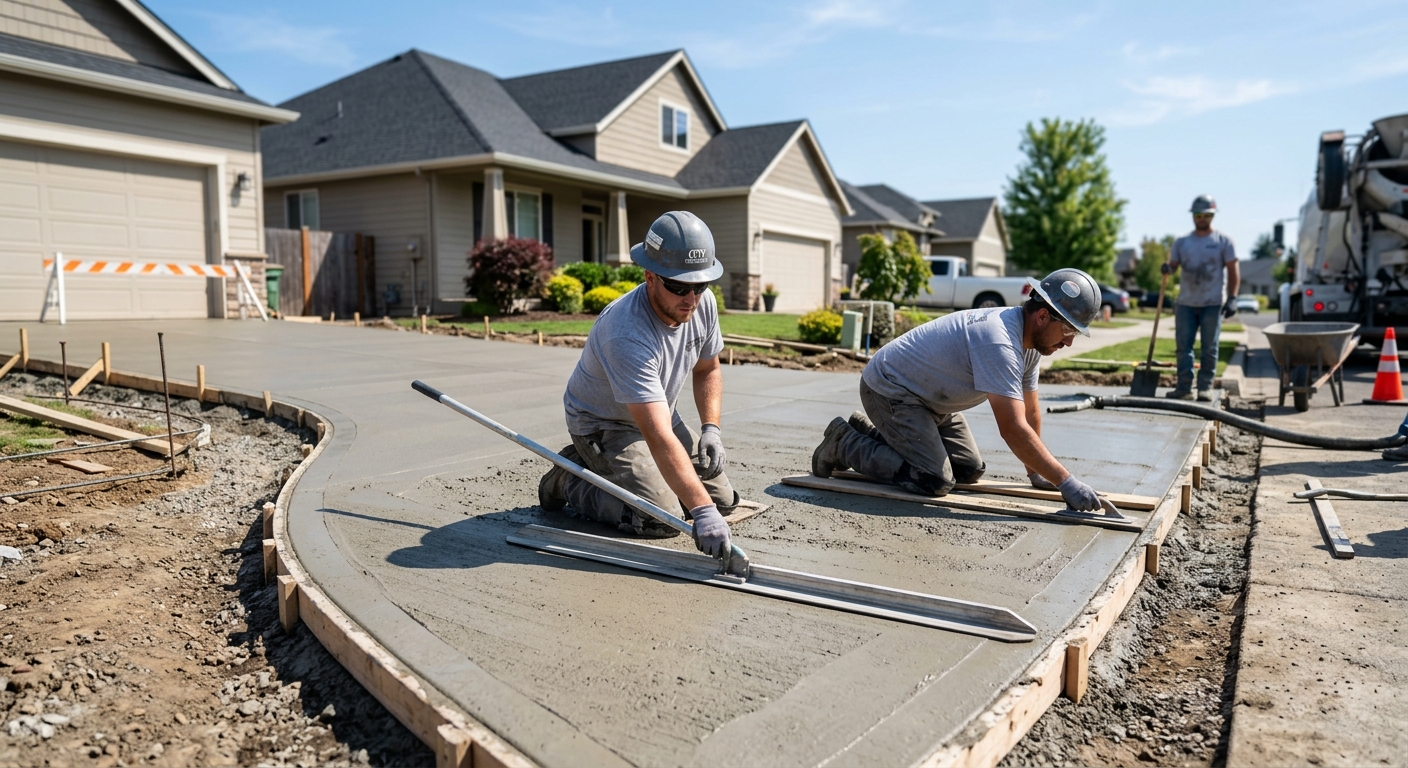
Concrete work options and costs in Yaletown
In Yaletown, concrete flatwork is a year-round staple because homeowners want durable surfaces that still look sharp on busy, walkable streets. With a population of 14,583 in the broader Yaletown area (Statistics Canada, 2021 Census), demand is steady for concrete driveways, patios and garage slabs—especially among single-detached homeowners who tend to renovate for curb appeal and weather resilience. Lower Mainland–Southwest pricing also reflects the reality that we’re pouring in a coastal-wet climate: frequent freeze–thaw cycles, saturated soils, and persistent rain increase the importance of proper base prep, air-entrained mixes, and careful curing. Even though the frost line is relatively shallow in coastal BC (local practice often assumes ~450 mm / 18" design depth), we still place footings and thickened edges below frost to prevent freeze-related movement and long-term cracking. Contractor availability can affect costs too—when schedule windows shrink due to cool, rainy stretches, crews and concrete trucks get booked tighter, and that shows up in the final numbers.
If you’re comparing options in the Yaletown and False Creek-adjacent streetscape, the finish choice matters as much as the excavation. Below is a practical range that reflects typical Lower Mainland–Southwest market pricing for common projects, from plain broom-finish slabs to decorative stamped drives and exposed aggregate. Use this table to sanity-check quotes, then tie it back to your site conditions (access, drainage, and reinforcement requirements) before you sign.
| Application |
Typical Size |
Key Spec |
Finish Option |
Price Range |
| Concrete driveway (standard broom finish) |
400–600 sq. ft. |
Air-entrained exterior mix; compacted granular base; control joints |
Broom finish, saw-cut joints |
$8,500–$15,000 |
| Exposed aggregate driveway |
400–600 sq. ft. |
Air-entrained mix; uniform thickness; surface retarder + wash |
Exposed aggregate with sealer-ready surface |
$10,500–$18,500 |
| Stamped concrete driveway or patio |
300–500 sq. ft. |
Air-entrained mix; integral colour or colour hardener; joints |
Stamped pattern (ashlar/fieldstone-style), release + sealer |
$9,000–$18,000 |
| Plain concrete patio or walkway |
250–450 sq. ft. |
Air-entrained mix; compacted base; edge forms |
Float + broom or light broom |
$4,000–$11,000 |
| Garage floor (interior slab) |
300–500 sq. ft. |
Vapour management if needed; reinforcement to match use |
Plain trowel/steel finish |
$6,000–$14,000 |
| Foundation footings (structural, below frost) |
Varies by home design |
Concrete below frost line; engineered rebar cage; site excavation |
Structural concrete |
$9,000–$18,000 |
Prices are estimates only and vary by project scope, site access and material selection.
What affects the price of concrete work in Yaletown
In the Lower Mainland–Southwest region, it’s common to see quotes for the “same” concrete job swing by 30–50%—and it isn’t just because one contractor is cheaper. Concrete cost is driven by what you can’t see: how deep excavation really goes, whether the subgrade is stable or saturated, how much reinforcement is required, and whether the contractor is using an exterior air-entrained mix and the correct curing plan for cool, humid conditions. In other parts of British Columbia, colder winters and different frost-depth assumptions can push deeper excavations, shorter pour seasons, and more cold-weather labour precautions—so unit pricing often shifts even when the finish looks identical.
Here in Yaletown, the frost line depth and freeze–thaw cycles dictate every spec. Footings must extend below the design frost depth to prevent frost heave, and exterior slabs require air-entrained concrete to survive repeated cycles and scaling. If the calendar turns wet and cool, cold-weather curing precautions (blankets, heaters, and longer hold times) can add real labour and equipment cost. De-icing salts in winter also accelerate surface spalling if the mix, air content, and sealing are not done correctly—so sealing isn’t an “upgrade,” it’s part of durability.
Two concrete examples you’ll notice in Yaletown: (1) a driveway on higher water-table soils often needs extra drainage and more granular base, which can raise a standard broom-finish pour compared with a simpler site; and (2) stamped or exposed aggregate looks premium, but the extra cost is justified only when the prep is consistent and joints are planned—otherwise you’re paying for aesthetics on a structure that may crack. As a baseline, standard driveway work often aligns with the $18–$28 per sq. ft. band, while stamped & decorative options typically land closer to the $22–$36 per sq. ft. range depending on thickness and detailing.
Also consider housing age and renovation patterns: in dense, established neighbourhood pockets near False Creek, there’s frequently limited access and older drainage tied into existing landscaping, which can increase truck time and disposal costs compared with a new build lot.
| Price Factor |
Why It Matters |
Cost Impact |
| Frost line depth — determines footing depth and form height |
Footings and thickened edges must sit below frost to prevent heave |
Lowered risk, higher excavation and forming cost when deeper than expected |
| Site preparation — excavation, grading, compacted granular base |
Saturated soils need proper base and drainage to stop settlement/cracking |
Can add major labour/materials if base depth or drainage is increased |
| Reinforcement — rebar or wire mesh requirement |
Controls cracking and supports structural loads and heavier use |
Material + placement time; may significantly change slab price |
| Mix design — air-entrainment and compressive strength spec |
Exterior air content and strength are critical in freeze–thaw and wet exposure |
Small per-metre cost difference, but non-negotiable for durability |
| Finish type — broom vs. stamped vs. exposed aggregate |
Stamping/release, surface retarder/wash add labour and tighter workmanship |
Often shifts you from “standard” driveway pricing toward decorative ranges |
| Pour size and concrete truck access to site |
Access limits concrete placement speed and can require pumps/extra labour |
Tighter access can raise costs through additional handling and time |
| Cold-weather curing precautions — heating and blankets |
Insulation and curing protection protect strength gain during cool spells |
Adds equipment and labour when the calendar is unfavourable |
| Control joint pattern and sealing cost |
Joints manage shrinkage; sealing helps repel de-icing salts and reduce scaling |
Skipping or cutting corners leads to earlier repairs; proper sealing costs extra |
Permits & regulations in British Columbia
In British Columbia, structural concrete work typically requires a building permit and, in many cases, engineered drawings that the municipality reviews. That includes footings, foundation walls, and grade beams. For example, if you’re underpinning, doing new foundations, or changing load paths, you should assume permits and inspections are part of the process.
Concrete flatwork—patios, walkways, sidewalks, and most driveways—usually does not require a permit by default. However, a permit may be triggered if your scope affects lot grading, changes stormwater drainage, alters impervious surface coverage limits, or involves work near a municipal right-of-way. Because Yaletown projects often sit in established streetscapes with existing drainage and landscaping, it’s smart to confirm before breaking ground.
Here’s how a homeowner in Yaletown can verify a contractor step-by-step in British Columbia:
- Ask for proof of liability insurance (certificate of insurance with project address listed if possible).
- Confirm the contractor’s coverage for workers (WSBC/WCB clearance where applicable) and request the clearance letter.
- Check their licence/registration details through the appropriate provincial online registry for trades/contractors (use the company name exactly as on the quote/invoice).
- Request recent references for jobs similar in size (driveways vs. foundations) and get photos from occupied homes if available.
- Verify the quote includes concrete specification items (air-entrainment, curing method) and clarifies what’s included for disposal and site protection.
Getting concrete right in Yaletown's freeze-thaw climate
Concrete fails in Yaletown’s climate when the job is designed for “dry days” but executed in wet, cool conditions without the right specs. The Lower Mainland–Southwest pattern is simple: saturated soils plus freeze–thaw cycles stress weaker concrete and poorly prepared bases, which can lead to settlement, random cracking, and the biggest visible issue—spalling from inadequate air-entrainment and weak surface durability. To get it right, you spec the full system: (1) base preparation, (2) mix design, (3) control joints, (4) curing, and (5) sealing.
Base prep means compacted granular sub-base to the right depth for local soils and frost assumptions, with drainage attention so water doesn’t sit under the slab. Mix design is where many quotes differ: for exterior flatwork, ask for air-entrained concrete (typically 5–7% air content) and a minimum 32 MPa compressive strength. Control joints should be spaced to limit random cracking rather than “as the crew feels.” Curing should be a minimum 7 days under proper conditions; when night temps drop or rain lingers, contractors may need curing blankets and protection to reach design strength. Finally, sealing with a penetrating sealer after cure helps repel de-icing salts and reduces scaling.
To help you budget intelligently: suppose you’re comparing a plain driveway at the lower band (often closer to the $18–$28 per sq. ft. range) versus stamped at the decorative band ($22–$36 per sq. ft.). The price jump is justified when the stamped job still includes the same robust base, air-entrainment, joint layout, and a proper curing/sealer schedule. If someone “saves money” by cutting specs to fund decorative work, you may end up repairing cracks sooner—especially in coastal-wet, freeze–thaw conditions.
Use these questions to protect your investment: “What air content are you targeting?”, “What’s your minimum compressive strength spec?”, “How deep is the base and how is it compacted?”, “What curing method will you use if it’s cool or rainy?”, and “What joint spacing and sealing timing are included?”
| Spec |
Why It Matters in Yaletown |
What to Ask For |
Impact if Skipped |
| Compacted granular base (depth?) |
Stabilizes subgrade and reduces settlement in saturated coastal soils |
Granular type and compacted depth; proof of proper grading/drainage |
Uneven surface, cracking, and premature slab failure |
| Air-entrained concrete mix (target air %?) |
Prevents freeze–thaw damage and reduces scaling/spalling |
Target air content typically 5–7% for exterior flatwork |
Surface deterioration and spalling within a few seasons |
| Compressive strength (MPa rating) |
Ensures durability and strength gain for exposure conditions |
Minimum 32 MPa specified for the pour |
Weaker concrete, increased risk of cracking and abrasion |
| Control joints (spacing per ACI guidelines) |
Controls where shrinkage cracks occur |
Joint layout plan and spacing before the pour |
Random cracks and expensive surface repairs |
| Minimum 7-day curing period |
Strength development is critical in cool, humid weather |
How curing will be maintained for at least 7 days |
Low strength, scaling, and early wear |
| Penetrating sealer (when applied after cure) |
Repels de-icing salts and helps reduce water-driven deterioration |
Sealer applied after cure—commonly around 28 days post-pour |
Faster surface aging and higher maintenance costs |
How to choose a concrete work contractor in Yaletown
Choosing the right contractor in Yaletown comes down to proof, not promises. Start with British Columbia verification: ask for their licence/registration details (through the relevant provincial online registry), a current certificate of liability insurance, and confirmation of WSBC/WCB coverage with a clearance letter where applicable. If a contractor can’t provide these quickly, pause—concrete work is unforgiving, and you don’t want to be the one covering gaps after a pour.
Next, get 2–3 itemised written quotes that break labour and materials, not just a lump sum. You want line items that reflect base prep, reinforcement (if required), concrete type (air-entrained exterior mix), finish and any special items like curing protection or disposal. Read the scope carefully: what’s excluded for excavation over/under a depth, what’s included for drainage work, and whether permits or inspections (for structural concrete) are accounted for.
Warranty matters—ask for the length of the workmanship warranty and whether product/manufacturer warranties apply to sealers/finishes. Confirm whether anything is transferable if you sell the property. On payment, don’t sign up for heavy upfront cash: keep deposits around 10–15%, and request a holdback until the job is complete and you’ve inspected the edges, joints, grading and sealer timing. Finally, get a written start date and completion estimate—tight seasonal windows in the Lower Mainland–Southwest can affect scheduling, especially during wet/cool stretches.
- Provide licence/registration details in British Columbia (and confirm they match the quote name).
- Supply liability insurance certificate and ensure the project address is referenced when possible.
- Provide WSBC/WCB clearance letter (where applicable) and verify coverage is active.
- Use an itemised quote: excavation, base, reinforcement, concrete mix spec, finishing, and curing.
- Confirm the concrete is air-entrained for exterior work (not “general purpose”).
- Ask for the target compressive strength and joint spacing plan.
- Clarify curing method and timeline (blankets/heaters if cool/rainy).
- Clarify sealing type and when it’s applied (e.g., after cure, commonly around 28 days).
- Check whether disposal and cleanup are included (spoils hauling can be a hidden cost).
- Confirm truck access and whether pumping/extra labour is needed.
- Get a written warranty statement for workmanship and surface defects.
- Request a realistic schedule with start and completion dates in writing.
In Yaletown, a few concrete red flags to watch for: they won’t discuss air-entrainment or curing; their quote is vague on base thickness and reinforcement; they want more than 10–15% upfront without clear milestones; they refuse to put joint layout and sealer timing in writing; or they dismiss freeze–thaw risk as “not a big deal” for coastal BC.
Frequently asked questions — concrete work in Yaletown
Stamped vs broom-finish concrete — cost difference?
In Yaletown and the Lower Mainland–Southwest, stamped concrete typically costs more than a broom-finish because it requires extra labour time, precise timing, and materials like colour and release products. Plain broom-finish exterior work often tracks closer to the standard driveway band of $18,000–$28,000 per project depending on size and site conditions, while stamped & decorative concrete commonly sits nearer the decorative band of $22–$36 per sq. ft. (billed by the area and thickness). The real question is whether the stamped quote still includes the durability specs: air-entrainment, proper base compaction, correct joint spacing, and curing protection during cool/rainy periods. A cheaper stamped quote with reduced prep can lead to earlier cracking or scaling.
When is the best time to pour concrete in Yaletown?
The “best” time in British Columbia’s coastal climate is less about a single month and more about the weather window and temperature at placement and during curing. In Yaletown, late spring through early fall often provides more stable conditions for curing, but you can still pour in shoulder seasons if the contractor is set up for cool-weather protection. Avoid pouring when heavy rain is expected to wash paste off the surface or when freezing temperatures are likely before strength gain. A good contractor will schedule around forecasted cool nights, plan curing blankets/sealers timing, and protect exposed edges. If your quote was priced for a straightforward pour and then the weather changes, ask how they’ll adjust curing—this can affect the final cost and durability.
How long does concrete take to cure?
Concrete curing is often misunderstood. For most exterior work in Yaletown, crews plan for at least 7 days of proper curing before you treat the slab as “functional,” and they design the workflow to achieve the intended strength gain in that window. Full design strength depends on the mix and temperature, so contractors typically don’t rush traffic or heavy loads. Sealing is generally timed after cure—commonly around 28 days post-pour—so the surface has stabilized enough for a penetrating sealer to perform well against wet conditions and winter de-icing salts. If you’re comparing quotes, ask what their curing plan is for cool, humid weeks (blankets, insulation, and wind/rain protection). That curing plan is as important as the finish.
Do I need a permit for concrete work in British Columbia?
In British Columbia, it depends on what you’re doing. Structural concrete work such as footings, foundation walls, and grade beams typically requires a building permit and often engineered drawings for municipal review. Concrete flatwork—like most patios, walkways, and driveways—usually doesn’t need a permit unless it affects lot grading, stormwater/drainage, impervious surface coverage limits, or work relates to municipal right-of-way. Since Yaletown lots can have existing drainage tie-ins and mature landscaping, it’s worth confirming with the local authority before breaking ground. Ask your contractor to clearly state whether permits are required for your scope and who will handle them. A reputable crew will help coordinate inspections where needed.
Concrete vs pavers for a patio in Yaletown?
Concrete and pavers can both look great in Yaletown, but they solve different problems. A plain concrete patio can be lower cost for larger, continuous areas and—when properly built with air-entrained mix and compaction—offers good durability in freeze–thaw conditions. Pavers often appeal for easier “spot repairs,” and they can handle slight movement because individual units can be adjusted. That said, paver longevity depends heavily on base prep and edge restraints; poor drainage under pavers can still cause settlement. As a rough guide, plain concrete patio pricing commonly sits in the $16–$26 per sq. ft. range, while decorative stamped concrete typically runs higher. The best choice comes down to drainage, site access, and whether you want a monolithic surface or modular units.
How long does a concrete driveway last?
With the right specs and execution in Yaletown’s Lower Mainland–Southwest climate, a concrete driveway can last decades. Durability depends most on base preparation, proper air-entrainment, correct control joint pattern, curing conditions, and sealing timing. The coastal-wet environment and freeze–thaw cycling stress slabs, especially around edges and joints, so these details matter. If a driveway is built with the correct air content and includes sealing after cure, it’s far less likely to suffer early spalling or scaling. If you’re comparing options, don’t choose solely on upfront cost—sometimes paying closer to the higher end of standard pricing (within the $18–$28 per sq. ft. driveway band) reflects stronger base prep and better finish workmanship. Regularly keeping surfaces clear of debris and managing drainage also helps extend service life.