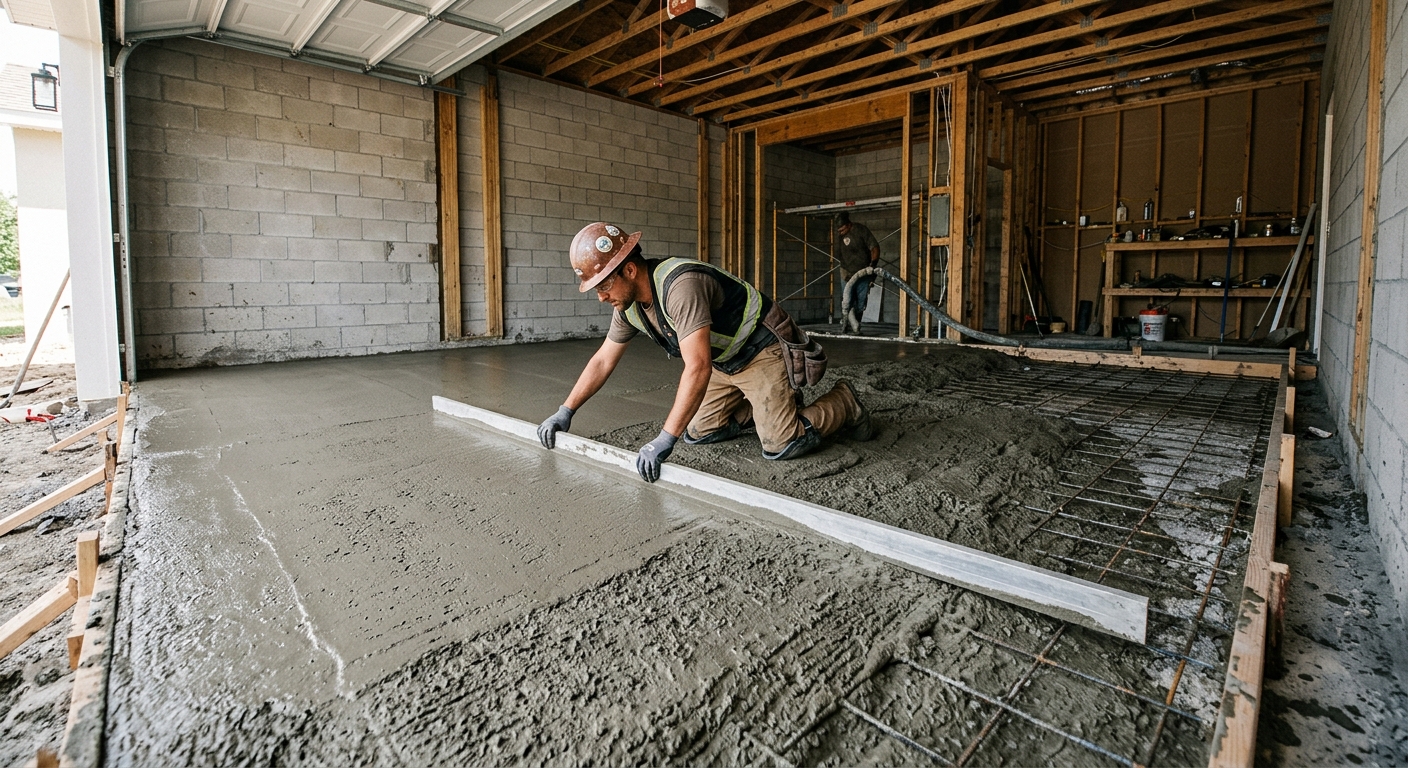
Concrete work options and costs in Courtenay
Concrete work in Courtenay is a practical upgrade for driveways, patios and walkways—especially because much of the housing stock around town is older. In Courtenay, single-detached homes make up about 50.1% of dwellings, and 30.2% of homes were built before 1981 (Statistics Canada, 2021 Census). That matters because many older properties have settling walkways, cracked slabs, or deteriorating edges where water gets in.
On Vancouver Island and the Coast, our concrete design is shaped by a relatively shallow frost line combined with frequent freeze–thaw cycles. Even when winters feel mild, saturated soils and repeated wetting/freezing can scale the surface and create random cracking if the base, air-entrainment, and jointing aren’t done correctly. That’s why contractors in Courtenay typically price weather contingencies—rain scheduling, cold snaps, and extra protection to support proper curing.
Labour availability and staging also affect cost. Areas like the North Island / Comox Valley foothills side and neighbourhoods with sloped lots often require more excavation, granular regrading, and careful truck access planning for the concrete pour. Because of these realities, two “same size” bids can still differ—particularly when one includes engineered foundation work below frost and the other only addresses visible surface cracking.
Below is a practical comparison of common concrete options and typical price ranges for Courtenay, so you can line up scopes before you request detailed estimates.
| Application |
Typical Size |
Key Spec |
Finish Option |
Price Range |
| Concrete driveway (standard broom finish) |
12 ft x 24 ft (288 sq ft) |
Air-entrained mix, control joints, sealed finish recommended |
Broom finish |
$4,600 – $7,200 |
| Exposed aggregate driveway |
12 ft x 24 ft (288 sq ft) |
Air-entrained mix, proper base and curing control |
Exposed aggregate |
$5,700 – $9,000 |
| Stamped concrete driveway or patio |
10 ft x 20 ft (200 sq ft) |
Air-entrained mix, release agent, colour hardeners |
Stamp + colouring |
$4,400 – $7,000 |
| Plain concrete patio or walkway |
8 ft x 12 ft (96 sq ft) |
Air-entrained mix, steel reinforcement where required |
Broom or smooth finish |
$1,350 – $2,100 |
| Garage floor (interior slab) |
20 ft x 22 ft (440 sq ft) |
Vapour/insulation where needed, reinforced slab |
Smooth or light broom |
$5,900 – $10,000 |
| Foundation footings (structural, below frost) |
Per house plan (typical 1,000–1,600 sq ft bearing perimeter) |
Excavation, granular base, reinforcing steel, formwork |
Structural finish (not decorative) |
$20,000 – $35,000 |
Prices are estimates only and vary by project scope, site access and material selection.
What affects the price of concrete work in Courtenay
It’s common to see quote swings of 30–50% for “the same” concrete work across Vancouver Island and Coast, and that’s not just contractor margins—spec requirements and site conditions change the cost drivers. In British Columbia, frost depth and freeze–thaw behaviour dictate every exterior detail: footings must sit below the design frost depth (in coastal BC this is often treated around 0.5–1.2 m), and exterior slabs need air-entrained concrete to resist surface scaling and internal damage during repeated wetting and freezing. If one quote assumes a plain mix and the other includes air-entrainment and the right cure protection, you’ll feel that difference in durability and long-term maintenance.
Contractors also price around the pour season. Colder weather snaps can slow strength gain and increase the risk of surface weakness; heating and insulating blankets aren’t “nice-to-haves” when temperatures drop. Finally, de-icing salt accelerates spalling in freeze–thaw regions—so sealing and edge detailing become part of doing it right, not part of value engineering.
In Courtenay specifically, costs rise when there’s soft subgrade, higher rainfall-driven drainage corrections, or slopes that require more excavation. They can drop when the base is already well-prepped, truck access is straightforward, and the finish is standard. For a sense of the range: a broom-finished driveway often lands in the $16–$25/sq ft band, while upgrades like exposed aggregate or stamped work can shift to the higher end of the local market. Foundation work is a different category altogether—footings are labour- and excavation-heavy, often starting around the $50–$90 per linear/structural allowance band, then scaling with soil conditions, wall layouts and reinforcement.
| Price Factor |
Why It Matters |
Cost Impact |
| Frost line depth — determines footing depth and form height |
Deeper frost protection means more excavation and higher forms. |
Often the biggest foundation variable; can add substantial labour and disposal costs. |
| Site preparation — excavation, grading, compacted granular base |
Concrete fails early when subgrade is poorly graded or not compacted. |
Can swing the job by several thousand dollars depending on access and soil remediation. |
| Reinforcement — rebar or wire mesh requirement |
Controls cracking and improves load capacity for driveways and garage slabs. |
Material and labour add cost; omission increases future patching risk. |
| Mix design — air-entrainment and compressive strength spec |
Air-entrainment is essential for freeze–thaw durability. |
Costs more than basic mixes, but reduces scaling and spalling claims later. |
| Finish type — broom vs. stamped vs. exposed aggregate |
Decorative systems add colour, tooling, and more labour time. |
Stamped/exposed typically add a noticeable premium versus plain broom finish. |
| Pour size and concrete truck access to site |
Smaller pours may still require full setup; difficult access forces more handling. |
Longer carries, extra labour, or smaller truck loads can increase cost. |
| Cold-weather curing precautions — heating and blankets |
Cool, wet conditions slow strength gain and can damage early surface integrity. |
Can add temporary heating/material costs during cold snaps. |
| Control joint pattern and sealing cost |
Joints manage shrinkage cracking and sealing reduces salt/ice damage. |
Moderate added scope up front; lower maintenance over time. |
Permits & regulations in British Columbia
In British Columbia, structural concrete work—like footings, foundation walls, grade beams and reinforced structural elements—generally requires a building permit, and engineered drawings are often reviewed by the municipality before work starts. Concrete flatwork such as driveways, patios and walkways usually does not require a permit by default, unless it changes lot grading, triggers municipal impervious surface coverage limits, or affects right-of-way conditions (for example, tying into a curb, boulevard, or drainage works). Because rules can hinge on slope, drainage and coverage, always confirm with the local authority before breaking ground.
For your contractor, don’t guess—verify in a simple, step-by-step way: (1) check they carry liability insurance and that the certificate matches the correct legal entity; (2) confirm they have applicable coverage for workplace safety (WCB/WSIB-equivalent coverage in BC), and ask for the most recent clearance documentation if applicable; (3) request references for similar Courtenay projects, including freeze–thaw exterior slabs and below-frost footings; and (4) use any online licensing registry tools available to ensure the contractor is properly registered for the work they’re claiming.
Tip: ask to see the certificate of insurance and the coverage/clearance letter before you pay for materials. It’s the quickest way to reduce risk if something goes wrong in Courtenay’s rainy, freeze–thaw conditions.
Getting concrete right in Courtenay's freeze-thaw climate
Concrete failures in Courtenay usually come from the same root causes: inadequate base preparation, poor mix selection, weak early curing, and control joints that aren’t installed to manage shrinkage. In a freeze–thaw environment, water movement is the enemy. If the base isn’t compacted to the right depth or drainage is wrong, frost heave can lift slabs and create voids. If the concrete isn’t air-entrained, the freeze–thaw cycle can cause surface scaling and spalling—even when the slab looks “fine” at first.
To spec the job correctly, focus on five essentials. First, use a compacted granular base to the correct design depth for local subgrade and frost conditions, with proper drainage. Second, require air-entrained concrete—commonly 5–7% air content for exterior flatwork—and minimum 32 MPa compressive strength for typical residential durability needs. Third, include control joints at an appropriate spacing to limit random cracking. Fourth, curing should be protected for at least 7 days, with blankets or other cold-weather protection during cool snaps so strength gain isn’t compromised. Fifth, plan for penetrating sealer applied after cure (often around 28 days) to repel de-icing salts.
When comparing options, ask what’s driving the price difference. For example, a plain patio might be in the $14–$22/sq ft band, while stamped concrete typically costs more due to colour hardeners and extra labour. That premium is justified when the base, mix, and joints are still built to freeze–thaw durability—not just when the finish looks nicer.
| Spec |
Why It Matters in Courtenay |
What to Ask For |
Impact if Skipped |
| Compacted granular base (depth?) |
Controls water and reduces frost-related movement. |
Granular base thickness and compaction method to suit subgrade and frost conditions. |
Settling, heave, and uneven cracking. |
| Air-entrained concrete mix (target air %?) |
Air voids help concrete survive freeze–thaw without scaling/spalling. |
Confirm air content is targeted around 5–7% for exterior flatwork. |
Surface scaling and spalling, especially where salts hit. |
| Compressive strength (MPa rating) |
Strength supports durability during wet/cold cycles. |
Specify minimum 32 MPa (or higher if required by design). |
Early wear, cracking, and reduced long-term performance. |
| Control joints (spacing per ACI guidelines) |
Manages shrinkage cracking so it happens where you planned. |
Joint spacing and saw-cut timing for your slab dimensions. |
Random cracks and moisture pathways. |
| Minimum 7-day curing period |
Cool, damp weather slows strength gain. |
How they will protect the pour; curing plan for rain/cold snaps. |
Weak surface and compromised durability. |
| Penetrating sealer (when applied after cure) |
Reduces penetration from salt and moisture. |
Penetrating sealer applied after cure, commonly around 28 days. |
Faster salt damage and staining; higher maintenance. |
How to choose a concrete work contractor in Courtenay
Choosing the right contractor in Courtenay starts with proof of coverage and competence. In British Columbia, verify licensing/registration as applicable to the scope, and request documentation for liability insurance plus workplace safety coverage (WCB/WSIB-equivalent clearance documentation where applicable). Ask for a certificate of insurance that lists the correct legal name of the contractor and shows it’s active on your job dates. If they can’t provide recent coverage documents quickly, that’s a red flag.
Next, require 2–3 itemised written quotes that separate labour and materials. You want clarity on: excavation/grading, granular base and compaction, reinforcement (rebar/wire mesh), mix specification (including air-entrainment), forms, finishing, joints and any sealing. Watch for exclusions like haul-away/disposal, dewatering, or site protection in wet weather—these are common Courtenay cost adders. Also confirm whether the permit process is included when structural work requires it (footings/foundation walls/grade beams) and whether engineered drawings are part of the package.
Warranty matters: ask for the workmanship warranty length and whether manufacturer warranties on decorative systems (like stamps/colour hardeners) apply to you directly. For payment, don’t pay more than 10–15% upfront; hold back the balance until the job is complete and properly cured. Finally, insist on a written timeline with a start date and completion estimate, including weather contingency notes for rain and cold snaps.
- Request itemised labour/material breakdown (not just a lump sum).
- Confirm air-entrainment and mix design for exterior freeze–thaw exposure.
- Ask for joint spacing and when joints will be cut/sawed.
- Verify granular base depth and compaction requirements.
- Check reinforcement plan (where rebar or mesh is required).
- Ask how they protect concrete during rain/cold snaps and curing duration.
- Confirm whether sealing is included and when it will be applied after cure.
- Get details on haul-away/disposal and any site clean-up scope.
- Clarify truck access plans (short pumps vs long carries can change costs).
- Review warranty terms for workmanship and any transferable manufacturer coverage.
- Confirm payment schedule and keephold amounts (avoid large upfront deposits).
- Require start date and completion timeline in writing.
Concrete red flags in Courtenay include: promises of “no need for air-entrainment” for driveways, vague curing plans during cool/rainy periods, missing joint layouts (leading to uncontrolled cracking), contractors who won’t show proof of liability and coverage clearance, and quotes that don’t address base preparation or disposal—then blame weather after the pour.
Frequently asked questions — concrete work in Courtenay
What is a concrete overlay and is it suited to Courtenay?
A concrete overlay is a thin (or sometimes thicker) layer placed over an existing concrete slab after repairs. In Courtenay, it can be a good option when the original slab is still structurally sound and only the surface is worn, spalled lightly, or looks uneven. However, overlays are not a cure-all—if the existing concrete has significant settlement, deep deterioration, or widespread moisture movement, you’ll get repeating issues. Because Vancouver Island sees repeated wetting and freeze–thaw cycles, we still need strong base preparation and proper drainage detailing before any overlay goes down. Pricing varies by prep and bonding system, but compared with a new broom driveway that’s often in the $16–$25 per square foot band, an overlay may reduce demo costs while still requiring careful surface prep.
How do I seal concrete to protect it in Courtenay?
For Courtenay driveways and patios, sealing is mainly about reducing moisture and salt penetration during freeze–thaw cycles. We recommend a penetrating sealer after the concrete has fully cured—commonly around 28 days post-pour—so the concrete surface is ready to accept the product. Make sure the surface is clean and dry before application; pressure washing is fine when done correctly and followed by adequate drying time. If you’re using de-icing salt, sealing becomes even more important because salts increase the risk of surface scaling/spalling over time. If your contractor is offering sealing, ask whether it’s included, which sealer type (penetrating vs film-forming), and whether it’s applied after cure as part of their warranty plan.
What is the difference between concrete and cement?
Concrete is the full building material—cement plus water, aggregate (sand and gravel), and often additives like air-entrainment. Cement is just one ingredient inside concrete; it’s the binder that reacts with water to develop strength. In Courtenay’s exterior freeze–thaw climate, what matters for durability is the whole concrete mix design: air-entrainment for exterior slabs, appropriate compressive strength, and the right curing and protection plan. You’ll see contractors talk about “air content” and “MPa strength” because those specs affect how well the slab handles repeated wetting/freezing, not because cement alone changes performance. When you compare quotes, insist on the mix spec details rather than focusing only on cement brand or marketing.
How much does concrete work cost in Courtenay?
Concrete costs in Courtenay depend heavily on size, site access, prep requirements, and the finish level. For flatwork, local pricing often lands in the $14–$22 per square foot range for patios and walkways, and about $16–$25 per square foot for a driveway with standard broom finish (price band reference for the Courtenay tier). Decorative upgrades can add cost: stamped concrete and exposed aggregate generally push you higher due to colour systems and additional labour. For structural items like foundation footings, pricing is usually quoted by the structural scope rather than just square footage, but it typically starts around the $50–$90 per unit allowance band depending on your design and excavation needs. Always compare quotes item-by-item so base prep, reinforcement, joints and sealing aren’t mysteriously “missing.”
How deep must footings be for Courtenay's frost line?
Courtenay’s frost-related design generally assumes a frost line closer to coastal BC values than interior regions, and local codes/designs typically treat frost depth roughly around 0.5–1.2 m for coastal settings. The key point isn’t the exact number you read online—it’s that your engineered footing depth must sit below the design frost depth shown on the approved drawings for your site conditions. In Courtenay, soil drainage and water movement can still make a “minimum depth” insufficient if subgrade conditions are poor, so excavation and granular base/drainage become part of frost protection. If your contractor is doing structural work, insist they follow the approved structural plan for footing depth and reinforcement spacing and that they document what they actually achieved during excavation.
Why does concrete crack in Courtenay and how is it prevented?
Concrete in Courtenay can crack because of shrinkage, temperature changes, and freeze–thaw stresses—especially where water gets trapped at slab edges or joints. The most common preventable cause is poor joint planning: if control joints aren’t placed and timed correctly, cracks tend to wander and become random. Another major factor is base preparation—if the granular base isn’t properly compacted or drainage isn’t corrected, the slab can move slightly with moisture and freeze cycles, creating cracking. To reduce cracking, we specify air-entrained concrete for freeze–thaw durability, install control joints at appropriate spacing per industry guidance, and cure/protect the pour for at least 7 days. For extra protection against salt and moisture, sealing after cure also helps slow down surface deterioration.