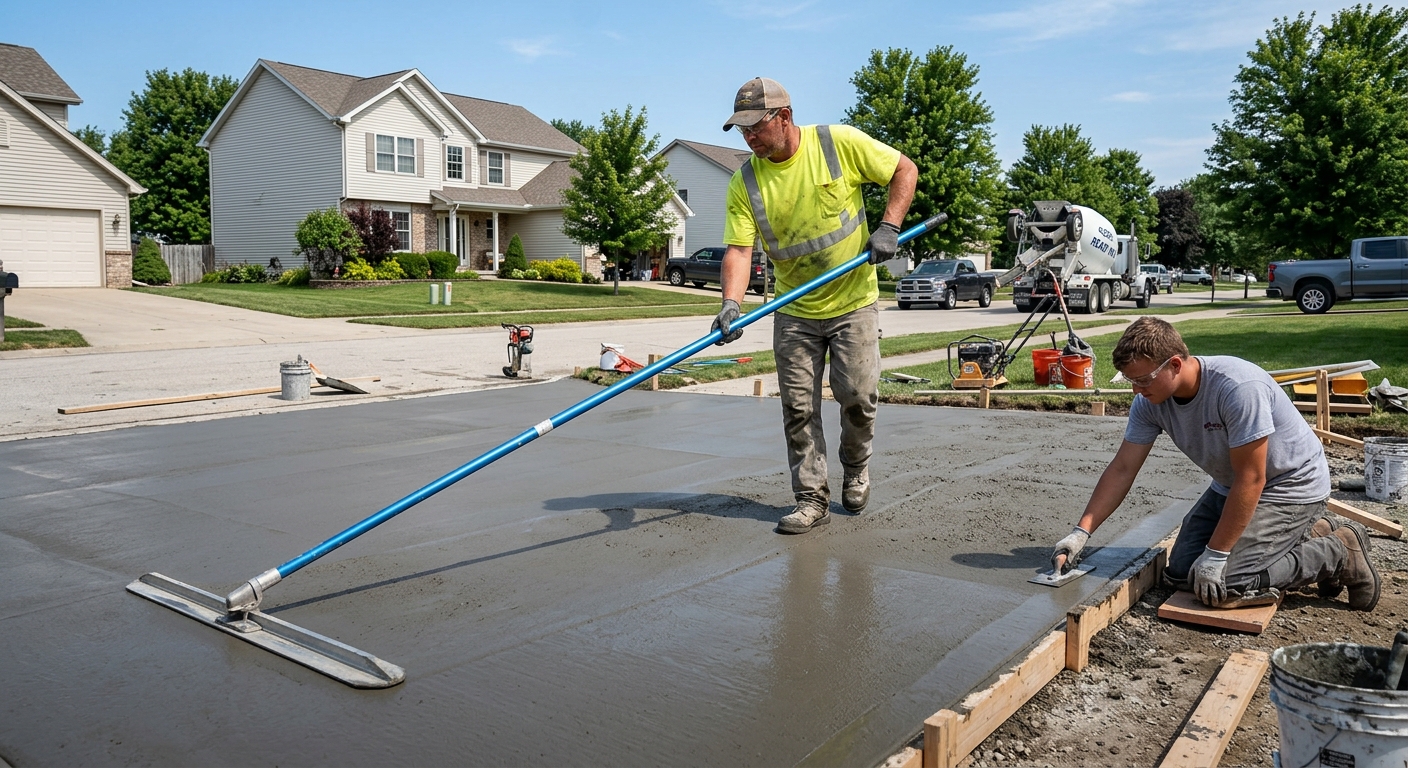
Concrete work options and costs in North Saanich
Concrete work in North Saanich is a common upgrade for homeowners, especially where driveways, patios, and walkways connect older homes to modern landscaping. North Saanich has 12,235 residents (Statistics Canada, 2021 Census), and the housing stock is heavily dominated by single-detached homes—79.2% of dwellings—so there’s steady demand for exterior concrete flatwork. With 4,405 homeowner households (87.9% of households own), many projects are planned as part of driveway replacements, backyard renovations, and foundation-related repairs.
On Vancouver Island and the Coast, pricing is shaped by our relatively shallow design frost line paired with frequent freeze–thaw cycles. That combination is why contractors here price the “invisible” parts of the job: proper granular base, air-entrained mixes, careful scheduling around rain/cold snaps, and control joints to reduce random cracking and scaling. Labour availability also affects turnaround time in areas like the McTavish/De Courcy corridor, where trades often have tighter calendars due to concurrent renovation seasons.
To help you compare apples-to-apples, below are typical, fully finished ranges for common North Saanich applications—from a standard broom driveway to exposed aggregate and stamped concrete. Use these ranges as a baseline, then refine with your site access, subgrade conditions, and the finish you want.
| Application |
Typical Size |
Key Spec |
Finish Option |
Price Range |
| Concrete driveway (standard broom finish) |
400 sq. ft. |
Air-entrained exterior mix, compacted granular base, control joints |
Broom finish |
$6,400 – $10,000 |
| Exposed aggregate driveway |
400 sq. ft. |
Air-entrained exterior mix, aggregate exposure, seal-ready surface |
Exposed aggregate |
$9,000 – $14,000 |
| Stamped concrete driveway or patio |
300 sq. ft. |
Air-entrained exterior mix, colour integral, release agent, sealer |
Stamped & textured pattern |
$7,000 – $12,000 |
| Plain concrete patio or walkway |
250 sq. ft. |
Air-entrained mix, compacted granular base, joints as required |
Float/trowel with broom edging |
$3,500 – $5,500 |
| Garage floor (interior slab) |
500 sq. ft. |
Vapour barrier (as applicable), reinforcement per design, proper curing |
Burnished/steel trowel |
$8,500 – $16,000 |
| Foundation footings (structural, below frost) |
Varies by home design |
Engineered sizing, excavation to below frost, forms & rebar cage |
Structural concrete |
$18,000 – $35,000 |
Prices are estimates only and vary by project scope, site access and material selection.
What affects the price of concrete work in North Saanich
The same concrete job can come in 30–50% different across Vancouver Island and Coast and across British Columbia because contractors aren’t just selling “cement”; they’re pricing excavation, subgrade remediation, mix design, forming, reinforcement, finishing labour, and weather protection. In North Saanich, we design for a shallow frost line but we still get freeze–thaw cycles, so exterior slabs and driveways need air-entrained concrete and a base that’s placed to the right depth and compaction. If the subgrade or granular base is off, you’ll see settlement, scaling, and cracking—often requiring costly repairs.
Frost line depth and freeze–thaw cycles dictate the spec: footings must extend below the design frost depth (coastal BC commonly uses roughly 0.5–1.2 m depending on conditions), and exterior flatwork needs air-entrained mixes to survive repeated wetting and freezing. When temperatures drop, cold-weather curing precautions—insulating blankets, curing protection, and sometimes mix or scheduling adjustments—add labour and materials. Also, de-icing salt accelerates surface spalling over time, so sealing isn’t “optional” for driveways in our climate; it’s part of long-term durability.
In practical terms, your quote can rise if you have poor soil conditions (extra base removal and replacement), complicated access (small back lanes or limited truck reach), or if you require reinforced slabs and additional joints. It can be lower when your site already has good drainage and you’re working with straightforward grades. For reference, a broom-finish driveway often tracks the regional $16–$25 per sq. ft. backbone, while stamped concrete typically lands in the higher range—commonly $22–$35 per sq. ft.—because of extra labour and finishing complexity.
| Price Factor |
Why It Matters |
Cost Impact |
| Frost line depth |
Determines footing depth and form height |
Higher depth = more excavation and concrete; major driver for foundation scopes |
| Site preparation |
Excavation, grading, compacted granular base |
Bad subgrade can add removal/replacement time and truckloads of base |
| Reinforcement |
Rebar or wire mesh requirement |
Material + labour for placement, spacers, and inspection |
| Mix design |
Air-entrainment and compressive strength spec |
Correct mix reduces scaling risk; wrong mix can fail early and cost more later |
| Finish type |
Broom vs. stamped vs. exposed aggregate |
Stamped/exposed adds labour, colour materials, and curing/sealing steps |
| Pour size and concrete truck access to site |
Impacts equipment, logistics, and how long pours take |
Restricted access can require smaller loads, extra labour, or pump truck fees |
| Cold-weather curing precautions |
Heating and blankets |
Added materials and labour during cold snaps can increase costs |
| Control joint pattern and sealing cost |
Controls cracking and protects from de-icing salts |
Better joint planning and sealing add line items but improve durability |
Permits & regulations in British Columbia
In British Columbia, structural concrete work typically needs the right permits and, in many cases, engineered drawings. Work such as concrete footings, foundation walls, and grade beams is generally considered structural and usually requires a building permit. Municipal review often checks that the design matches the approved drawings and local requirements. For concrete flatwork—patios, walkways, and driveways—permits are usually not required when the work doesn’t affect lot grading, impervious surface coverage limits, or the municipal right-of-way. That said, if you’re changing drainage patterns, raising/lowering grades near a boundary, or tieing into existing services, you should confirm requirements with the local authority before you break ground.
For homeowners in North Saanich, verify a contractor’s credentials before signing:
- Licence/registration: Ask what category of work they’re permitted to do and check their business information through the appropriate provincial registries (details vary by trade type).
- Liability insurance: Request a current certificate of insurance naming you correctly as an additional insured (where applicable) and confirm coverage limits.
- Workers’ compensation coverage: In BC, confirm WCB coverage (certificate or clearance documentation) before work starts.
- References: Request photos and contact info for similar North Saanich projects (driveways/patios in freeze–thaw conditions).
Once you’ve got the paperwork, compare it across contractors as carefully as you compare price—especially on foundations and any work near drainage or grades.
Getting concrete right in North Saanich's freeze-thaw climate
Concrete fails in North Saanich most often when the base isn’t prepared correctly or when the mix doesn’t have the air content needed to withstand freeze–thaw cycles. Even though coastal BC’s winters can feel mild, the repeated wetting/freezing pattern can still cause surface scaling and spalling—particularly when exterior slabs aren’t air-entrained. To spec the job correctly, start with five fundamentals.
(1) Base preparation: Compact a granular sub-base to the right depth for your soil and drainage conditions. The goal is stable support and control of water movement, not just “leveling.” (2) Mix design: Ask for an air-entrained exterior mix, typically 5–7% air content for exterior flatwork, and a minimum 32 MPa compressive strength rating (or higher where required by the engineered/design spec). (3) Control joints: Joint spacing must limit random cracking; they’re not cosmetic. (4) Curing: Plan for at least 7 days of proper curing protection—cool or rainy conditions slow strength gain and increase early surface damage risk. (5) Sealing: Use a penetrating sealer applied after cure (commonly 28 days post-pour) to repel de-icing salts and reduce water uptake.
A common homeowner decision is “broom finish vs. stamped.” Stamped typically costs more (often in the $22–$35 per sq. ft. range), but it can be justified for a 300 sq. ft. patio: you might pay roughly $7,000–$12,000 for stamped versus around $3,500–$5,500 for plain at similar sizes. If your main goal is durability for winter traffic, a broom finish with correct joints, air-entrainment, and sealing frequently offers the best long-term value.
| Spec |
Why It Matters in North Saanich |
What to Ask For |
Impact if Skipped |
| Compacted granular base (depth?) |
Stable support and drainage control through wet/dry cycles |
Base depth and compaction method/targets for your subgrade |
Settlement, cracking, and premature scaling |
| Air-entrained concrete mix (target air %?) |
Helps concrete resist freeze–thaw damage |
Air content target of 5–7% for exterior flatwork |
Spalling and surface deterioration |
| Compressive strength (MPa rating) |
Achieves required durability and long-term performance |
Minimum 32 MPa (confirm per your design) |
Weak early strength, higher risk of surface damage |
| Control joints (spacing per ACI guidelines) |
Manages cracking locations in freeze–thaw conditions |
Proposed joint spacing and cutting schedule |
Random cracking and appearance issues |
| Minimum 7-day curing period |
Curing supports strength gain in cool, wet seasons |
Curing protection plan (covers/blankets as needed) |
Reduced strength and damaged surface finish |
| Penetrating sealer (when applied after cure) |
Repels moisture and helps protect against de-icing salts |
Sealer applied after cure, commonly 28 days post-pour |
Higher water absorption and faster spalling risk |
How to choose a concrete work contractor in North Saanich
Choosing the right concrete contractor in North Saanich comes down to proof of capability, not just a number on a quote. First, verify British Columbia coverage and compliance. Ask for a certificate of liability insurance (current date, coverage limits, and project/location details) and confirm WCB coverage for workers. Most reputable contractors can provide clearance or documentation on request before the first pour. For licensing, ask what trades/building permit activities they handle and confirm they’re eligible for the scope you need—especially for foundation-related work that may require permits and engineered drawings.
Then get 2–3 itemised written quotes. You want a labour + materials breakdown, including excavation/disposal, granular base supply, reinforcement, concrete mix spec (air-entrainment), forming, finishing, joints, and sealing. Look for what’s excluded: is demolition included? Is permit pulling included (if required)? Is disposal haul-off included? Does the price assume normal access (no pump, no extra equipment, no night work for weather delays)?
Ask about warranty terms: workmanship warranty length, whether manufacturers’ warranties apply to products (e.g., sealers/colours), and whether coverage is transferable if you sell your home. Payment scheduling should be conservative—no more than 10–15% upfront, with a holdback until key items are complete. Finally, insist on a written timeline: a start date, weather contingency approach, and an estimated completion window.
- Upfront, written scope: thickness, base prep, reinforcement, and joints
- Concrete mix spec in writing (air-entrained for exterior)
- Proof of liability insurance and WCB coverage
- Photos of similar North Saanich freeze–thaw projects
- Clear allowance for demolition and disposal (or an explicit exclusion)
- Drainage plan: how water won’t pond on your slab
- Forming and edge details for longevity and neatness
- Joint cutting timeline (planned, not “as we get to it”)
- Curing and protection plan during cool/rainy weather
- Sealing included or scheduled at the correct post-pour timing
- Finish details: broom grade/surface texture or stamp/exposed aggregate method
- Payment schedule with a holdback until final cure/cleanup
Red flags in North Saanich include: refusing to specify air-entrainment for exterior work, quoting driveways without discussing granular base depth and drainage, offering “cheap sealing” that’s not applied at the right time, poor documentation of insurance/WCB, and pressure to pay large upfront deposits with no signed scope or timeline.
Frequently asked questions — concrete work in North Saanich
How much does concrete work cost in North Saanich?
In North Saanich, typical concrete flatwork pricing depends heavily on site prep, access, and the finish. For a concrete driveway, many homeowners land in the range of $6,400 – $10,000 for a standard broom-finished job around 400 sq. ft. Exposed aggregate and stamped finishes cost more because of additional labour and finishing steps; stamped driveway/patio projects commonly fall around $7,000 – $12,000 for a 300 sq. ft. scope. Plain patios and walkways are often more affordable, commonly $3,500 – $5,500 for about 250 sq. ft. On the foundation side, structural footings are a separate scope and vary widely with engineered design and excavation needs. (Statistics Canada, 2021 Census)
How deep must footings be for North Saanich's frost line?
For North Saanich (coastal BC), footings are designed to extend below the design frost depth to prevent frost heave. Coastal BC commonly assumes a frost depth roughly in the 0.5–1.2 m range depending on conditions, but your exact requirement depends on soil conditions, drainage, and the engineered foundation design. This is why quotes for footings should reference the drawings and frost depth basis rather than using a one-size number. If someone proposes shallow footings without an engineered basis, that’s a durability risk in a freeze–thaw climate. For homeowners, the best approach is to require the contractor to build exactly to the engineer’s spec and to confirm excavation and formwork plans match the approved foundation details.
Why does concrete crack in North Saanich and how is it prevented?
Concrete cracking in North Saanich is usually about restraint and movement: temperature changes, moisture changes, and—and most importantly—how the concrete is supported. Freeze–thaw cycles can worsen cracking if water penetrates and the mix isn’t correctly air-entrained. Prevention starts with a stable, compacted granular base; proper drainage so water doesn’t pond; and control joints that manage where shrinkage and movement will relieve stress. Air-entrained exterior concrete and correct curing help reduce early surface damage that can develop into cracking. When de-icing salts are used, surface protection matters too. Ask your contractor to specify air content, joint spacing, base prep, and the curing/protection plan in writing—these details are what keep driveway slabs looking good instead of developing random cracks over winters.
Stamped vs broom-finish concrete — cost difference?
Stamped concrete costs more than broom-finish because it requires additional labour, materials (colour systems and release agents), and careful finishing to achieve consistent pattern definition. In North Saanich, a broom-finished driveway in the regional band often lands around $6,400 – $10,000 for a typical sized scope, while a stamped driveway or patio commonly runs $7,000 – $12,000 depending on square footage and pattern complexity. The practical question isn’t just “which is cheaper?” but whether the finish is worth it for how you use the space. If you’re prioritizing maximum durability for winter traffic, both can be durable when the mix, base prep, joints, and curing are correct; stamped mainly adds aesthetic value at a higher installed cost.
When is the best time to pour concrete in North Saanich?
In North Saanich, the best time to pour is when temperatures stay reliably above cold-weather thresholds and you can control curing conditions. Rain is common on Vancouver Island and can complicate finishing and early curing, so contractors schedule pours around weather windows with protection plans. Even “milder” coastal winters can include cold snaps that slow strength gain; that’s when heating/blankets become necessary and costs can rise. For homeowners, ask for the contractor’s weather contingency: what happens if it’s too cold, too wet, or windy, and how they protect the slab during curing. In general, late spring through early fall often provides the smoothest path to a quality result, but a well-prepared contractor can still pour successfully in shoulder season with the right curing strategy.
How long does concrete take to cure?
Concrete curing depends on temperature and mix design, but for typical exterior flatwork in British Columbia, plan for meaningful strength gain over the first week. A common minimum is 7 days of proper curing conditions before you treat the slab as substantially ready for normal handling, and full performance continues to develop after that. For sealing, many contractors plan penetrating sealer around 28 days post-pour once the concrete has cured sufficiently to accept the product and reduce water uptake. If you skip curing protection in cool, damp conditions (a North Saanich reality), you increase the risk of weak surface laitance and later scaling/spalling. Ask your contractor to put the curing method in writing (covers/blankets, temperature targets, and when they will schedule sealing).