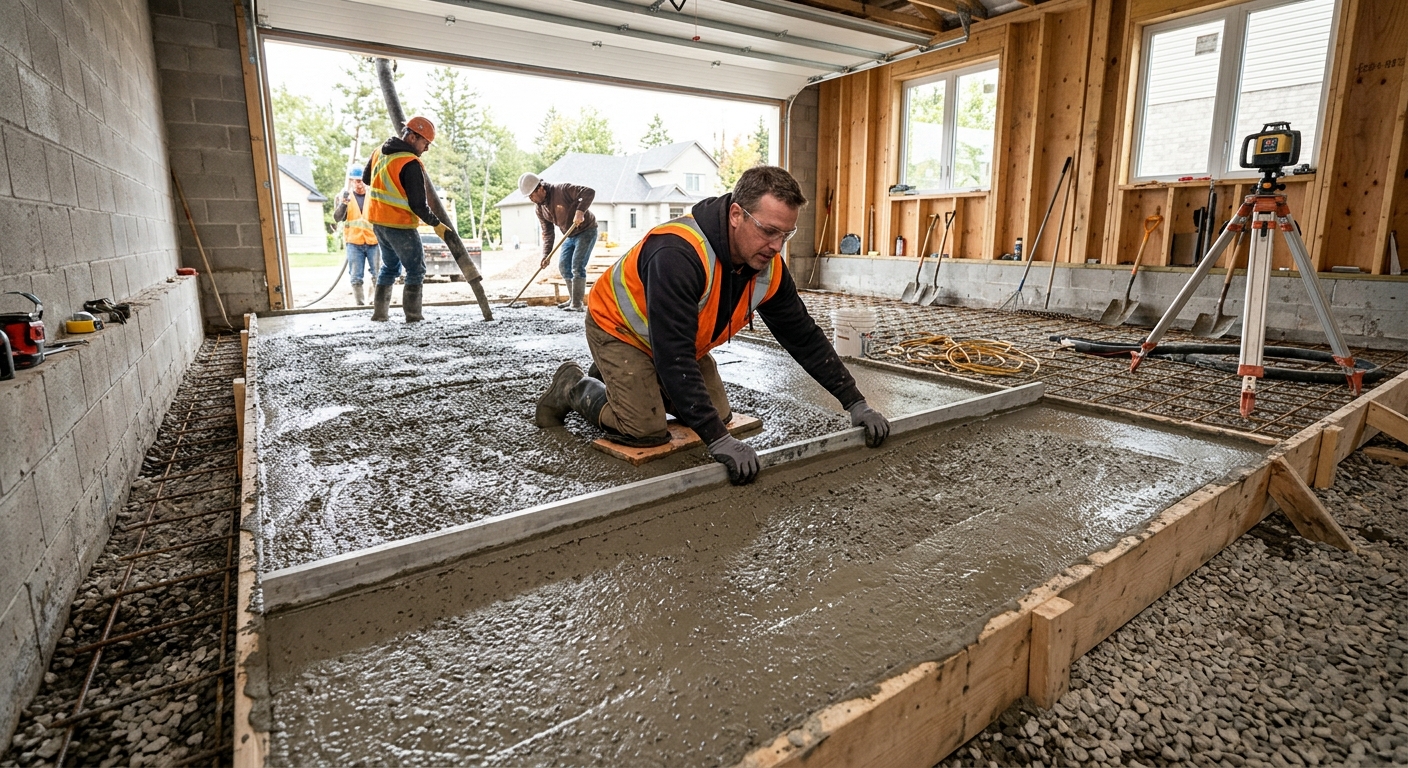
Concrete work options and costs in Golden Village
In Golden Village, British Columbia, homeowners typically choose concrete for durable flatwork because it holds up well to our coastal-wet weather and the freeze–thaw cycles that run through cold snaps. The local housing stock is heavily oriented toward single-detached homes, and the community’s population is about 2,855 people (Statistics Canada, 2021 Census), which usually means a steadier but smaller pool of concrete contractors than the big-city centres—so scheduling can matter as much as price. For many properties in Golden Village (especially around the river corridor and areas near the main services), driveways and patios are in constant demand because access and curb appeal often improve faster than landscaping for resale.
In the Lower Mainland–Southwest, mild winters and a shallow frost line still drive concrete design and costs. Local practice commonly assumes a frost depth around 450 mm / 18", so footings, piers, and thickened edges are placed below that to reduce frost heave risk. Freeze–thaw and saturated soils also mean base prep must include compacted granular and good drainage, and exterior slabs generally require air-entrained concrete plus properly placed control joints. Rain and cool, humid curing conditions can extend timelines and lead to added curing protection, which shows up in labour and materials.
Because these requirements are “baked into” the quote, the right comparison is by finish and structural spec, not just the total. Use the table below to anchor expectations before you call for an itemised estimate.
| Application |
Typical Size |
Key Spec |
Finish Option |
Price Range |
| Concrete driveway (standard broom finish) |
400–600 sq. ft. |
Air-entrained concrete, compacted granular base, control joints |
Broomed finish |
$7,200–$12,900 |
| Exposed aggregate driveway |
400–600 sq. ft. |
Air-entrained mix, proper base drainage, selected aggregate |
Exposed aggregate surface |
$9,000–$16,800 |
| Stamped concrete driveway or patio |
300–500 sq. ft. |
Air-entrained concrete, release agent system, integral colour |
Stamp + colour |
$8,100–$18,000 |
| Plain concrete patio or walkway |
200–400 sq. ft. |
Air-entrained concrete, compacted base, saw cuts |
Float/steel trowel + light broom edges |
$3,200–$9,800 |
| Garage floor (interior slab) |
300–500 sq. ft. |
Fibre or mesh, vapour considerations if required, flatness |
Plain trowel finish |
$6,600–$14,600 |
| Foundation footings (structural, below frost) |
Typical 1-storey house |
Reinforced concrete footings, excavation below design frost depth |
Structural concrete |
$12,000–$21,000 |
Prices are estimates only and vary by project scope, site access and material selection.
What affects the price of concrete work in Golden Village
In the Lower Mainland–Southwest, the same “concrete slab” can price 30–50% differently from one quote to the next, mainly because contractors don’t all include the same structural and durability requirements. In British Columbia, mild winters may sound inexpensive, but our real cost drivers are freeze–thaw cycles, saturated soils, and the need to build below the design frost depth. That means excavations, formwork height, and base prep often look similar to colder provinces even if the air temperature feels milder.
Specifically, local practice commonly assumes a frost depth around 450 mm / 18", so exterior footings and thickened edges are set below that to prevent frost heave. All exterior slabs typically use air-entrained concrete so the paste survives repeated freeze–thaw. When cold weather hits, the shorter pour season and cool nights can require cold-weather curing precautions—insulating blankets, curing control, and sometimes additional labour time—which adds cost. De-icing salt can also accelerate spalling if the mix and curing aren’t done correctly, so sealing and surface protection become part of the recommended durability plan.
Two examples you’ll see around Golden Village: (1) driveways on poorly drained slopes often cost more because base drainage and granular thickness get increased; (2) stamped concrete costs more than standard broom finishing, but it can be justified where you want colour and impact resistance—often pushing the project toward the stamped range (commonly $22–$36 per sq. ft. locally). On the other hand, if you keep it simple with plain patio work, you usually land closer to the typical concrete patio band (about $16–$26 per sq. ft.).
Finally, your home’s age can affect site conditions: older properties may have compromised drainage or uneven subgrade, which can add thousands in excavation and re-compaction to get a stable base before a pour.
| Price Factor |
Why It Matters |
Cost Impact |
| Frost line depth — determines footing depth and form height |
Footings must extend below design frost depth to prevent frost heave |
Higher excavation and deeper formwork can add significant labour and disposal costs |
| Site preparation — excavation, grading, compacted granular base |
Compacted base controls settlement and reduces cracking |
More hauling and granular material when subgrade is soft or wet |
| Reinforcement — rebar or wire mesh requirement |
Controls cracking and improves slab durability depending on use and loading |
Material and labour increases for thicker slabs, reinforcement, and tie-in work |
| Mix design — air-entrainment and compressive strength spec |
Air entrainment helps exterior slabs survive freeze–thaw |
Higher-quality mix and QC can add cost, but reduces future spalling risk |
| Finish type — broom vs. stamped vs. exposed aggregate |
Surface system affects material use and labour time |
Stamped and exposed work usually costs more than plain broom finished slabs |
| Pour size and concrete truck access to site |
Access determines pumping needs, labour, and schedule risk in wet weather |
Limited access can add pumps, smaller loads, and extra crew hours |
| Cold-weather curing precautions — heating and blankets |
Proper curing is critical when nights are cool or rain is frequent |
Added materials and labour to protect the pour and manage strength gain |
| Control joint pattern and sealing cost |
Joints reduce random cracking and sealing improves surface durability |
More saw cuts and sealant product/labour increases total, but protects edges and surfaces |
Permits & regulations in British Columbia
In British Columbia, the rule of thumb is: structural concrete generally needs municipal review, while typical decorative flatwork often does not. Concrete flatwork such as patios, walkways, and driveways usually does not require a permit by itself unless it affects lot grading, stormwater handling, or impervious surface coverage limits, or involves municipal right-of-way. By contrast, concrete that forms part of the structural system—such as foundation walls, grade beams, footings, and any engineered foundation elements—usually requires a building permit and often engineered drawings reviewed through the permit process.
For a homeowner in Golden Village, the practical steps are straightforward. First, ask your contractor to confirm whether your scope includes any permit-triggering structural work (footings, foundation walls, or grade beams) and whether they will obtain the permit. Next, verify the contractor is properly licensed for the work they’re doing, then confirm insurance.
To verify in BC, you’ll typically want to do all of the following: (1) check the contractor’s licensing status using the appropriate online registry for contractors; (2) request a Certificate of Insurance (COI) showing general liability coverage that matches the job value; and (3) ask for clearance documentation for work coverage obligations (commonly WSBC coverage, where applicable). If the contractor can’t provide current documents or references from similar-scale local concrete projects, treat that as a major red flag before you pay for any design or scheduling.
Getting concrete right in Golden Village's freeze-thaw climate
Concrete failures in Golden Village usually come down to three things: water management, mix durability, and curing. Our Lower Mainland–Southwest pattern of cool wet periods and freeze–thaw cycles can create freeze heave and surface scaling if the base isn’t properly prepared and the concrete isn’t specified for exterior exposure. To get it right, the job should be designed around five core steps: (1) base preparation with compacted granular sub-base to the right depth and grade for your soil and frost conditions; (2) a mix design that includes air-entrainment—typically 5–7% air for exterior flatwork—plus a minimum 32 MPa compressive strength; (3) control joints placed to limit random cracking; (4) curing for long enough to achieve strength under local conditions (often a minimum 7 days, with added protection in cool or rainy weather); and (5) sealing after curing (commonly after 28 days) with a penetrating sealer to reduce water and de-icer salt intrusion.
When homeowners skip air-entrainment or rush curing during a cool, humid stretch, spalling risk goes up quickly. A concrete driveway might still look “fine” at the start, but scaling and chipping often show up over the first winter cycle. You can ask hard technical questions: “What air content will you target in the load ticket?”, “How will you protect the pour at night?”, and “What joint spacing and curing plan do you follow for exterior slabs?”
Price-wise, the difference can be meaningful but defensible. For example, stamped concrete often costs more than plain patio work because it adds labour and integral colour; you might choose stamped at the higher band (about $22–$36 per sq. ft.) when you want a long-lasting colour system, versus a plain patio closer to the $16–$26 per sq. ft. band when appearance isn’t the priority. In both cases, the durability spec—base, air entrainment, joints, and curing—should not be “value engineered” out.
| Spec |
Why It Matters in Golden Village |
What to Ask For |
Impact if Skipped |
| Compacted granular base (depth?) |
Reduces settlement and water pumping toward the slab during wet/cold cycles |
Granular type and compacted depth, plus drainage/grade plan |
More cracking, uneven surface, and accelerated deterioration |
| Air-entrained concrete mix (target air %?) |
Protects the paste during repeated freeze–thaw cycles common in Golden Village |
Target air content typically 5–7% for exterior flatwork; confirm on ticket |
Spalling and scaling in early winters |
| Compressive strength (MPa rating) |
Controls strength gain and durability for loading and weather exposure |
Minimum 32 MPa compressive strength spec |
Surface wear, reduced long-term performance |
| Control joints (spacing per ACI guidelines) |
Directs shrinkage cracking and limits random cracks that let water in |
Planned joint spacing and whether saw-cut timing is followed |
Wider cracks, water intrusion, and freeze-related damage |
| Minimum 7-day curing period |
Strength development is slower in cool wet weather; curing protects the surface |
How the crew maintains curing conditions; protection plan for rain/cold |
Lower strength, dusting/weak surface, higher failure risk |
| Penetrating sealer (when applied after cure) |
Repels water and helps reduce de-icer salt damage on exterior slabs |
Application schedule after cure (commonly after 28 days) and product type |
Faster staining and spalling progression |
How to choose a concrete work contractor in Golden Village
Start by verifying concrete contractor credibility the way you would in any British Columbia construction scope: licensing status (where applicable to the contractor’s trade), liability insurance, and work coverage documentation. For licensing, look for the contractor’s listing in the online registry for trades and confirm it matches the legal company name you’ll contract with. For insurance, request a current Certificate of Insurance (COI) before work begins and ensure general liability limits are appropriate for the project size. If the contractor will have employees or sub-trades on site, ask for proof of work coverage documentation (commonly WSBC clearance or coverage evidence, as applicable in BC). Then verify the contractor’s track record: request photos and references from similar jobs (driveways, patios, or structural footings) in your general area, not just big commercial portfolios.
Next, get 2–3 itemised written quotes. Ideally, the quote should break out labour and materials (demo/excavation, formwork, rebar/mesh, concrete supply, finishing, curing protection, and sealing), along with what’s excluded. Ask whether permits are included if structural concrete is involved. Also ask where disposal goes and whether topsoil reinstatement is included or left to you.
For warranty and payment schedule, keep it homeowner-friendly: confirm the workmanship warranty length and whether it’s backed by the company doing the work. Use a payment schedule that never pays more than 10–15% upfront, and hold back a portion until the punch list is finished and the finish protection is applied. Finally, get a firm start date and realistic completion estimate in writing—especially during rainy weeks when curing protection and scheduling can change.
- Ask for a load-ticket approach: air content target and compressive strength spec for exterior slabs.
- Confirm base prep includes compacted granular and drainage/grade, not just “we’ll dig and pour.”
- Request joint layout details (where they cut, and timing for saw cuts).
- Verify reinforcement approach for your use (wire mesh vs. rebar, slab thickness assumptions).
- Ensure curing protection is described for cold nights or wet weather scheduling.
- Ask what finish method is included (broom, trowel, stamp system, or exposed aggregate process).
- Confirm sealing: product type and application timing after cure (commonly after 28 days).
- Get itemised disposal and haul-away included or clearly excluded.
- Clarify concrete truck access and whether pumping/short-load handling is included.
- Review the schedule: hold points for inspection or at least crew setup confirmation.
- Check warranty terms in writing, including what happens if cracking/spalling appears.
- Match the quote to your chosen band: plain patio vs. driveway vs. stamped work.
Concrete contractor red flags in Golden Village: vague scope (“we’ll pour concrete” with no base/joint/air details), missing COI or inability to provide current work coverage documentation, quotes that are far below the typical patio/driveway bands without explaining the spec changes, no written cure/sealer plan for exterior flatwork, and no clear start date/completion schedule for a rainy-season pour.
Frequently asked questions — concrete work in Golden Village
How do I prepare the base for a concrete slab?
For a concrete slab in Golden Village, base prep is where durability is won or lost. A good contractor will excavate to the design depth, then place compacted granular sub-base in lifts, compacted to a level that matches your soil conditions. Because Lower Mainland–Southwest conditions can bring saturated subgrade and freeze–thaw cycles, drainage and grade matter: the slab should shed water away and not trap moisture under the concrete. Ask what base depth and granular type they propose, and whether they include proper compaction testing or at least a compaction plan. If your property has older drainage issues or soft spots, base work can be the main cost driver versus just the concrete supply. A well-prepped base is what lets both plain patio work (often within the $16–$26 per sq. ft. band) and driveway slabs perform for years.
How do I compare concrete quotes?
When comparing quotes in Golden Village, compare scope and spec first, not just the total. An apples-to-apples quote should spell out: excavation and granular base depth, whether the work includes reinforcement (mesh or rebar), the concrete mix requirements (especially air entrainment for exterior slabs), control joint pattern, curing protection, and whether sealing is included. Ask to see a breakdown of labour vs. materials and confirm concrete access assumptions (truck reach, pumping, and cleanup). It’s also normal for stamped and decorative work to land higher—stamped driveway/patio is commonly in the $22–$36 per sq. ft. range—so don’t compare stamped pricing to a plain broom driveway and assume the difference is “profit.” If a quote looks too good to be true, look for the missing durability items that protect against freeze–thaw spalling and cracking.
Can concrete be poured in cold weather in Golden Village?
Yes, concrete can be poured in cold weather in Golden Village, but it must be managed correctly. The key is controlling temperature and curing so the concrete reaches the required strength without freezing too early. In the Lower Mainland–Southwest, cold snaps and wet, cool nights still trigger the need for cold-weather precautions—like insulated blankets, curing protection, and sometimes heating to maintain safe temperatures during early set. A contractor should also adjust scheduling to reduce exposure time after placement, and they should specify the curing plan in writing. If the forecast is calling for significant cold overnight, expect additional steps and possibly added labour to protect the pour. A rushed pour can lead to surface dusting and long-term durability problems, especially because freeze–thaw cycles can exploit weak, under-cured concrete.
How do I maintain concrete in Golden Village's freeze-thaw climate?
Maintenance in Golden Village is mostly about water and de-icing control. Keep runoff directed away from the slab, and promptly clear debris so water doesn’t pool at edges and joints. For exterior flatwork, sealing is a practical step: use a penetrating sealer applied after the cure period (commonly after 28 days) to reduce water and salt penetration. Avoid aggressive de-icing practices if possible; de-icing salts can accelerate surface spalling when the concrete isn’t sufficiently protected. Inspect seasonally for hairline cracks, joint separation, or spalls around edges—small issues are easier to repair early. Also, don’t apply sealing too soon; curing needs time. With the right air-entrained mix and jointing, your concrete can handle typical winter conditions, but sealing and good drainage help extend service life significantly.
What causes concrete to spall in Golden Village winters?
Spalling in Golden Village winters is usually caused by freeze–thaw damage combined with water intrusion and an inadequate durability spec. The most common technical culprit is insufficient air entrainment or poor quality control of the mix—air voids help relieve pressure as water freezes in the paste. Water can also enter through cracks and poorly formed joints, then expand during cold cycles, pushing the surface apart. Base problems contribute too: if the slab is on a weak or poorly drained sub-base, moisture moves toward the slab and increases freeze–thaw exposure. Curing issues can make matters worse because under-cured concrete is less durable at the surface. Ask contractors how they will control air content (confirm on the concrete ticket), how joints will be cut, and whether a penetrating sealer is planned for exterior work. These steps are especially important for driveways and patios exposed to de-icing salts.
What is rebar and when is it required in British Columbia?
Rebar (reinforcing steel) is used to improve a concrete slab or foundation’s ability to resist cracking and to manage structural loads. Whether it’s required depends on the structure type, slab thickness, soil support, and the engineering design. For structural concrete in British Columbia—like footings, foundation walls, or grade beams—reinforcement is typically specified by engineered drawings and is part of the structural system that helps resist bending and stress. For exterior flatwork like driveways and patios, some projects use welded wire mesh, fibre reinforcement, or rebar depending on thickness and expected loads. A good contractor should explain what reinforcement they’re proposing and why, and include it in the quote scope rather than assuming all slabs get the same steel. If your quote for driveway work is significantly lower than the typical driveway band (often $18–$28 per sq. ft.), double-check whether reinforcement and base prep are being reduced or omitted.