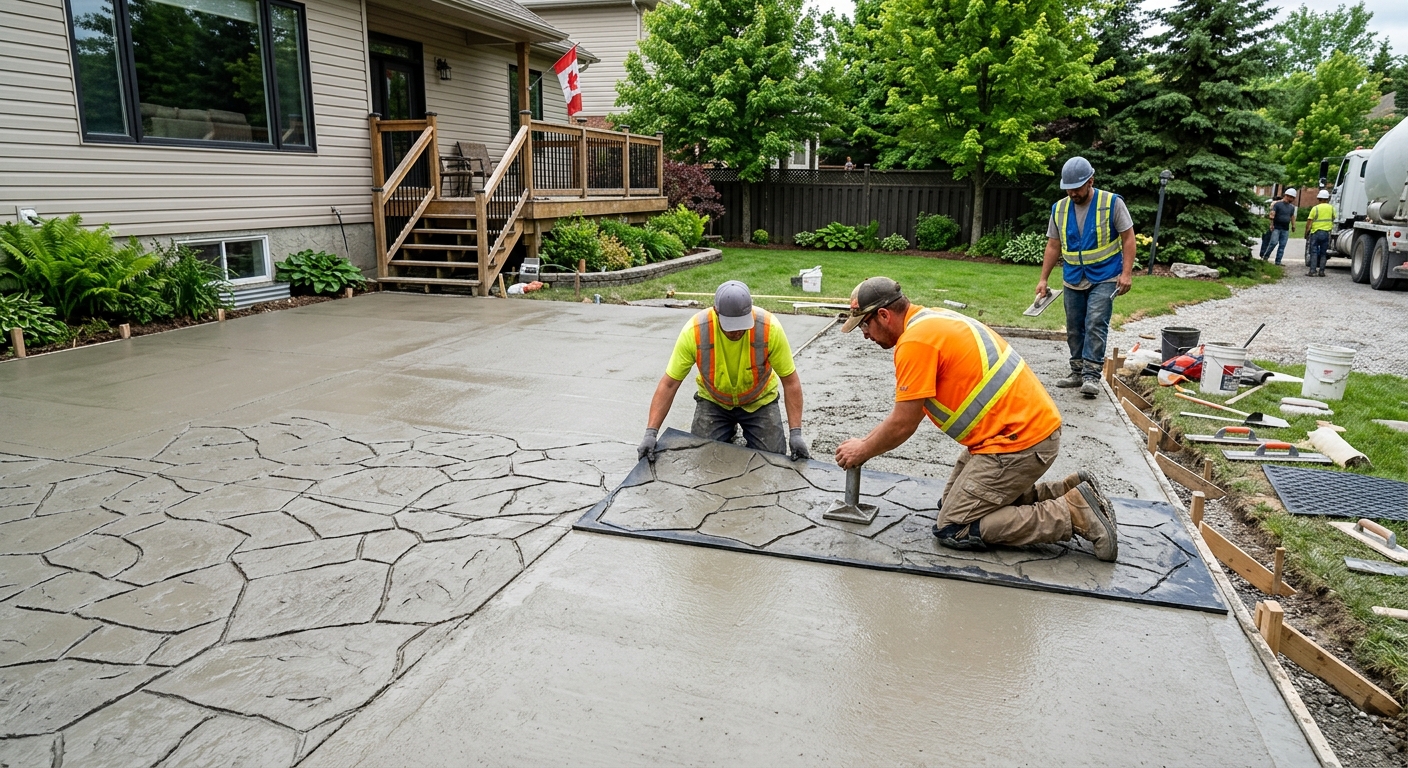
Concrete work options and costs in Seafair
Seafair is a great place for concrete flatwork, but homeowners pay attention to details because Lower Mainland–Southwest conditions are tougher than they look. With a population of 16,070 (Statistics Canada, 2021 Census), the area’s steady housing demand keeps scheduling tight for driveways and patios. In practical terms, many projects are in established residential pockets where upgrades to existing lots are common—especially where single-detached and older homes drive the need for new exterior slabs and thicker edges that can handle wet winters. The Lower Mainland–Southwest climate is mild overall, yet we still get freeze–thaw cycles, saturated soils, and frequent coastal rainfall. That combination affects every step: we excavate and build the base for drainage, we set footings below the local frost depth (typically around 450 mm / 18"), and we use air-entrained concrete plus proper control joints to reduce cracking and scaling. It also influences contractor availability and lead times because rain can interrupt finishing and because curing sometimes takes longer to reach target strength in high humidity and cool nights.
Costs also depend on what you’re building and how durable you want the surface to be. For example, a plain broom-finished driveway can fall near the $18–$28 range, while decorative work like stamping or exposed aggregate usually runs higher because of added labour, colour/material choices, and more complex prep. To help you compare quotes, use the table below for typical Seafair pricing and specifications.
| Application |
Typical Size |
Key Spec |
Finish Option |
Price Range |
| Concrete driveway (standard broom finish) |
12’ x 20’ (240 sq. ft.) |
4" slab, compacted granular base, air-entrained mix, control joints |
Broom finish, light edging/sealer |
$18,000–$28,000 |
| Exposed aggregate driveway |
12’ x 20’ (240 sq. ft.) |
4" slab, air-entrained mix, richer stone blend, cure/ wash process |
Exposed aggregate with colour options |
$22,000–$34,000 |
| Stamped concrete driveway or patio |
12’ x 20’ (240 sq. ft.) |
4" slab, base prep, air-entrained mix, colour hardener/release |
Stamp pattern, integrated colour, border detailing optional |
$26,000–$42,000 |
| Plain concrete patio or walkway |
10’ x 15’ (150 sq. ft.) |
4" slab, compacted granular base, air-entrained mix, joints as required |
Smooth or broom finish, sealer recommended |
$12,000–$26,000 |
| Garage floor (interior slab) |
20’ x 20’ (400 sq. ft.) |
4" slab, ground vapour protection, mesh or rebar as specified |
Light broom or power trowel, jointed for shrinkage |
$10,000–$20,000 |
| Foundation footings (structural, below frost) |
Per typical home (project-dependent) |
Excavation to below ~450 mm / 18" frost line depth, reinforced concrete |
Engineered formwork and rebar placement |
$4,500–$12,000 |
Prices are estimates only and vary by project scope, site access and material selection.
What affects the price of concrete work in Seafair
In the Lower Mainland–Southwest region, you can see the same “driveway replacement” priced quite differently—often by 30–50%—because concrete quotes aren’t just the slab. They’re the total system: excavation, subgrade drainage, granular base thickness and compaction, frost-protection depth planning, reinforcement detailing, mix design, finishing time, and curing in coastal humidity. The reason this swings more than people expect is that Seafair projects routinely involve saturated ground, tight access lanes, and scheduling around rain. Contractors who include robust base prep and winter-ready curing typically price higher, but that’s exactly what protects your slab from years of freeze–thaw cycling and scaling.
Frost line depth and freeze–thaw cycles dictate the specifications. In coastal BC we plan around a frost depth of roughly 450 mm / 18", but footings and thickened edges are still set below the design depth to prevent frost heave. Exterior slabs also need air-entrained concrete—commonly with about 5–7% air content—so the paste survives repeated wetting and temperature swings. If you pour in colder stretches, cold-weather curing precautions (insulating blankets, heat where required, longer cure strategy) add cost because crews must protect concrete until it reaches strength. Finally, de-icing salt can accelerate surface spalling, which is why sealing is a standard recommendation.
Two common Seafair examples: (1) a straightforward broom-finished driveway may land near the $18–$28 band, but moving from broom to stamped typically adds labour for form-and-finish sequencing and colour work (often pushing into the $22–$36 decorative band). (2) If your site has poor drainage or high groundwater, base prep and added granular/pipe work can raise the bill even if slab size stays the same. For older neighbourhood homes and infill lots, tight slopes and existing tie-ins can also add forming and disposal costs—sometimes several thousand dollars—compared with a flat, easy-access backyard.
| Price Factor |
Why It Matters |
Cost Impact |
| Frost line depth — determines footing depth and form height |
Protects against frost heave in freeze–thaw seasons |
Higher depth/forms increase excavation and concrete volume |
| Site preparation — excavation, grading, compacted granular base |
Drainage and load support prevent settlement and premature cracking |
More grading/haul/disposal can add substantial labour and equipment |
| Reinforcement — rebar or wire mesh requirement |
Controls cracking and improves durability under load |
Material plus placement labour; cost increases with thicker slabs and dowels |
| Mix design — air-entrainment and compressive strength spec |
Air voids resist freeze–thaw damage in exterior slabs |
Typically modest per-metre cost, but required for lasting exterior performance |
| Finish type — broom vs. stamped vs. exposed aggregate |
Finish affects labour hours and material complexity |
Decorative finishes commonly add the most cost (often in the $22–$36 band) |
| Pour size and concrete truck access to site |
Access controls pumping, hose time, and crew efficiency |
Pump/long hose may add truck charges and labour |
| Cold-weather curing precautions — heating and blankets |
Helps concrete reach strength before harmful exposure |
Heaters/blankets and longer protection days raise costs |
| Control joint pattern and sealing cost |
Joints manage shrinkage cracking; sealer improves surface durability with salt |
Sealer and additional saw-cut labour add line-item cost |
Permits & regulations in British Columbia
In British Columbia, the permit and review requirements depend on whether your concrete is considered part of the structure. Structural concrete work—such as footings, foundation walls, grade beams, and other elements that support the building—typically needs a building permit, and engineered drawings are often reviewed by the municipality. By contrast, concrete flatwork (driveways, patios, and walkways) usually does not require a permit unless it affects lot grading, roof/ground-water drainage direction, impervious surface coverage limits, or the municipal right-of-way (for example, work that touches boulevard areas). Because every lot is different, confirm with your local authority before breaking ground in Seafair.
Just as important as permits: verify the contractor is properly insured and accountable. Start by asking for their liability insurance certificate (and make sure it includes your project address and an appropriate limit). For workers, confirm coverage under the workplace safety requirements applicable in BC—your contractor should provide proof of coverage and be able to show documentation on request. Then ask for references on similar-scale projects (especially exterior slabs built in wet coastal conditions).
Step-by-step for homeowners: (1) search the contractor’s business/contractor listing in BC through the provincial registry or their posted registration details; (2) request their certificate of insurance and review policy dates/limits; (3) ask for proof of workplace coverage (clearance or equivalent proof paperwork); (4) request project references with photos from similar freeze–thaw exposure; and (5) confirm whether a permit is required for your scope before starting excavation.
Getting concrete right in Seafair's freeze-thaw climate
Concrete failure in Seafair usually isn’t the slab “cracking once”—it’s premature deterioration from moisture, salt, and temperature swings. The fix is to spec and build the full assembly: base prep, correct mix design, sensible jointing, and curing that matches our cool, wet shoulder seasons. In the Lower Mainland–Southwest market, we still plan for freeze–thaw cycles, saturated soils, and prolonged rainfall, so the job can’t rely on luck or a rushed pour.
(1) Base preparation: build a compacted granular sub-base to the right depth for local soil conditions and drainage. Even with a frost depth around 450 mm / 18", the slab still needs a stable platform that won’t pump fines or hold standing water. (2) Mix design: use air-entrained concrete with target air content typically around 5–7% for exterior flatwork, and specify minimum 32 MPa compressive strength so the mix performs over time. (3) Control joints: cut joints at spacing that limits random cracking; if you skip a plan, cracks will form where they’re weakest—often around transitions and stress points. (4) Curing: plan at least 7 days of curing under proper conditions; in cold weather, crews may insulate and protect to hit strength targets. (5) Sealing: apply a penetrating sealer after the concrete is cured—commonly around 28 days—to repel de-icing salts and reduce moisture uptake.
A good way to prevent the most common failure—spalling—is to ask directly about air-entrainment and jointing. If someone quotes a driveway without discussing the mix and air content, that’s a red flag. As for cost justification: moving from plain broom to stamped can add roughly $4–$10+ per sq. ft. depending on thickness, pattern complexity, and colour work. If your stamped patio is well base-prepped and sealed, that premium is often worth it; but if the base and curing are weak, you’ll pay more and still get a surface that deteriorates.
| Spec |
Why It Matters in Seafair |
What to Ask For |
Impact if Skipped |
| Compacted granular base (depth?) |
Stability and drainage reduce settlement and moisture retention through freeze–thaw |
Granular type and compacted depth; how they address soft spots and runoff |
Cracking, pumping fines, early surface scaling |
| Air-entrained concrete mix (target air %?) |
Air voids protect paste from freeze–thaw scaling and pop-outs in wet winters |
Air-entrainment target (commonly ~5–7%) and mix design documentation |
Spalling and rapid deterioration when temperatures swing |
| Compressive strength (MPa rating) |
Adequate strength supports surface durability and long-term performance |
Minimum 32 MPa compressive strength and cure plan |
Surface wear, reduced durability, faster cracking |
| Control joints (spacing per ACI guidelines) |
Controls where shrinkage cracks occur in freeze–thaw exposure |
Joint layout and saw-cut timing; sealing approach for exterior joints |
Random cracking and water intrusion into micro-cracks |
| Minimum 7-day curing period |
Builds strength before wet/cold exposure hits |
How they protect during cool nights and rainy stretches |
Surface weakness, scaling, reduced overall strength |
| Penetrating sealer (when applied after cure) |
Repels moisture and helps resist salt-related spalling |
Sealer type and timing (commonly after cure, around 28 days) |
Higher moisture absorption and faster surface deterioration |
How to choose a concrete work contractor in Seafair
Choosing the right contractor in Seafair comes down to verification and transparency. Start with British Columbia licence/registration—ask the contractor for their business registration details and how they’re listed/verified for your type of work. Next, request their liability insurance certificate and confirm it’s current and covers the project scope and address. For jobsite protection, confirm they have appropriate workplace coverage for their workers; ask for proof paperwork and keep it on file before work begins.
Then get 2–3 itemised written quotes. Not “all-in lump sum” only—look for a breakdown showing labour, materials, base prep (including excavation and compacted granular base), reinforcement, formwork, finishing, curing/blankets if needed, and concrete disposal/haul-away. Ask whether a permit is included (if required for structural elements) and whether traffic control or right-of-way requirements apply to your frontage.
Warranty matters too: a workmanship warranty should state the duration and what it covers (for example, minor surface defects vs. full re-slab due to base failure). Also confirm whether any manufacturer/product warranty is provided and whether it transfers to you.
For payment, avoid large upfront amounts—generally keep deposits around 10–15% and use a holdback until completion and final walkthrough. Finally, require a written timeline: start date, curing/protection period expectations, and an estimated completion date that accounts for rain and cool nights.
- Ask for proof of BC registration/licence details before scheduling excavation.
- Request certificate of liability insurance and verify dates/coverage limits.
- Ask for workplace coverage proof (and save copies for your records).
- Get at least 2–3 quotes with itemised labour and material line items.
- Confirm how they’ll handle drainage and soft subgrade areas during excavation.
- Ask what air-entrainment target and compressive strength they’re using for exterior slabs.
- Confirm base compacted depth and granular specification, not just “we’ll prep properly.”
- Require a written joint plan (spacing and where joints will be placed).
- Ask about curing steps for cool nights and prolonged damp weather.
- Confirm sealing timing (commonly around 28 days) and whether sealer is included.
- Discuss truck access and whether pumping/extra hose time is included in the quote.
- Clarify what’s excluded (demo limits, disposal, wire mesh/rebar supply, repairs to existing edges).
In Seafair, watch for these red flags: (1) quotes that don’t mention air-entrained concrete for exterior flatwork; (2) “standard” footing/edge depths without frost-protection reasoning around local frost depth; (3) no joint layout or no plan for saw-cut timing; (4) payment requests higher than 10–15% upfront without a clear contract schedule; and (5) vague scope language like “surface will be finished properly” with no cure/sealer commitment.
Frequently asked questions — concrete work in Seafair
What is air-entrained concrete and why does it matter here?
Air-entrained concrete is mixed with tiny microscopic air bubbles that give water a place to expand when temperatures drop and then warm again. In British Columbia’s Lower Mainland–Southwest, we don’t always get deep freezes, but we do see freeze–thaw cycles, persistent moisture, and coastal humidity. That combination is hard on exterior slabs because trapped water can expand and damage the concrete surface, leading to scaling and spalling. For Seafair driveways and patios, air-entrainment is a key durability spec, typically targeting about 5–7% air content for exterior flatwork. It’s one reason quality exterior jobs may price closer to the $18–$28 driveway band, even when the slab thickness looks similar on paper. When a contractor skips air-entrainment, you may see problems sooner—especially where de-icing salt and wet winters combine.
How do I prepare the base for a concrete slab?
Base preparation starts with excavation to the right depth for your site conditions, then grading to promote drainage. In Seafair, the goal is to avoid a soft subgrade that holds water or settles after the pour. A good prep includes compacted granular material (often with a specified thickness and granular type), proper compaction passes, and attention to drainage paths so rain doesn’t pool under the slab. Your contractor should also identify soft spots, replace unsuitable soils if needed, and confirm reinforcement placement. Because exterior slabs are exposed to freeze–thaw and wet winters, the base isn’t “optional”; it’s part of the frost-protection system (footings and thickened edges below design frost depth, typically planned around ~450 mm / 18" in coastal BC). If base work is vague or missing from the quote, that’s usually where long-term cost increases begin.
How do I compare concrete quotes?
To compare concrete quotes in Seafair fairly, ask for itemised scope details instead of comparing only totals. Look for: the slab thickness (and whether it’s 4" for flatwork), the compacted granular base thickness, reinforcement (mesh or rebar), air-entrainment and minimum compressive strength, joint layout, and curing/finish steps. Also check logistics: concrete truck access, any pumping, and whether demo and disposal are included. For decorative work, confirm what’s included in the premium—colour hardener/release, pattern labour, and finishing time—because stamped concrete often moves into the higher portion of the decorative band (roughly $22–$36 per sq. ft. depending on scope). Finally, clarify timelines and protection: if rain or cold nights are expected, the quote should address curing blankets or equivalent measures. A low bid that skips these items may look cheaper today but costs more to repair later.
Can concrete be poured in cold weather in Seafair?
Yes, concrete can be poured in cold weather in Seafair, but it must be protected so it reaches strength safely and cures properly. British Columbia’s Lower Mainland–Southwest winters can bring cool nights, high humidity, and rain, which can slow strength gain and increase surface vulnerability. A reliable contractor will set up a cold-weather curing plan—this may include insulating blankets and, where needed, controlled heating—so the mix continues curing until it reaches the required strength. The quote should explicitly mention curing precautions (not just “we’ll pour and finish”). Also, timing matters: rainy windows can disrupt finishing schedules, so crews plan pour days around expected conditions. If a contractor tells you they can “always pour anytime” with no protection strategy, that’s a risk. In practice, cold-weather work may cost more, especially if protection and longer cure time are required to meet durability targets.
How do I maintain concrete in Seafair's freeze-thaw climate?
Maintenance in the Seafair area focuses on keeping moisture out and managing wear from traffic and winter conditions. Start with proper initial protection: for exterior flatwork, a penetrating sealer applied after curing (commonly around 28 days) helps repel water and reduce how easily de-icing salts penetrate the surface. After that, keep drainage clear—don’t allow downspouts or garden runoff to dump onto the slab. For winter, use salt responsibly; heavy salt use can accelerate surface spalling. Sweep debris regularly, and fix small cracks early if they open enough to let water in, because water plus freeze–thaw can expand damage. If you have joints, maintain the joint lines so water doesn’t migrate into the base. With the right specs—air-entrained mix, correct joints, and curing—concrete can last a long time, but routine care prevents small issues from turning into costly repairs.
What causes concrete to spall in Seafair winters?
Spalling happens when the concrete surface deteriorates in small flakes or layers, and in Seafair the usual drivers are moisture, de-icing salts, and freeze–thaw cycling. When water gets into the concrete and temperatures swing below and above freezing, that water expands and damages the surface. If the concrete mix isn’t properly air-entrained, the paste is less able to tolerate that pressure, and scaling/spalling can develop faster. Poor curing or finishing too early can also weaken the near-surface concrete, making it more vulnerable in wet winters. Base issues contribute too: if drainage is poor and the slab subgrade stays saturated, freeze–thaw stress increases. Finally, poorly planned joints can allow water to travel where it shouldn’t. If your contractor’s quote doesn’t mention air-entrainment, control joints, and curing/sealer timing, treat that as a serious quality gap—especially for exterior slabs that sit in the coastal-wet conditions common across the Lower Mainland–Southwest.