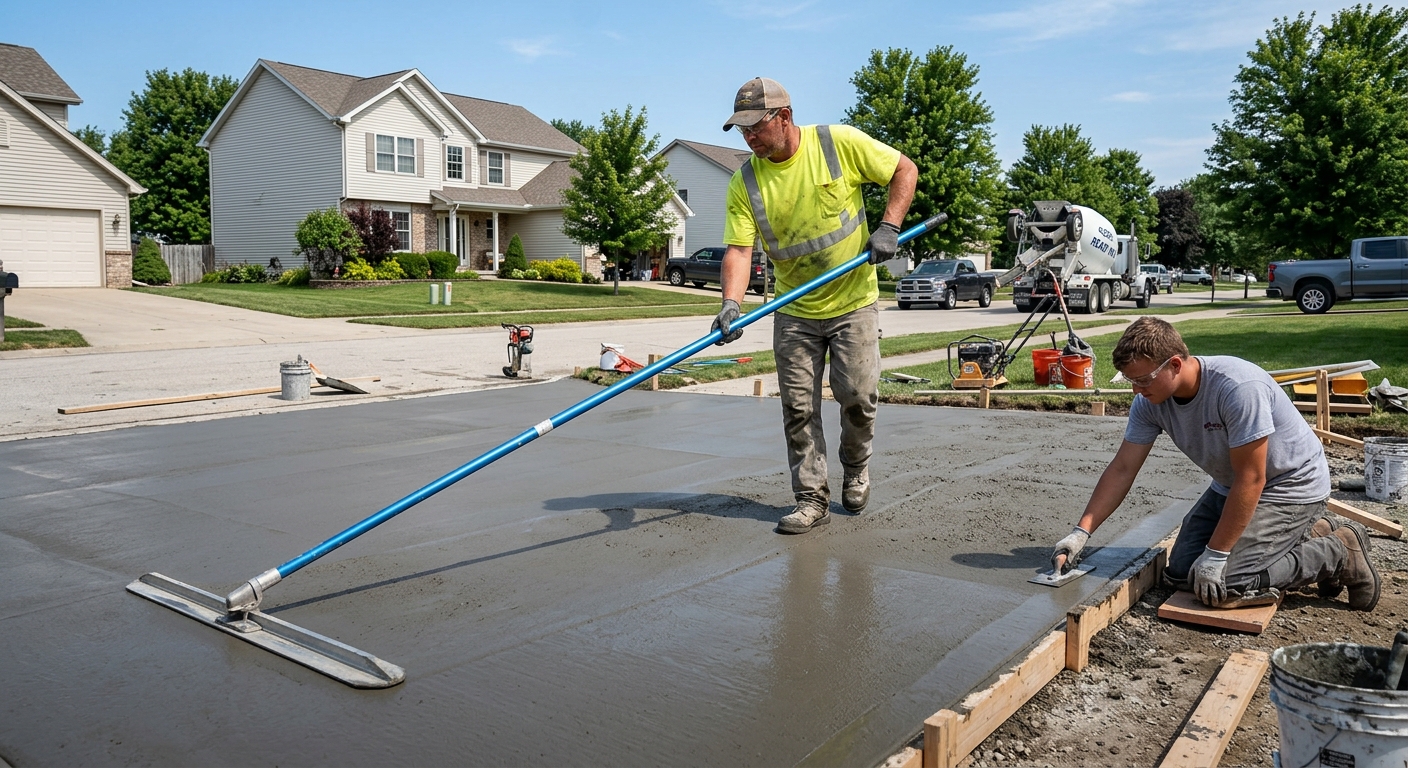
Concrete work options and costs in Champlain Heights
Concrete work in Champlain Heights often starts with a simple question: “What can I get for my budget?” The answer depends on your slab type, finish, and the specs needed to survive our coastal-wet freeze–thaw pattern. Champlain Heights is home to 11,958 residents (Statistics Canada, 2021 Census), and the neighbourhood’s housing stock is largely built around single-family living, which drives steady demand for driveways, patios, walkways, and garage slabs. In the Lower Mainland–Southwest, mild winters can make some homeowners assume concrete is “easy”—but costs still reflect the shallow frost depth and the real risk of freeze–thaw damage when saturated soils and poor drainage meet de-icing salts. In practice, we still place footings below the local design frost depth (commonly around 450 mm / 18") and we rely on air-entrained mixes, proper control joints, and curing plans that account for cool nights and high humidity.
Labour availability also affects pricing across the Vancouver–Surrey–Abbotsford corridor. When rain events stack up, crews schedule fewer pours and dispatching concrete trucks can get more expensive—especially on tight-access streets or where forms and rebar need extra staging. Neighbourhoods near high-traffic retail corridors and older lanes in Champlain Heights (around key collector roads) are often in demand because homeowners frequently update flatwork at the same time as landscaping and drainage improvements.
Below is a practical comparison of the most common options you’ll see in Champlain Heights, with realistic price ranges that contractors typically quote for this area. Use it as a baseline, then we’ll break down what changes the number in your quote.
| Application |
Typical Size |
Key Spec |
Finish Option |
Price Range |
| Concrete driveway (standard broom finish) |
24 ft x 10 ft (240 sq ft) |
4" slab, compacted granular base, air-entrained concrete, control joints |
Broom finish + edges |
$4,320–$6,720 |
| Exposed aggregate driveway |
24 ft x 10 ft (240 sq ft) |
4" slab, air-entrained mix, proper curing for surface durability |
Exposed aggregate (acid/retarder or wash method) |
$5,040–$7,680 |
| Stamped concrete driveway or patio |
20 ft x 12 ft (240 sq ft) |
4" slab, reinforced as needed, air-entrained mix, control joints built into pattern |
Stamp + colour hardener |
$5,280–$9,000 |
| Plain concrete patio or walkway |
12 ft x 10 ft (120 sq ft) |
4" slab, granular base, air-entrained concrete, joints |
Float/wood trowel with light broom |
$1,920–$3,120 |
| Garage floor (interior slab) |
20 ft x 22 ft (440 sq ft) |
4" slab, vapour barrier (as required), reinforcement/wire mesh or rebar |
Light broom or smooth trowel (as spec’d) |
$8,800–$13,200 |
| Foundation footings (structural, below frost) |
Typical 2-car house perimeter |
Below design frost, engineered sizing, rebar per drawings |
Concrete as per structural plan |
$14,000–$20,000 |
Prices are estimates only and vary by project scope, site access and material selection.
What affects the price of concrete work in Champlain Heights
Two contractors can quote the “same” concrete job and still come in 30–50% apart in the Lower Mainland–Southwest and across British Columbia. The biggest drivers aren’t only the slab thickness—they’re the engineered specs and site conditions that protect the concrete in our coastal-wet freeze–thaw environment. In most of BC, footings and thickened edges must be set below the design frost depth to prevent frost heave, and our practice often assumes frost depth around 450 mm / 18". When the excavation, forms, and reinforcement requirements change, you see real labour and material differences quickly. Exterior slabs also require air-entrained concrete to survive repeated freezing and thawing when soils stay saturated.
Quoting differences also come from seasonal constraints. Lower Mainland–Southwest has a longer pour season than colder BC regions, but we still plan around prolonged rain, cool nights, and high humidity, which can extend curing time and sometimes require blankets or sealers to maintain surface quality. In colder regions, heating and insulating blankets can push costs higher; in Champlain Heights, it’s often less extreme than the north, but it still shows up when crews pour late in the year. Finally, de-icing salt accelerates surface spalling on inadequately protected surfaces—so sealing and the right mix design are not optional if you want durability.
Local examples in Champlain Heights: a driveway over older, poorly drained soil may require extra granular excavation and improved drainage before you ever get to “the slab,” nudging a standard broom finish from roughly the $18–$28/sq ft band toward the higher end. On the other hand, a straightforward 120 sq ft patio on stable grade might stay near the lower $16–$26/sq ft band if base prep is minimal and truck access is easy.
| Price Factor |
Why It Matters |
Cost Impact |
| Frost line depth — determines footing depth and form height |
Footings must extend below design frost to prevent heave |
Higher excavation and forms; can add major labour cost |
| Site preparation — excavation, grading, compacted granular base |
Poor base leads to settlement and cracking |
More time and granular supply pushes pricing up |
| Reinforcement — rebar or wire mesh requirement |
Controls cracking and improves slab performance |
Material + labour; price varies with slab use and spans |
| Mix design — air-entrainment and compressive strength spec |
Air-entrainment resists freeze–thaw scaling |
Better mix may cost more per yard, but reduces failure risk |
| Finish type — broom vs. stamped vs. exposed aggregate |
Decorative finishing increases labour and curing attention |
Stamped/exposed typically commands a higher total range |
| Pour size and concrete truck access to site |
Small access constraints can require pumping or extra staging |
May add equipment, labour, and coordination costs |
| Cold-weather curing precautions — heating and blankets |
Protects strength gain and surface durability |
Can increase costs when nights are consistently cool |
| Control joint pattern and sealing cost |
Joints guide cracking; sealing reduces salt/impact damage |
Often overlooked; adding them improves lifespan |
Permits & regulations in British Columbia
In British Columbia, structural concrete work—things tied directly to supporting the building—typically requires a building permit, and in many cases engineered drawings must be reviewed by the municipality. That means concrete for footings, foundation walls, and grade beams usually falls into the “permit/engineer” bucket. Concrete flatwork like driveways, patios, and walkways often does not require a permit by default, unless the work changes lot grading, triggers impervious surface coverage limits, or affects municipal right-of-way conditions (for example, edges near a boulevard or sidewalk tie-ins). Before breaking ground, confirm requirements with your local authority—even if the contractor says “we’ve done this before.”
For hiring in Champlain Heights, verify these items step-by-step:
- Check the contractor’s licence/registration status using the BC government business registry or the appropriate trades registry listing for your contractor category (then confirm it matches the name on the quote).
- Request an insurance certificate of liability coverage and ensure it lists the correct insured party and the job address (ask for the latest date).
- Ask for proof of worker coverage for the province: WSIB/WCB clearance letter or equivalent documentation (and don’t rely on verbal confirmation).
- Collect references for similar-scale concrete pours in the Vancouver–Surrey–Abbotsford area and ask to see finished surfaces after winter.
If it’s a structural pour, request how permits and inspections will be handled before the first excavation.
Getting concrete right in Champlain Heights's freeze-thaw climate
In Champlain Heights, concrete tends to fail for predictable reasons: moisture gets trapped, freeze–thaw cycles expand and contract pore water, and de-icing salts speed up surface breakdown. The fix is not “stronger looking concrete”—it’s the right system: base preparation, the right air-entrainment, deliberate control joints, correct curing, and sealing. For base prep, we excavate to the plan grade and place a compacted granular sub-base that’s sized for local soils and designed drainage; if you under-compact or leave soft spots, the slab will settle and crack—even with a premium finish.
For mix design, exterior flatwork should use air-entrained concrete with a typical target air content of about 5–7% for freeze–thaw durability, plus a minimum 32 MPa compressive strength. Control joints should be placed to limit random cracking; they’re not just “cosmetic,” they’re the map that tells the concrete where to crack under shrinkage and temperature movement. Curing matters: minimum 7-day curing under proper conditions helps reach the strength required for durability, and in cool, damp stretches we protect the surface with curing blankets or similar measures to avoid early temperature swings. Finally, apply a penetrating sealer after cure—typically around 28 days post-pour—so de-icing salts don’t attack the surface.
Here’s a dollar example from the field: upgrading a driveway from standard broom to stamped might add roughly $1,000–$2,300 total on a 240 sq ft pour. That’s justified when the base, mix, joints, and curing are already being done correctly. If a contractor is cutting corners on base prep or air-entrainment, you can spend more on stamping and still get spalling and premature scaling.
When you’re comparing quotes, ask what air content and curing plan they’re using. Most “failure stories” in our winters trace back to insufficient air-entrainment and rushed curing—not the decorative finish.
| Spec |
Why It Matters in Champlain Heights |
What to Ask For |
Impact if Skipped |
| Compacted granular base (depth?) |
Supports the slab and controls settlement under wet coastal soils |
Minimum compacted base depth per site condition; compact test or method |
Uneven settlement, cracking, and early edge failure |
| Air-entrained concrete mix (target air %?) |
Reduces freeze–thaw scaling and helps concrete resist salt exposure |
Target 5–7% air for exterior flatwork |
Higher risk of spalling/scaling in winter |
| Compressive strength (MPa rating) |
Ensures strength gain for durability in our cool, humid curing conditions |
Minimum 32 MPa (as spec’d for exterior use) |
Surface wear accelerates; poor long-term performance |
| Control joints (spacing per ACI guidelines) |
Controls where shrinkage and temperature cracking occurs |
Specific joint spacing and layout plan on drawings |
Random cracking that compromises water management |
| Minimum 7-day curing period |
Protects hydration and helps prevent early micro-cracking |
What curing method is used during cool nights and rain |
Reduced strength gain and lower surface durability |
| Penetrating sealer (when applied after cure) |
Repels de-icing salts and reduces moisture intrusion during freeze–thaw |
Penetrating sealer at ~28 days post-pour |
Salt scaling/spalling risk increases |
How to choose a concrete work contractor in Champlain Heights
Start by verifying the contractor’s provincial standing and insurance. In British Columbia, you should request proof that they are properly licensed for the trade category they’re performing and that their liability coverage is current and matches your address. Ask for a certificate of insurance (COI) and check that it lists the correct legal name, effective dates, and that it includes general liability suitable for concrete work (including job-site activities like cutting and excavation). For worker coverage, request WSIB/WCB documentation or a clearance letter showing active coverage status—then confirm the paperwork is current, not expired.
For pricing, avoid “lump sum only.” Get 2–3 itemised written quotes that separate labour and materials (concrete supply, rebar/wire mesh, base materials, formwork, finishing, joints, sealer if included). Ask whether disposal is included for removed concrete and excavated soil, and whether the quote includes permit pulling if permits are required for structural work. A clear scope should also specify slab thickness, reinforcement type, joint plan, and curing/sealing steps.
Warranty matters: request workmanship warranty length and what it covers (cracks within reasonable limits, delamination, scaling due to mix problems, etc.). Also ask whether any manufacturer product warranty is included and whether it’s transferable to you as the homeowner.
Payment schedule: never pay more than 10–15% upfront. Hold back a portion until the final finish, cleanup, and documentation (if provided) are complete. Get a start date and completion estimate in writing—rain can change pour scheduling, but a good contractor will communicate impacts early and plan curing protection.
- License/trade registration info provided before the job is scheduled
- Current COI for liability with your address listed
- WSIB/WCB clearance or active coverage documentation
- Itemised quote (labour vs materials; base, reinforcement, finishing)
- Stated slab thickness and reinforcement type (mesh vs rebar)
- Concrete mix description including air-entrainment and strength spec
- Control joint spacing and where joints will be located
- Curing method explained for cool nights and rainy periods
- Sealer included or clearly excluded, with application timing
- Disposal and haul-away responsibilities clearly stated
- Permits and inspections responsibilities clearly identified
- Written schedule: start date, concrete day plan, completion timing
Concrete red flags in Champlain Heights include: promising “we’ll use whatever mix is cheapest” (no air content/strength spec), skipping or under-specifying control joints, claiming they can pour and “finish fast” without curing protection, avoiding discussion of drainage/base prep, or pressuring for large upfront payments. If you see any of these, slow down and ask for the technical details in writing.
Frequently asked questions — concrete work in Champlain Heights
What is air-entrained concrete and why does it matter here?
Air-entrained concrete is made with microscopic air bubbles intentionally distributed in the mix. In Champlain Heights and the broader Lower Mainland–Southwest, these bubbles create room for expanding water when temperatures drop, which is critical during freeze–thaw cycles and in saturated conditions after coastal rainfall. Without proper air-entrainment, concrete can scale and spall—surface flakes and chips—especially when homeowners use de-icing salts in winter. That’s why many exterior projects (driveways, patios, steps) use air-entrained concrete with a target air content commonly around 5–7%. When you compare quotes, ask for the mix spec (air-entrainment and strength), not just “concrete thickness.” For context, exterior broom-finish driveways often land around the $18–$28 band in Champlain Heights, but durability should be protected by the mix, not guessed. A cheaper quote that skips air content may look good short-term and cost more later.
How do I prepare the base for a concrete slab?
Base preparation is where most performance is won or lost. For a slab in Champlain Heights, the contractor should excavate to the required subgrade depth, remove organic/soft material, then place compacted granular base to the engineered thickness needed for local soils and load use. We also focus on drainage: the goal is to prevent water from pooling under the slab, because wet subgrades increase settlement risk and intensify freeze–thaw stress. Ask what granular material they will use (and how they will compact it), what the final grade tolerances are, and how they’ll handle low spots or existing soils that aren’t stable. For exterior flatwork, a well-built base typically means fewer cracks and less edge spalling. If you’re budgeting a patio in the $16–$26 band, base prep is still part of that number—don’t let “decorative finish” distract from the underlying compaction and drainage details.
How do I compare concrete quotes?
Start by comparing scope line-by-line instead of focusing only on the total. Ask for an itemised quote showing labour and materials: excavation/grading, compacted granular base, reinforcement (mesh vs rebar), concrete supply (including air-entrainment and strength), finishing, joints, and curing/curing protection. Confirm what’s included for disposal and whether any permit support is part of the scope. For example, a stamped driveway price may sit closer to the $22–$36 band, but only makes sense if the quote also specifies air-entrained mix, joint layout, proper curing, and sealing timing. If one contractor provides details and the other provides only “standard concrete,” that’s often where a 30–50% difference comes from across the Lower Mainland–Southwest. You should also check site access assumptions: will they need pumping, extra labour for forms, or additional staging due to tight access streets in Champlain Heights? Those details can change the real cost.
Can concrete be poured in cold weather in Champlain Heights?
Yes—concrete can often be poured in cold weather in British Columbia, including Champlain Heights, as long as the contractor protects the slab while it gains strength. The key is temperature management and curing control: cold nights can slow hydration, and if concrete freezes before it reaches sufficient strength, durability can suffer. A reputable crew will discuss cold-weather practices such as insulation blankets, curing protection, and—when needed—controlled heating to keep temperatures within acceptable limits during the early curing period. Also consider wind, rain, and damp conditions; cool and wet can affect set time and finishing. If you’re planning around late fall or early winter, ask how they schedule pours to maintain curing conditions and whether their quote includes curing protection for that season. Skipping cold-weather curing precautions is one reason patios or walkways may deteriorate faster, even if the initial finish looks fine.
How do I maintain concrete in Champlain Heights's freeze-thaw climate?
Maintenance in Champlain Heights is mostly about limiting moisture intrusion and protecting the surface from de-icing salts. After a driveway or patio is cured (often around 28 days for sealer application), use a penetrating sealer as recommended by the installer to reduce water absorption. During winter, use de-icing products carefully and try to limit salt dwell time; salt accelerates spalling when moisture repeatedly freezes and thaws within the surface pores. Keep gutters and downspouts directing water away from the slab edges to avoid saturation. Visually inspect joints and edges each season—small issues can often be addressed early with proper joint maintenance so water can’t get under the slab. If your contractor included sealing, ask for the product name and application date so you have a maintenance timeline. Well-built exterior concrete with air-entrainment and control joints typically lasts longer, but good drainage and sensible salt use protect that investment through our coastal-wet winters.
What causes concrete to spall in Champlain Heights winters?
Spalling (flaking, chipping, or scaling) in Champlain Heights winters is usually caused by a combination of moisture, freeze–thaw action, and salts—often made worse by inadequate mix design or early curing issues. When concrete lacks proper air-entrainment, the expansion of freezing water can break up the paste at the surface. Once de-icing salts are added, the damage accelerates because salts draw moisture in and stress the surface repeatedly through cycles. Another common cause is poor drainage or a base that stays wet, leading to repeated saturation of the slab edges. Control joints can also matter: if joints aren’t placed where cracking should occur, random cracks can become pathways for water. Finally, if concrete is poured and finished without maintaining curing protection during cool, damp periods, strength gain may be insufficient for long-term durability. When comparing quotes, insist on the air-entrainment and curing plan—those specs are what protect you beyond the decorative finish.