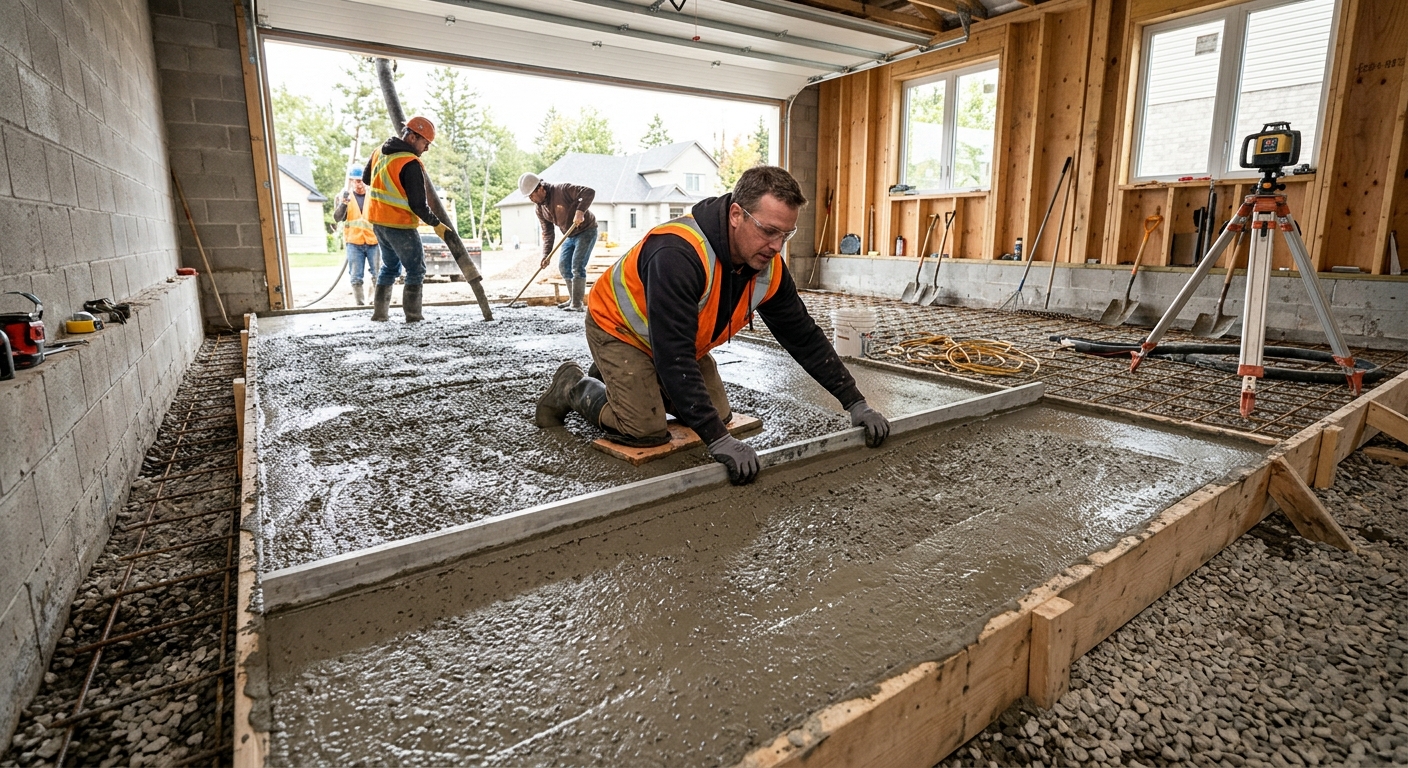
Concrete work options and costs in Chilliwack-Downtown
Concrete contractors in Chilliwack-Downtown get asked a lot about “the same job” at wildly different prices—mainly because the Lower Mainland–Southwest market designs concrete around a shallow frost line, frequent wet weather, and freeze–thaw cycles that punish poorly drained or under-spec bases. In a community of 31,410 people (Statistics Canada, 2021 Census), most flatwork demand comes from family homes and renovations where a new driveway, patio, or foundation upgrade adds real curb appeal and function. The largest volume of work is typically tied to single-detached neighbourhood streets in the Downtown/Agassiz-adjacent areas where driveways and grade transitions are common (Statistics Canada, 2021 Census).
In this region, we plan for footings and thickened edges placed below the design frost depth (commonly assumed around 450 mm / 18" for local code practice). That means excavation and forming effort even when winters are mild. Costs also reflect rain scheduling and curing: cool nights, high humidity, and prolonged wet spells can slow strength gain and require curing blankets or careful finishing windows—especially for exterior slabs. Contractor availability can tighten during peak spring and early-summer pours, when everyone wants to get ahead of the wetter season.
Below is a practical cost comparison for common concrete options you’ll see around Chilliwack-Downtown (including areas like the downtown core and nearby established residential blocks). Use it to benchmark quotes before you compare scopes in detail; then we’ll break down the biggest price drivers.
| Application |
Typical Size |
Key Spec |
Finish Option |
Price Range |
| Concrete driveway (standard broom finish) |
12 m x 3 m (36 m²) |
Air-entrained exterior mix; compacted granular base; control joints |
Broom finish, edges formed and sealed (as specified) |
$18,000–$28,000 |
| Exposed aggregate driveway |
12 m x 3.5 m (42 m²) |
Air-entrained mix; proper curing for clean exposure; good drainage base |
Exposed aggregate; brushed/surface-polished style |
$22,000–$34,000 |
| Stamped concrete driveway or patio |
10 m x 4 m (40 m²) |
Air-entrained mix; integral color or surface color system |
Stamp pattern + release agent (decorative system) |
$24,000–$40,000 |
| Plain concrete patio or walkway |
8 m x 2.5 m (20 m²) |
Exterior air-entrained mix; compacted base; control joints |
Float/steel trowel + broom or light broom texture |
$3,200–$5,500 |
| Garage floor (interior slab) |
6 m x 7 m (42 m²) |
Vapour barrier where required; reinforcement as per design |
Plain trowel finish (often with broom at edges) |
$6,500–$10,500 |
| Foundation footings (structural, below frost) |
Per house / typical partial or full footing scope |
Below frost depth; engineered dimensions; rebar as designed |
Structural concrete forming and finish to grade |
$9,000–$16,000 |
Prices are estimates only and vary by project scope, site access and material selection.
What affects the price of concrete work in Chilliwack-Downtown
In Chilliwack-Downtown and across the Lower Mainland–Southwest, two quotes for the same driveway or patio can differ by 30–50% because concrete pricing isn’t just “concrete per square foot.” It’s driven by how far we have to excavate and how we protect the slab from freeze–thaw cycles and saturated soils. Even though our coastal BC conditions usually mean a shallower frost line than interior provinces, local practice still assumes frost depth around 450 mm / 18"—so footings, thickened edges, and any portions at risk are placed below that depth to control frost heave.
Concrete also needs air-entrainment for exterior exposure in this region, and finish quality depends on managing rain, cool nights, and surface curing. When temperatures drop or the ground stays wet, crews may need curing blankets or longer protection time to reach proper strength and durability—adding labour and material handling costs. De-icing salt can accelerate surface spalling if a slab is under-spec or not sealed; sealing is often the difference between “looks good for a season” and “holds up through winter.”
To make it real: a plain patio or walkway often sits in the $16–$26 per square foot band for typical scopes, while stamped work usually moves into the $22–$36 band because the crew adds colour, stamps, and extra finishing control. A concrete driveway (often priced in the $18–$28 band) can swing higher if access is tight, if more base prep is needed after poor drainage, or if the job needs sawcut jointing and sealing to protect against scaling.
In older Chilliwack-Downtown housing stock, the ground around existing foundations can be uneven or poorly drained, so correcting grading and subgrade drainage can add days of excavation and forming. That’s often where the “same size” quotes diverge by thousands of dollars.
| Price Factor |
Why It Matters |
Cost Impact |
| Frost line depth — determines footing depth and form height |
Footings and thickened edges must sit below the design frost depth to prevent heave |
Can add major excavation and forming cost; typically a top driver for foundations |
| Site preparation — excavation, grading, compacted granular base |
Wet or soft subgrade leads to settlement and cracking |
Extra base material + labour; often the difference between “cheap” and “long-lasting” |
| Reinforcement — rebar or wire mesh requirement |
Controls cracking and improves performance under load |
Material and placement labour; increases costs especially on driveways and garage slabs |
| Mix design — air-entrainment and compressive strength spec |
Exterior exposure requires air entrainment for freeze–thaw durability |
Higher material cost but reduces risk of scaling and early spalling |
| Finish type — broom vs. stamped vs. exposed aggregate |
Decorative systems require additional steps and curing control |
Stamped and exposed finishes typically increase labour and material consumption |
| Pour size and concrete truck access to site |
Smaller pours often cost more per m²; limited access may require pumps or multiple loads |
Higher mobilization and delivery costs; can be a large driver in older neighbourhood lots |
| Cold-weather curing precautions — heating and blankets |
Cool nights and damp conditions slow strength gain |
Adds blankets, heaters and labour time—especially if scheduling slips late in season |
| Control joint pattern and sealing cost |
Joints manage random cracking; sealing helps repel de-icing salts and rainfall exposure |
Typically modest cost up front, but prevents expensive premature surface damage |
Permits & regulations in British Columbia
In British Columbia, the rule of thumb is: structural concrete almost always needs a permit and often engineered drawings, while typical driveway and patio flatwork usually does not. For Chilliwack-Downtown homeowners, that means foundation work—footings, foundation walls, grade beams, and structural slabs—typically requires a building permit and review by the municipality based on your permit plan set. If you’re altering the building footprint, changing load paths, or adding/removing structural elements, plan review and inspections are very commonly required.
By contrast, concrete flatwork like driveways, patios, and walkways often does not require a permit on its own—unless the work affects lot grading, impervious surface coverage limits, or municipal right-of-way rules (for example, work tied to curb/sidewalk interfaces). Even when a permit isn’t typically required for a patio, you should still confirm with the local authority before breaking ground, especially if the scope touches drainage swales, downspouts, or any city surface works.
Before you hire, verify three things in order: (1) the contractor’s credentials (look for their business information/registry listing and any applicable trade qualifications), (2) liability insurance with a valid certificate of insurance naming you as applicable, and (3) work coverage (WSIB/WCB coverage). Then ask for references from similar-scale projects in the Lower Mainland–Southwest—driveways and patios completed through winter wet periods are a good sign they understand curing and finishing in our climate.
If possible, request the permit status and inspection responsibility in writing as part of your scope so there’s no surprise later.
Getting concrete right in Chilliwack-Downtown's freeze-thaw climate
Concrete fails in Chilliwack-Downtown mainly when water gets into the slab or base and then expands during freeze–thaw cycles—leading to scaling and spalling. The fix is not just “better concrete”; it’s a full spec: base preparation, the right air-entrained mix, proper joints, correct curing timing, and sealing. In the Lower Mainland–Southwest, we still treat exterior slabs like they’re exposed to moisture cycling year-round because rainfall and saturated soils are frequent, and winter nights can trigger freeze–thaw.
(1) Base preparation: we build on compacted granular sub-base sized for your site conditions and placed to the depth needed for the frost-prone zone. If drainage is poor, the slab will crack no matter how nice the finish looks.
(2) Mix design: for exterior flatwork, we specify air-entrainment in the range of 5%–7% and target at least 32 MPa compressive strength, with the right consistency for proper placement. This air system is what helps resist freeze–thaw damage.
(3) Control joints: joints are cut and/or tooled to a spacing that limits random cracking; we also respect expansion/edge conditions around drains, posts, and garage thresholds.
(4) Curing: plan for minimum 7 days of curing under suitable conditions. When cool weather arrives, we use curing blankets and protection so the slab can reach strength before it’s exposed.
(5) Sealing: a penetrating sealer applied after the cure period helps repel moisture and de-icing salts—important when traffic and winter maintenance are hard on surfaces.
Ask your contractor: “What air content and curing plan are you using?” If a quote is lower by, say, several dollars per square foot but skips proper air entrainment, you can end up paying to remove and replace a driveway far sooner. For example, moving from a basic broom-finish driveway scope in the $18–$28 band to a properly spec’d exterior mix with correct curing and sealing can feel like a small upfront change—but it’s the part that protects your slab when winter wet meets freeze–thaw.
| Spec |
Why It Matters in Chilliwack-Downtown |
What to Ask For |
Impact if Skipped |
| Compacted granular base (depth?) |
Prevents settlement and keeps water from pooling under the slab |
“What granular material, what lift thickness, and what compacted depth for my soil?” |
Settlement, cracking, and early edge breakdown after wet winters |
| Air-entrained concrete mix (target air %?) |
Resists freeze–thaw scaling and spalling in a wet coastal winter |
“What air content are you specifying—5%–7%—and how will it be tested?” |
Surface scaling/spalling and loss of durability |
| Compressive strength (MPa rating) |
Ensures design durability and structural performance |
“Minimum 32 MPa (or higher if engineered)—can you state it on the quote?” |
Slow strength gain and weaker, more damage-prone concrete |
| Control joints (spacing per ACI guidelines) |
Limits random cracking and manages crack locations |
“What joint spacing, and will joints align with corners/edges properly?” |
Random cracking that can turn into water entry and freeze damage |
| Minimum 7-day curing period |
Cold nights and humidity can delay strength gain |
“How will you protect the slab during curing (blankets/sealer timing)?” |
Low early strength leading to surface defects and cracking |
| Penetrating sealer (when applied after cure) |
Repels moisture and helps protect from de-icing salt exposure |
“Will you apply sealer at 28 days post-pour (or per product), and is it included?” |
Faster moisture ingress, staining, and accelerated surface deterioration |
How to choose a concrete work contractor in Chilliwack-Downtown
Choosing a concrete contractor in Chilliwack-Downtown comes down to verification and clarity. First, confirm British Columbia compliance: ask for the contractor’s business registration details, request a certificate of liability insurance (and verify coverage limits are appropriate for your job size), and confirm they have WSIB/WCB work coverage for their crews. If anything is missing, slow down—concrete jobs involve heavy labour and site risks, and your homeowner protection depends on proper coverage.
Second, don’t accept vague pricing. Get 2–3 itemised written quotes that show labour and materials separately (excavation and base prep, concrete supply, reinforcement, finishing system, curing/protection, and any disposal/hauling). A good quote spells out what’s included and what isn’t: permit pull, site protection, removal of existing slab, disposal, and whether cutting/sawcutting and sealing are included. If they say “we’ll decide later,” that’s often where costs and quality slide.
Third, check warranty terms. Ask for the length and what it covers (workmanship only vs. product defects), and whether the warranty is transferable to future owners. Finally, payment schedule matters: never pay more than 10–15% upfront. Hold back the remainder until the finishing, curing requirements, cleanup, and any punch-list items are complete.
Insist on a written start date and a completion estimate. In our Lower Mainland–Southwest weather, scheduling certainty is part of the quality control.
- Request itemised quotes (labour + materials) instead of a lump sum.
- Confirm whether demolition/removal and disposal are included.
- Ask for the base prep details: compacted granular type, depth, and compaction method.
- Verify reinforcement scope (mesh vs. rebar) and where it’s used.
- Confirm mix specs: air-entrainment and minimum strength for exterior work.
- Ask about control joint spacing and how/when joints are cut or tooled.
- Require a curing plan for cool or rainy conditions (blankets/protection if needed).
- Check whether penetrating sealer and the timing (often after cure) are included.
- Get confirmation of truck access method (pump, multiple loads, staging plan).
- Review warranty: workmanship period, exclusions, and whether it transfers.
- Use a payment schedule with a clear holdback until completion.
- Get a written timeline including start date, pour day window, and completion date.
Red flags I see in Chilliwack-Downtown concrete contractor selections include: (1) quotes that are “too cheap” without explaining base drainage and air-entrainment, (2) skipping written curing/protection plans for wet/cool weather, (3) vague finish descriptions that don’t specify broom vs stamped vs exposed systems, (4) contractors who won’t provide a certificate of insurance or coverage confirmation, and (5) refusing itemised scopes or pushing for large upfront payments.
Frequently asked questions — concrete work in Chilliwack-Downtown
How deep must footings be for Chilliwack-Downtown's frost line?
For Chilliwack-Downtown and the broader Lower Mainland–Southwest region, local concrete practice typically assumes a design frost depth around 450 mm / 18" (used for footing and thickened edge placement planning). That means exterior structural supports—footings, piers, and any grade-beam type elements—are placed below that frost-prone zone to reduce frost heave risk during freeze–thaw cycles. Exact footing depth is still project-specific and should follow your engineered drawings or the applicable design requirements for your soil conditions and loads in British Columbia. If a contractor is proposing shallow or “surface-close” excavation without addressing below-frost placement, that’s a major durability risk and can lead to cracking and settlement over time.
Why does concrete crack in Chilliwack-Downtown and how is it prevented?
Concrete cracks in Chilliwack-Downtown mainly because of restraint and moisture cycling: temperature changes, saturated soils, and freeze–thaw expansion/contraction create stresses. The prevention approach is to control where cracks occur and keep water away from the slab and base. That means a well-compacted granular base, exterior air-entrained mix, and a deliberate control joint pattern with appropriate spacing. We also ensure proper curing so the slab gains strength before exposure and manage finishing timing when humidity or rain is in the forecast. Sealing after cure helps repel moisture and de-icing salts. If your quote is on the low end (for example, a plain patio might be targeted near the $16–$26 band), make sure the contractor still includes air entrainment, joints, and curing—those items prevent the “early crack” problems that cost more later.
Stamped vs broom-finish concrete — cost difference?
Stamped concrete costs more than a broom-finish because the job includes additional decorative steps: colour system, stamp mats, release agents, and more labour-intensive finishing and timing. In the Chilliwack-Downtown market, stamped work commonly lands in the $22–$36 band, while standard broom-finish driveway work typically falls around the $18–$28 band depending on size and base prep. The real cost justification is quality control: if the contractor rushes curing or doesn’t manage joint layout around decorative relief, you can get uneven wear or cracking that’s more visible on decorative finishes. A well-built stamped patio or driveway can absolutely be worth it—but only when the scope still includes the same durability essentials (air-entrained mix, correct joints, and curing protection) that protect broom-finish slabs too.
When is the best time to pour concrete in Chilliwack-Downtown?
In British Columbia’s Lower Mainland–Southwest, the best pours typically happen when days are warm enough for reliable finishing and curing, but you still get stable weather windows. While winters can be mild, our wet, coastal conditions and freeze–thaw cycles mean contractors plan around rain, cool nights, and high humidity. In practice, early spring through early summer often provides the most predictable schedules for driveways, patios, and walkways—especially when you want to avoid extended curing delays. If you must pour in colder or shoulder seasons, ask how the contractor will protect the slab (curing blankets, heating where appropriate, and longer curing timelines). Good curing practice matters as much as the pour date because cold or wet conditions that slow strength gain can compromise long-term durability.
How long does concrete take to cure?
Concrete curing is not one single day. For most exterior flatwork in Chilliwack-Downtown, plan for minimum 7 days of curing under proper conditions before you treat it as “ready” for heavier use, with protection (especially if cool nights or high humidity are expected). Full design strength is commonly longer, and durability improves when curing is managed carefully. The key is that curing conditions control strength gain: if rain or temperature swings interfere early, the surface can weaken and become more vulnerable to damage. For sealing, many penetrating sealers are applied after the concrete has cured—often around 28 days post-pour—so ask your contractor to align the sealer schedule with their specific product guidance. Skipping curing protection to “get done faster” is one of the most common ways slabs underperform in our freeze–thaw climate.
Do I need a permit for concrete work in British Columbia?
In British Columbia, it depends on what you’re building. Structural concrete work—such as footings, foundation walls, and grade beams—typically requires a building permit and often engineered drawings reviewed by the municipality. For many concrete flatwork projects (driveways, patios, and walkways), permits are commonly not required by themselves, but you must confirm if your work affects lot grading, impervious surface coverage limits, drainage patterns, or any right-of-way interface. In Chilliwack-Downtown, this is especially important if your driveway ties into existing drainage, changes surface runoff paths, or involves adjacent city-sidewalk/curb considerations. Before starting, ask the contractor what permits are needed, confirm the scope in writing, and verify the contractor carries liability insurance and coverage appropriate for their crews. When the permit decision is unclear, your best step is to ask the local authority before the first excavation.