Concrete work options and costs in Sun Peaks
Concrete work in Sun Peaks ranges from straightforward broom-finish driveways to engineered foundation footings, and the best choice depends on how you want the surface to look and how long you need it to last. Sun Peaks is a small community (1,400 residents reported in the 2021 Census) where many homeowners and seasonal visitors invest in durable exterior surfaces—especially around the areas with busy access routes to homes and lodges. In the Lower Mainland–Southwest, concrete pricing is shaped by a shallow-but-critical frost depth target (commonly treated as about 450 mm / 18") and frequent freeze–thaw cycles that demand air-entrained mixes, proper base drainage, and well-timed curing. Even though winters are milder than interior BC, the repeated wetting and cooling still pushes contractors to protect slabs from scaling and keep cracking under control with the right joint plan.
Trade demand is often highest in and around the Sun Peaks core village area, where driveways and patios see regular vehicle traffic, snow storage, and de-icing. On the labour side, the Vancouver–Surrey–Abbotsford corridor sets the “going rate” that spreads outward for materials haul, crew availability, and equipment mobilization—so you’ll usually see a premium when a job needs more excavation, a larger pour, or decorative finishing.
Use the table below to compare common options and realistic Sun Peaks budget ranges, then match the finish level to your tolerance for maintenance and future repairs.
| Application |
Typical Size |
Key Spec |
Finish Option |
Price Range |
| Concrete driveway (standard broom finish) |
300–500 sq. ft. |
Air-entrained exterior mix, compacted granular base, control joints |
Broom finish |
$12,000–$20,000 |
| Exposed aggregate driveway |
300–500 sq. ft. |
Air-entrained exterior mix, proper base and drainage, wash/surface control |
Exposed aggregate |
$16,000–$24,000 |
| Stamped concrete driveway or patio |
250–450 sq. ft. |
Air-entrained exterior mix, stamped colour and release, sealing |
Stamped / decorative |
$18,000–$32,000 |
| Plain concrete patio or walkway |
150–300 sq. ft. |
Exterior mix, compacted base, control joints |
Plain finish (trowel/broom depending on preference) |
$5,000–$10,000 |
| Garage floor (interior slab) |
400–650 sq. ft. |
Vapour control as needed, proper base and reinforcement, curing |
Plain finish (broom/light texture) |
$14,000–$24,000 |
| Foundation footings (structural, below frost) |
Per footing lineal metre / project scope |
Footings below design frost depth, compacted base, rebar placement |
Structural concrete |
$8,000–$18,000 |
Prices are estimates only and vary by project scope, site access and material selection.
What affects the price of concrete work in Sun Peaks
In Sun Peaks and across the Lower Mainland–Southwest, two quotes for the “same” driveway can differ by roughly 30–50% once you account for excavation depth, base preparation, reinforcement details, and what mix/curing plan the contractor uses. Material pricing matters, but in our climate the spec details are the real cost driver: footings and thickened edges have to sit below the design frost requirement (commonly planned around frost depth targets near 450 mm / 18" in practice), and that pushes formwork height, labour time, and sometimes excavation disposal. Freeze–thaw cycling also pushes contractors toward air-entrained concrete and correct control joint spacing to manage cracking and prevent scaling.
Cold weather requirements can further raise costs. Even with milder coastal winters, cool nights and high humidity affect cure rate and surface durability; crews often need curing blankets, sealers, and longer wait times to reliably hit design strength. De-icing salt accelerates surface wear on unprotected finishes, so sealing becomes more than “optional” for exterior slabs.
Here are a few Sun Peaks examples that commonly change the number: (1) a driveway over saturated soils may need improved drainage and thicker compacted granular base—raising base prep costs; (2) adding rebar or dowels for a garage tie-in costs more, but it reduces settlement cracking; (3) choosing stamped or exposed aggregate can be a good value compared with repeated patching—stamped driveway options typically align with a $22–$36 per sq. ft. band, while basic concrete flatwork generally sits in the $18–$28 per sq. ft. range for driveways depending on scope and thickness. On older homes that are being renovated, the demolition and haul-away can add several thousand dollars even before concrete starts.
| Price Factor |
Why It Matters |
Cost Impact |
| Frost line depth |
Footings must extend below the design frost depth to prevent frost heave and uplift |
Higher excavation and formwork; can push foundation/footing line items up from the low to mid range (or more) on tight access |
| Site preparation |
Excavation, grading, and compacted granular base control settlement and water movement |
Often the biggest swing factor; limited access can add haul/disposal time |
| Reinforcement |
Rebar or wire mesh helps control cracking and supports loads (vehicles, garage loads) |
Adds materials and labour; skipping it can lead to early cracking and patching |
| Mix design |
Exterior slabs in freeze–thaw climates use air-entrainment to resist scaling and spalling |
Air-entrained and strength-specified mixes cost more than basic mixes |
| Finish type |
Broom vs exposed aggregate vs stamped affects labour time and curing/sealer steps |
Decorative work can raise driveway/patio budgets into the $22–$36 per sq. ft. band |
| Pour size and concrete truck access to site |
Small pours can cost more per square foot; narrow access can increase labour and equipment needs |
Access constraints can add truck wait time, labour, and pump/placement measures |
| Cold-weather curing precautions |
Heating blankets and controlled curing help reach design strength and reduce surface defects |
Can add day-to-day operational cost during cool, damp periods |
| Control joint pattern and sealing cost |
Joints manage crack locations; sealing helps repel de-icing salt and moisture |
Additional line items; delaying sealing can reduce surface life |
Permits & regulations in British Columbia
In British Columbia, most structural concrete work needs municipal involvement before you start. Footings, foundation walls, grade beams, and other structural elements typically require a building permit, and engineered drawings are commonly reviewed as part of the permit process. Concrete flatwork like patios, walkways, and driveways often does not require a permit by itself—unless the work changes lot grading, impacts stormwater/drainage plans, triggers impervious surface coverage limits, or affects the municipal right-of-way (for example, curb/sidewalk tie-ins or work near drainage systems). Always confirm with the local authority before breaking ground, because Sun Peaks projects vary depending on access, drainage detailing, and how the finished surface ties into the rest of the property.
To verify a contractor in Sun Peaks (BC) the right way, start with licensing/registration confirmation through the province’s public contractor resources (look up their business name and classification). Next, ask for a current Certificate of Insurance (general liability) showing the coverage limits and effective dates. For workers, request proof of WSBC/WCB coverage—don’t accept “we’re covered” verbally; have them provide the clearance letter or documentation they normally issue. Then, verify the company has liability insurance that covers concrete operations (saw-cutting, excavation, forming, and material deliveries) and ask for references on similar-scope flatwork and foundation pours.
Getting concrete right in Sun Peaks's freeze-thaw climate
Concrete failure in Sun Peaks is usually a drainage and durability problem, not a “bad concrete” problem. In the Lower Mainland–Southwest climate, freeze–thaw cycles and saturated soils push water into microcracks; when that water freezes, it expands and can cause scaling or spalling—especially on exterior slabs exposed to de-icing salt. The way to spec the job is to build a system: base preparation that drains and supports, the correct air-entrained mix, a joint plan that controls cracking, and curing/sealing that protects the surface until it’s strong and then shields it from moisture and salts.
First, base prep: plan for a compacted granular sub-base to the right depth for local soil and frost considerations, with drainage attention so water doesn’t sit under the slab. Second, mix design: exterior flatwork should be air-entrained (target about 5–7% air content) and specified for minimum compressive strength—commonly at least 32 MPa for exterior structural-grade work. Third, control joints: install them early and at appropriate spacing to limit random cracking, then seal appropriately. Fourth, curing: aim for at least 7 days under proper conditions; cool, damp conditions often require additional curing protection to reliably achieve strength. Finally, sealing: apply a penetrating sealer after full cure (commonly 28 days post-pour) to repel de-icing salts.
If you’re choosing between options, that spec discipline is what keeps costs predictable. For example, stamped concrete might fall in the $22–$36 per sq. ft. band versus basic driveway flatwork closer to $18–$28 per sq. ft.; the price difference is justified when the contractor also budgets for correct base, air-entrainment, and longer curing windows. Cutting corners on air-entrainment and curing is the fastest route to expensive rework.
| Spec |
Why It Matters in Sun Peaks |
What to Ask For |
Impact if Skipped |
| Compacted granular base (depth?) |
Proper thickness and compaction reduce settlement and water pumping under slabs |
“What granular base depth are you using, and what compaction testing method do you follow?” |
Uneven settling, voids, and faster cracking/spalling |
| Air-entrained concrete mix (target air %?) |
Air bubbles let freezing water expand safely, reducing scaling in freeze–thaw cycles |
“What is the target air content (typically 5–7%) and is it tested?” |
Spalling, surface scaling, and shortened service life |
| Compressive strength (MPa rating) |
Strength controls long-term durability and abrasion resistance for vehicles |
“Confirm minimum compressive strength (at least 32 MPa for typical exterior work) and test/records.” |
Higher risk of early wear, cracking, and poor performance |
| Control joints (spacing per ACI guidelines) |
Joints control where shrinkage cracks occur and reduce random cracking |
“What joint spacing are you using for my slab thickness and layout?” |
Random cracking that can’t be patched neatly |
| Minimum 7-day curing period |
Cold nights and humidity slow strength gain, especially for exterior slabs |
“How will you protect the slab and schedule curing for cool, damp periods?” |
Surface weakness, increased cracking, and reduced durability |
| Penetrating sealer (when applied after cure) |
Repels moisture and de-icing salt to reduce scaling and staining |
“Will you apply penetrating sealer after full cure (commonly 28 days)?” |
Faster salt damage, higher maintenance, colour and texture fade |
How to choose a concrete work contractor in Sun Peaks
Choosing a concrete contractor in Sun Peaks (BC) starts with verification, because concrete failures are expensive and often tied to workmanship and drainage details. First, confirm British Columbia licensing/registration for the company (and that the person who will do the work is properly connected to the registered business). Next, request a current Certificate of Insurance for general liability and check it includes concrete-related operations such as excavation, cutting, and placement. For coverage of workers, ask for WSBC/WCB documentation—ideally a clearance letter showing active coverage and no outstanding issues. Don’t proceed if anything is missing or out of date.
Then get 2–3 itemised written quotes, not a single lump sum. Ask for a breakdown showing labour and materials (excavation/base prep, rebar/wire mesh, concrete supply, finishing, saw-cutting and joint sealing, curing protection, and cleanup/disposal). Read the scope carefully: is permit pull included (if required), is disposal included, and what happens if unsuitable soils are encountered? Clarify exclusions in writing—common exclusions include rock removal, hauling beyond a set distance, and drainage upgrades.
Warranty should be in writing with a clear workmanship term (how many months/years), what it covers (cracking from settlement vs shrinkage vs defective materials), and whether it’s transferable to future owners. For payment, never pay more than 10–15% upfront; use a holdback until the slab is complete, cleaned, joints sealed (where applicable), and the site is graded properly. Finally, require the timeline in writing: a start date, pour date conditions, and completion estimate.
- Provide proof of BC registration/licensing and current business details
- Show current general liability insurance (certificate) with effective dates
- Provide WSBC/WCB coverage evidence (clearance letter or documentation)
- Quote includes base prep depth, compaction method, and drainage considerations
- Concrete mix details: air-entrainment and strength spec (not “regular concrete”)
- Reinforcement described: mesh vs rebar, sizing, and placement
- Finish included: broom/exposed/stamped plus any colour or texture details
- Joint plan described: saw-cut timing and spacing, plus sealing where needed
- Curing protection addressed for cool, damp Sun Peaks conditions
- Disposal/haul-away included or clearly excluded, with thresholds
- Site access plan for concrete trucks (and any pump/ram requirements)
- Warranty term, exclusions, and product/manufacturer coverage clearly stated
Red flags in Sun Peaks include: contractors who won’t discuss air-entrainment and joint spacing, quotes that lump excavation into a vague “site work” line without base depth, no written curing/seasonal plan for cool nights, missing insurance/WSBC/WCB documentation, and offers that push high deposits without a signed scope and schedule.
Frequently asked questions — concrete work in Sun Peaks
How much does concrete work cost in Sun Peaks?
Concrete pricing in Sun Peaks typically follows the regional cost bands for the Lower Mainland–Southwest, with project scope and site prep doing most of the heavy lifting. For driveways, basic concrete flatwork is often budgeted around the $18–$28 per sq. ft. range, while decorative finishes can run higher—stamped concrete commonly lands in the $22–$36 per sq. ft. band depending on complexity and colour/texture. Patios and walkways usually track closer to $16–$26 per sq. ft. when base prep and jointing are standard. Foundation/footing work is quoted very differently because it’s structural and below frost; budgeting roughly $200–$350 per lineal metre (or per the footing scope) is a common band reference. Expect some jobs to move up in cost when excavation, drainage improvements, or winter curing precautions are needed.
How deep must footings be for Sun Peaks's frost line?
In practice across British Columbia’s climates, exterior structural elements are designed to sit below the design frost depth so soils can’t lift the foundation during freeze–thaw cycles. In the Lower Mainland–Southwest, contractors typically plan around a shallow frost target of about 450 mm / 18" (with footings/grade beams placed below that requirement), but the exact depth for your lot can be affected by local soil conditions and the engineered design for your foundation. Because Sun Peaks projects often involve varied ground conditions and seasonal moisture, the safest approach is to use the depth specified by the building permit/engineer and match your excavation and compacted base to that plan. Ask your contractor to show the footing depth/leveling details on the drawings and to confirm that excavation reaches suitable bearing before concrete is placed.
Why does concrete crack in Sun Peaks and how is it prevented?
Cracking in Sun Peaks is usually controlled shrinkage plus temperature and moisture movement—not “random bad concrete.” In freeze–thaw conditions, cycles can also worsen cracking if water reaches the slab edge or base. Prevention starts with a compacted granular base and good drainage so the slab doesn’t settle or pump moisture. Next is mix durability: exterior work should be air-entrained and specified for strength so it can resist scaling. Then use a proper control joint strategy: joints must be cut or formed early enough and spaced appropriately so cracks occur where you planned them. Finally, curing matters—cool, damp weather slows strength gain, and if curing is rushed the slab can crack sooner. A good contractor will talk joint spacing and curing protection up front and include sealing steps where needed.
Stamped vs broom-finish concrete — cost difference?
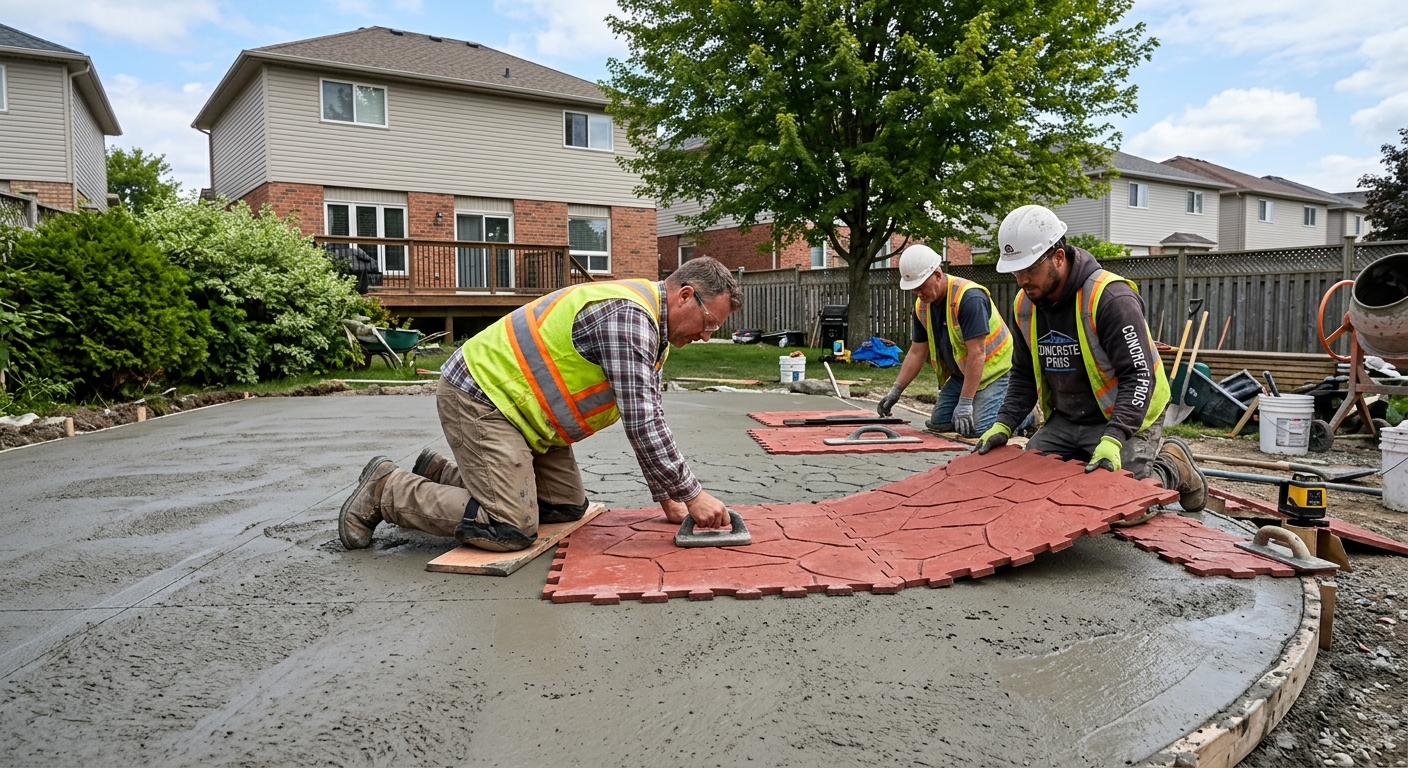
Stamped concrete costs more because it requires additional finishing steps: colour integration or surface colouring, release agents, stamping mats, careful timing, and sealing to protect the texture. In Sun Peaks, you’ll typically see driveway pricing that follows the broader regional bands—basic broom-finish driveway work often sits closer to $18–$28 per sq. ft., while stamped decorative concrete often lands around $22–$36 per sq. ft. The difference can be worth it if you’re also getting the same “durability package” (proper base prep, air-entrained mix, correct control joints, and adequate curing) rather than paying extra for appearance but accepting weak specs. If a quote for stamped work doesn’t clearly mention air-entrainment, joint spacing, and curing/seasonal protection, treat it as a red flag.
When is the best time to pour concrete in Sun Peaks?
In British Columbia’s mountain climate near Sun Peaks, the “best time” is when you can keep concrete curing safely despite cool nights and rain risk. Even in the Lower Mainland–Southwest, contractors plan around prolonged rain and humidity; in Sun Peaks, weather swings can be more noticeable, so crews schedule pour dates around workable temperatures and drying conditions. Practically, many contractors aim for periods where you can place the concrete, protect it, and keep it curing for the minimum period without freezing. If cool weather arrives, experienced crews use curing blankets and sometimes heat management to support strength gain. The best approach is to ask your contractor how they’ll handle the forecast for your exact pour date and what curing protection is included—this is often where costs shift between “good weather” scheduling and cold-weather precautions.
How long does concrete take to cure?
Concrete curing has two timelines: initial strength gain and longer-term durability. For most exterior flatwork, contractors aim for at least a 7-day curing period under proper conditions before the surface is relied upon for normal use and before additional treatments. However, durability and maximum strength continue beyond that; that’s why sealing is typically scheduled after the slab has fully cured—commonly around 28 days post-pour—for penetrating sealers. In Sun Peaks and across BC, cool nights and high humidity can slow the cure, and freeze–thaw cycles can start influencing performance if the slab is not protected early on. When you get a quote, ask how long the contractor will keep the slab protected, whether curing blankets or other cold-weather precautions are included, and when they plan the sealer application.