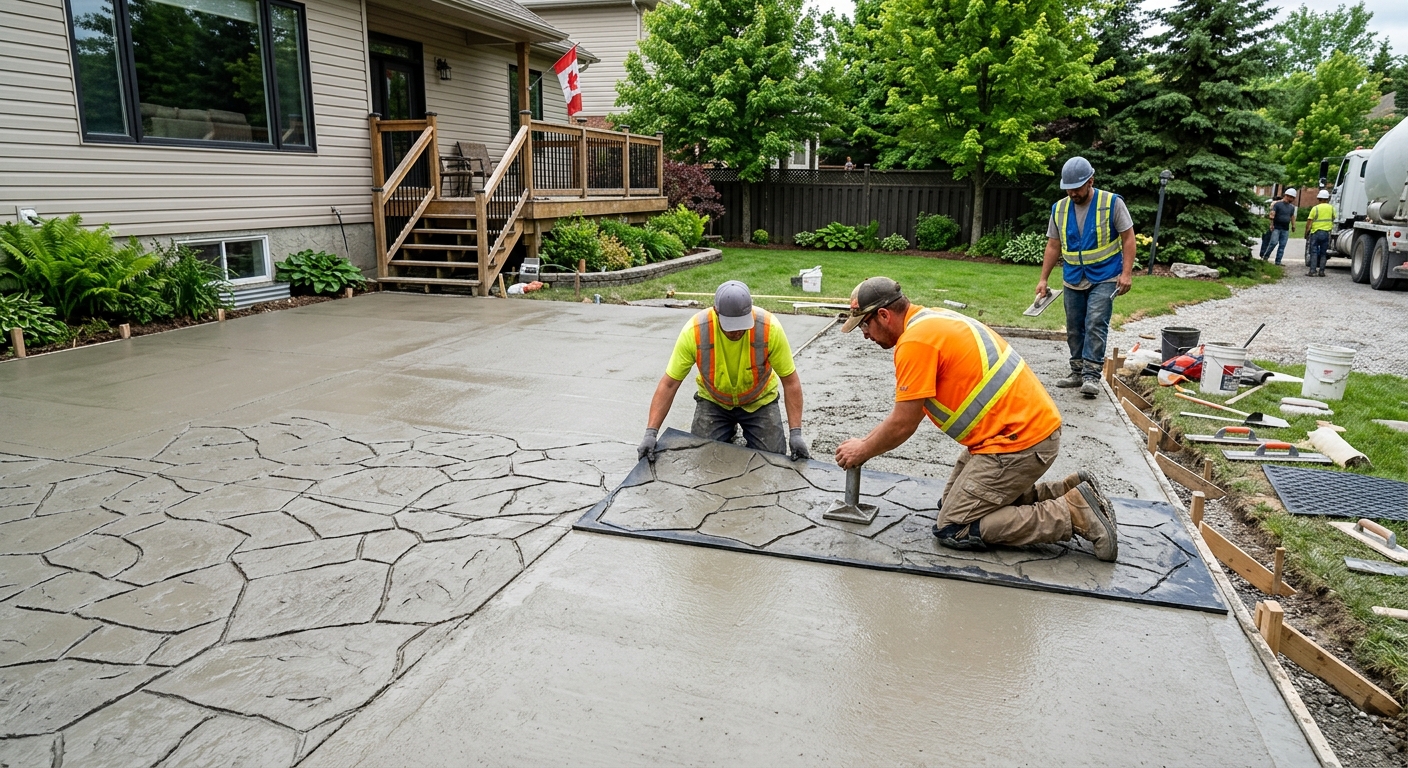
Concrete work options and costs in Albion
Albion, British Columbia is a great example of how concrete pricing and specifications move with the Lower Mainland–Southwest climate. With a 2021 population of 12,424 (Statistics Canada, 2021 Census), the local market is active and competitive for flatwork, especially around newer subdivisions where homeowners are upgrading driveways and outdoor living spaces. While Albion’s housing mix varies block-to-block, concrete flatwork demand is typically strongest where family homes drive additions—driveway widening, backyard patios, and garage pad upgrades—because these projects directly improve day-to-day usability.
In our region, mild winters can be deceptive: the frost line is shallow (often planned around about 450 mm / 18"), but freeze–thaw cycles, saturated soils, and coastal rainfall still drive cost. Contractors commonly place footings and thickened edges below the design frost depth to protect against frost heave, and exterior slabs require air-entrained mixes and tight control joint planning. Curing is another cost driver—cool nights and high humidity mean we often use curing blankets or schedule longer cure windows to reach durability targets before surface exposure.
For many homeowners, the biggest scheduling bottleneck is not pouring itself—it’s rain management, formwork readiness, and base drainage prep. In practice, we see especially strong demand in areas near Albion’s residential corridors and busy streets where access for concrete trucks and material staging is tight. From there, the cost difference between broom-finished slabs and decorative upgrades (like stamping or exposed aggregate) becomes very predictable. Below is a practical comparison table for common options in Albion.
| Application |
Typical Size |
Key Spec |
Finish Option |
Price Range |
| Concrete driveway (standard broom finish) |
400–600 sq. ft. |
Air-entrained exterior mix, compacted granular base, control joints |
Broom finish, sealed (recommended) |
$7,200–$13,200 |
| Exposed aggregate driveway |
400–600 sq. ft. |
Air-entrained mix, dressed base, consistent aggregate exposure |
Exposed aggregate with sealer |
$9,200–$16,800 |
| Stamped concrete driveway or patio |
300–500 sq. ft. |
Air-entrained mix, integral colour (or stain), control joints |
Stamp pattern + release + seal coat |
$8,000–$18,000 |
| Plain concrete patio or walkway |
200–400 sq. ft. |
Vibrated concrete, compacted base, proper slope and drainage |
Broom or light trowel finish |
$3,200–$10,400 |
| Garage floor (interior slab) |
400–600 sq. ft. |
Vapour/insulation details as needed, reinforcement as required |
Float finish or broom finish |
$7,800–$16,200 |
| Foundation footings (structural, below frost) |
Per project (linear/formwork dependent) |
Excavation to design frost depth, rebar cage, engineered thickness |
Typically finished for wall/beam interface |
$8,000–$25,000 |
Prices are estimates only and vary by project scope, site access and material selection.
What affects the price of concrete work in Albion
Homeowners often notice that the “same” concrete project—say a driveway replacement—can swing by 30–50% in the Lower Mainland–Southwest compared with other parts of British Columbia and even within the corridor. The reason is that concrete pricing here is not just about the slab itself; it’s about what we have to build underneath and around it to prevent freeze–thaw damage and drainage failures. Even though Lower Mainland–Southwest frost depth is typically planned shallow (commonly around 450 mm / 18"), our designs still place footings and thickened edges below the design frost depth to prevent frost heave, especially where soils stay saturated after coastal rainfall.
Across BC, colder regions usually require deeper excavations and shorter pour seasons, which pushes excavation, forming and heating/blanket costs up. In Albion specifically, exterior slabs must be built with air-entrained concrete mixes to survive freeze–thaw cycles, and we rely on proper control joints to manage cracking (cracks are normal; random cracking isn’t). De-icing salt can accelerate surface scaling and spalling, so sealing is a practical durability step.
Two concrete examples show where cost goes: first, a broom-finished driveway might land around the $18–$28 per sq. ft. backbone rate, while an exposed aggregate driveway often costs more because we’re adding more labour/time for consistent exposure and finishing (budget closer to the upper band). Second, a foundation or footing scope priced with structural details tends to be the highest variable line item—estimated footing work can follow the regional band of $200–$350 per unit depending on design and formwork complexity.
Finally, housing age matters. In older Albion homes, you may find removed driveways with poor drainage or compacted fill that needs extra granular base and re-grading; that base prep can shift a project’s total cost by thousands even before a single truck arrives.
| Price Factor |
Why It Matters |
Cost Impact |
| Frost line depth — determines footing depth and form height |
Footings and thickened edges must sit below design frost to avoid heave |
Higher excavation depth can add significant labour/equipment cost |
| Site preparation — excavation, grading, compacted granular base |
Unsuitable subgrade leads to settlement and cracking |
Can swing cost the most on older sites and poor-drainage lots |
| Reinforcement — rebar or wire mesh requirement |
Helps control cracking and supports loads |
Adds material and placement labour; sometimes essential for garage slabs |
| Mix design — air-entrainment and compressive strength spec |
Air void system improves freeze–thaw durability |
Usually moderate material cost but major durability value |
| Finish type — broom vs. stamped vs. exposed aggregate |
Decorative finishes require extra prep, timing and finishing steps |
Decorative options typically add labour and consumables |
| Pour size and concrete truck access to site |
Limited access increases wheelbarrowing/pumping time |
Staging and logistics can add hundreds to thousands |
| Cold-weather curing precautions — heating and blankets |
Maintains temperature so concrete reaches design strength |
Costs rise during shoulder-season or after cold snaps |
| Control joint pattern and sealing cost |
Joints guide cracking; sealing reduces salt/scale damage |
Often a small add-on relative to total project cost, with big ROI |
Permits & regulations in British Columbia
In British Columbia, structural concrete work—such as footings, foundation walls, and grade beams—usually requires a building permit, and engineered drawings are commonly reviewed by the municipality. Concrete flatwork (patios, walkways, and most driveways) typically does not require a permit unless the scope changes lot grading, affects stormwater/lot drainage, or triggers impervious-surface or right-of-way considerations. In Albion, the practical point is simple: before you break ground, confirm what your specific project affects with the local authority.
Here’s what to ask for on day one when you’re hiring. First, verify the contractor carries liability insurance and WSIB/WCB coverage (or the applicable provincial coverage structure for the workers involved). Second, request references from similar-scale jobs in the Lower Mainland–Southwest, not just decorative work—ask about their drainage prep and crack-control approach.
Step-by-step homeowner checks you can do:
- Licence verification: look up the contractor on the appropriate provincial registry/online directory for B.C. (you should see their business information and status).
- Certificate of insurance: request a current Certificate of Insurance showing general liability limits; confirm the effective dates.
- Clearance letter / coverage proof: ask for evidence of WSIB/WCB coverage for workers involved on the project.
- Match scope to paperwork: ensure the permit pull responsibility (if required) is clearly stated in your written proposal.
- Ask for proof of experience: request photos and addresses of similar concrete flatwork and foundation work.
Getting concrete right in Albion's freeze-thaw climate
In Albion, concrete failures are usually not “mystery chemistry”—they’re predictable results of base problems, missing air-entrainment, poor joint layout, or curing that doesn’t reach proper strength. Freeze–thaw cycles and saturated soils drive expansion and scaling at the surface, and de-icing salts can worsen spalling when the concrete is porous or air voids aren’t correctly engineered. Even with a shallow frost line (commonly planned around 450 mm / 18"), we still need proper frost-protected construction details and exterior drainage so water doesn’t sit under the slab or edge thickening.
To spec the job correctly, focus on five areas. (1) Base preparation: compacted granular sub-base to the right depth for your soil and frost-protection design, with drainage that routes water away. (2) Mix design: exterior concrete should be air-entrained (commonly targeted around 5–7% air content for freeze–thaw durability) and meet at least 32 MPa compressive strength requirements. (3) Control joints: spacing planned to limit random cracking and to keep cracks where you can manage them. (4) Curing: minimum 7-day curing under appropriate conditions; in cold or damp shoulder-season weather, contractors often use insulating blankets/curing protection. (5) Sealing: a penetrating sealer applied after the concrete has cured (commonly after about 28 days) to repel de-icing salts.
Here’s where the cost difference is usually justified: if your driveway is going to see salt and winter traffic, sealing plus the correct air-entrained mix often costs far less than the eventual repair. A stamped driveway might start around the $22–$36 per sq. ft. decorative band, but skipping air-entrainment or joint/sealer steps can turn a cheaper broom-finish slab into a costly redo in a few seasons—especially on sites with persistent drainage issues.
| Spec |
Why It Matters in Albion |
What to Ask For |
Impact if Skipped |
| Compacted granular base (depth?) |
Controls settlement and supports frost-protected edges under wet conditions |
Confirm granular type, lift thickness, compaction method and design depth |
Settlement, cracking, and premature surface deterioration |
| Air-entrained concrete mix (target air %?) |
Improves freeze–thaw durability during cycles and coastal moisture exposure |
Request air-entrainment target (commonly 5–7% for exterior flatwork) |
Higher risk of scaling and spalling in winter |
| Compressive strength (MPa rating) |
Ensures durability and load capacity after curing in cool, humid weather |
Specify minimum strength (commonly 32 MPa for typical exterior needs) |
Lower durability, surface wear, and reduced performance |
| Control joints (spacing per ACI guidelines) |
Limits random cracking from shrinkage and temperature changes |
Ask for joint layout drawings/schedule and cutting timing |
Uncontrolled cracking and water infiltration along cracks |
| Minimum 7-day curing period |
Cold nights and humidity can slow strength gain |
Ask how curing will be maintained; confirm protection plan if temperatures drop |
Reduced strength and increased scaling risk |
| Penetrating sealer (when applied after cure) |
Helps resist de-icing salt and moisture absorption in Albion winters |
Confirm sealer type and timing after full cure (often ~28 days) |
More rapid surface breakdown and staining |
How to choose a concrete work contractor in Albion
Choosing the right contractor in Albion is mostly about confirming capability and accountability—not just getting the lowest number. Start with British Columbia licensing: ask for their licence number and verify their business status on the appropriate provincial online registry. Next, confirm liability insurance is current by requesting a Certificate of Insurance. For coverage, ask for proof of WSIB/WCB coverage for workers involved in your project so you’re not exposed if someone is injured onsite.
Then, get 2–3 itemised written quotes. You want a breakdown that separates labour, concrete supply, reinforcement, base prep, excavation, disposal, and finishing (broom vs. stamped vs. exposed aggregate). Avoid vague “all-in” pricing where the scope isn’t clear. Pay special attention to what’s excluded: is saw-cutting and joint filling included? Is sealing included or optional? Is the permit pull included where required? Also confirm disposal—haul-away and tipping fees are common adders if not stated.
Warranty matters too. Ask for a workmanship warranty length and whether manufacturer warranties (for sealers/admixtures) apply to your specific installation. Verify if warranty coverage is transferable if you sell your home. For payment schedule, a safe rule is never pay more than 10–15% upfront, and hold back a meaningful portion until the job is complete and cleaned up to standard. Finally, demand a written timeline: a start date, concrete pour day plan (including rain contingencies), and completion estimate.
- Provide licence/registry info and insurance documentation before signing
- Confirm WSIB/WCB coverage for workers
- Use a written scope with measurements and slab thickness details
- Require base spec: granular type, depth, and compaction requirements
- Ask for mix design notes: air-entrainment and compressive strength
- Request joint plan: spacing, saw-cut timing, and finish around joints
- Clarify reinforcement plan (mesh vs rebar) for your application
- Confirm curing method and minimum curing period
- Know finishing timeline: sealing included or excluded, and when it’s applied
- Itemise excavation, disposal/haul-away, and any pump or access fees
- Confirm warranty terms in writing and what triggers service
- Keep a clear payment schedule (small deposit; retainage at completion)
Concrete contractor red flags in Albion: quotes that don’t mention air-entrainment for exterior work, missing or generic joint layout, refusing to provide insurance/coverage proof, promising “quick pour” schedules without rain/cold-weather curing plan, and leaving base drainage and compaction as vague allowances.
Frequently asked questions — concrete work in Albion
How do I prepare the base for a concrete slab?
In Albion and across the Lower Mainland–Southwest, base prep is where durability is won or lost. A proper base starts with excavation to design depth, removing unsuitable organic fill, then installing compacted granular to the required lift thickness and compaction standard. Because we deal with saturated soils and freeze–thaw cycles, drainage matters: water should be directed away from the slab, not trapped underneath. For exterior slabs, contractors also need to plan the edge details and frost protection (often planned with a shallow frost depth concept, commonly around 450 mm / 18"). When quotes differ, it’s often because one contractor includes proper base granular and compaction and the other uses thinner or less detailed prep. That difference can be thousands of dollars over a driveway’s life.
How do I compare concrete quotes?
When comparing quotes in Albion, compare scopes line-by-line, not just the total. Ask each contractor for an itemised breakdown: excavation, granular base and compaction, concrete supply (including air-entrainment and minimum strength), reinforcement, formwork, finishing, joints, curing protection, and sealing. Also confirm truck access and whether pump/handling is included. A decorative upgrade like stamped concrete generally lands higher than plain broom-finish work; for reference, exterior driveway and slab backbone pricing often sits around $18–$28 per sq. ft. for standard driveway work, while stamped & decorative concrete typically runs $22–$36 per sq. ft. If one quote is much lower, it’s usually missing base drainage prep, omitting air-entrainment notes, or excluding sealing and proper curing.
Can concrete be poured in cold weather in Albion?
Yes, concrete can be poured in cold weather in British Columbia, including Albion—but it must be done with the right protection plan. The key risk isn’t “freezing on contact” alone; it’s losing strength gain before the mix reaches safe maturity. Contractors typically control this by using curing blankets, keeping water and materials within workable temperatures, and planning around cold nights. They should also communicate how long curing protection will stay in place. If your pour date is in a cool, damp window, ask how they’ll protect the slab so it reaches design strength and durability targets. Also ask whether saw-cut timing and finishing steps will be adjusted. A good contractor will never treat curing as optional—especially when freeze–thaw scaling is a concern.
How do I maintain concrete in Albion's freeze-thaw climate?
Maintenance in Albion is mostly about keeping water and salts off the surface long enough to reduce freeze–thaw damage. First, use de-icing products thoughtfully—salt can accelerate surface spalling when concrete is exposed and porous. Second, seal exterior flatwork when the concrete is fully cured (commonly after about 28 days for many sealers) using a penetrating sealer that helps repel moisture. Third, keep drainage paths clear: downspouts, swales, and curb edges should not dump water onto the slab. Fourth, address minor cracks early by managing joint function rather than ignoring them—control joints are meant to be the places where cracking occurs. For reference, standard exterior driveway work often sits around the $18–$28 per sq. ft. band; sealing and good joint upkeep are a small fraction of that total and can extend service life substantially.
What causes concrete to spall in Albion winters?
Spalling is usually caused by water getting into the concrete and then freezing, expanding and breaking surface layers—made worse by inadequate air-entrainment or poor curing. In Albion’s Lower Mainland–Southwest conditions, wet soils and coastal moisture feed that cycle, and de-icing salts can intensify scaling when the surface is exposed. The most common root causes are: exterior concrete not meeting the air-entrainment requirement, incorrect mix design, weak surface from insufficient curing time in cool weather, or inadequate drainage/base prep leading to repeated saturation. Control joints that aren’t planned or cut properly can also allow water to find unintended crack paths. If you’re seeing spalling, ask for proof of mix specification (air content and strength) and review curing records—those details explain most failures.
What is rebar and when is it required in British Columbia?
Rebar (reinforcing bar) is steel reinforcement placed inside concrete to improve tensile capacity and help control cracking and durability under loads. In British Columbia, rebar is required when engineering/design indicates reinforcement is needed—commonly for structural slabs, certain foundation elements, garage floors, and cases where the slab must resist heavier point loads or where soil conditions justify reinforcement. The requirement isn’t universal for every patio; many smaller non-structural walkways use wire mesh or no reinforcement depending on slab thickness and support. For structural work (like footings and foundation walls) permits and engineered drawings are usually involved. When reviewing quotes in Albion, ask whether the design calls for rebar or mesh, and whether it’s supported/placed at the correct cover. Don’t accept “we’ll see on site”—that’s how cracking and premature wear start.