Concrete work options and costs in Hope
Concrete contractors are in demand in Hope, British Columbia, because most local homeowners want durable, low-maintenance flatwork that can handle the Lower Mainland–Southwest’s wet weather and frequent freeze–thaw cycles. In Hope, about 79.3% of households own their homes, and the housing mix is heavily single-detached (74.0% of dwellings), which is exactly the profile that leads to regular driveway, patio, walkway and foundation work. That matters for pricing because contractor capacity, materials planning, and scheduling are driven by how often driveways and patios are added, replaced, or expanded in neighbourhoods like Chilliwack River/Grandview area and around downtown Hope.
In this region, costs still hinge on frost protection and drainage. Even with a relatively shallow frost depth (typical practice assumes roughly 450 mm / 18"), footings and thickened edges are placed below frost to reduce frost heave. Exterior slabs also require air-entrained concrete and properly placed control joints to manage cracking and scaling in cool, humid conditions. Add in prolonged rain risk and high humidity, and you’ll see longer cure planning (curing blankets and/or sealers), which affects labour time and crew availability.
Below are practical “apples-to-apples” budget ranges you can use when comparing quotes for common concrete jobs in Hope, including standard broom finishes, decorative options, and structural foundation footings. Use this table to calibrate expectations before you request itemised pricing.
| Application |
Typical Size |
Key Spec |
Finish Option |
Price Range |
| Concrete driveway (standard broom finish) |
400–550 sq ft |
Air-entrained exterior mix, compacted base, control joints |
Broom finish, light saw-cut pattern |
$18,000 – $28,000 |
| Exposed aggregate driveway |
400–550 sq ft |
Air-entrained exterior mix, proper curing, sealed surface |
Aggregate exposure after placement |
$22,000 – $34,000 |
| Stamped concrete driveway or patio |
250–450 sq ft |
Reinforced slab where required, control joints, release agent system |
Stamps + color hardener or integral colour |
$16,000 – $30,000 |
| Plain concrete patio or walkway |
150–300 sq ft |
Air-entrained mix, compacted base, joints |
Steel-trowel or broom, light texture |
$2,400 – $7,800 |
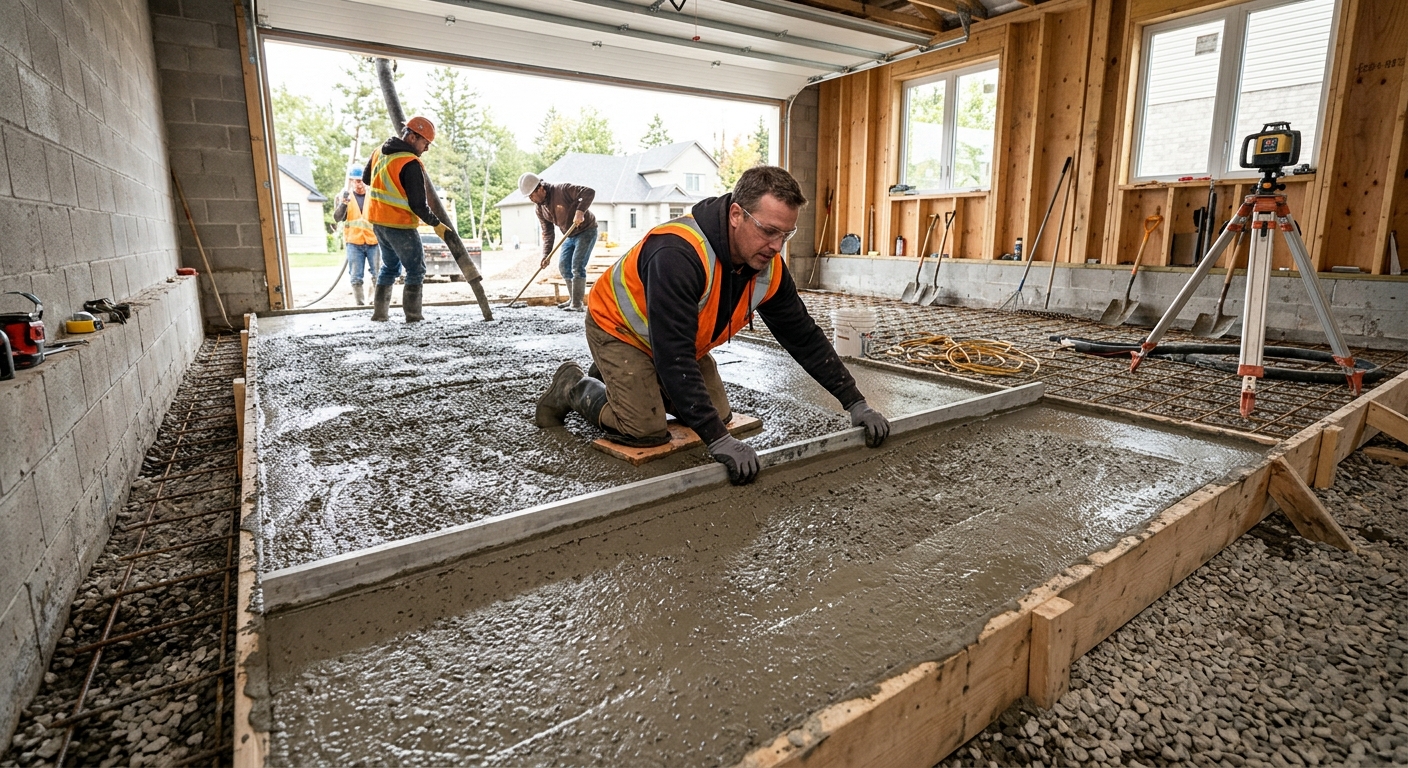
| Garage floor (interior slab) |
400–600 sq ft |
Vapour barrier (if required), reinforcement, proper base thickness |
Floated finish, optional hardener |
$18,500 – $30,000 |
| Foundation footings (structural, below frost) |
Per linear ft / typical small home plan |
Below frost depth, excavate/form/pour, rebar cage placement |
Structural concrete only (not decorative) |
$200 – $350 |
Prices are estimates only and vary by project scope, site access and material selection.
What affects the price of concrete work in Hope
In the Lower Mainland–Southwest, you can easily see 30–50% differences between quotes for “the same” concrete job because the foundation of the price is usually not just concrete—it’s excavation depth, base preparation, mix design, reinforcement, curing time, and how the contractor schedules around rain and cool nights. In BC, many crews also batch and plan around winter conditions and the short window when wet subgrades can be stabilized without delays.
Frost line depth and freeze-thaw cycles dictate specs every time: footings must extend below design frost to reduce frost heave, and exterior slabs should use air-entrained mixes to survive repeated freezing and thawing. While colder provinces often require deeper excavations and longer heat/cold-weather curing protection (which raises excavation, heating and forming costs), Hope’s coastal-wet climate still means you must protect slabs from moisture and scaling. De-icing salts compound the issue—surface sealing becomes a practical way to protect the finish, especially on driveways that get salted in winter.
Two local examples show why costs move. First, a driveway that requires deeper excavation for a stable granular base will cost closer to the higher end of the driveway band (for example, the $18–$28 per sq ft type range for a standard driveway); if soil is soft and drainage is poor, that can push the job higher because base depth and compaction time increase. Second, upgrading from broom finish to stamped or exposed aggregate adds finishing time and materials; that’s where the jump toward the stamped/decorative band (about $22–$36) is usually justified when homeowners want higher curb appeal.
Finally, housing age matters: with 48.0% of homes built before 1981 in Hope (Statistics Canada, 2021 Census), we often see older drainage patterns, uneven subgrades, and replacement work that includes selective demo and disposal—small differences in what’s removed and how it’s hauled can translate into real dollars.
| Price Factor |
Why It Matters |
Cost Impact |
| Frost line depth — determines footing depth and form height |
Footings must sit below design frost to prevent heave |
More excavation and form labour; higher unit cost for structural work |
| Site preparation — excavation, grading, compacted granular base |
Subgrade stability and drainage control cracking and settlement |
Extra truckloads/material handling can add thousands to exterior slab work |
| Reinforcement — rebar or wire mesh requirement |
Controls cracking and improves slab performance under load |
Rebar detailing and chairing increases labour; mesh alone may not meet specs |
| Mix design — air-entrainment and compressive strength spec |
Air entrainment resists freeze-thaw scaling/spalling |
Material cost increase plus tighter batching/testing expectations |
| Finish type — broom vs. stamped vs. exposed aggregate |
Finishing steps affect labour time, cure handling, and materials |
Stamped/exposed often adds decorative labour and color system costs |
| Pour size and concrete truck access to site |
Access affects pump/boom needs and pour logistics |
Pump fees, waiting time, and added labour can significantly change totals |
| Cold-weather curing precautions — heating and blankets |
Consistent curing is critical for achieving design strength |
Heating/blankets can add crew time and equipment rental |
| Control joint pattern and sealing cost |
Joints guide shrinkage cracking; sealing helps resist de-icing salts |
Saw-cut timing and sealer materials can add a modest but important premium |
Permits & regulations in British Columbia
In British Columbia, structural concrete work typically requires a building permit and, in many cases, engineered drawings reviewed as part of the municipal process. That usually includes foundations such as footings, foundation walls, grade beams and related structural elements. For concrete flatwork—patios, walkways and driveways—permits are often not required unless the work affects lot grading, stormwater drainage, or local requirements around impervious surface coverage and how water is managed. Even if a permit isn’t common for a simple slab, it’s smart to confirm with the municipality before breaking ground, especially if your driveway ties into culverts, swales, or changes the way water runs off your property.
Step-by-step, here’s how a Hope homeowner can verify a contractor is properly set up. First, ask for their proof of liability insurance and check that it’s current (a certificate of insurance should show your contractor’s name, policy period, and coverage). Second, confirm they carry the required workplace coverage (WSBC/WCB coverage) so you’re not exposed if someone is injured on site. Third, ask for references on similar-scope projects—especially exterior work with air-entrained mixes and control joints in freeze-thaw climates like ours. Finally, for the permit side, ask who pulls the permit (if needed) and whether engineered documents are included in the scope.
If you’re planning structural work, don’t start excavation until you’ve confirmed permits and site-specific foundation requirements with the local authority.
Getting concrete right in Hope's freeze-thaw climate
Concrete failures in Hope usually aren’t “mystery” problems—they’re predictable outcomes of moisture movement, inadequate frost protection, and improper finishing and curing. The Lower Mainland–Southwest climate brings cool nights, coastal humidity, and frequent wetting; then freeze-thaw cycles stress the surface. If the concrete isn’t designed for it, you can see scaling, spalling, and early cracking within a few seasons. The fix is to spec the job correctly from the ground up.
Start with base preparation: use compacted granular sub-base to the correct depth for local soil conditions and drainage control. Next, require an air-entrained mix—commonly 5–7% air for exterior flatwork—paired with minimum 32 MPa compressive strength so the slab achieves performance without early deterioration. Control joints are also non-negotiable: they limit random cracking by creating planned crack locations. Curing comes next: plan for a minimum 7-day curing period under proper conditions; in cool, wet weather, curing blankets or temperature protection may be required to reach strength and reduce surface damage. Finally, sealing helps protect the surface from de-icing salt impact—plan a penetrating sealer application after cure (typically around 28 days post-pour) to improve durability.
When comparing options, price alone can mislead you. For example, upgrading a driveway from plain broom-finished concrete to a sealed, properly jointed air-entrained specification may cost more, but it can prevent the kind of surface breakdown that forces replacement—where a full driveway can fall into the $18–$28 band for standard installs and much higher when you add decorative finishes. Stamped or exposed aggregate looks great, but the “must-have” durability specs are what protect your investment through Hope winters.
| Spec |
Why It Matters in Hope |
What to Ask For |
Impact if Skipped |
| Compacted granular base (depth?) |
Stabilizes subgrade and controls settlement under freeze-thaw moisture |
Base thickness, granular type, compaction testing method, drainage notes |
Soft spots, cracking, uneven surface and faster deterioration |
| Air-entrained concrete mix (target air %?) |
Resists freeze-thaw scaling and spalling from saturated concrete |
5–7% air target for exterior flatwork; admixture confirmation |
Surface scaling/spalling, especially where salt and water sit |
| Compressive strength (MPa rating) |
Ensures strength gain under local curing conditions |
Minimum 32 MPa rating and curing plan |
Lower performance, higher risk of premature cracking and surface wear |
| Control joints (spacing per ACI guidelines) |
Directs shrinkage cracking and reduces random splits |
Joint spacing, saw-cut timing, and detail near edges |
Random cracking pattern, water intrusion and accelerated freeze-thaw damage |
| Minimum 7-day curing period |
Strength development supports durability in cool, humid periods |
Weather protection plan and when traffic/loads are allowed |
Weaker surface, increased scaling risk and surface dusting/weak topping |
| Penetrating sealer (when applied after cure) |
Helps resist de-icing salts and rainfall-driven moisture movement |
Type of sealer and timing (around 28 days after pour) |
Faster salt damage and reduced long-term surface protection |
How to choose a concrete work contractor in Hope
Choosing the right concrete contractor in Hope comes down to verification plus transparency. First, confirm British Columbia compliance. Ask for current liability insurance (often provided as a certificate of insurance) and verify the policy period covers your dates. Next, ask for WSBC/WCB clearance or proof of coverage—this is important for your protection if a worker is injured on your property. For licensing and trade qualifications, request their business registration details and any trade authorization they are required to hold for the scope you’re hiring.
Second, get 2–3 itemised written quotes. Don’t accept a single lump-sum number without knowing what’s included. You want a labour + materials breakdown that covers excavation, base prep, reinforcement, concrete volume and finish, plus allowance for cleanup and disposal. Ask explicitly: is rebar/wire mesh included, what’s the cure protection plan, and is sealing included (and when it will be applied)? If permits are needed for structural work, clarify who pulls the permit and whether that cost is included.
Third, evaluate warranty. A workmanship warranty should be stated clearly (length and what it covers). Product/manufacturer warranty (for sealers, hardeners, and admixtures) should be separated from workmanship. Ask if the warranty transfers if you sell the home.
Fourth, payment schedule matters. In my experience, never pay more than 10–15% upfront. Hold back a portion until the job is complete and final grading/cleanup is done. Finally, insist on a timeline in writing: start date, concrete pour date (or window), and completion estimate.
- Request insurance and WSBC/WCB proof before signing anything
- Ask for job photos of similar exterior flatwork in wet-freeze climates
- Get quotes itemised by demo, excavation, base, reinforcement, concrete supply, labour and finishing
- Confirm air-entrained mix is included for exterior slabs
- Ask for control joint type, spacing and saw-cut timing
- Clarify curing method (blankets/sealer curing schedule if cool weather hits)
- Verify drainage details (base thickness, slope, and where water goes)
- Confirm disposal and haul-away are included for removed concrete
- Ask who provides protection of landscaping/grass during the pour and curing
- Make sure concrete truck access/pump plan is discussed for your lot
- Check warranty terms for workmanship and exclusions for de-icing salt
- Avoid large deposits; plan progress payments tied to milestones
In Hope, concrete red flags include: quotes that omit air entrainment and joint/cure details, “too-good-to-be-true” pricing that cuts base depth or reinforcement, vague scopes that don’t state disposal/cleanup, no proof of liability or WSBC/WCB coverage, and crews who want a large deposit before any site prep is started.
Frequently asked questions — concrete work in Hope
Do I need a permit for concrete work in British Columbia?
In British Columbia, structural concrete work—like footings, foundation walls and grade beams—usually requires a building permit, and municipalities often expect engineered drawings. Concrete flatwork (patios, walkways and typical driveways) often does not require a permit, unless your project changes lot grading, affects stormwater drainage, or triggers local impervious surface/grading rules. In Hope and the Lower Mainland–Southwest, drainage details are particularly important because rainfall and freeze-thaw cycles can move water toward foundations and slab edges. The best approach is to ask your contractor what they expect and then confirm with the municipality before excavation. Also insist on liability insurance and WSBC/WCB coverage before work begins—those are key homeowner protections regardless of whether a permit is required.
Concrete vs pavers for a patio in Hope?
For patios in Hope, concrete typically wins on long-term “set-and-forget” maintenance when it’s built with the right base, air-entrained mix, and a sensible joint layout. Pavers can also perform well, but they depend on consistent base compaction and joint sand management; wet freeze-thaw cycles can lead to shifting or weed growth if the base isn’t right. Concrete patios also handle light vehicle loads better when reinforced for the right use. Budget-wise, plain concrete patios often fall in the general patio/flatwork band (commonly around $16–$26 per sq ft in this market tier), while pavers can add costs when you include excavation, edging, and proper base depth. If your area has poor drainage or lots of foot traffic, ask about concrete slope/drainage details and whether the concrete will be sealed for durability against moisture and de-icing salt exposure on nearby slabs.
How long does a concrete driveway last?
With proper specs, a concrete driveway in Hope can last decades, but “life span” depends heavily on how it was built for freeze-thaw moisture cycling. The two biggest durability drivers are an exterior air-entrained mix and a base that’s properly compacted and drained so water doesn’t sit under the slab. Control joints are also critical—they help manage cracking in a predictable pattern instead of random breaks that let water penetrate. Finally, curing and sealing matter: in our humid, rain-prone conditions, contractors need a real curing plan rather than rushing traffic onto fresh concrete. Costs align with this: a standard broom-finished driveway often sits in the $18–$28 range per sq ft type band for this region, and the more you invest in proper base, joints and sealing, the more you reduce early scaling/spalling risk near edges and expansion points.
What is air-entrained concrete and why does it matter here?
Air-entrained concrete is mixed with a controlled amount of microscopic air bubbles so that, when water in the concrete freezes, the expansion has room to occur without crushing the paste. In Hope and throughout the Lower Mainland–Southwest, the freeze-thaw cycle plus wetting from coastal rainfall can rapidly damage unprotected or poorly mixed exterior concrete. That’s why exterior slabs, especially driveways and patios exposed to moisture and de-icing salt, should use air-entrainment and the right control joint pattern. When air content is correct and curing is done properly, you greatly reduce scaling and spalling at the surface. If a quote doesn’t clearly mention an air-entrained mix for exterior work, treat that as a major gap. It’s one of the most common ways inexpensive installs end up costing more later when surface repairs or full replacement becomes necessary.
How do I prepare the base for a concrete slab?
Proper base prep is what makes a concrete slab stay level and crack less in Hope’s climate. The contractor should excavate to the design depth, remove unsuitable soil, and build up a compacted granular base in layers, then grade to the correct slope for drainage. The base should be compacted to the specified standard (often with compaction testing depending on the scope) because poorly compacted granular material can settle over time, leading to surface cracking. For exterior slabs, drainage details are especially important because repeated wetting and freeze-thaw cycles increase water movement. Ask your contractor what granular material is being used, how thick it will be, whether they’re adding separation fabric if needed, and how they’ll protect the base during rainy conditions. A good prep plan protects both plain work (like a $16–$26 patio) and decorative work where cracking ruins the finish.
How do I compare concrete quotes?
To compare concrete quotes in Hope, don’t just compare totals—compare scope and concrete specs. Ask for itemised pricing that separates excavation/site prep, base material and compaction, reinforcement (rebar or wire mesh), concrete supply (including air-entrainment for exterior slabs), finishing labour, curing protection, and sealing (if included). Confirm whether disposal and haul-away are part of the quote, and whether permits are included when structural work is involved. Check wording around joints: spacing, saw-cut timing, and how edges are detailed. If one quote is far below the others, look for skipped essentials like base depth, reinforcement, or curing time—those are often the hidden cost drivers that appear later as scaling or spalling. As a reference point, plain exterior flatwork commonly aligns with the $16–$26 band in this tier, while stamped/decorative options tend to run higher (about $22–$36). A fair comparison will reflect the same finish, size, and durability specs.