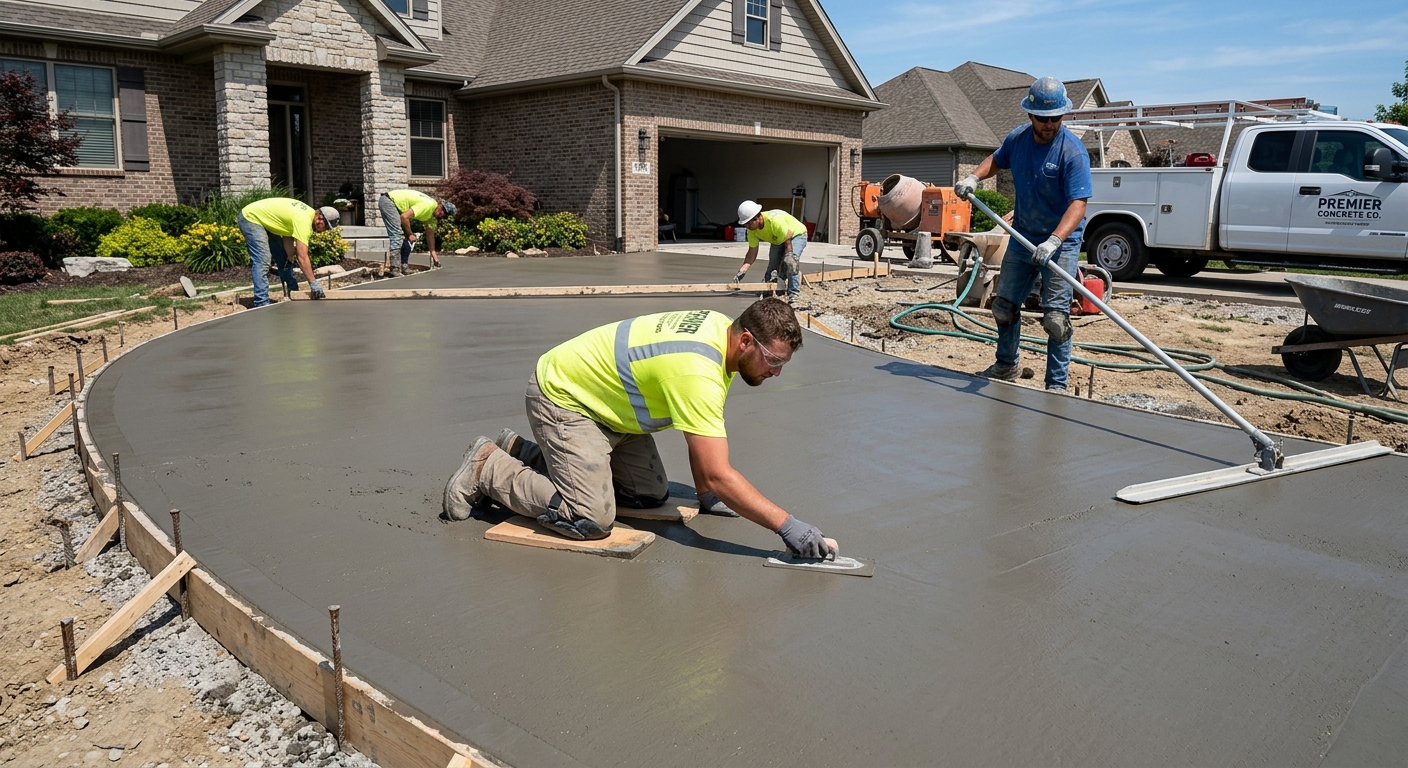
Concrete work options and costs in Houston
In Houston, British Columbia, homeowners typically book concrete work for driveways, patios and walkways because the town’s housing stock is dominated by single-detached homes—60.2% of dwellings in the area are that style. With 900 homeowner households (70.9% of households own), there’s steady demand for fresh flatwork around older properties too: 62.2% of homes were built before 1981, so many projects involve replacement of existing slabs that have settled or cracked. In the Nechako economic region, pricing is strongly shaped by the cold-climate interior freeze–thaw cycle. Contractors plan deeper excavation and place footings and slabs below the frost influence, using air-entrained concrete and properly spaced control joints to limit heaving and random surface cracking. The pour season can be shorter than in milder parts of B.C., so cold-weather placement often requires insulated blankets, temporary heat, or accelerators—small changes in weather protection can add real labour and equipment time. Logistics matter as well: material supply and truck access are priced differently than lower-elevation routes, especially on winter-softened ground. Around town, trade demand is especially high in older residential pockets near downtown Houston and the main residential stretches where access is tight and existing driveways are frequently being widened or replaced.
Use the table below to compare common options and realistic Houston price bands, then we’ll break down what moves those numbers up or down.
| Application |
Typical Size |
Key Spec |
Finish Option |
Price Range |
| Concrete driveway (standard broom finish) |
400 sq ft (about 20 ft × 20 ft) |
Air-entrained mix, compacted granular base, control joints |
Broom finish |
$7,200 – $10,000 |
| Exposed aggregate driveway |
400 sq ft (about 20 ft × 20 ft) |
Air-entrained mix, careful curing, proper jointing |
Exposed aggregate (sand/stone wash or reveal) |
$8,400 – $12,200 |
| Stamped concrete driveway or patio |
300 sq ft (about 15 ft × 20 ft) |
Air-entrained mix, base prep, release agent & curing schedule |
Stamped pattern with colour hardener |
$8,400 – $10,500 |
| Plain concrete patio or walkway |
200 sq ft (about 10 ft × 20 ft) |
Air-entrained mix, compacted base, edge forms |
Broom or light trowel finish |
$3,200 – $4,400 |
| Garage floor (interior slab) |
480 sq ft (about 24 ft × 20 ft) |
Interior mix, vapour considerations, reinforcement as required |
Steel-trowel or broom finish |
$8,000 – $12,000 |
| Foundation footings (structural, below frost) |
Varies (commonly 2–3 ft wide walls) |
Below-frost placement, engineered dimensions, rebar & concrete class per design |
Typically formed and finished to spec for the foundation wall |
$6,000 – $9,500 |
Prices are estimates only and vary by project scope, site access and material selection.
What affects the price of concrete work in Houston
In Houston, two quotes for what looks like the same concrete job can differ by 30–50% across the Nechako region and wider British Columbia because the real cost drivers are site and climate—not just concrete price. In colder interiors, frost and freeze–thaw cycles dictate every spec. Footings must extend below the design frost depth to prevent frost heave, and that means deeper excavation, more formwork height, and more aggregate backfill. For exterior slabs and driveways, contractors also specify air-entrained concrete because it survives repeated freezing and thawing far better than non-air-entrained mixes. Cold-weather placement is another big variable: pours may require insulated blankets, heaters, or accelerators to protect the slab while it gains strength, and that can shift labour scheduling and add equipment costs.
At the same time, local conditions can raise or lower the total bill quickly. If your driveway needs removal of old concrete plus haul-away, disposal and regrading can move the project toward the upper end of the $18–$25 per sq ft driveway band. If your site is flat with good truck access and you only need a basic patio replacement, you’ll often land closer to the $16–$22 per sq ft patio/walkway band. Housing age matters too: older properties (and the high share of pre-1981 homes) often have settled bases or compromised drainage; improving drainage and rebuilding compacted granular base can add work now, but it prevents early heaving and future patching.
To keep bids comparable, ask the contractor to quote per the same reinforcement level, air content and curing plan, not just by square footage.
| Price Factor |
Why It Matters |
Cost Impact |
| Frost line depth |
Determines footing depth and form height |
Higher excavation and rebar placement can push footing jobs toward the top of the $60–$90 per unit range |
| Site preparation |
Excavation, grading, compacted granular base |
Loose soils or poor drainage add labour, aggregate and compaction time |
| Reinforcement |
Rebar or wire mesh requirement |
Mesh/rebar adds material and labour, especially on driveways and structural elements |
| Mix design |
Air-entrainment and compressive strength spec |
Air-entrained exterior mixes and specified strength can cost more but reduce spalling risk |
| Finish type |
Broom vs. stamped vs. exposed aggregate |
Stamped/exposed work includes extra steps, colour work and finishing time |
| Pour size and concrete truck access to site |
Placement efficiency and delivery logistics |
Limited access can increase labour and affect how many trips are needed |
| Cold-weather curing precautions |
Heating and blankets |
Insulation/heaters/accelerators can add noticeable cost during short pour windows |
| Control joint pattern and sealing cost |
Controls cracking and limits moisture intrusion |
More joints and a proper sealing step can raise the total slightly but protects long-term |
Permits & regulations in British Columbia
In British Columbia, the permit and review process depends on what concrete work you’re doing. Structural concrete work—such as footings, foundation walls, grade beams, and other elements that support a building—typically requires a building permit, and in many cases engineered drawings must be reviewed by the municipality before construction. For concrete flatwork (patios, walkways, and typical driveways), a permit is often not required when the work is limited to the slab and does not significantly change lot grading or violate impervious-surface/lot drainage expectations. That said, if your concrete driveway or patio affects surface drainage, ties into municipal right-of-way elements, or changes water flow toward neighbouring properties, the local authority may require a permit or at least prior approval.
Before breaking ground in Houston or anywhere in B.C., confirm the requirement with the local authority (even if you’re confident it’s “just flatwork”). Also verify your contractor is properly insured and compliant: ask for liability insurance and proof of WCB coverage. Then check references on similar-scale projects in the region, because freeze–thaw performance depends heavily on base prep and mix specs.
Step-by-step homeowner checks (where to look): (1) Search the online registry for contractor credentials/licence status (if applicable to the work type), (2) request a certificate of insurance and confirm the effective dates match your project period and that the address of work is covered, (3) request a WCB clearance letter or proof of registration for the relevant coverage, and (4) keep copies in a project folder before scheduling the pour.
Getting concrete right in Houston's freeze-thaw climate
Concrete fails in Houston’s freeze–thaw climate when water gets into the slab system, freezes, and expands—especially when the base isn’t compacted correctly or the concrete mix isn’t built for freeze survival. The right way to spec the job starts at the ground: compacted granular sub-base to the correct depth for the local soil and frost influence, with drainage paths that reduce standing water. Next is mix design. For exterior flatwork, request air-entrained concrete with a typical air content in the 5–7% range and minimum 32 MPa compressive strength so the paste can tolerate repeated freezing. Control joints also matter: a properly planned joint spacing pattern limits random cracking that can become entry points for moisture. In cold weather, curing is where many “cheap” jobs lose quality—plan for at least a 7-day curing period under protection so the slab reaches strength without freezing too early. Finally, sealing helps: a penetrating sealer applied after the cure (commonly around 28 days post-pour) can repel de-icing salts and rainwater, improving surface durability.
Ask targeted questions to prevent spalling, which is a classic symptom of inadequate air-entrainment and rushed curing. For example, a plain broom-finished patio often fits the $16–$22 per sq ft band, but the moment a contractor cuts corners on air content or curing, you can end up paying again for grinding, patching, or premature replacement—typically costing far more than the small premium for doing it right the first time.
| Spec |
Why It Matters in Houston |
What to Ask For |
Impact if Skipped |
| Compacted granular base (depth?) |
Controls settlement and helps prevent frost-related movement |
Confirm base depth and compacted lift method (granular type and compaction targets) |
Uneven settlement, pumping, and early cracking |
| Air-entrained concrete mix (target air %?) |
Improves freeze–thaw durability for exterior slabs |
Request air content target (typically 5–7% for exterior flatwork) |
Higher risk of scaling/spalling in winter cycles |
| Compressive strength (MPa rating) |
Ensures the slab reaches design strength under local curing conditions |
Specify minimum 32 MPa and protect from freezing during early strength gain |
Surface weakness, increased wear and cracking |
| Control joints (spacing per ACI guidelines) |
Limits uncontrolled cracking pathways |
Ask for a joint layout plan and spacing appropriate to slab thickness and dimensions |
Random cracks, water entry, and freeze-induced expansion |
| Minimum 7-day curing period |
Prevents early freezing and ensures proper strength development |
Confirm curing protection method if temps drop (blankets/heaters as needed) |
Reduced strength and durability—often shows up as early deterioration |
| Penetrating sealer (when applied after cure) |
Repels moisture and de-icing salts during winter |
Ask for penetrating sealer after cure (commonly around 28 days post-pour) |
Salt and water soak in, accelerating surface scaling |
How to choose a concrete work contractor in Houston
Choosing the right contractor in Houston starts with verification. In B.C., confirm your contractor carries liability insurance with coverage that matches your project dates and jobsite address. Ask for proof of WCB coverage (or a current clearance letter), then verify dates so you’re not relying on expired documents. Next, request proof of experience with cold-climate flatwork—specifically jobs with air-entrained exterior mixes, proper jointing, and cold-weather curing plans.
For pricing, avoid “single number” quotes. Get 2–3 itemised written quotes that separate labour and materials (concrete supply, base material, reinforcement, forms, sealing, saw-cutting for joints, and disposal). Check whether demolition and haul-away are included, whether permit pulling (when required for structural work) is part of the scope, and what exactly is excluded—such as unforeseen rock, frost-impacted soils, or drainage improvements.
Warranty matters too. Ask for a workmanship warranty length and whether it covers cracking/spalling related to installation. Also ask whether the product/manufacturer warranty applies to the sealer, stain/colour systems (for stamped work) and any proprietary admixtures used. Ensure it’s transferable if you sell your home.
Payment schedule: never pay more than 10–15% upfront. Hold back a portion until the work is complete and joints/sealing are done as specified. Finally, get a start date and completion estimate in writing—cold-weather protection and curing time affect scheduling.
- Ask for proof of liability insurance (active dates) and WCB clearance/registration.
- Confirm they build for freeze–thaw: air-entrained exterior mix and jointing plan.
- Get itemised quotes (labour, concrete, base prep, rebar/mesh, forms, saw-cutting, disposal).
- Verify what’s included for demolition of existing concrete and haul-away.
- Ask who supplies and compacts granular base, and confirm the compacted thickness.
- Request a curing plan for cold nights (blankets/heaters/accelerators if needed).
- Confirm sealing scope (type, when applied, and which joints are treated).
- Check whether reinforcements are specified where needed (driveway edges, larger slabs, or garage slabs).
- Review finish specs (broom pattern, exposed aggregate method, stamping process and release agent).
- Ensure control joints are cut/specified—not just “we’ll cut later”.
- Ask for a written timeline and pour-day conditions they won’t proceed under.
- Clarify warranty terms and what outcomes are covered versus excluded.
Houston red flags: contractors who won’t discuss air-entrainment or curing protection, vague joint spacing with no layout, quotes that treat “foundation/footings” like flatwork (wrong scope), crews asking for large upfront payments, and no written spec sheets showing concrete strength or admixtures.
Frequently asked questions — concrete work in Houston
How long does concrete take to cure?
In Houston, British Columbia, curing time is about strength gain, not just “drying.” Most concrete reaches functional strength in the first few days, but for exterior flatwork you should plan for at least 7 days of proper curing protection before treating the slab as fully complete for hard use. If temperatures drop at night, you may need insulated blankets or heaters to prevent early freezing while the concrete is still gaining strength. For durability-focused steps like sealing, contractors commonly wait until about 28 days post-pour so the slab has finished curing and moisture levels are appropriate. If your contractor is offering to seal or open the slab immediately, ask how they’re managing curing in the freeze–thaw conditions that affect Nechako-area properties.
Do I need a permit for concrete work in British Columbia?
Often, typical concrete flatwork such as patios, walkways and driveways doesn’t require a permit in B.C., unless it affects lot grading, drainage patterns, or impervious surface requirements, or it impacts municipal right-of-way considerations. Structural concrete work—like footings, foundation walls, and grade beams—usually requires a building permit and, in many cases, engineered drawings reviewed by the municipality. In Houston, confirm with the local authority before pouring, especially if you’re changing the site drainage away from the foundation or relocating downspout discharge. Also verify the contractor is licensed/qualified for the work and carries liability insurance and WCB coverage. When bids are unclear, you should ask directly whether permit pulling (if required) is included in the scope.
Concrete vs pavers for a patio in Houston?
Concrete and pavers both work well, but in Houston’s cold interior climate the difference usually comes down to joint strategy and freeze–thaw performance. A properly designed concrete patio with air-entrained concrete, compacted base prep, and control joints typically performs predictably—especially when a penetrating sealer is applied after curing to help resist de-icing salts. Pavers can be durable too, but they rely on a stable base and correct bedding; if drainage isn’t managed, pavers can heave or shift and become uneven. Cost-wise, a plain concrete patio or walkway often aligns with the $16–$22 per sq ft band, while pavers can vary widely depending on unit price and labour for excavation, base, and edging. If you want a low-maintenance finish and consistent surfaces, well-built concrete is often the easier call in the Nechako region.
How long does a concrete driveway last?
A concrete driveway can last decades when it’s built for freeze–thaw cycles: air-entrained exterior concrete, proper base prep, correct joint spacing, and adequate curing protection in cold weather. In Houston, the driveway often faces winter moisture and freeze expansion, so durability depends more on installation quality than on “concrete brand.” If the slab was poured without air-entrainment or with poor jointing, you may see scaling/spalling or cracking earlier than expected. If it was built with correct drainage and control joints, it can hold up very well even through repeated seasons. For budgeting, the typical driveway pricing is often in the $18–$25 per sq ft range depending on thickness, reinforcement, and finish. For a small decorative upgrade, stamped options generally cost more—so it’s worth ensuring the underlying specs are right first.
What is air-entrained concrete and why does it matter here?
Air-entrained concrete is a mix designed with microscopic air bubbles that give freezing water a place to expand without damaging the paste. In Houston, British Columbia, that’s crucial because exterior slabs experience repeated freeze–thaw cycles that can drive moisture movement into the concrete and lead to spalling or scaling if the mix isn’t properly designed. Many contractors will specify air-entrainment for all exterior flatwork and maintain a target air content—commonly in the 5–7% range for exterior slabs. If a quote doesn’t mention air-entrainment for a driveway or patio, that’s a technical gap you should address before the pour. Paying the correct mix-cost is usually cheaper than repairing early deterioration, especially during winter when curing and protection are more challenging in the Nechako interior.
How do I prepare the base for a concrete slab?
Base preparation is where most long-term performance is won or lost in Houston’s climate. A contractor should excavate to the design depth, grade the sub-base properly, and then place and compact granular material in lifts to create a stable, well-draining base. The target depth and base build-up depend on soil type and frost influence, but the key is compaction and drainage—otherwise the slab can settle and cracks can open pathways for water. Ask your contractor what granular material they use and how they compact it, and ensure there’s a plan for managing water away from the foundation and slab edges. For exterior work, the base prep is often as important as the finish; even a standard broom finish can fail early if the base wasn’t rebuilt correctly. This is especially true on older properties built before 1981 where previous drainage may be compromised. (Statistics Canada, 2021 Census)