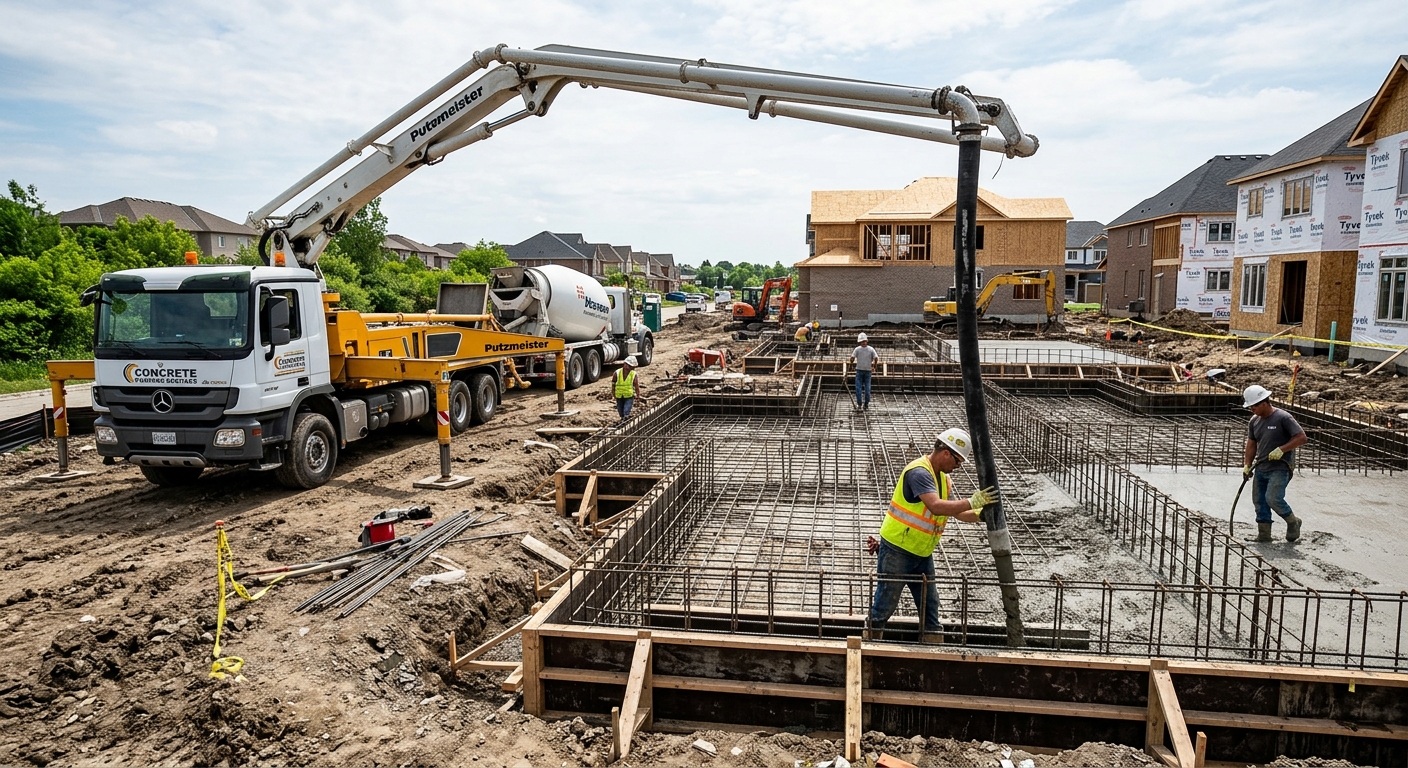
Concrete work options and costs in Aberdeen
Concrete work in Aberdeen, British Columbia is mainly driven by the Lower Mainland–Southwest climate: mild winters overall, but frequent coastal wetting and freeze–thaw cycles can still damage slabs and exposed edges. With a population of 12,437 (Statistics Canada, 2021 Census), Aberdeen is a smaller but active community where local contractors tend to be most in demand when homeowners are upgrading older properties and improving curb appeal—especially around the Sapperton Road / Aberdeen neighbourhood corridor, where driveway and patio replacements are common. In this market, most concrete flatwork is built for long service life, not just quick appearance.
For homeowners weighing options, the biggest cost differences usually come from base preparation, mix design, and finishing. Exterior slabs are typically built with air-entrained concrete and proper control joints to manage cracking and surface scaling. Even though our design frost depth is commonly treated at about 450 mm / 18", footings and thickened edges still need to be placed below frost to avoid heave, and that requirement can influence excavation and forming labour. Scheduling also matters: coastal rain and cool nights can slow curing, so contractors plan around weather windows using curing blankets, sealers, and extended cure times to reach the target performance. That same planning effort affects contractor availability and pricing across the Lower Mainland–Southwest corridor.
Below are realistic project price ranges you’ll see for common concrete applications in Aberdeen, followed by the specs that usually explain why one quote can be higher than another.
| Application |
Typical Size |
Key Spec |
Finish Option |
Price Range |
| Concrete driveway (standard broom finish) |
400–600 sq. ft. (single driveway) |
Air-entrained exterior mix; compacted granular base; control joints |
Broom finish |
$9,000–$16,000 |
| Exposed aggregate driveway |
400–600 sq. ft. (single driveway) |
Air-entrained exterior mix; adequate curing to expose aggregate |
Exposed aggregate |
$14,000–$22,000 |
| Stamped concrete driveway or patio |
300–500 sq. ft. |
Air-entrained exterior mix; release agent; color hardener (as selected) |
Stamped (pattern + color) |
$11,500–$20,500 |
| Plain concrete patio or walkway |
150–300 sq. ft. |
Air-entrained exterior mix; compacted base; slope for drainage |
Smooth/steel trowel with light broom edge |
$2,600–$7,800 |
| Garage floor (interior slab) |
300–600 sq. ft. |
Slab reinforcement as required; vapour barrier (if specified) |
Float/smooth finish |
$6,000–$16,000 |
| Foundation footings (structural, below frost) |
~40–120 linear ft. (varies by house size) |
Excavation and concrete below design frost; engineered footing dimensions |
Structural concrete (no decorative finish) |
$8,000–$28,000 |
Prices are estimates only and vary by project scope, site access and material selection.
What affects the price of concrete work in Aberdeen
In Aberdeen and across the Lower Mainland–Southwest region, it’s common to see concrete quotes for the “same” job come in 30–50% apart. Some of that difference is simply scope (base depth, reinforcement, and finishing), but a lot is driven by how contractors design for our frost and moisture conditions. While colder provinces require deeper solutions and longer work windows, even here in coastal-wet BC, we still plan around freeze–thaw cycling and saturated soils. That’s why exterior slabs and sidewalks are normally built with air-entrained concrete and proper drainage—those details protect against scaling and premature surface wear.
Frost line depth influences excavation and form height for footings and thickened edges. Local practice commonly assumes a frost depth around 450 mm / 18" for design, and contractors still dig and build below frost to reduce frost heave risk. In colder regions, contractors sometimes face deeper excavations and shorter pour seasons, which raises costs through higher labour and equipment time; in BC, we often save some excavation depth compared to areas with deeper frost, but we still pay for rain planning and curing. For cold-weather curing, contractors may need insulating blankets, wind protection, and careful temperature management, which adds cost during shoulder seasons.
Two real examples help explain pricing swings in Aberdeen: (1) choosing stamped concrete can push you from a standard exterior slab budget into the decorative band—while a plain patio/sidewalk may land near $16–$26 per sq. ft., stamped work commonly prices closer to the $22–$36 per sq. ft. equivalent range due to colour materials, stamp labour, and tighter finishing control; (2) driveway base prep can change the job more than homeowners expect—if an excavation is deeper than anticipated due to soft subgrade or drainage needs, excavation and granular supply can add several thousand dollars even if the visible square footage stays the same. For older housing stock, uneven yard slopes and older drainage paths often require re-grading and improved drainage, which typically affects cost more than surface finish.
| Price Factor |
Why It Matters |
Cost Impact |
| Frost line depth |
Determines footing depth and form height below design frost to prevent heave |
Major excavation and forming cost change; can swing structural scope |
| Site preparation |
Excavation, grading, and compacted granular base control settlement and cracking |
Often the biggest variable on driveways and patios |
| Reinforcement |
Rebar or wire mesh improves structural capacity and helps manage slab movement |
Material + installation labour; higher if engineering requires it |
| Mix design |
Air-entrainment and specified strength help concrete survive freeze–thaw and moisture |
Direct material cost increase; prevents costly failures |
| Finish type |
Broom vs. stamped vs. exposed aggregate changes labour, materials and curing control |
Decorative finishes typically add labour and specialty supplies |
| Pour size and concrete truck access to site |
Small pours or difficult access can require more trips and extra crews |
Labour and logistics premiums if equipment can’t reach |
| Cold-weather curing precautions |
Blankets/heating protect strength gain when cool nights slow cement hydration |
Adds consumables and time; especially in shoulder seasons |
| Control joint pattern and sealing cost |
Correct joints reduce random cracking; sealing helps repel de-icing salts and moisture |
Costs vary by joint layout and whether sealer is included |
Permits & regulations in British Columbia
In British Columbia, structural concrete work typically needs a building permit. That includes footings, foundation walls, and grade beams, especially when they’re part of a structural system reviewed by the municipality. In many cases, engineered drawings are required or reviewed as part of the permit package. For concrete flatwork—driveways, patios, and walkways—permits often are not required by default, but they can be triggered if your project affects lot grading, impervious surface coverage limits, stormwater drainage, or the municipal right-of-way. Because rules and interpretations can vary by municipality, confirm with the local authority before breaking ground.
Before you sign, verify three essentials for contractors working in Aberdeen: 1) liability insurance, 2) workers’ compensation coverage (WSBC/WCB), and 3) references on similar-scale projects. Step-by-step: (a) ask for the contractor’s certificate of insurance and confirm it’s current and matches the work address; (b) request proof of workers’ compensation clearance; (c) check their business registration/licensing using the appropriate online registry links provided by the province/contractor associations; and (d) insist on written scope details and how they’ll handle disposal, forming, and weather-related curing. A reputable crew should provide documentation without hesitation.
Getting concrete right in Aberdeen's freeze-thaw climate
Concrete fails in Aberdeen’s climate for predictable reasons: water gets in, freezes, expands, and then repeats—especially at edges, joints, and poorly prepared bases. The fix isn’t just “stronger concrete”; it’s the full system: (1) correct base prep and drainage so the slab doesn’t sit on saturated, pumping soil, (2) a mix with the right air-entrainment so freeze–thaw doesn’t scale the surface, (3) control joints placed to guide cracking, (4) curing long enough to reach strength, and (5) sealing to reduce moisture ingress and improve resistance to de-icing salt and wet coastal conditions.
In Lower Mainland–Southwest, we still design with frost risk in mind. Local practice commonly uses a design frost depth around 450 mm / 18", so exterior thickened edges and structural footings are set below frost. For exterior flatwork, air-entrainment targets typically fall in the 5–7% range, paired with a minimum 32 MPa compressive strength spec so the slab achieves performance even through cool nights and rainy stretches. When pouring near cold snaps, crews may need curing blankets or temperature management to avoid weak early-age strength.
To help you ask smarter questions, compare how small details protect your wallet. For example, a homeowner may see a standard broom-finish driveway come in near $18–$28 per sq. ft. equivalent pricing, while stamped concrete may push toward the $22–$36 per sq. ft. range. That extra cost is justified when the contractor includes proper base preparation, air-entrained mix, and a curing/sealing plan—because the performance still depends on those fundamentals, not just the pattern.
| Spec |
Why It Matters in Aberdeen |
What to Ask For |
Impact if Skipped |
| Compacted granular base (depth?) |
Stability and drainage reduce settlement and water pumping under freeze–thaw conditions |
Base depth to match your slab thickness and local soil; compaction testing (if available) |
Cracking, uneven surface, and faster deterioration at joints and edges |
| Air-entrained concrete mix (target air %?) |
Air voids protect the paste from freeze–thaw scaling and spalling |
Air content target typically 5–7% for exterior flatwork; batch tickets provided |
Surface scaling and spalling within a few winter cycles |
| Compressive strength (MPa rating) |
Ensures the slab reaches the required durability and strength for load and weather exposure |
Minimum 32 MPa at specified testing age |
Higher chance of premature wear, chipping, and joint failure |
| Control joints (spacing per ACI guidelines) |
Controls where shrinkage and movement cracks will occur in wet-cold cycling |
Joint layout and spacing planned to guide cracking; saw-cut timing details |
Random cracking and moisture infiltration through uncontrolled cracks |
| Minimum 7-day curing period |
Cold nights and rain slow hydration; curing affects final strength and surface durability |
Temperature/rain plan; curing method (blankets/sealing timing) documented |
Lower strength gain and reduced resistance to freeze–thaw damage |
| Penetrating sealer (when applied after cure) |
Repels moisture and helps resist de-icing salt effects on exposed surfaces |
Applied after the recommended cure period, commonly 28 days for best results |
Faster staining, scaling, and surface breakdown |
How to choose a concrete work contractor in Aberdeen
Choosing the right concrete contractor in Aberdeen starts with verifying coverage and then matching bids to the same scope. In British Columbia, confirm the contractor has current liability insurance (so you’re not exposed if there’s property damage) and proof of workers’ compensation coverage for their crew (WSBC/WCB). How to check: request the certificate of insurance for your project address and expiry date; ask for a WSBC/WCB clearance letter or equivalent proof; and check their business listing/registration online to confirm the company is active and properly identified.
Next, get 2–3 itemised written quotes that break labour and materials separately (concrete supply, base materials, reinforcement, forms, saw cutting, finishing, and disposal). Avoid “single line” lump sums—on a driveway or patio, the devil is in the prep and curing. Ask what’s excluded: permit pull (if applicable), tree root removal, trucking/access fees, excavation overages, and whether saw-cut joints and sealing are included. Also clarify the warranty: workmanship warranty length (how long they stand behind cracks/spalling issues from workmanship), product/manufacturer warranty terms, and whether it transfers to you as the homeowner.
For payment, never pay more than about 10–15% upfront. Use a holdback until completion and any curing/sealer requirements are met. Finally, insist on a written timeline with start date, weather contingency, and completion estimate—concrete in Aberdeen is weather-dependent, and good crews plan curing around cool, wet stretches.
- Provide written scope with footing/base depth, reinforcement type, and joint pattern
- Confirm air-entrained mix is specified for all exterior slabs
- Ask for curing method details (blankets/wind/rain plan) for your pour dates
- Request concrete ticket/batch information if they supply the mix
- Ensure drainage plan and slope are included for driveways and patios
- Check that control joints are saw-cut at the correct timing
- Verify sealer type and when it’s applied (after cure)
- Get disposal/excavation overage terms in writing
- Confirm truck access and whether pump/extra handling is included
- Require proof of liability insurance and WCB/WSBC coverage before work starts
- Ask for 2–3 recent references in Aberdeen or nearby Lower Mainland–Southwest projects
- Use milestone-based payments tied to measurable progress, not time alone
Concrete red flags in Aberdeen: vague scope with no base depth, “we’ll pour no matter the weather” promises without curing protection, quotes that don’t mention air-entrainment, missing insurance/WCB proof, and warranties that only cover materials while excluding workmanship or joint failures.
Frequently asked questions — concrete work in Aberdeen
What is air-entrained concrete and why does it matter here?
Air-entrained concrete is mixed with tiny, evenly distributed air bubbles that give freezing water somewhere to expand. In Aberdeen and across British Columbia’s Lower Mainland–Southwest, that matters because even when winters are mild, exterior surfaces still experience wetting, cooling, and freeze–thaw cycles—especially at slab edges, steps, and joints. Without air entrainment, the paste can crack internally and the surface can scale, then spall over successive winters.
In practice, reputable contractors for driveways and patios specify an exterior-rated air-entrained mix and include control joints. When comparing quotes, ask what air content target they use and whether it’s applied to the entire exterior placement—not just “where needed.” For typical driveway work, pricing commonly sits around $18–$28 per sq. ft. in this tier when the mix and base prep are done properly.
How do I prepare the base for a concrete slab?
Base preparation is where most failures are prevented. For Aberdeen projects, contractors should excavate to the planned depth, remove organic or soft soils, and then place compacted granular material in lifts to achieve stable support. The goal is drainage and uniform support, because saturated subgrade can lead to settlement and water pumping under freeze–thaw cycles. For driveways and patios, slope and grading must also be set before concrete goes down so water drains away from the slab.
When you review a quote, look for mention of compacted granular base, compaction approach, and drainage considerations. If the contractor is working on older properties near the Aberdeen neighbourhood corridor, ask whether they’re correcting existing drainage patterns or raising/lowering spots that collect water. Good base prep is a major contributor to cost accuracy—if the base depth changes after inspection, expect the price to adjust accordingly.
How do I compare concrete quotes?
To compare quotes fairly in Aberdeen, you need apples-to-apples scope. Ask each contractor to itemise labour and materials: excavation and hauling, granular base, reinforcement (rebar or mesh), formwork, concrete supply, finishing, saw-cut control joints, and curing/sealing. Confirm the thickness and any thickened edges, plus whether they include air-entrained mix for exterior placements.
Also compare what’s excluded: disposal, permit handling (for structural work), and site access limitations (truck/pump logistics). A quote that looks cheaper can be missing key durability steps, especially air-entrainment or proper base prep. If one quote mentions standard broom finish and another includes decorative work, the price difference is usually expected—standard driveway work often aligns near $18–$28 per sq. ft., while stamped decorative placements frequently fall closer to the $22–$36 range depending on square footage and design complexity.
Can concrete be poured in cold weather in Aberdeen?
Yes, concrete can be poured in cold weather in Aberdeen, but it must be managed correctly. Cool nights slow hydration and can reduce early strength gain, which makes the slab more vulnerable before it reaches adequate durability. Contractors should plan around temperature, wind, and moisture, using methods like curing blankets, insulating forms, and temperature monitoring to protect the pour until strength gain is on track.
Ask the contractor what temperature thresholds they use, how they’ll handle rain/cold fronts, and whether they’ll provide curing protection. A good contractor won’t treat cold-weather pours casually—they’ll schedule concrete delivery and finishing steps to avoid delayed placement and they’ll document curing practices. If your pour lands near a cold snap, pricing can rise due to extra labour time, blankets/heating, and longer planning windows.
How do I maintain concrete in Aberdeen's freeze-thaw climate?
Maintenance in Aberdeen is about keeping water out and reducing salt/surface abrasion. Start with sealing: many contractors recommend a penetrating sealer after the concrete has cured (commonly around 28 days) so moisture and contaminants repel more effectively. Then, keep drainage paths clear—downspouts, yard grading, and surface runoff should direct water away from patios, steps, and driveway edges.
During winter, avoid aggressive scraping that gouges the surface. Use de-icing products sparingly and follow manufacturer guidance; too much salt can accelerate surface deterioration. After freeze–thaw seasons, inspect control joints and edges: small joint openings should be maintained according to the original joint design so water can’t infiltrate and enlarge cracks.
If you’re budgeting, sealing and joint upkeep is usually cheaper than full replacement—especially for exterior slabs exposed to coastal wetting.
What causes concrete to spall in Aberdeen winters?
Spalling happens when surface concrete chips or flakes off, typically because freeze–thaw cycles damage the outer layer. In Aberdeen’s coastal-wet climate, spalling is often linked to inadequate air entrainment, poor curing, or water entering through uncontrolled cracks or joints. If the base prep is weak or the slab is sitting on saturated soils, water can reach the slab and then freeze at the surface, expanding and breaking the concrete cover.
Another cause is insufficient control joint spacing or poor timing for joint cutting, which allows random cracking. De-icing salts can worsen the problem by increasing chemical attack once moisture is present. When comparing quotes, make sure air-entrained mix and proper joint design are specifically included for exterior work. Getting the right specs upfront is usually more cost-effective than repairing spalled areas after a winter cycle.