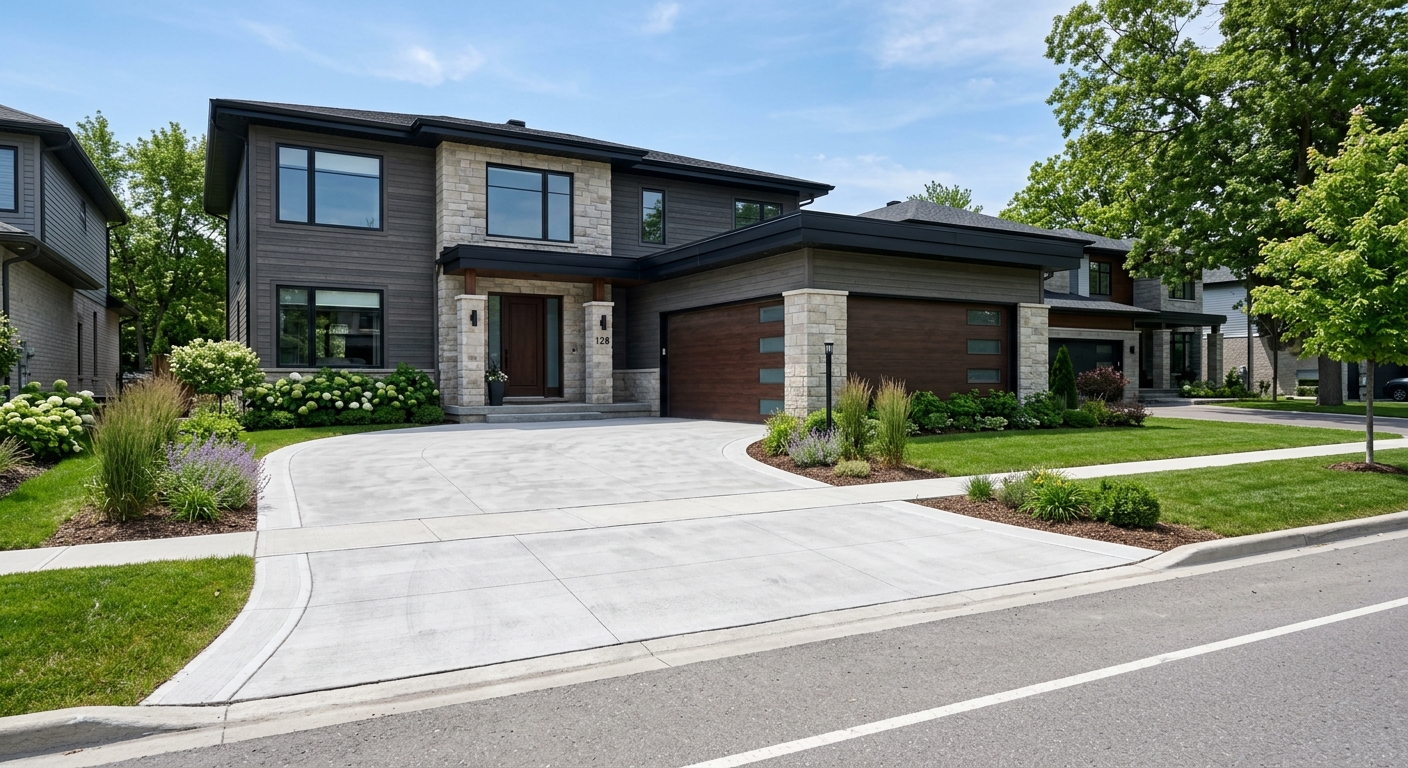
Concrete work options and costs in Elkford
Elkford, British Columbia is a small community with a practical housing stock—about 54.3% of dwellings are single-detached homes (Statistics Canada, 2021 Census). That matters because most local concrete flatwork demand comes from driveways, patios, and walkways tied to those houses. With 975 homeowner households (84.1% of households own), many projects are upgrades: replacing cracked slabs, adding a proper entry pad, or renewing surfaces before winter weather tightens up.
In the Kootenays, pricing is shaped by cold continental winters and highly variable micro-climates—your job can behave differently from the next street over depending on drainage, wind exposure, and how the site drains toward a valley. Contractor costs run higher than milder parts of BC because footings and exterior slabs must be protected from freeze–thaw movement: we typically require air-entrained mixes for exterior flatwork and deeper, well-compacted bases for frost performance. Plus, Elkford’s shorter pour season means more scheduling constraints—heating, curing blankets, and careful coordination can affect labour and unit costs.
Because much of Elkford’s demand is tied to older homes—55.6% built before 1981—there’s often additional work for demolition, regrading, and tying into existing foundations and drainage. In the neighbourhoods and streets near the older housing areas by the town core, homeowners commonly replace driveway slabs and entry walks to reduce tripping hazards and winter salt damage.
Below is a practical cost comparison so you can line up quotes with apples-to-apples specs before you book a site visit.
| Application |
Typical Size |
Key Spec |
Finish Option |
Price Range |
| Concrete driveway (standard broom finish) |
400–600 sq. ft. |
Air-entrained exterior mix, compacted base, control joints |
Broom finished, sealer recommended |
$7,200 – $14,000 |
| Exposed aggregate driveway |
400–600 sq. ft. |
Air-entrained mix, proper retard/cleaning process, sealed after cure |
Exposed aggregate (light brushing) |
$10,000 – $18,500 |
| Stamped concrete driveway or patio |
250–500 sq. ft. |
Air-entrained exterior mix, thicker slab where required, joints match pattern |
Stamped finish with release agent and color |
$9,000 – $20,000 |
| Plain concrete patio or walkway |
120–300 sq. ft. |
Exterior air-entrained mix, compacted base, control joints |
Float and broom texture, edges tooled |
$1,700 – $6,800 |
| Garage floor (interior slab) |
300–500 sq. ft. |
Minimum 32 MPa mix, poly/ground prep, joints per plan |
Power float and light broom, optional densifier |
$4,900 – $10,800 |
| Foundation footings (structural, below frost) |
Varies by foundation plan |
Engineered reinforcement, below frost depth, drainage-ready excavation |
Structural concrete placement only |
$8,500 – $18,500 |
Prices are estimates only and vary by project scope, site access and material selection.
What affects the price of concrete work in Elkford
In Elkford and across the Kootenays, two quotes for the same “driveway replacement” can differ by 30–50% because the real work isn’t just the concrete—it’s everything around it: frost-safe excavation, drainage, reinforcement, and the controls needed to survive freeze–thaw cycles. Contractors also price in labour availability and winter constraints across the region, from Cranbrook to Nelson and Trail, where scheduling pressure and fuel/material inflation have been a consistent factor.
Specifically, frost line depth dictates footing depth and form height. In colder interior climates we plan footings well below grade and design for frost movement; for exterior slabs and walkways we use air-entrained concrete mixes to handle repeated freeze–thaw. When cold weather shortens the pour season, crews may need heating, insulation, curing blankets, and tighter daily scheduling—those steps add real cost. Also, de-icing salt can accelerate surface scaling if the slab isn’t properly air-entrained and later sealed; the sealing step can prevent premature wear.
In practical Elkford jobs, costs rise when a driveway needs significant regrading or when the old slab has to be removed down to suitable base. Costs can be lower when access is straightforward and the existing base is sound, but most older homes (55.6% built before 1981) usually require some level of base correction and subgrade evaluation. For context, a basic broom-finished driveway commonly tracks the regional band of $18,000 – $28,000 for larger jobs, while decorative options like stamped concrete typically fall into the higher $25,000 – $40,000 range once labour and finish materials are included.
| Price Factor |
Why It Matters |
Cost Impact |
| Frost line depth |
Determines footing depth and form height |
More excavation and concrete volume increases labour and materials |
| Site preparation |
Excavation, grading, compacted granular base |
Extra hauling and base material can materially raise the price |
| Reinforcement |
Rebar or wire mesh requirement |
Steel placement time plus bar supports and lapping adds cost |
| Mix design |
Air-entrainment and compressive strength spec |
Better mix is usually pricier and may require longer protection time |
| Finish type |
Broom vs. stamped vs. exposed aggregate |
Decorative finishes add labour, forms/materials, and finishing time |
| Pour size and concrete truck access to site |
Footprint size, hose placement, and turnaround |
Tighter access can require smaller loads or more crew hours |
| Cold-weather curing precautions |
Heating and blankets to protect early-age concrete |
Heaters, insulation, and monitoring can add a noticeable premium |
| Control joint pattern and sealing cost |
Joints manage cracking; sealer reduces salt scaling |
More joints and proper sealing materials add line-item cost |
Permits & regulations in British Columbia
In British Columbia, structural concrete work typically requires a building permit, often with engineered drawings reviewed by the municipality. That usually includes footings, foundation walls, grade beams, and other load-bearing structural elements. If your project changes load paths, foundation geometry, or involves new structural openings, expect permitting. For concrete flatwork—such as driveways, patios, and walkways—permits often aren’t required unless the work affects lot grading, drainage, impervious surface coverage limits, or impacts a municipal right-of-way (for example, work that changes an approach near a curb or sidewalk).
How to verify a contractor in Elkford (British Columbia) step by step:
- Request their certificate of insurance (liability) naming you as additional insured when appropriate.
- Confirm they have WCB coverage for their workers (and that coverage is current).
- Verify their contractor licence status through the appropriate online registry and match the licence details to the company name on your contract.
- Ask for clearance/coverage evidence (clearance letters or current WCB confirmation), not just a verbal assurance.
- Check references for similar-scale work in the Kootenays (driveways, slabs, or foundations depending on scope).
Before breaking ground, always confirm permit requirements with the local authority, especially if drainage changes or if the slab ties into foundation modifications.
Getting concrete right in Elkford's freeze-thaw climate
Concrete failures in Elkford usually come back to one theme: freeze–thaw movement that the slab wasn’t designed to handle. The most common symptom homeowners see is spalling—surface scaling and flaking—often triggered by inadequate air-entrainment, poor base prep, or curing problems. In the Kootenays, we also manage drainage carefully because water trapped under a slab or at slab edges freezes and lifts the concrete.
To spec the job correctly, focus on five areas. (1) Base preparation: excavate to the correct depth for your site and frost considerations, then install and compact a clean granular sub-base. (2) Mix design: for exterior flatwork, specify air-entrainment typically around 5–7% air content and a minimum compressive strength such as 32 MPa, depending on the scope. (3) Control joints: plan joint spacing so cracks occur where expected rather than randomly. (4) Curing: in cold weather, we protect the pour and target a minimum 7-day curing period under suitable conditions. (5) Sealing: apply a penetrating sealer after curing (often at 28 days) to reduce salt-driven surface deterioration.
Ask technical questions up front: “What air content are you targeting?”, “How deep is the compacted base?”, “What’s your joint spacing plan?”, and “What cold-weather curing method are you using?” A key example: if you choose plain broom concrete at the lower driveway slab pricing band (often around $18,000 – $28,000 for typical larger replacements), you can justify the savings only if the contractor still meets frost-safe base prep, air-entrainment, and proper joints. Decorative finishes may cost more (stamped/exposed options typically rise toward $25,000 – $40,000), but the added expense is only “worth it” when the underlying durability specs are correct.
| Spec |
Why It Matters in Elkford |
What to Ask For |
Impact if Skipped |
| Compacted granular base (depth?) |
Stable support against frost movement and settlement |
Confirmed excavation depth, granular type, and compaction method |
Uneven settling, early cracking, and joint failure |
| Air-entrained concrete mix (target air %?) |
Protects the paste from freeze–thaw damage |
Air content target (commonly 5–7% for exterior flatwork) |
Higher risk of spalling and surface scaling in winter |
| Compressive strength (MPa rating) |
Ensures the slab meets strength needs for loads and durability |
Minimum 32 MPa (or higher per engineered/structural needs) |
Reduced wear resistance and increased cracking risk |
| Control joints (spacing per ACI guidelines) |
Controls where cracks occur during freeze–thaw expansion/contraction |
Joint layout plan and spacing for your slab size |
Random cracking that can expose edges to water and salt |
| Minimum 7-day curing period |
Early-age strength gain is critical before winter stress |
How curing will be protected in cold weather (blankets/heating) |
Weak early concrete leads to cracking, scaling, and reduced lifespan |
| Penetrating sealer (when applied after cure) |
Repels moisture and helps resist salt deterioration |
Application timing (commonly after full cure, often at 28 days) |
Faster spalling and mottling from repeated winter de-icing |
How to choose a concrete work contractor in Elkford
Start by confirming contractor credentials in British Columbia and making sure coverage is current. Ask for: (1) licensing details for the company you’re hiring, (2) liability insurance with a certificate of insurance and (where appropriate) proof they can add you as additional insured, and (3) WCB coverage for their workers. In practice, the best contractors hand you clear paperwork without pressure—don’t settle for “we’re covered” with no documentation.
Then get 2–3 itemised written quotes rather than a single lump sum. You want a breakdown that separates excavation/site prep, base materials, formwork, reinforcement, concrete supply, finishing, curing protection, and any sealing. Make sure the quote answers the “scope clarity” questions: what’s included for demolition, disposal, and haul-off? Is permit work included if required? Are there allowances for soils that don’t compact to spec?
Warranty matters. Ask for the workmanship warranty length, what it covers (cracking vs. spalling vs. settlement), and whether any manufacturer product warranty transfers to you for sealers or specialty finishes. For payment, a safe approach is to keep upfront payment to 10–15%, then hold back until completion and final inspection. Finally, request a written timeline with a start date window, estimated completion date, and what happens if temperatures fall below workable thresholds.
- Ask who your pour crew lead is and how many similar local projects they’ve completed.
- Confirm air-entrained mix and curing method in writing.
- Require joint layout and sealing plan in the scope.
- Verify truck access plan and how they’ll prevent cold joints.
- Check whether they include saw-cutting vs. alternative joint methods.
- Request concrete strength spec (e.g., 32 MPa or higher as needed).
- Make sure base prep includes granular type and compaction standard.
- Confirm reinforcement needs (wire mesh vs. rebar) are specified, not guessed.
- Ask how they handle water management at edges and slopes.
- Review disposal/haul-off details for demo and excess material.
- Ensure the quote includes cold-weather blankets/heating if scheduled in winter.
- Get everything in writing: scope, exclusions, warranty, and payment schedule.
Concrete red flags in Elkford: a quote that doesn’t mention air-entrainment for exterior slabs, no clear plan for base depth/compaction, “we’ll do it in one day no matter the temperature” without curing protection, a vague warranty with no coverage details, and contractors asking for large upfront payments or refusing itemised scope and proof of insurance/WCB.
Frequently asked questions — concrete work in Elkford
How do I compare concrete quotes?
In Elkford, compare quotes by scope first, not by total price. Ask each contractor to itemise excavation/site prep, base material, reinforcement (wire mesh vs. rebar if required), concrete supply spec (including air-entrainment for exterior work), finishing method (broom vs. stamped), and curing protection for the planned pour date. A lower number can be misleading if it omits sealer or under-specifies base prep. Also compare line items for joint cutting and sealing—those details are crucial in freeze–thaw conditions. For budgeting, confirm whether your driveway aligns with the local regional bands (for example, typical driveway slab pricing often sits around $18,000 – $28,000 for standard broom-finish scenarios), then see what exactly increases costs for decorative options.
Can concrete be poured in cold weather in Elkford?
Yes, concrete can be poured in cold weather in Elkford, but it must be protected so it cures properly. The main risk is that early-age concrete won’t gain strength fast enough, which increases cracking and surface scaling later during winter freeze–thaw cycles. Reputable crews use measures like curing blankets, insulation, heated enclosures where practical, and temperature monitoring to keep the concrete within the acceptable range. Timing also matters because Elkford’s shorter pour season means scheduling and crew readiness must be planned. When you request quotes, ask what cold-weather curing precautions they include (and whether those costs are in the price). If a contractor won’t discuss curing protection in writing, treat it as a warning.
How do I maintain concrete in Elkford's freeze-thaw climate?
Maintenance in British Columbia is about preventing moisture and salt from reaching vulnerable surfaces. For exterior slabs and driveways, start with sealing after the concrete has fully cured—often around 28 days—using a penetrating sealer designed to repel water. During winter, use de-icing methods carefully: avoid over-applying salt and try calcium chloride or sand-based traction when appropriate. Keep expansion joints clear of debris so water doesn’t pond and freeze under edges. Reapply sealer if you notice water no longer beads or if staining returns. Also inspect annually for hairline cracks around joints—small issues are easier to manage than settlement-driven damage, especially on older Elkford homes where subgrade conditions can vary.
What causes concrete to spall in Elkford winters?
Concrete spalls when the surface paste and near-surface concrete break down after repeated freeze–thaw, usually combined with moisture and de-icing salt. The most common technical causes are inadequate air-entrainment, poor curing, and inadequate base drainage. If the mix isn’t air-entrained for exterior exposure, the freezing water expands inside the concrete and damages the surface over time. If curing is rushed due to cold weather (insufficient blankets/heating), the slab may not reach adequate strength before winter stress. Also, if water accumulates at edges or joints because drainage and compaction weren’t handled properly, spalling speeds up. In Elkford, ensure exterior flatwork includes air-entrainment and that joints and sealing are included in the scope.
What is rebar and when is it required in British Columbia?
Rebar is reinforcing steel bars embedded in concrete to help resist tension and cracking from loads and movement. In British Columbia, whether rebar is required depends on the structural design and the engineered spec for your foundation or slab system. Structural elements like foundation footings, grade beams, and reinforced foundation walls typically require engineered reinforcement—your municipality or engineer’s drawings determine the amount, size, and placement. For non-structural exterior slabs like some driveways, reinforcement might be wire mesh or could be omitted based on slab thickness, soil support, and the design loads; however, many driveways do include reinforcement to improve crack control. Ask your contractor to state what reinforcement is included, where it is placed, and whether it matches an engineer’s requirement.
How long does a concrete project take in Elkford?
Timelines in Elkford depend on scope, weather, and site access, but a typical driveway or patio project often takes several days from demo to final finishing when conditions are favourable. You’ll usually see: day 1 for layout, excavation, and base prep; day 2 for forms/reinforcement and the concrete pour; and subsequent days for finishing, curing protection setup, and joint cutting if included in the schedule. Decorative work like stamped concrete may require extra finishing time. Cold weather can extend timelines because curing blankets/heating must remain in place until the concrete reaches sufficient early strength. Foundation and footing work can take longer because of excavation, formwork, reinforcement placement, and inspection steps. Always request a written start date window and completion estimate.