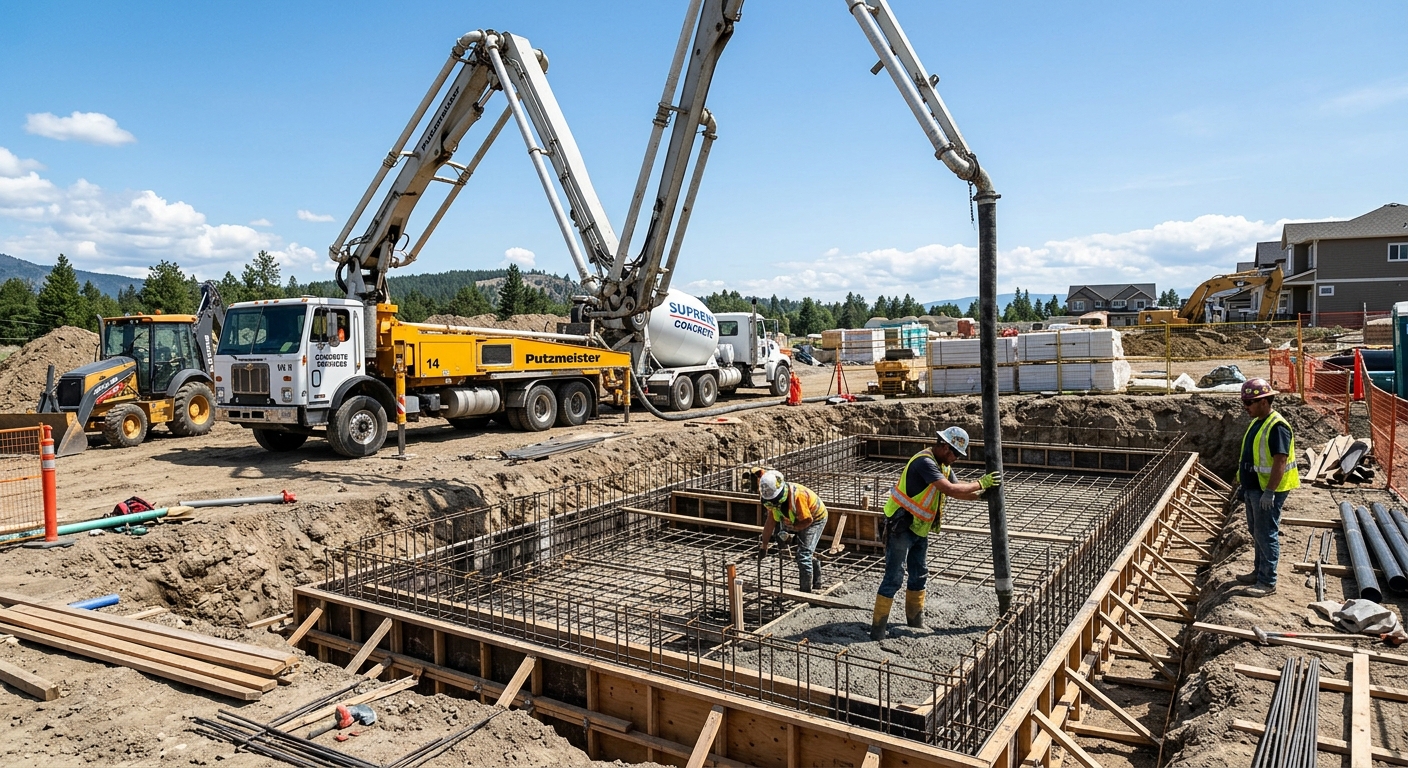
Concrete work options and costs in Chetwynd
Chetwynd is where homeowners count on durable, low-maintenance flatwork—especially with the Peace River District’s long, cold winters and frequent freeze–thaw cycles. Most concrete driveway and patio demand comes from single-detached homes; in Chetwynd, 57.8% of dwellings are single-detached, and homeowner households make up 63.6% of all households (Statistics Canada, 2021 Census). That mix matters because driveways, front walks, and entry pads are the everyday projects that get scheduled during the short construction season.
In Northeast British Columbia, concrete pricing is higher than milder parts of the province because exterior slabs and driveways must be built for deep frost protection, good drainage, and longer, protected curing. In many northern sites, excavations often land in the 6–8 ft range for footings and sub-base preparation, and that adds labour, equipment time, and backfill cost. Seasonal demand also compresses scheduling into warmer months, so crews and concrete trucks can book up faster around Fort St. John and the surrounding Peace River districts—pulling pricing up even when your scope is “simple.”
If you’re planning work near the downtown core or the busier residential pockets with easy access for trucks (homeowners commonly request driveways and approach slabs there), the real driver is not just the finish—it's the thickness, reinforcement, base build-up, and winter-ready curing plan.
Below are typical cost ranges you can use to compare contractor proposals before you dial in thickness, reinforcement, and finish.
| Application |
Typical Size |
Key Spec |
Finish Option |
Price Range |
| Concrete driveway (standard broom finish) |
400–600 sq ft |
4 in slab, compacted granular base, joints |
Broomed texture, standard edging |
$7,200 – $16,800 |
| Exposed aggregate driveway |
400–600 sq ft |
4–5 in slab, polished aggregate surface prep |
Exposed stone, sealer recommended |
$9,000 – $20,400 |
| Stamped concrete driveway or patio |
300–500 sq ft |
4 in slab, colour hardener and sealer system |
Stamped pattern (slip-resistant texture) |
$10,000 – $22,500 |
| Plain concrete patio or walkway |
150–300 sq ft |
4 in slab, compacted base, control joints |
Float and broom or smooth trowel (where suitable) |
$2,300 – $7,500 |
| Garage floor (interior slab) |
500–700 sq ft |
4 in slab, vapour control as needed |
Standard trowel finish with edges |
$9,000 – $19,600 |
| Foundation footings (structural, below frost) |
Per home footprint; typical 1,200–1,800 sq ft build |
Engineered design, excavation below frost, rebar as required |
Structural concrete (no decorative finish) |
$18,000 – $54,000 |
Prices are estimates only and vary by project scope, site access and material selection.
What affects the price of concrete work in Chetwynd
In Chetwynd, two contractors can quote the “same” driveway and still be 30–50% apart—and it usually comes down to depth, preparation, reinforcement, and how they protect concrete through Northeast British Columbia’s freeze–thaw cycles. Even when your finish choice looks straightforward (broom vs. stamped), the real cost is often hidden in the sub-base, drainage, and cold-weather curing plan. In the Peace River district, the short pour season means crews and concrete trucks are booked tightly in warmer windows, so labour availability and dispatch logistics can push pricing upward.
Frost protection drives many differences. Footings and exterior slab assemblies must extend below the local design frost depth to prevent frost heave and slab cracking, and that can mean deeper excavations than in southern regions. Exterior concrete also needs air-entrainment to handle repeated freezing and thawing; without it, the surface can spall and deteriorate quickly. Cold-weather curing adds cost because protecting the pour with curing blankets, insulation, and sometimes heat control is essential for strength gain—especially near the edge of the season.
Concrete sealing is another cost driver. De-icing salt commonly accelerates surface scaling and spalling, so sealing is strongly recommended for driveways and walkways. In older housing areas—over half of homes in Chetwynd were built before 1981 (56.1%) (Statistics Canada, 2021 Census)—I often see thicker, irregular approaches and utility constraints that require more excavation and careful patching, which raises total cost.
For context, a plain patio or walkway may land around the $15–$25 per sq ft band, while stamped work often sits higher in the $25–$40 per sq ft band once colour, stamps, and the correct curing/sealer system are included. You’ll also see foundation/footings budget come in higher when excavation reaches the full frost requirement—typically budget $55–$90 for foundation/footings line items, depending on engineered scope and rebar demands.
| Price Factor |
Why It Matters |
Cost Impact |
| Frost line depth |
Footing depth and form height must reach below frost to prevent heave |
Can add significant excavation and backfill cost |
| Site preparation |
Excavation, grading, and compacted granular base control settlement and cracking |
More base material and labour if the site is soft or uneven |
| Reinforcement |
Rebar or wire mesh helps control shrinkage and heavy-load cracking |
Higher material and tie-in labour where required |
| Mix design |
Air-entrainment and compressive strength specs improve freeze–thaw durability |
Premium mix and test/quality control time |
| Finish type |
Broom vs. stamped vs. exposed aggregate changes labour and materials |
Stamped/exposed usually add more per sq ft |
| Pour size and concrete truck access |
Long carries, limited access, or multiple pours increase coordination time |
More labour hours and potential additional truck charges |
| Cold-weather curing precautions |
Blankets, insulation, and heating protect strength gain and surface durability |
Added materials and monitoring during the season edge |
| Control joint pattern and sealing cost |
Joints and sealing manage cracking and protect from salt and moisture |
Extra layout time and sealer cost |
Permits & regulations in British Columbia
In British Columbia, the rule of thumb is: structural concrete work typically needs a building permit, while most simple flatwork usually does not. Concrete items like footings, foundation walls, and grade beams are structural, so they generally require a building permit and often engineered drawings that the municipality reviews. If your project changes load paths, foundation elevations, or lot/grading conditions, don’t assume it’s “just concrete.”
Concrete flatwork—driveways, patios, and walkways—usually doesn’t require a permit unless it affects lot grading, impervious surface coverage limits, drainage, or municipal right-of-way considerations. In Chetwynd, it’s still smart to confirm before breaking ground because snow storage, drainage direction, and setbacks can matter in neighbourhood layouts.
Step-by-step for Chetwynd homeowners:
- Ask the contractor what permits they’re pulling (or not pulling) for your scope and request it in writing.
- Request the contractor’s liability insurance certificate of insurance naming you as applicable (or confirming coverage limits).
- Verify their WCB coverage (or the current worker coverage status) and keep a copy for your records.
- Confirm they meet provincial business requirements through the appropriate provincial registry tools and make sure their contact details match the quote.
- Ask for references on similar-scale Peace River district work where deep frost protection and cold-season curing were required.
If a quote doesn’t clarify whether permits, engineered details, or protection measures for curing are included, treat that as a gap—not a bargain.
Getting concrete right in Chetwynd's freeze-thaw climate
Concrete failures in Chetwynd are rarely about “bad luck.” They’re usually about base preparation, mix design, control joints, and curing details that must be tuned to Northeast British Columbia’s freeze–thaw cycles, deep frost, and de-icing salt exposure. The most common problem I see on exterior slabs is spalling from inadequate air-entrainment—basically, the concrete can’t tolerate repeated freeze expansion, so the surface breaks down over winters.
To spec the job correctly, start with base preparation. You want a compacted granular sub-base to the depth needed for the local soil and the frost-protected assembly. Next is mix design: for exterior flatwork, air-entrained concrete typically targets about 5–7% air content and should meet a minimum 32 MPa compressive strength requirement. Then plan control joints early—spacing matters, and joints need to be cut soon enough to guide cracking away from visible edges. Curing is the make-or-break step in cold weather; you generally need at least 7 days of curing under conditions that allow strength gain, using blankets/insulation when temperatures dip.
Finally, sealing is your practical defence against moisture and salt. A penetrating sealer is typically applied after the concrete has cured—commonly at 28 days post-pour—to repel de-icing salts and reduce freeze–thaw surface deterioration.
When comparing options, a stamped driveway will cost more than broom-finish, but it’s justified when you’re getting the full correct system (base, joints, air-entrained mix, proper curing, and sealing). If someone quotes you stamped work within the broom band ($18–$28 for a typical driveway), ask what’s different—because the stamp system, colour, and finishing labour usually push it closer to the $25–$40 decorative range.
| Spec |
Why It Matters in Chetwynd |
What to Ask For |
Impact if Skipped |
| Compacted granular base (depth?) |
Controls settlement and frost movement under slab |
Documented base depth and compaction method/testing |
Uneven slabs, cracking, and premature failure |
| Air-entrained concrete mix (target air %?) |
Helps concrete survive freeze–thaw without surface damage |
Air content target of about 5–7% for exterior flatwork |
Spalling and scaling in 1–3 winters |
| Compressive strength (MPa rating) |
Strength gain supports durability under load and cold |
Minimum 32 MPa at specified curing/age |
Lower strength and higher cracking risk |
| Control joints (spacing per ACI guidelines) |
Guides shrinkage cracking to predictable locations |
Proposed joint layout, spacing, and timing of cutting |
Random cracking and hard-to-repair damage |
| Minimum 7-day curing period |
Cold weather can slow strength development |
Plan for curing protection (blankets/insulation) if temperatures drop |
Weak surface, increased cracking and scaling |
| Penetrating sealer (when applied after cure) |
Reduces salt/moisture attack during Northeast winters |
Confirm application timeline—commonly after 28 days |
Faster deterioration from de-icing salts |
How to choose a concrete work contractor in Chetwynd
Choosing the right contractor in Chetwynd is mostly about proof: proof they can build for deep frost protection, proof they protect curing during the cold shoulder of the season, and proof they’re properly insured. Start by verifying British Columbia requirements in a practical order. Ask for a certificate of liability insurance (confirm coverage limits and that it’s current), then ask for confirmation of WCB coverage status. If a contractor can’t provide documentation quickly, that’s a red flag. Next, verify their business registration and make sure the quote and documentation match the same legal entity.
Then get 2–3 itemised written quotes. You want line items that separate labour and materials and clearly list scope: demo/removal, excavation and hauling, granular base depth, reinforcement type, concrete thickness, joint layout, curing blankets/insulation (if needed), and sealing. A lump-sum number without those details is hard to compare and easy to dispute later.
Read the scope exclusions carefully. Are permits included (where required), is disposal included, and who handles backfill and compaction testing? Warranty matters too: ask for the workmanship warranty length and what it covers (cracking guidance, spalling claims, and drainage-related issues), plus the product/manufacturer warranty and whether it’s transferable to you. In terms of payment schedule, never pay more than 10–15% upfront; hold back a meaningful portion until forms are removed, finishing is accepted, and curing/sealing steps are completed.
Finally, insist on a timeline in writing: start date window and completion estimate. In the Peace River district, weather can delay pours, but a professional contractor will plan around that rather than leaving you with uncertainty.
- Request WCB confirmation and keep a copy.
- Get liability insurance proof with coverage limits listed.
- Verify the contractor’s identity matches the quote paperwork.
- Ask for examples of Northeast BC jobs, not just southern projects.
- Insist quotes include excavation depth to frost-ready specifications.
- Confirm air-entrained mix and compressive strength requirements.
- Require a control joint layout plan (not “we’ll cut them later”).
- Ask how they handle cold-weather curing (blankets/heating/insulation).
- Clarify reinforcement type and where it’s placed.
- Check whether disposal and hauling are included.
- Ask who is responsible for site grading/drainage around the slab.
- Review warranty terms in writing and what triggers a claim.
Concrete contractor red flags in Chetwynd: they refuse to discuss frost depth/base prep, they skip air-entrainment details, they can’t show insurance/WCB paperwork, they quote stamped work too close to broom pricing without explaining what’s excluded, or they ask for a large upfront deposit and won’t provide an itemised scope.
Frequently asked questions — concrete work in Chetwynd
How do I seal concrete to protect it in Chetwynd?
In Chetwynd and Northeast British Columbia, sealing is about reducing moisture and de-icing salt intrusion so the surface doesn’t scale and spall through repeated freeze–thaw cycles. For most exterior slabs and driveways, a penetrating sealer is typically applied after the concrete has cured—commonly at 28 days post-pour—so the concrete is dry enough to accept the sealer. Ask your contractor what sealer type they’re using (penetrating vs. film-forming) and whether they’ll prep the surface (cleaning and, if needed, light profiling). If your driveway is in use immediately after curing, also ask about curing protection during the first winter. Budget-wise, sealing is usually a line item on top of your base concrete, and driveway totals often still fall within the general driveway bands such as $18–$28 for standard broom work, depending on finish and site prep.
What is the difference between concrete and cement?
Cement is one ingredient inside concrete. Concrete is the full mix: cement plus water plus sand and gravel (and sometimes admixtures for air-entrainment and workability). In Chetwynd’s climate, what matters isn’t just the word “cement,” but the engineered concrete mix design—especially air-entrainment and compressive strength. A contractor can use “cement” that sounds standard, but if they don’t specify air content (commonly about 5–7% for exterior flatwork) and a minimum strength target (often 32 MPa), the concrete may not tolerate our freeze–thaw cycles. That’s why good quotes describe the concrete spec, not just the ingredient list. When you request a quote, ask for the planned air-entrainment target, curing plan, and joint layout so you’re buying durability, not just materials.
How much does concrete work cost in Chetwynd?
Concrete costs in Chetwynd generally run higher than southern BC because deeper frost-ready prep, air-entrained mixes, and cold-weather curing precautions add labour and materials. For driveways and slabs, typical local pricing bands for the Chetwynd tier are about $18–$28 for concrete driveway/slab work, and patios/walkways commonly land around $15–$25. Decorative options rise: stamped and decorative concrete often runs $25–$40 per sq ft once colour, stamping labour, and the correct curing/sealer system are included. If you’re comparing quotes, make sure you’re comparing the same thickness, base depth, reinforcement, and finishing plan—those are the pieces that swing bids by 30–50%. Foundation/footings are a separate, deeper scope; in Northeast BC, they often reflect frost-depth excavation and can cost materially more than flatwork.
How deep must footings be for Chetwynd's frost line?
Footing depth is determined by the design frost depth used in engineering and by local soil conditions. In Northeast British Columbia, frost penetration is deep and can create a need for excavation in the broader range of about 6–8 ft in many site conditions to stay below frost and prevent frost heave and slab cracking. The exact depth on your property should be confirmed by the engineered foundation design for your build, because frost depth can vary with soil type, drainage, and how the site is graded. When you get a quote in Chetwynd, ask the contractor to state that they will excavate to the engineered below-frost depth and to explain their backfill and compaction plan. If someone gives you a shallow “rule of thumb” without referencing the engineered specs, it’s a durability risk.
Why does concrete crack in Chetwynd and how is it prevented?
Cracking is common in concrete, especially in exterior flatwork, because of shrinkage, temperature swings, and—most importantly for Chetwynd—freeze–thaw movement. The key prevention steps are: correct base preparation and compaction, the right mix design for exterior exposure, a controlled joint pattern, and curing that actually allows strength gain. In practice, contractors reduce random cracking by cutting control joints on a planned schedule so shrinkage cracks form where they’re easiest to manage. If the concrete isn’t air-entrained to handle freeze–thaw, surface deterioration can worsen and create more visible cracking over time. De-icing salt also accelerates surface damage, so sealing helps protect the surface. When comparing bids, ask for the proposed joint layout and cutting timing, plus whether they’re using curing blankets/insulation during the cold shoulder of the season.
Stamped vs broom-finish concrete — cost difference?
Stamped concrete costs more than broom-finish because you’re paying for colour materials, release agents, stamping labour, and an enhanced curing/sealer system to maintain the look through Northeast winters. In Chetwynd, broom-finish driveway/slab work commonly falls in the $18–$28 driveway band depending on thickness and base prep. Stamped decorative concrete is usually higher, often within the $25–$40 range for that decorative category. A stamped finish can be worth it if you’re already planning a new driveway or patio and you want the slip-resistant texture plus curb appeal. But don’t assume it’s automatic value—if a quote for stamped work is priced too close to the broom band, ask what’s different (thickness, base depth, reinforcement, air content, curing protection, or sealing). The cheapest option isn’t the lowest risk if it shortcuts the freeze–thaw durability specs that keep exterior concrete intact.