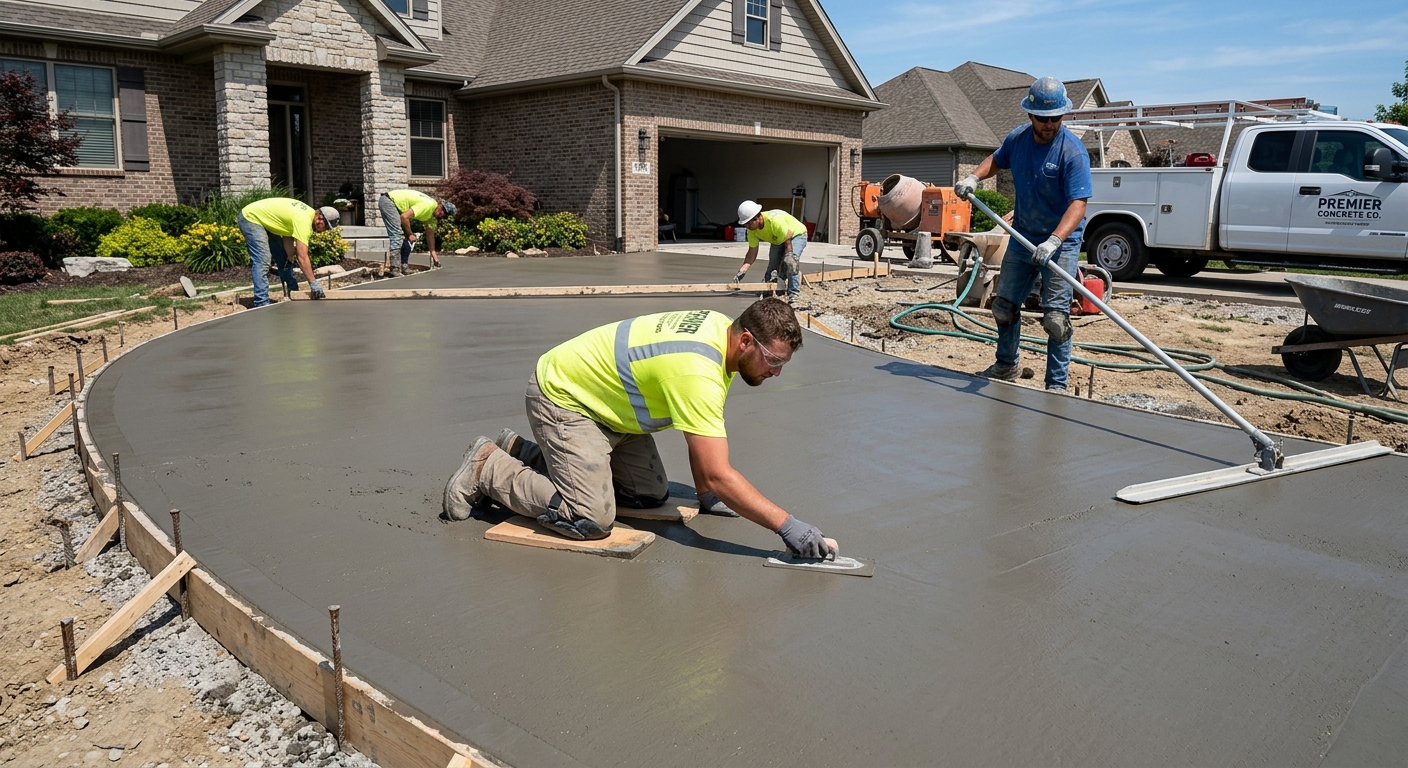
Concrete work options and costs in Fort Langley
Concrete work in Fort Langley ranges from simple flatwork to foundation-grade pours, and the right option depends on your use, your soil, and how you want it to look. In Fort Langley (population 3,836 as reported in the Statistics Canada, 2021 Census), a lot of driveway and patio demand is driven by the area’s family neighbourhoods around streets serving the Langley City–Fort Langley corridor, where homeowners often renovate older homes and update curb appeal. You’ll also see plenty of demand for durable exterior slabs—because this region’s Lower Mainland–Southwest climate means frequent wetting and freeze–thaw cycles near the edges of slabs and steps, not just deep winter frost. Even with a shallow frost depth (commonly planned around 450 mm / 18" in local practice), footings and thickened edges still must be protected to avoid frost heave and settlement-related cracking.
Because Lower Mainland–Southwest winters are mild but moisture-heavy, concrete crews plan pours around rain windows, cool nights, and curing conditions. That pushes labour, scheduling, and curing measures (blankets, sealers, longer cure time) into the final price—so two quotes can differ even when the “square footage” looks the same. Availability also matters in the Vancouver–Surrey–Abbotsford corridor; when several jobs are scheduled for similar weather windows, labour and truck time can tighten.
Below is a practical price comparison for common projects in Fort Langley, so you can sanity-check quotes before you lock in finishes, base thickness, and structural specs.
| Application |
Typical Size |
Key Spec |
Finish Option |
Price Range |
| Concrete driveway (standard broom finish) |
400–600 sq. ft. |
Air-entrained mix, compacted base, control joints, 100 mm slab (typical residential) |
Broom finish + sealer recommended |
$18,000–$28,000 |
| Exposed aggregate driveway |
400–600 sq. ft. |
Air-entrained mix, proper curing, wash/exposure process |
Exposed aggregate (surface texture) |
$22,000–$34,000 |
| Stamped concrete driveway or patio |
250–500 sq. ft. |
Air-entrained mix, integral colouring, proper release timing |
Stamp + colour |
$22,000–$36,000 |
| Plain concrete patio or walkway |
200–400 sq. ft. |
Air-entrained mix, compacted base, light broom or smooth trowel (as specified) |
Plain finish |
$3,200–$10,400 |
| Garage floor (interior slab) |
400–600 sq. ft. |
Vapour barrier (as needed), reinforcement, flatness for finishes |
Steel-trowel or broom (based on use) |
$18,000–$28,000 |
| Foundation footings (structural, below frost) |
Per linear foot / small footing layout |
Excavation to frost-protected depth, formwork, reinforcing, engineered bearing as required |
Concrete footings only (not walls) |
$8,000–$35,000 |
Prices are estimates only and vary by project scope, site access and material selection.
What affects the price of concrete work in Fort Langley
In Fort Langley and the broader Lower Mainland–Southwest region, it’s common to see concrete quotes for the “same” job vary by 30–50% once you compare the real specifications—especially base prep, mix design, and curing requirements. Even if two contractors quote the same driveway size, one may be building to a deeper, better-drained base with proper air-entrainment and a thicker edge, while another may assume a cheaper, less robust assembly. In British Columbia, those details are amplified by our weather pattern: coastal-wet conditions keep subgrades saturated, and freeze–thaw cycles target the slab edges, steps, and any weak drainage points.
Frost protection drives major cost differences. Local practice typically assumes a frost depth around 450 mm / 18", so exterior footings and thickened edges are placed below that to reduce frost heave risk. All exterior slabs still need air-entrained concrete mixes to handle freeze–thaw scaling and surface deterioration. Meanwhile, colder regions often have shorter pour seasons and require more cold-weather curing precautions (heating and insulated blankets), which raises forming and heating costs. In Fort Langley, we don’t usually need extreme winter heating like interior BC, but cool, damp nights still mean we schedule carefully and sometimes extend cure times to reach proper strength.
Two quick cost examples: an exterior broom-finished driveway typically sits in the $18–$28 per sq. ft. backbone band, while stamped/decorative work can jump to the $22–$36 band due to colouring, stamping labour, and extra finishing control. Also, if you need more excavation and granular replacement because the site is soft or poorly drained, your per-square-foot cost moves toward the higher end—even before you choose finishes. With older housing stock and frequent landscaping rework in the Fort Langley area, it’s not unusual to see surprises in excavation volume and disposal, which can materially change the total.
| Price Factor |
Why It Matters | Why It Matters |
Cost Impact |
| Frost line depth |
Determines footing depth and form height |
Higher excavation depth increases labour, forming, and concrete volume |
| Site preparation |
Excavation, grading, compacted granular base |
Soft subgrade, extra granular, and drainage work push costs up |
| Reinforcement |
Rebar or wire mesh requirement |
Additional steel and tying/spacing take labour; heavy loads require more steel |
| Mix design |
Air-entrainment and compressive strength spec |
Air-entrained, higher-strength mixes cost more and require tighter control |
| Finish type |
Broom vs. stamped vs. exposed aggregate |
Decorative finishes add colouring, stamping tools, and extra finishing time |
| Pour size and concrete truck access to site |
How fast/efficient the placement can be |
Long carries, limited access, and more mobilizations increase labour and costs |
| Cold-weather curing precautions |
Heating and blankets |
Cool nights and damp conditions may require insulated curing measures |
| Control joint pattern and sealing cost |
Controls cracking and protects from moisture/chemicals |
Better jointing and sealer add line-item cost but reduce long-term spalling risk |
Permits & regulations in British Columbia
In British Columbia, concrete isn’t automatically “permit-free.” Typically, structural concrete work—such as footings, foundation walls, grade beams, and other elements that support the building—requires a building permit and often engineered drawings that are reviewed by the municipality. For example, a new foundation or underpinning is treated as structural work, not just a concrete pour. On the other hand, concrete flatwork like patios, walkways, and driveways usually does not require a permit unless it affects lot grading, impervious surface coverage limits, or the municipal right-of-way (for example, when tie-ins or curb/walk access are involved). Because requirements can vary by scope and site conditions, confirm with the local authority before breaking ground.
For homeowner due diligence in Fort Langley, verify three things before you sign: (1) the contractor’s licensing/credentials required for the work they’ll perform, (2) liability insurance, and (3) coverage for workers (WCB/WSIB equivalent coverage in BC). Step-by-step, I tell clients to: request a current certificate of insurance (COI) naming you or the project as required, ask for the clearance letter or proof of worker coverage, and then confirm insurance remains valid through the start and completion dates. Finally, ask for references on similar-scale flatwork and structural pours—especially jobs in the Lower Mainland–Southwest area where drainage and freeze–thaw detailing are critical.
Getting concrete right in Fort Langley's freeze-thaw climate
Concrete commonly fails in Fort Langley when the assembly can’t manage moisture movement and temperature swings—especially at slab edges, steps, and locations that collect water. In our Lower Mainland–Southwest climate, the biggest performance threats are saturated subgrades, inadequate drainage, insufficient air-entrainment, and control joints that aren’t planned. The fix is a spec-first approach: start with compacted granular base to the correct depth for local soil and frost protection; use an air-entrained exterior mix (typical target 5–7% air content) and specify a minimum 32 MPa compressive strength; and include control joints that limit random cracking.
Curing and protection matter more than many people expect. Even when Fort Langley winters are mild, cool nights and high humidity can slow early strength gain—so plan for at least 7 days of proper curing conditions. If rain is frequent, crews may use curing blankets and schedule around weather windows to avoid surface damage. After cure, sealing is your first line of defence against de-icing salts and water penetration: apply a penetrating sealer after full cure (often around 28 days post-pour) to improve surface durability and reduce scaling risk.
Here’s where price differences are justified: a plain broom-finished patio might be closer to the $16–$26 per sq. ft. backbone band, while decorative stamped work can run higher because it adds colouring and more controlled finishing. But if a quote “saves” by using non-air-entrained mix or skipping proper base drainage, you can end up paying again for patching and rework—especially when spalling starts in the first winter cycle. The cheapest option is usually not the cheapest in Fort Langley’s wet-cold pattern.
| Spec |
Why It Matters in Fort Langley |
What to Ask For |
Impact if Skipped |
| Compacted granular base (depth?) |
Controls settlement and provides drainage so water doesn’t saturate the slab |
Documented base depth and granular compaction target, plus any drainage plan |
Edge cracking, uneven settlement, and faster freeze–thaw deterioration |
| Air-entrained concrete mix (target air %?) |
Improves freeze–thaw resistance and reduces scaling/spalling risk |
Target 5–7% air for exterior flatwork, plus proof of mix design |
Spalling in winter cycles, surface scaling, and early surface failure |
| Compressive strength (MPa rating) |
Ensures the slab reaches required durability and structural performance |
Minimum 32 MPa (as specified for exposure and application) |
Higher cracking risk and weaker performance under traffic and moisture |
| Control joints (spacing per ACI guidelines) |
Limits uncontrolled cracking from shrinkage and temperature movement |
Joint spacing and layout plan tied to slab dimensions and thickness |
Random cracks that can widen and let water into the slab system |
| Minimum 7-day curing period |
Builds strength and reduces surface defects from early moisture loss or rain |
Weather plan for cool, damp periods and curing method/coverage |
Reduced strength, surface powdering, and poor long-term durability |
| Penetrating sealer (when applied after cure) |
Repels water and slows salt penetration on exterior slabs |
Apply penetrating sealer after full cure (commonly around 28 days) |
More water ingress, increased freeze–thaw stress, earlier scaling |
How to choose a concrete work contractor in Fort Langley
Choosing the right contractor is mostly about confirming they’ll build to the right spec—not just pour concrete. In British Columbia, start by verifying the contractor’s credentials for the type of work they’ll perform, plus proof of liability insurance. Then confirm worker coverage documentation (WCB/WCB-equivalent coverage in BC) so you’re not exposed if there’s an on-site incident. Ask for a certificate of insurance and a clearance/proof-of-coverage letter, and make sure the COI covers the project period. You can also ask for references on jobs in the Lower Mainland–Southwest corridor with similar exposure (driveways and exterior patios).
Next, get 2–3 itemised written quotes. The best bids break labour and materials down, so you can compare things like excavation volume, granular base thickness, reinforcement type, mix design (including air-entrainment), and curing/sealing. Avoid vague “turnkey” pricing where you can’t see what’s included. Carefully review scope exclusions too: is disposal included, are saw cuts/joint sealing included, and is a permit pull (if required) included or listed as a separate task?
Also be cautious with payment terms and timelines. Never pay more than 10–15% upfront, and ask for a holdback until completion and final cleanup. Get a start date and completion estimate in writing, because weather windows in Fort Langley can affect pour scheduling and curing time.
- Confirm the quote includes air-entrained mix for exterior work.
- Ask for base thickness and compaction requirements, not just “granular fill.”
- Verify reinforcement details: rebar sizing, spacing, and where mesh is actually required.
- Require a control joint plan tied to slab dimensions and crack control.
- Check whether curing blankets or curing protection are included for cool/wet conditions.
- Ask if sealer is included (penetrating sealer after full cure) or a line-item add-on.
- Request disposal and off-haul quantities included, or a clear allowance.
- Confirm access assumptions (staging, truck distance, and concrete pump needs).
- Get a detailed finish description: broom vs stamped vs exposed aggregate method.
- Demand itemised pricing for labour + materials (no “lump sum” without explanation).
- Review warranty: workmanship duration and what it covers (and doesn’t).
- Clarify the payment schedule: low deposit, milestone payments, final holdback.
Red flags I see in Fort Langley include: quotes that don’t mention air-entrainment for exterior slabs, no discussion of drainage/compacted granular base, promises to pour in unsafe rain/cold windows without curing protection, unclear reinforcement details for garage floors or heavy-use driveways, and contractors who won’t provide insurance/coverage proof or itemised scope.
Frequently asked questions — concrete work in Fort Langley
How do I compare concrete quotes?
To compare concrete quotes in Fort Langley (and across the Lower Mainland–Southwest), don’t start with the total price alone—start with the spec. Ask whether the exterior mix is air-entrained (typical target 5–7% air), what the minimum compressive strength is, and whether the quote includes proper compacted granular base and documented thickness. Next, compare finishing and curing: a stamped job costs more than broom finishing because colouring and finishing labour are real; plain exterior work is often closer to the $16–$26 band for patios/walkways, while decorative work may align with the $22–$36 band. Finally, look for hidden cost gaps: reinforcement details, control joint spacing, sealing timing, and disposal/off-haul. A quote that’s cheaper but skips drainage, joints, or curing protection will usually cost more after the first winter freeze–thaw cycle.
Can concrete be poured in cold weather in Fort Langley?
Yes, concrete can be poured in colder periods in Fort Langley, but it needs a cold-weather plan. Because the climate is coastal-wet with cool nights, crews must protect early-age concrete from freezing and from excessive moisture loss. In practice, that can mean scheduling around rain windows, using curing blankets, controlling the water/cementitious materials ratio as specified, and ensuring the slab reaches adequate early strength before exposure. Even though our frost depth planning is generally around 450 mm / 18" in local practice, the pour-time weather affects curing—not just long-term frost. If a contractor tells you they’ll “just pour and hope,” that’s a warning sign. A solid quote should describe curing precautions and how they’ll manage cold, damp conditions so the slab reaches design durability.
How do I maintain concrete in Fort Langley's freeze-thaw climate?
Maintenance in Fort Langley focuses on keeping water out and controlling surface exposure. For exterior slabs, sealing is a practical step: apply a penetrating sealer after the slab has fully cured (commonly around 28 days post-pour) so water and de-icing salts penetrate less deeply. Use gentle cleaning methods and avoid harsh chemicals that can degrade surfaces. Keep downspouts directed away from edges and repair any drainage issues that lead to puddling—saturated base conditions are where freeze–thaw damage starts. For driveways, remove snow using non-metal shovels where possible; de-icing salts can accelerate surface spalling if the surface isn’t protected. If you see hairline cracking at joints, clean and re-seal joints rather than ignoring them—joint maintenance is usually cheaper than slab patching.
What causes concrete to spall in Fort Langley winters?
Spalling in Fort Langley usually comes from a combination of water saturation, freeze–thaw action, and inadequate durability spec. The most common root cause is missing or insufficient air-entrainment. Exterior concrete in freeze–thaw conditions needs a properly air-entrained mix (typically 5–7% air content for exterior flatwork) so freeze–thaw pressures don’t break down the paste structure. A second contributor is poor base preparation or drainage—if the slab edges stay wet, the freeze–thaw effect intensifies. Control joints that aren’t planned or sealed can also allow water to migrate into the crack network. Even well-designed slabs can fail early if curing was rushed in cool, damp weather. In quotes, if the contractor doesn’t talk about air-entrainment and curing, that’s the biggest reason spalling risk increases.
What is rebar and when is it required in British Columbia?
Rebar is reinforcing steel used to control cracking and add tensile capacity to concrete. In British Columbia, whether rebar is required depends on the structural design and the concrete application—not a one-size-fits-all rule. For typical residential foundation footings and foundation elements (structural concrete), rebar is commonly specified by engineers and must match the design drawings. For exterior flatwork like patios and driveways, reinforcement may be included based on slab thickness, subgrade conditions, and expected loads (and sometimes a welded wire mesh is used instead of rebar). The key is that reinforcement spacing, cover, and placement matter, and contractors should explain what’s being used and why. If you’re seeing a price that’s far below the $18–$28 driveway backbone band, ask whether they reduced reinforcement or skipped drainage—because that’s where durability can be compromised.
How long does a concrete project take in Fort Langley?
Project duration depends on the type of work and weather. For a typical exterior flatwork job in Fort Langley, you’ll often see: 1–3 days for layout, excavation, and base prep; 1 day for forms/reinforcement and then the pour day; and the main curing time before heavy use. While the slab may be walkable sooner, good practice means protecting it during the first week—so you should plan around at least 7 days before normal traffic, with longer cure time for full strength and durability. Decorative stamped work can add labour time for colouring and stamping (and sometimes additional curing steps). If cold weather or prolonged rain hits, curing precautions (blankets, sealers timing) can extend the calendar even if the “work hours” stay similar. Ask your contractor for a written start date, completion estimate, and what happens if weather delays the pour.