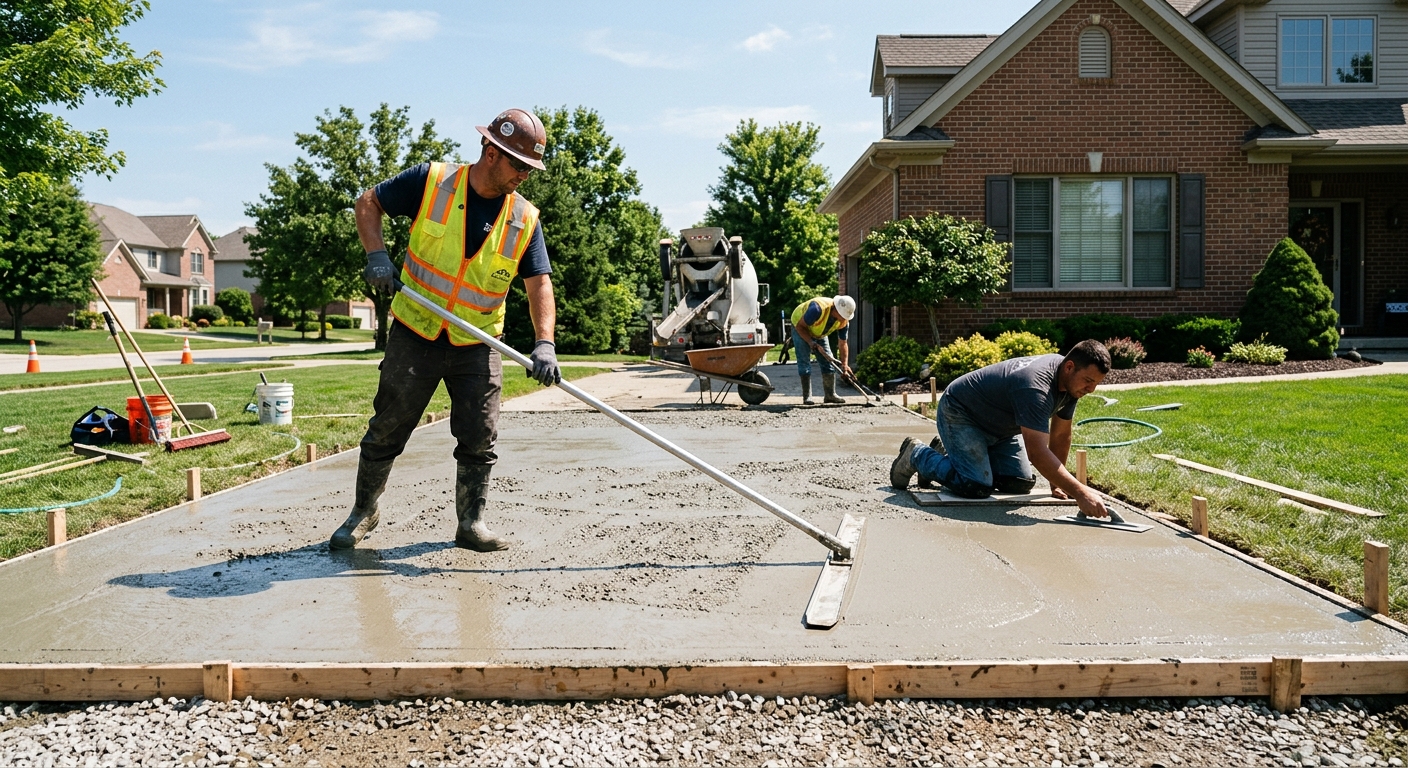
Concrete work options and costs in Blundell
Blundell is a growing community in the Lower Mainland–Southwest, where homeowners regularly choose concrete flatwork for its durability and clean maintenance routine. With a population of 18,065 (Statistics Canada, 2021 Census), the demand for new driveways, patios, and foundation work stays steady—especially because much of the housing stock is family-oriented and built to support everyday vehicles and outdoor living. In this area, concrete is also a common upgrade path for older lots where cracked walkways or uneven driveway slabs are becoming more noticeable.
Pricing is shaped by our coastal-wet conditions and a shallow but meaningful frost depth concept (practice typically assumes frost depth around 450 mm / 18"). That combination matters: footings and thickened edges have to be built below frost to reduce freeze–thaw heaving, and exterior slabs need air-entrained mix plus properly planned joints. Work often gets scheduled around rain, cool nights, and high humidity, which can extend cure times and influence labour availability in peak periods.
In Blundell, concrete crews are especially in demand in and around the residential areas near Steveston Highway and the broader neighbourhood streets where drive access, drainage, and compacted base prep are frequent sticking points. If you’re comparing quote options, it helps to anchor expectations using realistic price ranges before you move into the technical specs.
| Application |
Typical Size |
Key Spec |
Finish Option |
Price Range |
| Concrete driveway (standard broom finish) |
300–400 sq. ft. |
Air-entrained mix, compacted base, control joints |
Broom finish |
$18,000–$28,000 |
| Exposed aggregate driveway |
300–400 sq. ft. |
Air-entrained mix, screened wash, base prep and joints |
Exposed aggregate |
$22,000–$34,000 |
| Stamped concrete driveway or patio |
200–350 sq. ft. |
Air-entrained mix, colouring, release agent, stamped mats |
Stamped & coloured |
$22,000–$36,000 |
| Plain concrete patio or walkway |
150–300 sq. ft. |
Compacted base, dowels/anchors as needed, joints |
Light broom or smooth trowel |
$16,000–$26,000 |
| Garage floor (interior slab) |
400–600 sq. ft. |
Vapour barrier where required, steel reinforcement if specified |
Power trowel or broom (per use) |
$20,000–$32,000 |
| Foundation footings (structural, below frost) |
Varies by foundation plan |
Below design frost, rebar per engineer, waterproofing coordination |
Structural finish (not decorative) |
$200,000–$350,000 |
Prices are estimates only and vary by project scope, site access and material selection.
What affects the price of concrete work in Blundell
In the Lower Mainland–Southwest, you can see the same general concrete scope come in 30–50% apart because “concrete” is only part of the cost. The big swings usually come from excavation volume, base design and drainage, reinforcement requirements, and how contractors manage weather exposure while meeting strength and durability specs. A second reason is subcontractor scheduling—when crews are booked around rain windows and cold nights, labour time and curing precautions cost more.
Frost line depth and freeze–thaw cycles dictate every exterior spec. Even though coastal BC practices commonly work with a design frost concept in the 0.5–1.2 m range, footings and thickened edges still need to sit below that design depth to prevent frost heave. Exterior slabs should also use air-entrained concrete to survive repeated wetting, cooling, and thawing. Colder regions often face deeper excavation and shorter pour seasons; that’s why heating/blanket precautions are a cost driver when temperatures drop and when curing conditions are harder to maintain in British Columbia.
In Blundell specifically, coastal rainfall and saturated soils raise the importance of proper granular base prep and drainage—miss it and the slab can settle or deteriorate faster. Conversely, a straightforward replacement on a site with good access and stable subgrade can keep your project closer to the driveway band (for example, standard broom-finish typically aligns with the $18–$28 per sq. ft. local tier). Decorative work can raise costs—stamped concrete in the $22–$36 per sq. ft. tier can be justified when you want appearance and durability, but it won’t “fix” a poorly prepared base.
Housing age also matters: older Blundell properties often have legacy drainage patterns and compacted fills that require extra grading and base replacement. Where that adds depth or trucking, costs can rise quickly—sometimes hundreds to thousands more in aggregate material and disposal.
| Price Factor |
Why It Matters |
Cost Impact |
| Frost line depth — determines footing depth and form height |
Footings must extend below design frost to reduce frost heave |
Higher excavation and forming cost |
| Site preparation — excavation, grading, compacted granular base |
Correct base thickness and compaction prevent settlement and pumping |
Extra trucking, granular supply, and labour time |
| Reinforcement — rebar or wire mesh requirement |
Controls cracking and supports load transfer where needed |
Material plus tying/binding labour |
| Mix design — air-entrainment and compressive strength spec |
Air entrainment improves freeze–thaw durability |
Upgraded mix and tighter batching/QA |
| Finish type — broom vs. stamped vs. exposed aggregate |
Finishes change finishing time, materials, and crew skill |
Labour premium for stamps/washing |
| Pour size and concrete truck access to site |
Access affects pumping/hosing and pour logistics |
Additional equipment or pump charges |
| Cold-weather curing precautions — heating and blankets |
Protects early strength gain during cool snaps |
Blankets, heaters, and longer scheduling |
| Control joint pattern and sealing cost |
Joints guide cracking and sealing reduces salt-driven surface damage |
Saw-cut time plus sealer and application |
Permits & regulations in British Columbia
In British Columbia, most structural concrete work—like foundation walls, grade beams, footings, and any concrete that’s part of the engineered structural system—requires a building permit and often engineered drawings that the municipality reviews. Concrete flatwork (patios, walkways, and driveways) usually does not require a permit by default, but it can become regulated if it impacts lot grading, drainage, stormwater management, or impervious surface coverage limits. If you’re changing elevations, building close to a right-of-way, or connecting to existing drainage systems, you should verify the requirement with the local authority before breaking ground.
For contractor accountability in Blundell, always confirm three things: contractor licensing/registration where applicable, liability insurance, and coverage for workers. Step-by-step, ask for:
- Licence/registration: look up the contractor through the appropriate BC business/contractor registry (use the contractor’s legal name).
- Certificate of Insurance: request a current COI showing general liability for property damage and bodily injury; verify it lists your address or is written on a blanket basis for the job.
- WSIB/WCB coverage: ask whether they have workers’ compensation coverage and obtain a clearance letter (or proof) for the project timeframe.
- References: request similar-scale jobs in the Lower Mainland–Southwest so you can judge finish quality and curing practices in our climate.
Then compare quotes based on the same scope—especially sub-base depth, reinforcement, and whether curing/sealing is included—so you’re comparing apples to apples, not only concrete quantity.
Getting concrete right in Blundell's freeze-thaw climate
Concrete problems in Blundell usually come down to water management, base preparation, and durability specs during freeze–thaw. The biggest failure I see is spalling (surface scaling and flaking) caused by inadequate air-entrainment or poor curing, especially after de-icing salts and repeated wet/cool cycles. To spec the job correctly, focus on five essentials. First, base preparation: compacted granular sub-base to the correct depth for local soil conditions and frost considerations, with drainage so the slab doesn’t stay saturated. Second, mix design: air-entrained concrete (typically 5–7% air content for exterior flatwork in Canadian practice) and a minimum 32 MPa compressive strength so the slab reaches reliable durability. Third, control joints: cut joints to limit random cracking and specify consistent spacing so cracks occur where you can manage them. Fourth, curing: plan for at least 7 days of curing under proper conditions; in cool, humid weather you may need longer and possibly curing blankets to protect early strength gain. Fifth, sealing: apply a penetrating sealer after full cure (commonly around 28 days) to repel moisture and reduce salt-driven surface damage.
Ask technical questions that directly prevent spalling: “What air content are you targeting?” and “When will you seal, and what sealer type are you using?” If a contractor is vague on air-entrainment and curing, it’s a red flag in British Columbia’s coastal-wet, freeze–thaw environment.
As for cost justification, stamped concrete (often in the $22–$36 per sq. ft. tier) can be worth it when the sub-base is properly prepared and joints are correctly planned—because you’re paying for both appearance and correct performance. But if the site prep is rushed, paying for decoration won’t protect the slab; poor base quality affects both plain broom and stamped finishes.
| Spec |
Why It Matters in Blundell |
What to Ask For |
Impact if Skipped |
| Compacted granular base (depth?) |
Prevents settlement and reduces water retention under the slab |
Granular depth and compaction standard tailored to your lot conditions |
Uneven slab, cracking, and premature deterioration |
| Air-entrained concrete mix (target air %?) |
Improves freeze–thaw durability in coastal-wet cycles |
Target air content (typically 5–7% for exterior flatwork) |
Spalling, scaling, and surface failure |
| Compressive strength (MPa rating) |
Supports long-term strength and durability performance |
Minimum 32 MPa specified and confirmed by mix documentation |
Higher risk of cracking and reduced service life |
| Control joints (spacing per ACI guidelines) |
Controls where cracks form during drying and temperature movement |
Joint spacing plan and timing for sawing (or forming) joints |
Random cracking and unsightly damage |
| Minimum 7-day curing period |
Early strength gain is critical in cool, humid weather windows |
Curing method and protection plan (blankets/cover as needed) |
Surface weakness, dusting, and scaling |
| Penetrating sealer (when applied after cure) |
Reduces moisture and de-icing salt impact on the surface |
Specify sealer type and application after full cure (commonly ~28 days) |
Faster weathering and higher maintenance |
How to choose a concrete work contractor in Blundell
Choosing the right concrete contractor in Blundell starts with verification. In British Columbia, confirm the contractor’s business standing and licensing/registration where applicable, then check insurance and worker coverage. Ask for a current certificate of insurance (COI) showing general liability for the job dates. For workers, request proof of WSIB/WCB coverage—commonly as a clearance letter—and make sure the paperwork matches the project period. If they can’t provide these quickly, assume they’ll be hard to manage if something goes wrong.
Next, get 2–3 itemised written quotes. Don’t accept a vague lump sum. Request a breakdown of labour and materials (concrete volume, granular base, reinforcement, forms, saw cutting, sealers, and disposal). Make sure the scope is aligned: permit pull included or not, disposal of excavated material included or not, and whether drainage improvements (like adjusting downspout discharge/graded swales) are part of the work.
Warranty matters too. Look for a clear workmanship warranty length for labour and installation; ask whether any product/manufacturer warranty applies and if it’s transferable to you. For payment, never pay more than 10–15% upfront—hold back a portion until completion checks are done (including curing protection and any final sealing). Finally, insist on a written start date and completion estimate; weather windows in the Lower Mainland can change timelines, but good contractors will plan around cure requirements.
- Ask for at least two recent references in the Lower Mainland–Southwest with similar scope.
- Verify COI dates match your planned start and pour date.
- Confirm WCB/WSIB clearance letter for worker coverage.
- Use itemised quotes with concrete mix type/strength and reinforcement notes.
- Confirm sub-base depth, granular type, and compaction method.
- Ask how they handle prolonged rain and cool nights (curing blankets/sealer plan).
- Require a jointing plan (spacing and when joints will be cut).
- Clarify finishing responsibility: broom vs. smooth vs. stamped/exposed aggregate.
- Confirm disposal/trucking is included for excess excavation.
- Check whether permits (if needed) are included or costed separately.
- Ensure they provide a written warranty statement and what it covers.
- Set payment milestones tied to inspections (base completion, pour day, final cure/sealer).
Concrete contractor red flags in Blundell: (1) no clear answer on air-entrainment or curing procedures, (2) quotes based on concrete only with no granular base or drainage scope, (3) refusal to provide COI/WCB proof, (4) “we’ll seal later” without a date and product type, and (5) very low pricing that omits reinforcement or proper jointing.
Frequently asked questions — concrete work in Blundell
What is rebar and when is it required in British Columbia?
Rebar is steel reinforcement placed inside concrete to help control cracking and improve strength for bending loads. In British Columbia, rebar requirements aren’t “one-size-fits-all”—they come from the project design (engineered drawings for structural components) and the slab’s intended loading. For example, basement and foundation elements like footings and foundation walls typically require reinforcement per the engineer, especially where loads and frost action are factors. For exterior flatwork in Blundell, some designs call for wire mesh or rebar depending on slab thickness, span/loading, and sub-base quality. If your driveway is expected to carry heavier vehicles or your base prep is questionable, reinforcement becomes more important.
When comparing quotes, ask: “Is rebar or mesh included, and what size/spacings are specified?” A foundation scope is often priced in a much higher tier than flatwork; local backbone pricing for foundation/footings is $200,000–$350,000 depending on scope and engineering requirements.
How long does a concrete project take in Blundell?
Timing depends on whether you’re doing exterior flatwork (driveways, patios, walkways) or structural work (footings/foundations). In Blundell and across the Lower Mainland–Southwest, the pour day itself is usually quick, but real schedules include site prep, inspection (if required), curing protection, and finishing. For a typical driveway or patio replacement, expect a process that can span roughly 1–2 weeks from excavation to final finishing, with weather affecting how quickly crews can proceed. Rain and high humidity can delay finishing and curing, and cool nights can require curing blankets or additional protection to reach strength.
Even when crews “finish” the surface, concrete still needs curing; for proper durability we plan for at least 7 days under appropriate conditions before you fully treat it like a finished surface. If sealing is part of your plan, it’s commonly applied after full cure (often around 28 days). If you’re comparing pricing, a contractor quoting decorative stamped work (often $22,000–$36,000 in this tier) may require additional labour steps that add days even when the pour is one day.
What is a concrete overlay and is it suited to Blundell?
A concrete overlay is an additional concrete layer placed over an existing concrete slab. It’s suited only when the existing slab is structurally sound—no major settlement, deep spalling, or widespread failure—because an overlay can’t correct a moving or badly drained base. In Blundell’s coastal-wet, freeze–thaw climate, overlays can perform well when the surface is properly prepared (cleaned, profiled, and bonded) and drainage is managed. However, if your current slab has chronic cracking or moisture trapped below, an overlay may only hide symptoms temporarily.
Before choosing overlay, ask for a condition assessment: where are the cracks, are there hollow-sounding areas, and how does water behave around the slab? If water is pooling, the long-term durability risk increases. Overlay pricing can sometimes approach the cost of removal and replacement once you account for preparation and potential patching. If you’re currently budgeting for plain patio or walkway work (often $16,000–$26,000 in this local tier), make sure you compare overlay vs. removal as two truly different scopes, not as “the same finished look.”
How do I seal concrete to protect it in Blundell?
Sealing helps repel moisture and reduces how quickly de-icing salts can attack the surface during freeze–thaw cycles. In Blundell, I recommend sealing only after the concrete has fully cured—commonly around 28 days—so you don’t trap moisture in the slab. Choose the right product for your exposure: a penetrating sealer (rather than a simple film) typically performs better for exterior slabs because it reduces water absorption while still allowing the concrete to breathe. Surface preparation matters: clean off dirt, laitance, and any residues, and ensure the surface is dry and ready for application.
Ask your contractor what they’re using and when it will be applied. Also, clarify whether the quote includes sealing labour and materials. If you’re comparing options, note that even in a plain broom-finish job, skipping sealing can shorten the lifespan of the surface in our wet coastal conditions. For homeowners budgeting at the driveway tier (e.g., standard work often lands around $18,000–$28,000 depending on size and prep), sealing is a practical step that protects the finish you’re paying for.
What is the difference between concrete and cement?
Concrete is the final construction material you see in your driveway or patio. Cement is one of its ingredients. Concrete is typically made from cement (the binder), water, fine aggregate (sand), coarse aggregate (gravel/crushed stone), and sometimes admixtures. One key admixture for Blundell exterior work is air-entraining agent—this helps concrete survive freeze–thaw cycles by creating microscopic air bubbles that provide space for water expansion. That’s why exterior mixes in British Columbia often specify air content and minimum strength targets.
When contractors quote “concrete,” they should be specifying the concrete mix design—not just saying “we used concrete.” Ask what strength (e.g., minimum 32 MPa for exterior work) and what air-entrainment target is included. If the quote is unclear, it’s often where cost differences come from. For example, decorative options like stamped concrete (often $22,000–$36,000 in this tier) can include colouring and longer finishing steps, but performance still relies on the correct cement/water/aggregate mix and the right durability specs.
How much does concrete work cost in Blundell?
Concrete costs vary based on size, excavation, access, base preparation, reinforcement, and finish. In Blundell, the local backbone pricing tier for concrete flatwork typically lands around $18–$28 for driveways and $16–$26 for patios/walkways (depending on sq. ft. and scope). For stamped and decorative concrete, the tier is commonly $22–$36. Those ranges reflect the Lower Mainland–Southwest climate reality: air-entrained mixes, proper control joints, and longer curing/finishing windows when rain and cool nights affect scheduling.
Foundation work is a completely different category because it’s structural and engineered. Local foundation/footings backbone pricing can be much higher, commonly $200,000–$350,000 depending on what the foundation design and rework scope require. If you’re getting quotes, compare itemised scopes: ask whether compacted granular base depth, drainage provisions, reinforcement, disposal, curing protection, and sealing are included. That’s where homeowners usually find the real reason one quote is $5,000–$15,000 different.