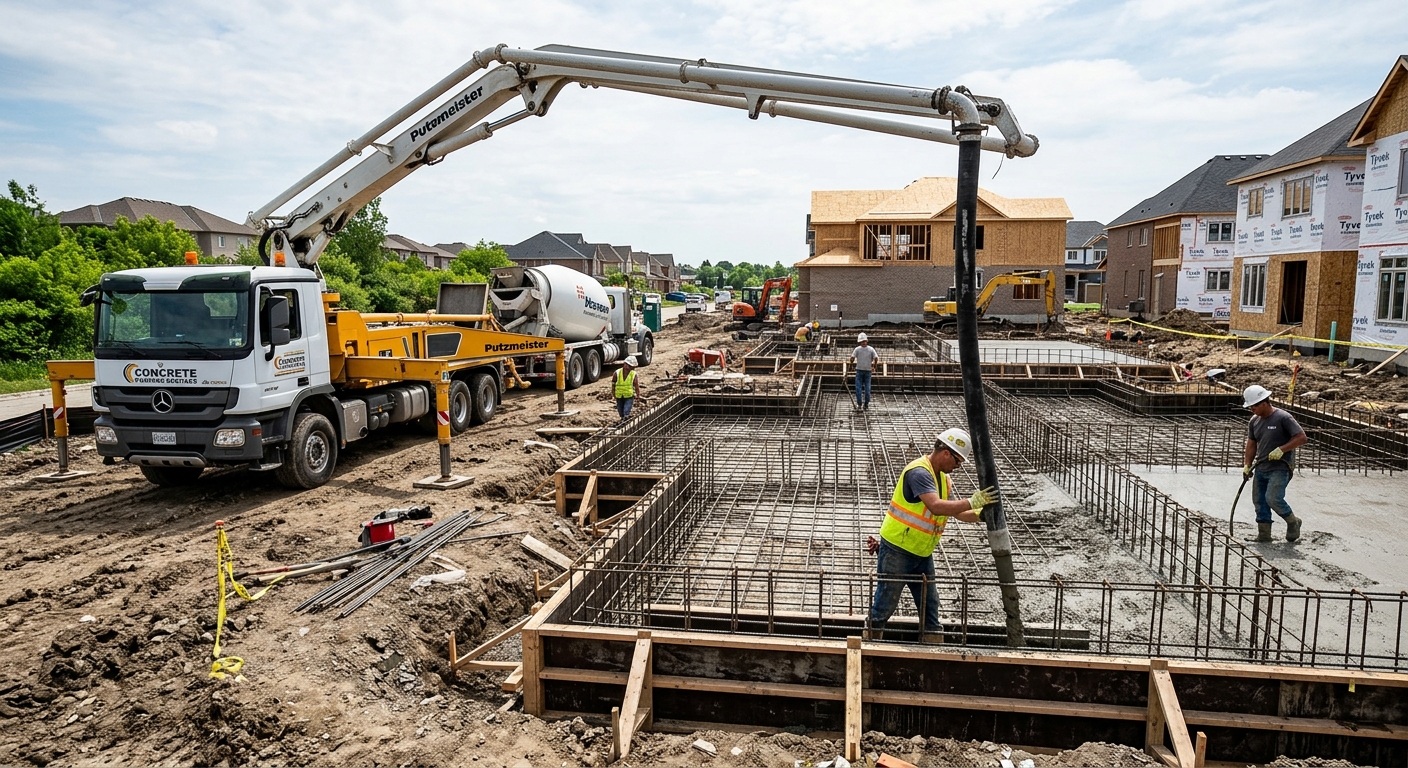
Concrete work options and costs in Saint Helen's Park
In Saint Helen's Park, British Columbia, concrete flatwork is one of the most common upgrades homeowners consider for long-lasting curb appeal and low-maintenance surfaces. In a community of 2,644 people (Statistics Canada, 2021 Census), you’ll notice a lot of single-detached housing that drives demand for driveways, patios, and front walkways—typically the same trades that see year-round work in the Lower Mainland–Southwest.
Pricing in this region runs a bit different than much of inland BC because our winters are mild but still bring freeze–thaw cycles, coastal-wet conditions, and a shallow but consequential frost depth (practice typically assumes about 450 mm / 18" design frost). That combination influences everything from footing depth and granular base specs to air-entrained mix design and the extra attention contractors give to curing under cool, humid weather. You’ll also see scheduling pressure: prolonged rain and high humidity can slow finishing and set-up, so experienced crews plan around drying windows, curing blankets, and longer protection times to reliably reach design strength.
In particular, streets and lanes around White Rock–style rainfall exposure zones (low spots where water naturally collects) often need more drainage attention before a driveway or walkway pour—an extra step that can protect your investment. Whether you’re updating a driveway in a nearby residential cluster or building new grade and flatwork, the best way to compare options is to look at typical scope, finish, and the range of costs below.
| Application |
Typical Size |
Key Spec |
Finish Option |
Price Range |
| Concrete driveway (standard broom finish) |
400–500 sq. ft. |
Engineered base, air-entrained mix, control joints |
Broomed, light broom texture |
$10,000 – $14,000 |
| Exposed aggregate driveway |
400–500 sq. ft. |
Proper mix & retarder timing, sealed surface |
Exposed stone texture |
$12,500 – $17,500 |
| Stamped concrete driveway or patio |
300–450 sq. ft. |
Color hardener or integral color, air-entrained mix |
Stamped pattern with release and sealer |
$11,000 – $18,000 |
| Plain concrete patio or walkway |
200–300 sq. ft. |
Compacted sub-base, joints sized for shrinkage |
Screed & broom or light trowel finish |
$3,200 – $6,500 |
| Garage floor (interior slab) |
400–650 sq. ft. |
Vapour barrier (as needed), fibre or rebar as specified |
Float & light broom, optional densifier |
$8,500 – $14,500 |
| Foundation footings (structural, below frost) |
Per project (often 1,000–2,500 linear ft. equivalent total) |
Excavate to frost depth, form & pour below frost line |
Typically formed concrete only |
$20,000 – $55,000 |
Prices are estimates only and vary by project scope, site access and material selection.
What affects the price of concrete work in Saint Helen's Park
Homeowners often notice that two quotes for the “same” concrete job can differ by 30–50% across the Lower Mainland–Southwest and other parts of British Columbia. In Saint Helen's Park, that gap usually comes from the less-visible parts of the scope: excavation depth, base preparation quality, reinforcement, mix design for freeze–thaw durability, and the time spent protecting curing concrete from cool nights and high humidity.
Our frost line matters because exterior concrete has to be built for freeze–thaw longevity. In colder regions, footings commonly need deeper excavation to stay below the design frost depth to prevent frost heave; in coastal BC we typically design for roughly 0.5–1.2 m depth depending on soil and structural requirements, but contractors still base excavation and footing elevations on local design and geotechnical assumptions. Every exterior slab should use an air-entrained mix so water has somewhere to expand during freeze–thaw cycles; if the mix isn’t right, you can see surface scaling or early spalling.
Local scheduling also changes costs. Rain windows can delay finishing and extend curing protection—so crews may use curing blankets and sealers later, which adds labour. If you’re in a neighbourhood where drainage is tricky (low grades near downspouts), base prep and slope corrections can add dollars but prevent settlement and cracking. A standard broom driveway might land near the regional range of $18–$28 per sq. ft., while decorative options like stamped concrete often cost more because colour materials, stamps, and extra finishing time are built into the labour. For example, upgrading from plain patio work ($16–$26 per sq. ft. band) to stamped finishes is usually justified when you want a longer-term visual improvement and you’re willing to maintain it with sealing after cure.
| Price Factor |
Why It Matters | Cost Impact |
Cost Impact |
| Frost line depth — determines footing depth and form height |
Deeper excavation and taller forms increase material and labour |
Higher in frost-sensitive areas; can swing concrete foundation/footing pricing substantially |
| Site preparation — excavation, grading, compacted granular base |
Good base compaction reduces settlement and future cracking |
More base material and longer prep time increase costs; poor access can add equipment charges |
| Reinforcement — rebar or wire mesh requirement |
Controls crack widths and improves slab toughness under loads |
Rebar labour and tying/welding add cost, but it prevents premature failure |
| Mix design — air-entrainment and compressive strength spec |
Air-entrainment is critical for freeze–thaw durability |
Higher-spec mix and QA/field control can raise material costs but improves longevity |
| Finish type — broom vs. stamped vs. exposed aggregate |
Finishes require different timing, tools and labour skill |
Stamped/exposed work typically adds significant labour and materials versus broom or plain |
| Pour size and concrete truck access to site |
Smaller pours need more handling; tight access increases time and labour |
Access limits can add pumping, labour, or extra service time |
| Cold-weather curing precautions — heating and blankets |
Protects strength gain and surface quality when nights are cool |
Blankets/heaters and longer protection increase labour and schedule cost |
| Control joint pattern and sealing cost |
Joints reduce random cracking; sealer protects against salt and moisture |
Skipping proper jointing or delaying sealer can lead to early deterioration |
Permits & regulations in British Columbia
In British Columbia, the rules depend on whether you’re doing structural concrete or non-structural flatwork. Structural concrete work—such as footings, foundation walls, grade beams, and other load-bearing foundation elements—typically requires a building permit, and engineered drawings are often reviewed by the municipality (or as required through the building process). In contrast, concrete driveways, patios, and walkways usually do not require a permit by default, unless the work affects lot grading, impacts impervious surface coverage, or connects in a way that affects the municipal right-of-way. Before any excavation, confirm the requirements with the local authority.
For your contractor, don’t rely on verbal assurance—verify documentation in writing. Step-by-step for Saint Helen's Park homeowners: (1) ask for the contractor’s business details and license references; (2) request a current certificate of insurance showing general liability coverage, and ensure your name or the job site is noted where appropriate; (3) confirm the contractor’s coverage for workers through WCB/WSIB (in BC this is done through the WCB system) and ask for proof; and (4) request references on comparable projects (similar size, similar exposure to rain and freeze–thaw).
Where to look: use the online registry sources for licensing status, then cross-check the certificate of insurance expiry date and WCB clearance letters before scheduling the pour.
Getting concrete right in Saint Helen's Park's freeze-thaw climate
Concrete in Saint Helen's Park fails most often when the job is treated like a “one-weather” project instead of a freeze–thaw durability system. In the Lower Mainland–Southwest, water movement is the enemy: after coastal rainfall, water can saturate the surface and subgrade, then expand during cold snaps. If the slab lacks air-entrainment, freeze–thaw pressure turns into cracking and scaling, and in severe cases spalling that exposes aggregate and accelerates deterioration.
To spec the job correctly, focus on five practical areas. First is base preparation: compacted granular sub-base to the right depth and bearing for local soil conditions, with drainage details that prevent water pooling under the slab. Second is mix design: air-entrainment typically targets about 5–7% air for exterior flatwork and a minimum 32 MPa compressive strength (or higher if the design/spec calls for it). Third is control joints: planned spacing that limits random shrinkage cracking paths. Fourth is curing: plan on minimum 7 days curing under proper conditions—when nights are cool, contractors may use blankets or curing protection to support strength gain. Fifth is sealing: apply a penetrating sealer after the required cure period to repel water and reduce the impact of de-icing salts.
A good question to ask is: “What mix design are you using for exterior freeze–thaw durability, and how do you protect curing in cool/rainy weather?” If you’re comparing options, the price difference can be sensible. For example, a standard broom patio in the $16–$26 per sq. ft. band is often cheaper than decorative work, but the contractor should still include air-entrained concrete, correct base prep, and jointing—those are the items that prevent costly repeat repairs.
| Spec |
Why It Matters in Saint Helen's Park |
What to Ask For |
Impact if Skipped |
| Compacted granular base (depth?) |
Controls settlement and water retention around shallow frost effects and wet soil |
Base depth, compaction method, and drainage/slope details |
Uneven slab, cracking, and faster edge deterioration |
| Air-entrained concrete mix (target air %?) |
Prevents freeze–thaw scaling and spalling by allowing expansion space |
Confirm air content (typically 5–7% for exterior) and mix design |
Scaling/spalling risk increases, especially on driveways and steps |
| Compressive strength (MPa rating) |
Achieves design performance under loads and temperature swings |
Minimum 32 MPa (or higher per spec) and mix/QA documentation |
Surface wear, reduced durability, and premature surface damage |
| Control joints (spacing per ACI guidelines) |
Controls shrinkage cracks in an orderly pattern |
Joint layout plan and cutting timing |
Random cracking and water ingress into concrete edges |
| Minimum 7-day curing period |
Strength gain and surface quality depend on temperature and humidity |
How curing is protected during cool nights and rain (blankets/sealer timing) |
Surface weakness and durability issues under freeze–thaw cycles |
| Penetrating sealer (when applied after cure) |
Repels moisture and reduces salt-related surface damage in BC winters |
Sealer type and application timing (commonly after cure, around day 28) |
Faster staining, scaling, and spalling from repeated wetting |
How to choose a concrete work contractor in Saint Helen's Park
Choosing the right contractor in Saint Helen's Park starts with verification. In British Columbia, ask for proof of current liability insurance (certificate of insurance) and confirm worker coverage through WCB documentation before any work begins. For licensing, request the contractor’s business details and check their status through the relevant online registry sources. If a contractor can’t provide certificates, it’s a red flag—concrete jobs involve excavation, forming, and heavy pours where risks are real.
Next, get 2–3 itemised written quotes. You want a breakdown that shows excavation/grading, granular base, reinforcement, concrete supply, finish materials, curing and sealing, and disposal. Avoid lump sums with vague descriptions. Scope clarity matters: ask what’s excluded (tree roots, rock removal, existing slab demolition, permit handling if required), whether disposal is included, and how close the truck can access your driveway or patio without extra pumping or labour.
Warranty should be specific: workmanship warranty length, whether it covers cracking related to freeze–thaw durability, and what product/manufacturer warranty applies to sealers or specialty admixtures. Also ask if the warranty is transferable to future owners.
For payment, never pay more than 10–15% upfront. Hold back a portion until the job is completed and cleaned, and ensure the contract states the exact milestones. Finally, demand a written timeline: proposed start date and an estimated completion date based on weather windows.
- Verify liability insurance and confirm it covers the job site.
- Confirm WCB coverage with proof before work starts.
- Use itemised quotes (labour + materials + disposal + prep).
- Ask for footing depth and base depth details (especially for exterior slabs).
- Confirm air-entrained mix design and minimum strength (exterior durability).
- Require reinforcement specs (wire mesh vs. rebar vs. fibres, where appropriate).
- Ask how control joints will be laid out and cut timing.
- Confirm curing method during cool nights and wet weather (blankets/sealing timing).
- Ask what sealer is used and when it’s applied after cure.
- Clarify truck access limits and whether pumping is included.
- Understand exclusions: permit pull, demolition, rock, tree roots, drainage corrections.
- Use a written contract with warranty terms and holdback/payment schedule.
Red flags I see often in Saint Helen's Park include: “standard mix” promises with no air-entrainment details, quotes that skip base prep depth or reinforcement, no mention of control joints and curing protection, pressure to take full payment upfront, and schedules that ignore rainy/cool weather windows for curing.
Frequently asked questions — concrete work in Saint Helen's Park
Can concrete be poured in cold weather in Saint Helen's Park?
Yes—concrete can be poured in cold weather in Saint Helen's Park, but it should be done with a plan, not guesswork. In British Columbia’s Lower Mainland–Southwest climate, the challenge is usually cool nights and damp conditions that slow strength gain. A competent crew will protect the slab or footings with curing blankets and/or approved heaters so the concrete reaches strength safely before exposing it to freeze–thaw cycles. They’ll also adjust operations based on the day’s temperature and the forecast, and they’ll use air-entrained mixes for exterior durability. If you’re comparing quotes, ask whether the crew includes cold-weather curing precautions in the scope—those precautions can protect a driveway that might otherwise fall within the $18–$28 per sq. ft. band but fail prematurely due to inadequate curing.
How do I maintain concrete in Saint Helen's Park's freeze-thaw climate?
Maintenance is mainly about keeping water from saturating the surface and edges. In Saint Helen's Park, that means cleaning debris, addressing clogged downspouts, and making sure water drains away from the slab so freeze–thaw pressure doesn’t build. After your pour is fully cured, apply a penetrating sealer (often around day 28) so moisture and de-icing salts don’t reach the concrete’s pores as easily. Reapply sealing based on the product and exposure. Avoid using high-pressure washing that can damage the surface, and don’t scrape with sharp metal tools. If you notice small scaling or hairline cracking, seal early—don’t let water migrate under the slab. For a patio in the $16–$26 per sq. ft. pricing band, a proper seal and basic drainage care can extend service life far beyond what you’d get from “no maintenance” concrete.
What causes concrete to spall in Saint Helen's Park winters?
Spalling is usually caused by water getting into the concrete and then freezing. In Saint Helen's Park and across the Lower Mainland–Southwest, rain-saturated surfaces followed by cold snaps create the freeze–thaw cycles that stress concrete. The most preventable cause is inadequate air-entrainment—without the right air content (commonly 5–7% for exterior flatwork), internal freeze pressure breaks the surface. Other contributors include poor base drainage, lack of control joints, and weak surface curing that leaves concrete vulnerable before it reaches design strength. De-icing salt can accelerate deterioration once water movement starts, so sealing matters. If spalling shows up early, it often indicates the contractor didn’t meet mix and curing requirements. When you’re reviewing a quote, look for explicit wording about air-entrained concrete, curing protection, and sealing timing.
What is rebar and when is it required in British Columbia?
Rebar (reinforcing steel bars) helps concrete resist tension and improves crack control and durability under loads. In British Columbia, whether rebar is required depends on the structural design and the type of concrete work—not just local weather. For structural elements like footings and foundation walls, rebar is often specified by engineered plans. For exterior slabs like driveways and garage floors, rebar or wire mesh may be required based on slab thickness, soil bearing, and load expectations (cars, heavy vehicles, garage traffic), as well as the design spec. Fibres can sometimes be used as part of the reinforcement strategy, but they don’t automatically replace engineered rebar where structural requirements call for it. In practice, a good contractor will show you the reinforcement plan and how it’s tied to durability against freeze–thaw cycles in the Lower Mainland–Southwest.
How long does a concrete project take in Saint Helen's Park?
Typical timelines in Saint Helen's Park vary by scope, weather, and curing conditions. A standard driveway can often be completed in a few days of active work (excavation and forming, pour and finishing, and initial protection), but the total timeline includes curing protection and scheduling around rain. Even after the surface is finished, concrete needs time to develop strength—commonly you should plan around at least a week for basic cure readiness, with sealer often applied later after full cure requirements (commonly around day 28). Decorative work like stamped concrete takes extra time for colour and pattern setup, while foundation footings involve longer lead times due to engineering, inspection steps, and backfilling schedules. If you’re budgeting, remember that jobs priced in the $18–$28 per sq. ft. driveway band or $22–$36 per sq. ft. stamped band still require the full curing window for best durability in freeze–thaw conditions.
What is a concrete overlay and is it suited to Saint Helen's Park?
A concrete overlay is a new layer placed on top of an existing concrete slab, usually after surface preparation and repairs. It can be a cost-effective option when your original slab is generally sound but the surface is worn, uneven, or stained. In Saint Helen's Park, overlays can be suitable, but only if the underlying slab isn’t actively failing—any widespread cracking, major settlement, or ongoing drainage problems will transfer up through the overlay. Freeze–thaw durability is critical: the overlay must be properly bonded, and the mix and finishing must be designed for exterior exposure and water resistance. You should also address drainage so water doesn’t collect and freeze in the joint lines. For many homeowners, an overlay is best when you want a refreshed look without full demolition and replacement, but it’s not a substitute for correct base drainage and proper jointing.