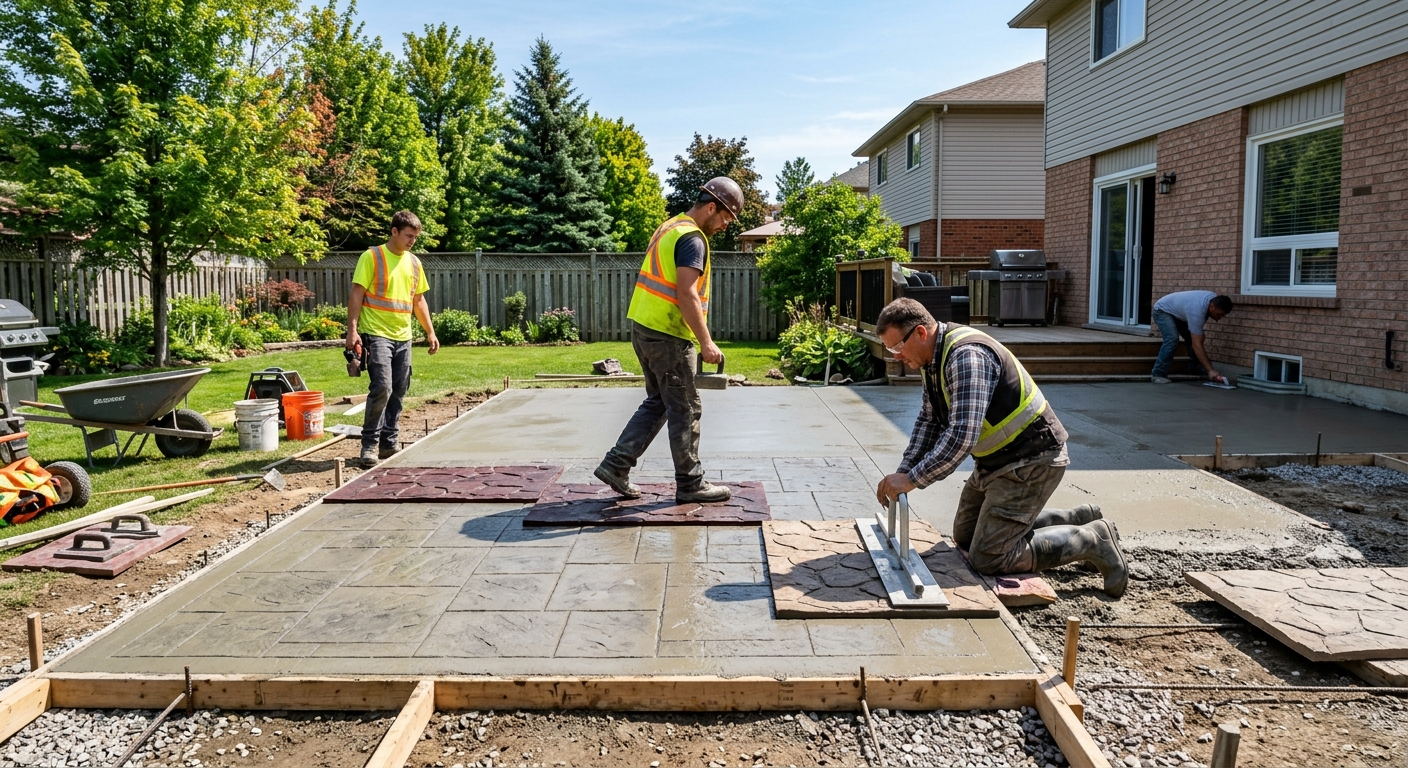
Concrete work options and costs in Departure Bay
In Departure Bay, concrete flatwork is a practical choice for driveways, patios and walkways—especially with a coastal, rain-heavy climate and the local freeze–thaw cycles that can stress even well-built slabs. Departure Bay’s housing base is largely single-detached neighbourhoods, and the broader community count sits at 6,540 residents (Statistics Canada, 2021 Census). That kind of steady demand supports consistent crews for concrete work in the Vancouver–Surrey–Abbotsford corridor, but it also means contractors price in seasonal scheduling and site prep time.
In the Lower Mainland–Southwest, a shallow frost line (practice often assumes ~450 mm / 18" for design purposes) helps keep costs lower than interior BC, yet we still place footings and thickened edges below the frost depth to prevent frost heave. Coastal wet weather also affects delivery and curing: prolonged rain, cool nights and high humidity mean we plan around schedule risk, use curing blankets and apply sealers at the right time to protect exterior surfaces. These climate-driven details—base prep, drainage, air-entrained mixes, jointing and curing—are major drivers of what you’ll see in bids.
Trade demand is especially common around Departure Bay’s beachfront and residential pockets where homeowners renovate driveways and add patios for backyard living. Next, compare typical options and price ranges in the table below so you can line up apples-to-apples when you request quotes.
| Application |
Typical Size |
Key Spec |
Finish Option |
Price Range |
| Concrete driveway (standard broom finish) |
400–600 sq. ft. |
Air-entrained exterior mix, compacted granular base, control joints |
Broom finish, optional basic sealer |
$3,600 – $5,900 |
| Exposed aggregate driveway |
400–600 sq. ft. |
Air-entrained exterior mix, washed aggregate exposure technique |
Exposed aggregate, sealer recommended |
$4,800 – $8,200 |
| Stamped concrete driveway or patio |
300–500 sq. ft. |
Air-entrained exterior mix, base prep for freeze–thaw durability |
Stamped pattern with release agent, sealer |
$6,000 – $12,500 |
| Plain concrete patio or walkway |
250–400 sq. ft. |
Air-entrained exterior mix, compacted base, joints |
Float finish or light broom, optional sealer |
$2,600 – $8,000 |
| Garage floor (interior slab) |
300–600 sq. ft. |
Slab thickness per design, vapour barrier if specified, reinforcement as needed |
Steel trowel/float, optional hardener or coating-ready surface |
$6,000 – $12,800 |
| Foundation footings (structural, below frost) |
Per house/engineered plan |
Excavation and forming below frost depth, reinforcement and inspection |
Structural concrete to spec |
$8,000 – $20,500 |
Prices are estimates only and vary by project scope, site access and material selection.
What affects the price of concrete work in Departure Bay
In the Lower Mainland–Southwest, the same concrete project can come in 30–50% apart in British Columbia because quotes reflect differences in site conditions and how contractors build for climate durability. Where interior and northern regions deal with deeper frost and shorter seasonal pours, our local frost depth is shallower (often ~450 mm / 18" for design), yet Departure Bay’s coastal rainfall and repeated freeze–thaw still demand robust base preparation, air-entrained concrete and careful jointing. That’s why exterior slabs and driveways typically land in the same general price bands—roughly $18–$28 for a concrete driveway and $16–$26 for a patio/walkway—while job-by-job scope differences swing the final number.
Frost line depth dictates the footing and thickened-edge spec: footings must extend below the design frost depth to prevent frost heave. Exterior slabs require air-entrained concrete to survive freeze–thaw cycles and resist scaling. Colder regions need heated pours and blanket curing, but even in Departure Bay we still plan for cool nights and high humidity—extending cure times and adding scheduling cost. Another real factor is de-icing salt: when it’s used, surface spalling risk rises, so sealing becomes essential. You’ll often see contractors budget sealing materials and proper timing rather than cutting corners.
Two local examples: if your driveway base is soft or poorly drained, excavation and added compacted granular base increases cost even if the finish stays “standard broom.” Conversely, if access is easy and the site prep is straightforward, a plain patio can stay closer to the lower end of the $16–$26 band. Housing stock also matters—older lots may have uneven grading or compromised subgrade, and repairs can add a few thousand dollars compared to a newer, flatter site.
| Price Factor |
Why It Matters |
Cost Impact |
| Frost line depth — determines footing depth and form height |
Protects foundations and thickened edges from frost heave during freeze–thaw cycles |
Can add excavation and forming time; higher-end jobs commonly shift upward on footing-related components |
| Site preparation — excavation, grading, compacted granular base |
Correct base depth and compaction prevent settlement and help drain water away from the slab |
Soft or wet soils increase removal, haul-off, and granular/top-up costs |
| Reinforcement — rebar or wire mesh requirement |
Controls cracking and improves load transfer for driveways and garage slabs |
Material + labour; can move pricing noticeably for larger slabs |
| Mix design — air-entrainment and compressive strength spec |
Air content and strength target durability against scaling and freeze–thaw exposure |
Higher-spec mix and QA testing can raise material costs, especially for exterior work |
| Finish type — broom vs. stamped vs. exposed aggregate |
Finish affects labour time, materials, and rework risk |
Stamped/exposed typically push toward the upper end of $22–$36 for decorative work |
| Pour size and concrete truck access to site |
Access controls how long crews wait, how they place, and how much they pump/maneuver |
Poor access can add labour and equipment costs quickly |
| Cold-weather curing precautions — heating and blankets |
Maintains temperature and prevents surface damage when nights cool |
Blankets/heating add rental and labour line items during shoulder seasons |
| Control joint pattern and sealing cost |
Good jointing reduces random cracking; sealing protects against moisture and de-icing salts |
Skipping or delaying sealing can save money short-term but increases maintenance risk; sealing is often priced as an add-on |
Permits & regulations in British Columbia
In British Columbia, structural concrete work generally needs a building permit and, in many cases, engineered drawings that the municipality reviews. That includes footings, foundation walls, grade beams and other elements that carry structural loads. For concrete flatwork—patios, walkways and many driveway pours—permits are often not required unless the work affects lot grading, triggers impervious surface/ drainage constraints, or impacts municipal right-of-way conditions. Because municipal requirements can vary with the location and site drainage, confirm with the local authority before breaking ground.
For homeowner verification in Departure Bay, don’t rely on a verbal claim. Step-by-step: first, ask the contractor for their certificate of insurance (liability) and review the expiry date and coverage limits. Second, confirm how they’re covered for workers through the required workplace coverage program (workers’ coverage). Many contractors will provide a clearance letter or documentation; if they can’t, that’s a red flag. Third, verify licensing/credentials through the appropriate online registry access and ensure the person/firm matches the legal entity on the quote.
Also request references from similar-scale projects—exterior flatwork in wet coastal conditions and structural concrete in comparable excavation conditions—then ask if they encountered schedule delays due to rain and how they handled curing.
Getting concrete right in Departure Bay's freeze-thaw climate
Concrete failure in Departure Bay is usually about water and temperature working together. Water gets into the slab or base, freezes, expands, and then the freeze–thaw cycle loosens material at the surface—leading to scaling or spalling. The most common avoidable cause is inadequate air-entrainment combined with weak or poorly drained base prep. To spec the job correctly, start with (1) base preparation: excavate to the correct subgrade depth for your soil and compact a granular base so the slab has firm support and drainage. Then (2) mix design: for exterior flatwork, use air-entrained concrete with target air content around 5–7% and specify minimum compressive strength of 32 MPa. Next (3) control joints: plan joint placement to limit random cracking to predictable lines. (4) curing: plan for at least 7 days of curing under suitable conditions—cool, wet weather may require curing blankets or careful protection to ensure strength gain. Finally (5) sealing: apply a penetrating sealer after the slab has cured (commonly at 28 days) to repel moisture and reduce vulnerability to de-icing salts.
When you’re comparing options, the “cheap” price can vanish if cracking opens up water pathways. For example, a plain broom-finish patio might fall near the $16–$26 per sq. ft. band, but switching to a decorative stamped finish at $22–$36 per sq. ft. is only justified if you’re also locking in air-entrainment, jointing and curing. The finish changes the appearance; the specs control whether it lasts through coastal wet winters.
| Spec |
Why It Matters in Departure Bay |
What to Ask For |
Impact if Skipped |
| Compacted granular base (depth?) |
Reduces settlement and helps control moisture near the slab during wet coastal weather and freeze–thaw |
Confirm base thickness and compaction requirements based on your subgrade |
Settlement, rocking, and premature cracking |
| Air-entrained concrete mix (target air %?) |
Air bubbles provide freeze–thaw protection in Departure Bay’s exterior exposure |
Specify air content target of 5–7% for exterior flatwork |
Higher risk of scaling and spalling |
| Compressive strength (MPa rating) |
Ensures the concrete reaches durable strength despite cool, humid conditions |
Minimum 32 MPa (or higher if specified for the design/load) |
Surface weakness and accelerated wear |
| Control joints (spacing per ACI guidelines) |
Limits random cracking patterns from shrinkage and thermal movement |
Request joint spacing and saw-cut timing details |
Uncontrolled cracking and easier water ingress |
| Minimum 7-day curing period |
Strength gain depends on curing conditions in cool, wet coastal weather |
Ask how they’ll protect the slab during cold nights/high humidity |
Low strength at early service; increased cracking risk |
| Penetrating sealer (when applied after cure) |
Repels water and helps resist de-icing salt effects |
Confirm sealer type and timing (commonly after 28 days) |
Faster moisture-related deterioration and staining |
How to choose a concrete work contractor in Departure Bay
Choosing the right concrete contractor in Departure Bay starts with verification. In British Columbia, ask for (and read) their certificate of insurance for liability, including limits and policy expiry dates. Next, confirm workplace coverage for workers (commonly provided as documentation or clearance information). Then verify the contractor’s credentials/licensing through the proper online registry and ensure the quote is issued under the correct legal business name. If a contractor won’t provide documentation up front, keep looking.
Get 2–3 itemised written quotes—not just a lump sum. You want line items that separate excavation/site prep, granular base, reinforcement, concrete supply, finishing, joints, curing protection, sealing and disposal. Ask whether permit pull (when required), inspections and engineering/redraws are included for foundation work. Clarify what’s excluded: rock removal, haul-away, tree root cutting, replacement of unsuitable soil, and any rain delay contingency.
Warranty matters too. Confirm the workmanship warranty length, what it covers (cracks, spalling, surface scaling), and whether any product/manufacturer warranty is transferable to you. For payment schedule, never pay more than about 10–15% upfront; hold back the remainder until completion and cleanup. Finally, request a written start date and an estimated completion window that accounts for weather—especially in shoulder seasons when rain and cool nights can affect curing timelines.
- Ask for insurance certificate (liability) and verify expiry date and coverage limits.
- Confirm workers’ coverage documentation for the job site.
- Verify licensing/credentials from the appropriate BC registry and match it to the quote.
- Get 2–3 quotes with line-by-line pricing (labour vs materials vs access equipment).
- Ensure base prep scope is explicit: excavation depth, granular type and compaction.
- Confirm reinforcement spec: mesh vs rebar, and slab thickness where applicable.
- Ask for the concrete mix spec: air-entrainment and minimum 32 MPa for exterior.
- Require joint details: spacing, saw-cut timing, and sealing plan.
- Confirm curing plan: blankets/protection in cool nights, and minimum 7-day curing.
- Ask when penetrating sealer is applied and which product is used (after cure, commonly 28 days).
- Clarify disposal/haul-away and whether rain delays change the price.
- Set a realistic payment schedule with a holdback until final inspection and cleanup.
Red flags to watch for in Departure Bay: (1) they won’t specify air-entrainment or refuse to discuss curing protection; (2) quotes that ignore drainage and base compaction; (3) they demand a large upfront payment; (4) no written scope for joints/sealer; and (5) vague warranty terms or no proof of insurance/coverage.
Frequently asked questions — concrete work in Departure Bay
Why does concrete crack in Departure Bay and how is it prevented?
In Departure Bay, cracking is commonly driven by shrinkage, temperature movement and—most importantly—water getting into small openings then freezing during coastal cold snaps. Even when the concrete looks fine early, freeze–thaw cycles can widen cracks if joints and curing weren’t done properly. Prevention starts with a proper compacted granular base so the slab doesn’t settle, and a correct air-entrained exterior mix so the surface resists scaling. Control joints should be planned to “force” cracking into predictable lines, with saw-cut timing that suits the mix. Finally, curing matters: cool nights and high humidity in British Columbia can slow strength gain, so crews may use curing blankets and keep the slab protected. Sealing after cure (often around 28 days) helps reduce water and de-icing salt exposure that accelerates deterioration.
Stamped vs broom-finish concrete — cost difference?
Stamped concrete costs more because it requires additional labour and materials: moulds/release agents, more careful finishing, and typically a slightly higher finishing time and rework sensitivity. In the Lower Mainland–Southwest, decorative concrete is commonly priced in the $22–$36 per sq. ft. range, while standard broom-finish driveways often sit lower, around $18–$28 per sq. ft. For a homeowner comparison, a plain concrete patio near the $16–$26 band may be a more direct value choice if your goal is durability and a clean finish. Stamped or exposed aggregate is worth it when you want a specific look—particularly for high-visibility patios near the home—without sacrificing the core requirements: air-entrainment, correct base prep, jointing and proper curing for our coastal freeze–thaw conditions.
When is the best time to pour concrete in Departure Bay?
The best timing in Departure Bay is when you have stable weather that supports curing—typically late spring through early fall, when daytime temperatures are reliable and nights are less likely to drop into “cold pour” risk territory. British Columbia’s coastal rain can disrupt scheduling even in warm months, so contractors often plan around multi-day windows and may adjust protection (blankets and insulation) when conditions are borderline. If you must pour in cooler seasons, reputable crews factor in the extra labour for curing protection and time required to reach design strength before exposure. That can change your cost compared with peak-season pours, even if the finish is the same. Discuss your project timeline early and ask your contractor how they’ll manage rain, high humidity and curing targets so the concrete reaches the durability spec.
How long does concrete take to cure?
Concrete curing happens in stages. For practical scheduling, many contractors plan for at least 7 days of curing under proper conditions before expecting typical light use, because strength gain continues significantly over that period. In British Columbia’s coastal climate, cool nights and high humidity can slow early strength development, so crews may use curing blankets or protective coverings to keep the slab within a safe curing range. Even after the slab has “set” and looks hard, sealing for exterior durability is usually targeted after full cure—commonly around 28 days—so a penetrating sealer can best repel water and help limit moisture and de-icing salt impacts. Ask your contractor for the exact curing steps they’ll follow and the expected timeline to reach design strength for your slab thickness and application.
Do I need a permit for concrete work in British Columbia?
In most cases in British Columbia, structural concrete work such as footings, foundation walls and grade beams requires a building permit, often with engineered drawings reviewed by the municipality. Concrete flatwork like patios and walkways often does not require a permit, unless it affects lot grading, impervious surface coverage limits, or municipal right-of-way/drainage requirements. Because rules can vary with site conditions, the safest approach is to confirm with the local authority before the first cut of pavement. From a homeowner perspective, ask your contractor whether the work is permit-triggering and whether permit pulling is included if required. A good contractor will tell you upfront, provide documentation if needed, and coordinate inspections rather than treating permits as an afterthought.
Concrete vs pavers for a patio in Departure Bay?
Concrete and pavers both work well in Departure Bay, but they behave differently over time. Concrete patios typically offer a more uniform surface and can be finished to last, especially with air-entrained mix, correct base prep and control joints to manage cracking. Pavers can be a strong choice for aesthetics and for easier localized repairs (if a section settles or lifts), but they still require a well-compacted base and correct drainage to prevent movement during freeze–thaw cycles. From a cost standpoint, a plain concrete patio often aligns with the $16–$26 per sq. ft. band, while decorative options (stamped) commonly sit higher, and pavers often come with their own material and labour pricing that can be comparable once excavation and base layers are done properly. If you’re using de-icing salts, sealing a concrete slab can improve durability—ask contractors to explain their water management details for coastal wet conditions.