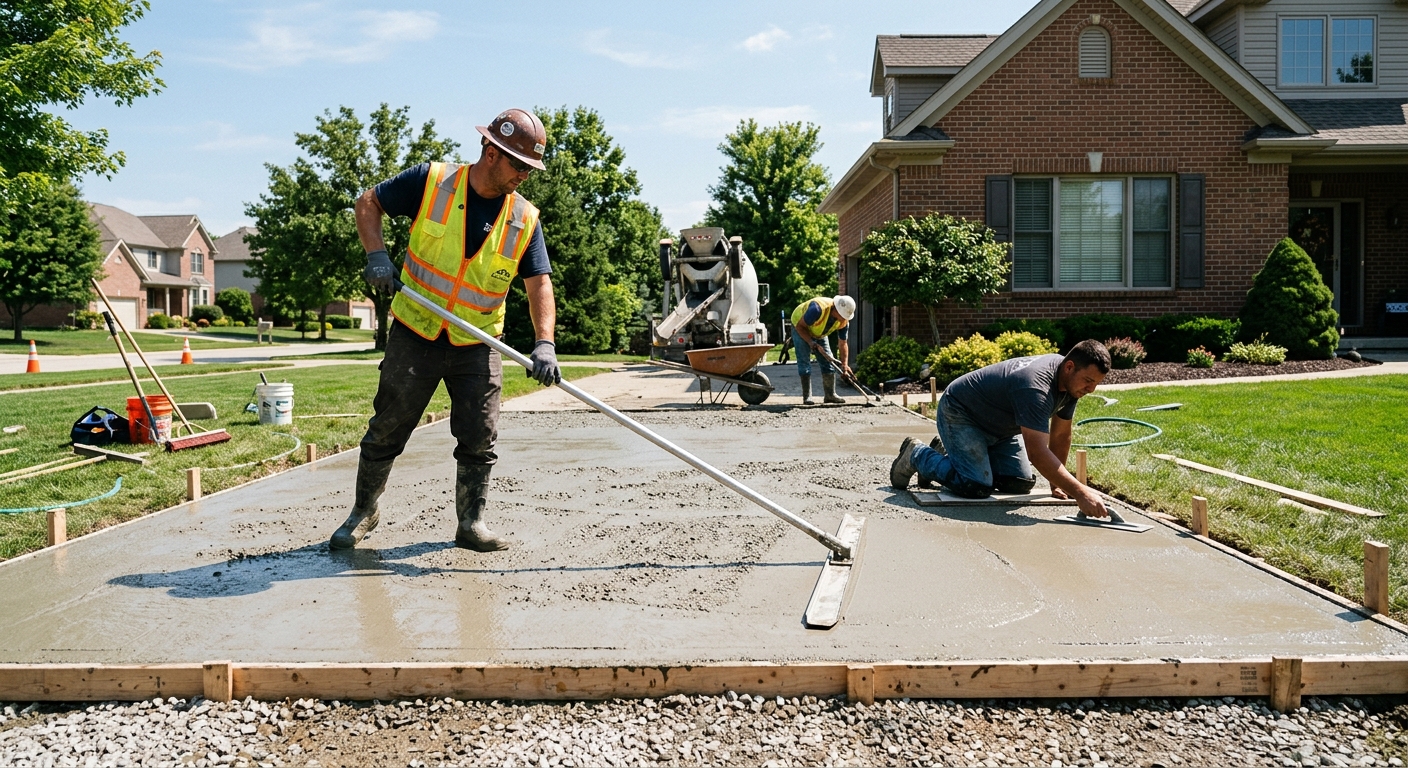
Concrete work options and costs in Bridgeport
In Bridgeport, concrete flatwork is a practical choice for homeowners who want durable, low-maintenance surfaces—especially in a neighbourhood where weather swings can be tough on foundations and outdoor slabs. Bridgeport’s housing mix includes a lot of single-detached homes (Statistics Canada, 2021 Census), and that matters because driveways, patios and walkways are typically the first concrete upgrades many homeowners plan. With a smaller local population base (Statistics Canada, 2021 Census), contractor scheduling can be tight during peak season, so booking early helps secure the crew time and curing materials you need.
In the Lower Mainland–Southwest, mild winters and a shallow frost line still drive concrete design because we protect slabs and foundations from freeze–thaw damage and heavy coastal rainfall. Typical practice assumes a frost depth around 450 mm / 18", so exterior footings and thickened edges are placed below that to reduce frost heave risk. Costs often run a bit higher than you’d expect compared with “dry” climates due to engineered base prep, air-entrained mixes for freeze–thaw durability, and longer cure/scheduling windows when humidity and rain slow strength gain.
In Bridgeport (especially around the Patterson corridor and nearby residential streets), driveway replacements and patio upgrades are in steady demand—often paired with drainage improvements to keep water from saturating the base. Use the table below to compare the most common options and what typical scope levels look like.
| Application |
Typical Size |
Key Spec |
Finish Option |
Price Range |
| Concrete driveway (standard broom finish) |
300–500 sq. ft. |
Compacted granular base, air-entrained exterior mix, control joints |
Broom finish, plain colour |
$18,500–$28,000 |
| Exposed aggregate driveway |
300–500 sq. ft. |
Compacted base, air-entrained mix, proper curing to resist scaling |
Exposed aggregate (seeded/washed finish) |
$22,500–$32,000 |
| Stamped concrete driveway or patio |
200–450 sq. ft. |
Air-entrained mix, integral colouring, release powder system |
Stamped texture (brick/fieldstone/patterns) |
$22,000–$38,000 |
| Plain concrete patio or walkway |
100–300 sq. ft. |
Compacted granular base, control joints, exterior air-entrained mix |
Float & broom/steel trowel, plain colour |
$4,800–$10,200 |
| Garage floor (interior slab) |
400–600 sq. ft. |
Vapour considerations (if needed), flatness, dowels as required |
Steel trowel finish, plain |
$12,000–$22,000 |
| Foundation footings (structural, below frost) |
Varies by foundation design |
Excavation below design frost depth (~450 mm / 18" typical assumption), reinforced concrete |
Structural finish (no decorative finish) |
$5,000–$14,000 |
Prices are estimates only and vary by project scope, site access and material selection.
What affects the price of concrete work in Bridgeport
In the Lower Mainland–Southwest, two contractors can quote the “same” driveway differently because concrete pricing isn’t just about pouring—it’s about excavation, engineering assumptions, base performance, mix design, and the calendar. A 30–50% spread isn’t unusual across the region and across British Columbia when you compare frost depth requirements, drainage complexity, and cold-weather precautions. Even within the Lower Mainland, rain patterns and soil moisture change how contractors scope base prep and curing windows.
Here’s the core driver: frost line depth and freeze–thaw cycles dictate every exterior spec. Typical practice assumes a frost depth around 450 mm / 18", so footings, piers and thickened edges are placed below that to prevent frost heave. Exterior slabs also need air-entrained concrete to survive freeze–thaw, and our saturated soils mean drainage details (and the right granular base) become part of the cost—because contractors can’t “wish away” water. In colder parts of BC, the pour season can be shorter and cold-weather curing precautions (heating, insulated blankets) add cost; that same mentality carries into Bridgeport jobs when we’re close to cold nights or the forecast turns.
Concrete examples that commonly raise cost in Bridgeport: replacing failing base under an old driveway (extra excavation and granular replacement), and adding a proper drainage layer to stop recurring puddling that threatens the slab edge. Costs can also be lower when access is easy and the base condition is confirmed as sound—then a broom-finished driveway may land closer to the $18–$28 band, while decorative work (like stamped concrete) justifies its higher $22–$36 type pricing when you’re paying for colour control, finishing steps, and additional material systems.
| Price Factor |
Why It Matters |
Cost Impact |
| Frost line depth |
Determines footing depth and form height |
More excavation and higher forming costs if you must go deeper than expected |
| Site preparation |
Excavation, grading, compacted granular base |
Unstable soil or poor drainage increases base volume, disposal, and labour |
| Reinforcement |
Rebar or wire mesh requirement |
Adds material and labour; may reduce crack risk on heavier-use areas |
| Mix design |
Air-entrainment and compressive strength spec |
Exterior air-entrained mixes typically cost more but improve freeze–thaw durability |
| Finish type |
Broom vs. stamped vs. exposed aggregate |
Stamped/exposed systems require extra materials and crew time |
| Pour size and concrete truck access to site |
Short access drives up labour and pumping needs |
Pumping/form adjustments can add significant line items |
| Cold-weather curing precautions |
Heating and blankets |
Insulation materials and additional time to protect strength gain |
| Control joint pattern and sealing cost |
Controls random cracking and helps protect surface |
Proper jointing plus sealing labour and materials can add but reduces maintenance |
Permits & regulations in British Columbia
In British Columbia, structural concrete work—such as footings, foundation walls, and grade beams—typically requires a building permit and often involves engineered drawings reviewed by the municipality. Concrete flatwork (like patios, walkways and most driveways) usually does not require a permit on its own, unless it affects lot grading, impervious surface coverage limits, or the municipal right-of-way. Even when permits are not usually required for a driveway, you should confirm with the local authority before breaking ground, especially if you’re changing drainage patterns near sidewalks, catch basins, or property lines.
Before you hire in Bridgeport, verify the contractor is set up to do the job safely and legally. Step-by-step, ask for and check: (1) their licence/registration status through the provincial contractor directory or their business information page, (2) a Certificate of Liability Insurance that lists your address/project as applicable or includes the proper insured interest, and (3) WSIB/WCB coverage information for their workers (a clearance letter or current coverage documentation). Then ask for references on similar concrete scopes—driveways with comparable access and base conditions, not just decorative work on easy lots.
If a contractor can’t provide current insurance documents or references, or if they’re vague about responsibility for engineering/permit requirements on structural elements, consider it a red flag. For flatwork, clear in writing whether demolition, hauling/disposal, and traffic protection are included.
Getting concrete right in Bridgeport's freeze-thaw climate
Concrete failures in Bridgeport are usually tied to water movement and temperature swings. The biggest threats we manage here are freeze–thaw cycling at the surface and along slab edges, plus saturated subgrades that pump water during colder periods. To spec the job correctly in the Lower Mainland–Southwest, start with base preparation: place a compacted granular sub-base to the right depth and profile so the slab drains and doesn’t sit over soft, moisture-laden material. Next, specify the mix: exterior flatwork should use air-entrainment (targeting about 5–7% air content for typical exterior exposure) so the concrete can tolerate freeze–thaw rather than scaling and spalling.
Third, control cracking with a joint plan. Proper control joint spacing helps limit random cracking and gives the slab “weak points” where cracks can form without damaging performance. Fourth, curing matters: allow a minimum 7-day curing period under proper conditions, and when we’re facing cool nights or a damp forecast, contractors should use curing blankets and/or sealers aligned with the curing schedule so strength development isn’t compromised. Finally, sealing is an insurance policy against chloride intrusion and de-icing salts—apply a penetrating sealer after cure (commonly at about 28 days post-pour) to repel moisture at the surface.
When homeowners compare options, it helps to connect price to risk. For example, a standard broom-finished driveway may land near the $18–$28 band, but skipping air-entrainment or base compaction is a false saving—those failures show up as scaling and edge deterioration that can push you toward a full replacement sooner.
| Spec |
Why It Matters in Bridgeport |
What to Ask For |
Impact if Skipped |
| Compacted granular base (depth?) |
Reduces settlement and helps prevent water saturation under the slab |
Granular type and target compacted depth for your soil and frost assumptions |
Uneven slab, cracking, and accelerated deterioration at the edges |
| Air-entrained concrete mix (target air %?) |
Protects against freeze–thaw scaling in a coastal-wet environment |
Air content target around 5–7% for exterior flatwork |
Spalling and surface scaling, especially near joints and the slab perimeter |
| Compressive strength (MPa rating) |
Ensures the slab reaches design strength for durability and wear |
Minimum 32 MPa compressive strength (or higher if specified) |
Lower durability, increased risk of surface damage and cracking |
| Control joints (spacing per ACI guidelines) |
Limits uncontrolled cracking caused by shrinkage |
Proposed joint spacing and saw-cut timing plan |
Random cracking patterns that can allow water ingress |
| Minimum 7-day curing period |
Strength gain is slower in cool, humid, rainy conditions |
How curing blankets/sealers are used when nights are cool or forecasts are wet |
Weak concrete at early age, higher scaling and joint deterioration |
| Penetrating sealer (when applied after cure) |
Repels moisture and helps protect against salt and repeated wetting |
Sealer type and timing (commonly around 28 days post-pour) |
Faster moisture absorption, staining, and premature surface wear |
How to choose a concrete work contractor in Bridgeport
Choosing the right concrete contractor in Bridgeport is less about flashy photos and more about proof: credentials, a clear scope, and how they manage curing and drainage. Start with British Columbia checks. Confirm their business licensing/registration status (so you know who you’re paying). Request a Certificate of Liability Insurance (and ensure it’s current) and verify WSIB/WCB coverage for workers—ask for a clearance letter or up-to-date coverage documentation. Don’t accept “we’re covered” without documents; reputable crews hand this over quickly.
Next, get 2–3 itemised written quotes, not lump sums. Ask for labour + materials line items where possible (excavation/granular, reinforcement, concrete supply, finishing, saw-cutting, and sealing), and note inclusions and exclusions. A fair quote should say whether permits are handled where required for structural work, whether demolition and disposal are included, and what happens to removed concrete (haul-off). For warranty, ask for the workmanship warranty length and whether product warranties apply (and if they are transferable). Cementitious products often have manufacturer support, but workmanship coverage is what protects the installation details.
Payment schedule matters: never agree to more than about 10–15% upfront. Hold back a portion until the job is complete, inspected, and surfaces are sealed (if included). Finally, get a start date and completion estimate in writing. If they can’t provide a schedule that accounts for rain and curing windows, plan for delays and weakened finishing quality.
- Confirm their BC registration/licensing and business address.
- Request current liability insurance documents before work begins.
- Verify WSIB/WCB clearance or equivalent coverage documentation.
- Ask for 2–3 local references with similar driveway/patio scopes.
- Get an itemised quote (base prep, concrete supply, reinforcement, finishing, joints, sealing).
- Clarify what “site access” includes (stairs, gates, pumping, traffic control).
- Confirm excavation/disposal is included or priced separately.
- Ask what base depth and granular type they’ll use for your soil condition.
- Ensure air-entrained exterior mix is specified for freeze–thaw durability.
- Require a joint plan (spacing and when they’ll saw-cut).
- Confirm curing method and minimum protection time (especially in cool/rainy weather).
- Verify warranty length and whether it covers surface scaling/spalling issues.
Concrete contractor red flags in Bridgeport: quoting a “cheap” exterior slab without specifying air-entrainment, refusing to show insurance/WSIB/WCB proof, vague scopes that don’t mention base preparation or joints, pressuring you to pay most of the job upfront, and starting pours right before heavy rain/cold nights without a documented curing plan.
Frequently asked questions — concrete work in Bridgeport
Can concrete be poured in cold weather in Bridgeport?
Yes, you can pour concrete in British Columbia during cold weather, but it depends on temperature, wind, and the plan to protect early-age concrete. In Bridgeport and the Lower Mainland–Southwest, we don’t always get deep freezing, yet we do see cool nights and short frost periods that can affect strength gain. A good contractor will protect the pour with insulated blankets or heat as needed, keep surface temps in the safe range, and extend curing time so the mix achieves design strength. Ask whether they have cold-weather procedures and what they’ll do if rain or drizzle is forecast. If your project is priced near typical driveway ranges (for example, the $18–$28 band for standard broom-finished work), ensure the quote doesn’t secretly reduce curing protection to hit price targets.
How do I maintain concrete in Bridgeport's freeze-thaw climate?
Maintenance in Bridgeport mainly means controlling moisture and protecting the surface. First, keep edges and joints clear of debris so water can’t sit and freeze in place. Second, if de-icing salts are used in your area, they can accelerate spalling on unprotected concrete—this is why a penetrating sealer after curing is commonly recommended for exterior flatwork. A typical approach is sealing around 28 days post-pour, once the slab has fully cured. Third, avoid harsh scrubbing on textured finishes; use appropriate cleaners and rinse well after. If you notice early hairline cracking, don’t ignore it—evaluate joints and sealing to prevent water intrusion. The goal is to keep water from repeatedly saturating the slab and subgrade during freeze–thaw cycles.
What causes concrete to spall in Bridgeport winters?
Spalling is usually caused by water getting into the concrete and then freezing, which creates internal pressure and breaks down the surface. In Bridgeport’s coastal-wet conditions, saturated bases and poor drainage increase the chance of water reaching the slab face, especially near joints and edges. The other common culprit is an improper mix—specifically inadequate air-entrainment. Exterior flatwork should generally target about 5–7% air content so the concrete can resist freeze–thaw scaling. If a contractor cuts corners on mix design, or if the job is finished and cured too quickly during cool, humid weather, spalling risk climbs. That’s why it’s worth paying for the right spec even when the job is priced toward the lower end of the driveway band.
What is rebar and when is it required in British Columbia?
Rebar (reinforcing steel) is used to add tensile strength and control cracking in structural concrete. In British Columbia, whether rebar is required depends on engineered design and the type of concrete element: foundation footings, foundation walls, and grade beams are typically reinforced as part of structural design. For exterior flatwork like driveways and patios, reinforcement may be recommended depending on slab thickness, subgrade quality, loading conditions (including vehicle traffic), and the contractor’s engineering assumptions. Bridgeport projects often rely on good base prep and proper jointing even when reinforcement is limited. Ask your contractor how they determine reinforcement needs and whether the plan matches your engineered drawings for structural portions.
How long does a concrete project take in Bridgeport?
The overall timeline depends on demolition, excavation, base preparation, weather, and curing. For a typical driveway replacement, you might see: demo and base prep on a first window, pour day with finishing and jointing, and then curing/protection before heavy use. While you may see the surface completed in 1–3 working days, “usable strength” for light traffic can differ from full strength. In a climate with coastal rain and cool nights, crews often plan for longer cure and may use blankets to maintain proper conditions. Sealing is commonly scheduled after full cure (often around 28 days) if it’s included in the scope. If a quote is near the $22–$36 range for stamped/decorative work, timing can also include additional stamping/colour steps and tighter crew coordination.
What is a concrete overlay and is it suited to Bridgeport?
A concrete overlay is a new cementitious layer placed over an existing concrete slab to restore appearance and correct minor surface issues without full removal. Overlays can be suitable in some Bridgeport cases—particularly when the original slab is generally sound, not extensively broken, and the surface can be prepared correctly (often with grinding and proper bonding measures). However, overlay is not a cure-all for structural problems like settlement, significant delamination, or widespread joint failure. Because freeze–thaw cycles and saturation can drive moisture under failing slabs, an overlay may trap moisture if the base is compromised. If your existing driveway shows extensive cracking, heaving, or spalling, removal and replacement is usually the more durable option. Ask contractors to assess subgrade condition and explain whether the overlay plan includes bonding and moisture considerations.