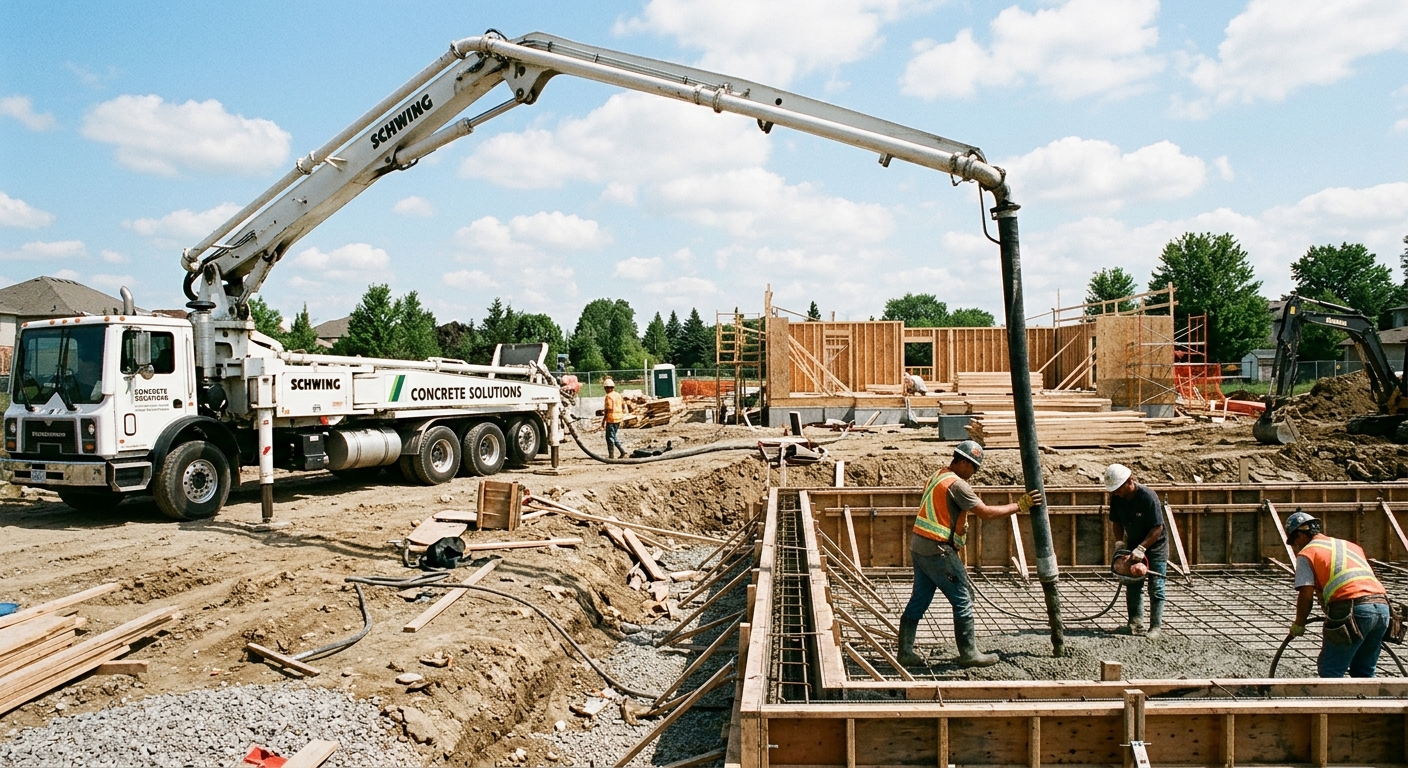
Concrete work options and costs in Kerrisdale
Kerrisdale homeowners typically choose concrete flatwork because it’s durable, low-maintenance, and blends well with Vancouver-area streetscapes. With a city population of 13,975 (Statistics Canada, 2021 Census), there’s steady demand for driveways, patios, walkways and basement-related concrete that service the neighbourhood’s mostly established housing stock. Many properties in Kerrisdale are older, and renovations often add or replace exterior flatwork—especially around entry walks and backyard patio pads—so contractors stay busy coordinating pours with tight access lanes, mature landscaping and occupied homes.
In the Lower Mainland–Southwest, mild winters can make it seem like timing isn’t as critical, but the cost and spec still reflect a shallow frost depth (commonly planned around 450 mm / 18") and frequent coastal-wet freeze–thaw cycles. That means base prep with compacted granular, attention to subgrade drainage, and air-entrained mixes with proper control joints are standard practice—not optional upgrades. Scheduling also depends on rain days, cool nights and humidity; we often plan longer curing support (blankets and curing compound/sealer timing) so driveways and patios reach design strength and surface durability.
Trade demand is especially noticeable around the Village area and along major corridors where homeowners are refreshing curb appeal—driveways and entry platforms are frequently replaced to improve drainage and reduce trip hazards. Below is a practical comparison of common concrete options and realistic price ranges so you can benchmark quotes before comparing details in the scope table.
| Application |
Typical Size |
Key Spec |
Finish Option |
Price Range |
| Concrete driveway (standard broom finish) |
400 sq ft (about 12' x 33') |
Reinforcement, compacted granular base, air-entrained mix |
Broom finish + control joints |
$7,200–$11,200 |
| Exposed aggregate driveway |
400 sq ft (about 12' x 33') |
Controlled surface finish, base drainage, air-entrained concrete |
Exposed aggregate with retarder |
$10,000–$14,800 |
| Stamped concrete driveway or patio |
250 sq ft (about 12' x 20') |
Air-entrained mix, release agent, joints to manage cracking |
Stamping + colour hardener |
$7,200–$13,000 |
| Plain concrete patio or walkway |
200 sq ft (about 10' x 20') |
Granular base, reinforcement as required, air-entrained mix |
Smooth float + broom or light finish |
$3,400–$5,200 |
| Garage floor (interior slab) |
400 sq ft (about 20' x 20') |
Vapor barrier (as applicable), reinforcement, 32 MPa concrete |
Light broom/float finish |
$6,000–$10,000 |
| Foundation footings (structural, below frost) |
Per project allowance |
Excavation to frost depth, formwork, rebar, air-entrained where exposed |
Structural concrete (no decorative finish) |
$10,000–$25,000 |
Prices are estimates only and vary by project scope, site access and material selection.
What affects the price of concrete work in Kerrisdale
In the Lower Mainland–Southwest, it’s common to see quotes for the “same” concrete job land 30–50% apart once you compare the hidden drivers—excavation depth, base engineering, mix design and curing plan. Even though Kerrisdale is part of a mild coastal region, the shallow planned frost depth (commonly about 450 mm / 18") still requires footings and thickened edges to sit below frost to reduce the risk of frost heave. That’s why two contractors may quote different footing excavation allowances or different reinforcement layouts even when they’re talking about one driveway.
Freeze–thaw cycles and coastal rainfall also affect the spec. Exterior slabs need air-entrained concrete so water exposure and temperature swings don’t lead to scaling and surface loss. Where colder BC regions force a shorter pour season, we still plan around rain bands and cool nights here in Kerrisdale, which can require curing blankets or extended curing support. De-icing salts—common for winter driveways—accelerate surface spalling on improperly specified concrete, so sealing is often the difference between a driveway that holds up and one that flakes.
In practice, a standard broom-finished driveway often fits the regional backbone of $18,000–$28,000 depending on size, but if you move to exposed aggregate or stamped work, costs commonly push toward the higher end because the surface preparation and finishing time are greater. Likewise, a foundation scope may start with the baseline “foundation/footings” budget of $200–$350 per linear foot allowance, but excavation complications and below-grade waterproofing coordination can quickly move the total.
Finally, Kerrisdale’s housing age matters: older lots often have mature trees, tighter access and existing drainage issues. If we need extra base depth, import granular, or correct subgrade drainage before forming, it shows up in the invoice—often more than the difference between broom and stamped surfaces on smaller areas.
| Price Factor |
Why It Matters |
Cost Impact |
| Frost line depth |
Determines footing depth and form height below frost to prevent heave |
Raises excavation and forming; can add major labour hours |
| Site preparation |
Excavation, grading, compacted granular base, and drainage grading |
Directly affects quantities; common swing between low/high quotes |
| Reinforcement |
Rebar or wire mesh where required for slab and crack control |
Materials + installation labour; varies by engineer/spec |
| Mix design |
Air-entrainment and compressive strength spec for durability in wet freeze–thaw exposure |
More care in batching and approvals; reduces failures |
| Finish type |
Broom vs. stamped vs. exposed aggregate changes labour time and tooling |
Stamped/exposed typically add cost vs plain broom finishing |
| Pour size and concrete truck access to site |
Narrow lanes, long hose runs and barriers affect logistics |
May require extra crew time or smaller batch planning |
| Cold-weather curing precautions |
Blankets, insulating covers and curing controls when nights cool or rain persists |
Can add equipment and schedule delay costs |
| Control joint pattern and sealing cost |
Joints manage cracking; sealing repels salts and water ingress |
Material + labour; reduces long-term surface deterioration |
Permits & regulations in British Columbia
In British Columbia, the rule of thumb is: structural concrete needs permitting and review, while most simple flatwork typically does not. If your project involves structural elements—such as footings, foundation walls, grade beams or other load-bearing concrete—expect a building permit and, for many jobs, engineered drawings reviewed by the municipality. For Kerrisdale homeowners, that usually applies to new foundations, significant foundation repairs, underpinning, or any structural modification where the concrete is carrying loads.
Concrete flatwork (driveways, patios, walkways) often doesn’t require a permit unless it affects lot grading, stormwater flow, or impervious surface/coverage limits, or it impacts municipal right-of-way. Before breaking ground, you should confirm requirements with the local authority to avoid stop-work or reconstruction.
To protect yourself, verify your contractor carries proper liability insurance and workers’ compensation coverage (WSIB/WCB), and ask for references on similar-scale BC work—especially projects poured through cool, wet periods. Step-by-step, here’s how to verify:
- Look up the contractor’s licence/registration where applicable using online provincial registry tools.
- Request a current Certificate of Insurance (COI) for liability; confirm the effective dates and that it covers your job address.
- Ask for proof of workers’ compensation account/coverage (WSIB/WCB) relevant to the contractor’s operations in BC.
- Get written confirmation of what is included (haul/disposal, base prep, reinforcement, curing/blankets if needed).
- Confirm whether the permit (if needed) is pulled by the builder/contractor or coordinated by you—get it in writing.
Getting concrete right in Kerrisdale's freeze-thaw climate
Concrete fails in Kerrisdale most often due to water movement—rain, surface pooling, and freeze–thaw—paired with insufficient base preparation, incorrect mix design and poor crack/joint control. Even with a shallow design frost depth (often planned around 450 mm / 18"), saturated soils and coastal-wet conditions can drive repeated temperature changes at the slab surface. To spec the job correctly, we focus on five fundamentals: (1) base preparation—compacted granular sub-base to the right depth for local soils and drainage; (2) mix design—air-entrainment (commonly 5–7% air content for exterior flatwork) and minimum 32 MPa compressive strength; (3) control joints—placed to limit random cracking; (4) curing—at least 7 days under appropriate conditions, and longer/with protection when it’s cool or rainy; and (5) sealing—typically applied after curing (often around 28 days) to repel salts and reduce surface breakdown.
Ask technical questions that target the failures you want to avoid. For example, spalling is frequently linked to inadequate air-entrainment and inconsistent curing. If a contractor proposes “standard mix” with no mention of air content or joint spacing, that’s a red flag. If they discuss air-entrained concrete, proper granular compaction and joint layout, you’re on the right track.
Where pricing differences make sense: stamped concrete might cost more than a broom-finished patio because of the finishing labour and surface treatment. If you’re comparing a plain patio in the regional band of $16,000–$26,000 (depending on size and site conditions) to a stamped option at the higher $22,000–$36,000 band, the premium is usually justified by the stamp tooling, additional colour/materials and more time to achieve crisp texture. If, however, the site prep scope is weak in both quotes, the cheaper option tends to “look fine for a season” and then deteriorate sooner.
| Spec |
Why It Matters in Kerrisdale |
What to Ask For |
Impact if Skipped |
| Compacted granular base (depth?) |
Reduces pumping and settlement under wet coastal soils and repeated temperature swings |
Granular type, target compacted depth and proof of compaction plan |
Uneven settling, cracking and accelerated surface wear |
| Air-entrained concrete mix (target air %?) |
Protects against scaling and spalling from freeze–thaw cycles and moisture exposure |
Target air content (commonly 5–7%) and documentation of mix design |
Surface scaling/spalling and early deterioration |
| Compressive strength (MPa rating) |
Adequate strength helps the slab resist wear during wet/dry transitions |
Minimum 32 MPa and confirmation of curing approach |
Lower durability, surface weakness and premature cracking |
| Control joints (spacing per ACI guidelines) |
Manages shrinkage and limits random cracking in exterior flatwork |
Planned joint spacing, saw-cut timing and layout details |
Random cracks and more frequent repairs |
| Minimum 7-day curing period |
Cool, humid conditions slow strength gain; proper curing is critical in Kerrisdale |
Minimum 7 days under protective conditions; plan for rain/cold nights |
Slower strength gain, weaker surface and finish failure risks |
| Penetrating sealer (when applied after cure) |
Repels water and de-icing salts common on driveways, reducing surface breakdown |
Sealer type and timing (commonly after ~28 days cure) |
More salt/water damage and faster surface spalling |
How to choose a concrete work contractor in Kerrisdale
Choosing the right concrete contractor in Kerrisdale comes down to verification, transparency and a scope that matches the climate. First, confirm British Columbia coverage and responsibility: request proof of current liability insurance (COI) naming you/your project as appropriate, and verify workers’ compensation coverage (WSIB/WCB) for their crews. Next, check licensing/registration status using available online provincial registries, and make sure the company address and contact details match the documents you receive.
For pricing, ask for 2–3 written, itemised quotes—not just a lump sum. You want labour and materials separated (excavation/base prep, reinforcement, concrete supply, finishing, joints, sealing, saw-cutting, disposal/haul). Read the scope line-by-line: what’s excluded (tree/landscape protection, rock removal, load-out, permit coordination, weekend work)? If a permit is required for structural concrete, clarify who pulls it and who pays the fees.
Warranty matters. Ask for the workmanship warranty length in writing, whether it covers labour for repair, and whether it depends on maintenance (like sealing). Also check whether any product/manufacturer warranty is transferable to you.
Payment schedule should be conservative: never pay more than 10–15% upfront. Hold back a portion until the work is complete, cleaned, and any finishing/curing commitments are satisfied. Finally, insist on a written start date and an estimated completion timeline so rain-sensitive scheduling is accounted for.
- Provide a COI with effective dates and correct project address.
- Confirm WSIB/WCB coverage for all crews.
- Share references for similar Kerrisdale or Vancouver-area exterior flatwork.
- Use an itemised quote: excavation/base, reinforcement, concrete supply, finishing, joints, sealing.
- Confirm frost-depth assumptions for any structural scopes.
- Ask for mix details: air-entrainment and minimum 32 MPa.
- Clarify joint layout and saw-cut timing.
- Ask how they handle rain/cool nights (blankets/curing plan).
- Confirm disposal/haul is included or quoted separately.
- Get load-in/logistics details for narrow streets and property access.
- Review cleanup and protection of landscaping/edges.
- Put warranty and payment schedule in writing.
Concrete red flags to watch for in Kerrisdale: (1) “one-size-fits-all” mix with no mention of air-entrainment or joint spacing; (2) vague base prep descriptions (“we’ll level it”) without compacted granular depth; (3) no written curing plan for cool/wet weeks; (4) large upfront payments with little holdback; (5) quotes that ignore disposal/haul or make site access assumptions without a site visit.
Frequently asked questions — concrete work in Kerrisdale
Why does concrete crack in Kerrisdale and how is it prevented?
Concrete cracks in Kerrisdale mainly because of shrinkage, settlement, and water-driven freeze–thaw stress at the surface. Even though our planned frost depth is often around 450 mm / 18", coastal-wet conditions can saturate soils, and temperature swings at and near the slab level increase movement. Prevention starts before the pour: proper compacted granular base, correct drainage grading, and reinforcement when required. During the pour, air-entrained concrete helps durability; after the pour, control joints are critical—spacing and saw-cut timing should be planned so cracks form where you expect. Finally, proper curing (including blankets or curing protection when nights are cool and rain is frequent) gives the slab strength early so it can resist stresses. A properly specified broom-finish driveway typically falls into the regional $18–$28 band, but the “crack prevention” pieces are what you’re paying for.
Stamped vs broom-finish concrete — cost difference?
In Kerrisdale, the cost difference is usually less about the concrete itself and more about labour and materials. Broom-finish concrete is a straightforward float-and-broom process with straightforward surface tooling and relies on control joints for cracking management. Stamped concrete adds form-ready stamp tooling, release agents, and often colour hardeners or integral colouring, which takes additional skilled finishing time. That’s why stamped options generally sit above standard driveway work: in the Lower Mainland–Southwest, stamped & decorative concrete pricing commonly aligns with the $22–$36 range, while standard concrete driveway pricing commonly aligns with $18–$28 depending on size and access. If your site prep is weak (poor base compaction or drainage), both finishes can fail—stamping won’t fix an underbuilt foundation or slab. The best value is usually choosing the simplest finish that matches how you’ll maintain it.
When is the best time to pour concrete in Kerrisdale?
The “best time” in Kerrisdale is when you can protect curing from rain and prolonged cool nights. While winters are mild compared with interior BC, coastal humidity and wet periods can still interfere with finishing and strength gain. Practically, crews aim for stretches with predictable weather and plan concrete delivery logistics around truck access and narrow lanes typical of older neighbourhood streets. If temperatures drop, contractors should adjust with cold-weather curing precautions—insulating blankets and controlled curing—so the slab achieves design strength. We also schedule to allow finishing and curing support before rain returns, because a slab that’s exposed too early can be weaker and more prone to surface scaling. If you’re planning a driveway or patio, it’s smart to book ahead because the contractor availability is strong around peak seasons and any delay can push you into less ideal weather windows.
How long does concrete take to cure?
Concrete “sets” within hours, but curing for strength is what matters. For typical exterior flatwork in British Columbia, plan on at least 7 days of curing under proper conditions before you treat the slab as fully stable for normal use. In Kerrisdale’s coastal-wet environment, we often pay extra attention to curing protection when nights are cool or rain lingers. Surface finishing quality and durability also depend on curing time—especially to reduce the risk of scaling. If you want to apply a penetrating sealer designed to repel de-icing salts, ask your contractor about timing; it’s commonly applied after the slab has fully cured, often around 28 days. Don’t rush into heavy loads or scraping ice aggressively before curing is complete. A well-run schedule may look slow, but it prevents costly early repairs.
Do I need a permit for concrete work in British Columbia?
In British Columbia, structural concrete typically requires a building permit and, in many cases, engineered drawings reviewed by the municipality. That includes footings, foundation walls and grade beams—anything carrying structural loads or changing the foundation system. Concrete flatwork like patios, walkways and driveways usually doesn’t need a permit unless it affects lot grading, stormwater flow, impervious surface coverage limits, or the municipal right-of-way. Because each Kerrisdale lot can have different drainage and municipal requirements, confirm with the local authority before work begins. A good contractor will be comfortable discussing whether your scope is permit-required and will provide documentation on what’s included. Also verify your contractor has liability insurance and workers’ compensation coverage (WSIB/WCB), and ask for references on similar BC projects so you know the job will match local expectations.
Concrete vs pavers for a patio in Kerrisdale?
Concrete and pavers both work well in Kerrisdale, but concrete usually wins on long-term uniformity when it’s built with a proper base and air-entrained mix. Pavers can look more “custom” and are sometimes easier to local-replace if a section fails, but the overall system still depends on the sub-base, bedding sand, and drainage. In Kerrisdale’s freeze–thaw and wet-season conditions, drainage and installation quality are what determine performance—whether it’s concrete or pavers. Concrete patios commonly align with the $16–$26 band for many typical sizes, while stamped or decorative finishes trend higher. If you prefer minimal maintenance and want fewer joints to weed over time, a broom-finish concrete patio is often practical. If your priority is easy spot repairs or a specific pattern look, pavers can be worth it—just be sure the installer addresses drainage and compaction just as carefully as a concrete contractor would.