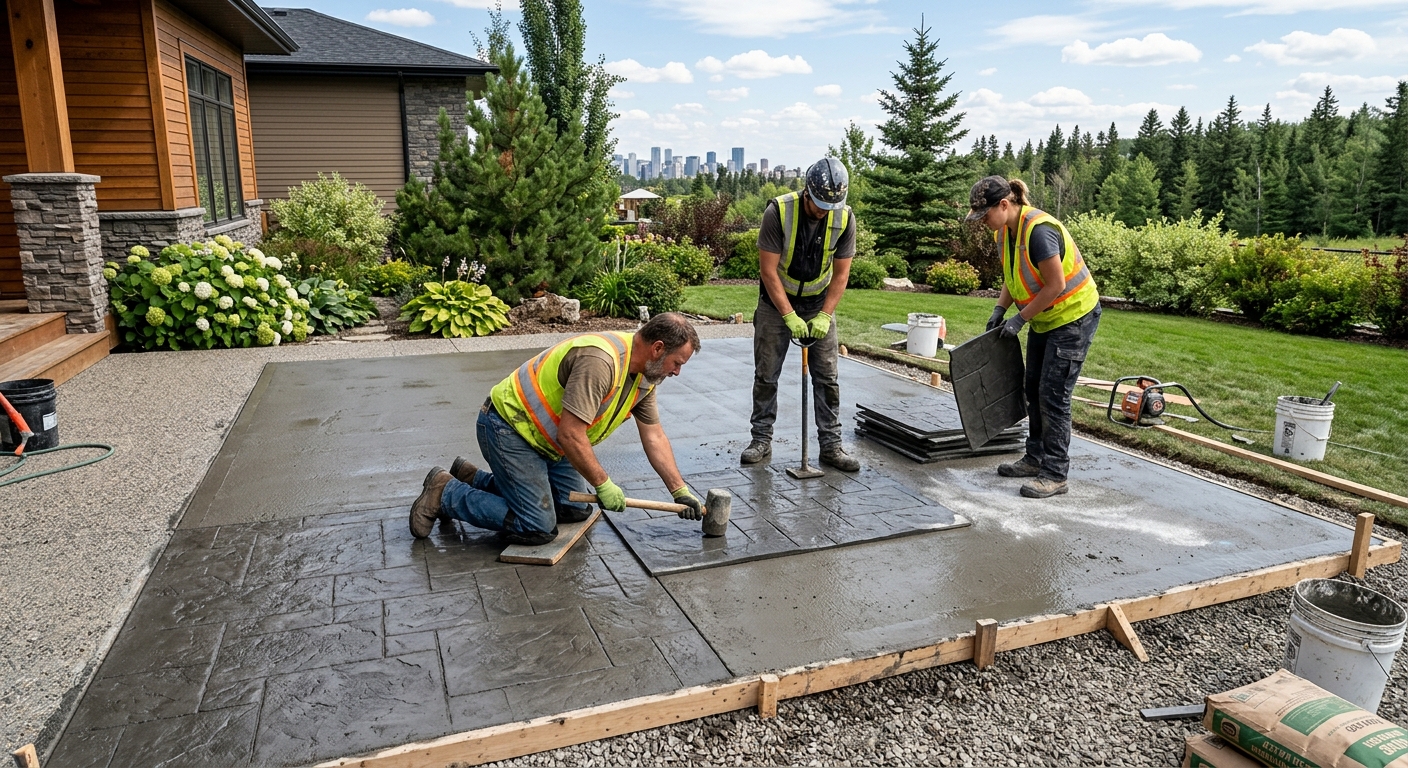
Concrete work options and costs in Ambleside
In Ambleside, concrete flatwork is a common choice because the neighbourhood’s older housing stock and ongoing infill activity keep demand steady. With a population of 11,998 (Statistics Canada, 2021 Census), local homeowners frequently upgrade driveways, patios, and walkways as part of landscaping and exterior refreshes. In this part of the Lower Mainland–Southwest, concrete work is especially in demand around the waterfront and the Denman/Marine Parade-adjacent corridors where people want durable surfaces that handle coastal-wet conditions.
Concrete pricing here is shaped by our mild winters paired with a shallow frost depth—practice typically assumes roughly 450 mm / 18" for design. Even so, freeze–thaw cycles and saturated soils drive the need for protected bases, air-entrained mixes, and correctly placed control joints to manage cracking and scaling. That’s why you’ll often see quotes differ by more than just finish: contractors may propose different footing depths, different granular base specifications, and different curing/sealer schedules based on soil drainage and expected rain windows.
You’ll also find scheduling pressure affects cost. Rainy stretches and cool nights slow curing, so teams may plan around longer curing/covering time to reach target strength and surface durability. For typical flatwork, Lower Mainland–Southwest crews price around established budget ranges—standard broom-finished slabs often land in the mid-to-upper teens per square foot/meter equivalent, while decorative options like stamped concrete carry a premium.
Below is a comparison of common options so you can benchmark quotes before you start detailing scope—then match the finish to your use, traffic, and weather exposure.
| Application |
Typical Size |
Key Spec |
Finish Option |
Price Range |
| Concrete driveway (standard broom finish) |
400–600 sq ft (approx. 37–56 m²) |
Air-entrained exterior mix, compacted granular base, control joints |
Broom finish, light sealer optional |
$18,500–$27,500 |
| Exposed aggregate driveway |
350–550 sq ft (approx. 33–51 m²) |
Air-entrained mix, proper curing window, surface retarder planning |
Exposed aggregate finish, typically higher material handling |
$22,000–$33,000 |
| Stamped concrete driveway or patio |
250–450 sq ft (approx. 23–42 m²) |
Air-entrained exterior mix, integral colour, joint layout |
Stamped pattern + release + sealer |
$20,500–$36,000 |
| Plain concrete patio or walkway |
200–350 sq ft (approx. 19–33 m²) |
Air-entrained mix, compacted sub-base, slope for drainage |
Stamped not included; plain broom or smooth trowel |
$4,800–$9,100 |
| Garage floor (interior slab) |
300–520 sq ft (approx. 28–48 m²) |
Minimum 32 MPa mix, vapour considerations, jointing |
Plain finish (broom/lightly burnished) |
$6,500–$12,500 |
| Foundation footings (structural, below frost) |
Varies by structure |
Below local frost depth, engineered rebar spacing, proper formwork |
Structural concrete only |
$14,000–$30,000 |
Prices are estimates only and vary by project scope, site access and material selection.
What affects the price of concrete work in Ambleside
In Ambleside and across the Lower Mainland–Southwest, two contractors can quote the “same” driveway or patio and still be 30–50% apart because concrete cost drivers aren’t optional—they’re dictated by durability requirements. In a coastal-wet, freeze–thaw environment, spec items like base depth, air-entrainment, reinforcement, and curing windows can change materially from one proposal to the next. When crews have to spend extra time protecting slabs during cool nights or rainy periods, the labour and scheduling costs increase, even if the finished concrete looks similar.
Frost line depth and freeze–thaw cycles are the big reasons pricing differs between BC and other regions of Canada. Local practice typically assumes about 450 mm / 18" frost depth, but exterior slabs and footings are still built below that design requirement to reduce frost heave. Cold-weather precautions can add cost: heating, insulating blankets, and slower cure management during shoulder-season pours. Exterior flatwork also needs air-entrained concrete to better withstand freeze–thaw cycling and scaling. Finally, de-icing salt (used on driveways and walkways) accelerates surface wear, so sealing and proper jointing are often recommended to protect the top few millimetres.
For example, a standard broom driveway priced closer to the $18–$28 band typically assumes a straightforward base build and manageable access. If your subgrade is saturated or you require more aggressive drainage/over-excavation, that same job can creep toward the upper end. On the flip side, a smaller plain patio can stay nearer the $16–$26 band if excavation is limited and truck access is direct. Housing age in Ambleside also matters: older yards often have compacted fill, uneven drainage, or buried debris that can increase excavation and disposal—costs you’ll feel before concrete is even poured.
| Price Factor |
Why It Matters |
Cost Impact |
| Frost line depth |
Determines footing depth and form height |
Higher excavation and formwork; can add thousands for structural work |
| Site preparation |
Excavation, grading, compacted granular base |
More base material and hauling if soils are wet/soft |
| Reinforcement |
Rebar or wire mesh requirement |
Increases material and labour; required for thickened edges/slabs |
| Mix design |
Air-entrainment and compressive strength spec |
Exterior durability upgrades raise material cost |
| Finish type |
Broom vs. stamped vs. exposed aggregate |
Decorative work typically costs more due to labour and consumables |
| Pour size and concrete truck access |
Distance, line pump vs. chute, staging time |
Poor access can require equipment or slower placement |
| Cold-weather curing precautions |
Heating and blankets |
Can add labour and materials to protect early-age strength |
| Control joint pattern and sealing cost |
Controls cracking; protects surface from de-icing salts |
Extra layout labour plus sealer material and application time |
Permits & regulations in British Columbia
In British Columbia, structural concrete work—footings, foundation walls, and grade beams—typically requires a building permit and often engineered drawings that the municipality reviews. Concrete flatwork (driveways, patios, walkways) usually does not require a permit by itself unless it affects lot grading, increases impervious surface coverage beyond what’s allowed, or impacts municipal right-of-way elements (for example, certain driveway crossings/approaches). Because rules can vary by site and how drainage is handled, confirm with the local authority before breaking ground.
For your Ambleside project, also treat contractor compliance as part of “due diligence.” A reputable contractor should carry liability insurance and have appropriate workers’ compensation coverage. Step-by-step, here’s how to verify before you sign: (1) ask for a certificate of insurance showing the contractor is insured and the work is covered; (2) request proof of workers’ compensation registration/clearance (the contractor should provide current documentation); (3) confirm the contractor’s business details and trades/registrations as applicable for the scope; (4) request references for similar-size BC jobs (same footing depth/spec level, similar exposure).
If you’re unsure whether your job triggers engineered drawings or permit review—especially for foundation modifications or drainage-related grading—ask the contractor to clearly list what they’re responsible for (permit application, drawings, and inspections). Never assume “flatwork” is exempt if it changes how water moves on the lot.
Getting concrete right in Ambleside's freeze-thaw climate
Concrete failure in Ambleside is usually a story of water management and early-age protection. Even with a shallow frost depth (commonly assumed around 450 mm / 18"), freeze–thaw cycles plus coastal rainfall can saturate soil beneath slabs. If the base isn’t compacted properly or if drainage is poor, you get movement, and that leads to cracking or scaling. The most common technical issue homeowners notice is spalling—often caused by inadequate air-entrainment or inconsistent curing—followed by “random” cracking because jointing didn’t match expected shrinkage.
To spec the job correctly, focus on five core areas. (1) Base preparation: build the compacted granular sub-base to the required thickness for your soil and exposure, and ensure the slab has slope for drainage. (2) Mix design: for exterior flatwork, use air-entrained concrete with an air content in the 5–7% range and a minimum 32 MPa compressive strength spec. (3) Control joints: plan joint spacing to limit cracking to predictable lines, not the middle of a driveway panel. (4) Curing: aim for a minimum 7-day curing period under conditions that achieve design strength; in cool damp weather, curing blankets or seal-curing practices can be necessary. (5) Sealing: apply a penetrating sealer after the slab cures (often around 28 days) to help repel salts and reduce surface deterioration.
Price comparisons should reflect these durability choices. For instance, if you’re choosing between a plain patio and stamped concrete, the added cost (often in the $22–$36 band for stamped/decorative) is justified only when the contractor also maintains the same exterior durability specs—air-entrainment, base build, and joint layout—rather than cutting corners to fund the appearance.
| Spec |
Why It Matters in Ambleside |
What to Ask For |
Impact if Skipped |
| Compacted granular base (depth?) |
Prevents pumping/settlement and limits water saturation |
State granular thickness, compaction method, and drainage plan |
Premature cracking, uneven surface, and scaling risk increases |
| Air-entrained concrete mix (target air %?) |
Improves resistance to freeze–thaw and salt scaling |
Confirm exterior air content target (typically 5–7%) |
Spalling and surface breakdown in wet/cold cycles |
| Compressive strength (MPa rating) |
Ensures designed durability and surface performance |
Minimum 32 MPa and whether it’s a verified spec |
Lower strength can mean early surface wear and cracking |
| Control joints (spacing per ACI guidelines) |
Keeps shrinkage cracking controlled in freeze–thaw conditions |
Joint spacing, saw-cut timing, and layout plan |
Random cracks and water infiltration along uncontrolled lines |
| Minimum 7-day curing period |
Early-age strength gain is critical under cool damp weather |
How curing will be maintained (blankets/sealer curing if needed) |
Reduced strength and higher long-term scaling risk |
| Penetrating sealer (when applied after cure) |
Repels de-icing salts and moisture for longer surface life |
Confirm application after curing (often around 28 days) |
Faster surface deterioration and more frequent repairs |
How to choose a concrete work contractor in Ambleside
Start by verifying the right credentials for British Columbia. First, confirm the contractor’s liability insurance: request a certificate of insurance showing coverage amounts and that the work is within scope. Second, verify workers’ compensation coverage (WSIB/WCB clearance in the documentation they provide—your contractor should be able to supply current proof). Third, confirm the contractor can legally carry out the trade/scope they’re proposing (and that subcontractors—if used—are similarly insured and covered). Where possible, ask for references on similar-scale Lower Mainland projects with comparable exposure (driveways and patios that get wet, salted, and freeze–thaw cycled).
Next, get 2–3 written, itemised quotes that separate labour and materials. You want line items for excavation/site prep, granular base, reinforcement (if included), formwork, concrete supply, finishing, joints, curing method, and sealing. Be strict about exclusions: ask whether disposal/haul-away is included, whether any permit work or drawings are covered, and what happens if soil conditions require over-excavation.
For warranty, look for a workmanship warranty length and what it covers (cracks, spalling, joint performance, settlement). Also ask about product/manufacturer warranties on admixtures or sealers and whether they transfer to the next owner. Payment schedule matters: don’t pay more than 10–15% upfront, and hold back a portion until completion and cleanup are verified. Require a start date and completion estimate in writing so rain delays and cold-weather measures are planned, not improvised.
- Ask for proof of liability insurance and current workers’ compensation clearance documentation.
- Require an itemised quote with labour and materials broken out (not just one lump sum).
- Confirm whether excavation depth, base thickness, and drainage are explicitly included.
- Verify the concrete spec: air-entrainment for exterior flatwork and minimum 32 MPa.
- Ask how control joints will be laid out (spacing and saw-cut timing).
- Confirm curing plan (blankets/covering if cool nights or rain are expected).
- Ask if a penetrating sealer is included and when it will be applied (after curing).
- Check whether reinforcement is included (and the type: rebar vs. mesh).
- Clarify truck access and placement method (chute vs. line pump) to avoid “walkway-only” shortcuts.
- Confirm disposal/haul-away is included for excess soil and old concrete.
- Get a written schedule with weather contingencies for Lower Mainland rain.
- Review warranty terms in writing, including what triggers a service call.
Concrete red flags I see in Ambleside include quotes that omit air-entrainment details, no mention of base thickness or drainage, pressure to pay most of the job upfront, vague jointing (“we’ll do it as we go”), and contractors who won’t commit to curing/sealer timing in cool damp weather.
Frequently asked questions — concrete work in Ambleside
Concrete vs pavers for a patio in Ambleside?
Both can work well in Ambleside, but concrete is often the better “set it and protect it” choice for a patio exposed to coastal rainfall and freeze–thaw cycling. A properly prepared concrete base with air-entrained mix and correctly spaced control joints can resist cracking better than thin paving layouts—especially when water drains poorly around paver edges. Pavers can also fail when they settle or when joint sand washes out, creating rocking and weeds. Price-wise, plain concrete patios typically fall into the $16–$26 band for the project scope, while paver costs vary widely based on stone thickness and base requirements. If you choose pavers, insist on a compacted granular base, edge restraints, and proper drainage grading—otherwise you’ll pay again to re-level.
How long does a concrete driveway last?
With the right exterior spec and maintenance, a concrete driveway in British Columbia commonly lasts decades rather than years. The two biggest “life” factors are freeze–thaw resistance and water management: air-entrained concrete, correct base prep, and control joint planning help prevent spalling and uncontrolled cracking. Sealing after curing (often around 28 days) also helps reduce surface deterioration from moisture and de-icing salt. In Ambleside, the shallow frost depth (practice around 450 mm / 18") helps, but the climate still brings wetting and cooling cycles, so durability specs matter. If you’re budgeting, standard driveway projects often land in the $18–$28 range; paying closer to the upper end can be worthwhile when excavation/disposal, base depth, and proper curing are clearly included in the quote.
What is air-entrained concrete and why does it matter here?
Air-entrained concrete has tiny, evenly distributed air bubbles that give freeze–thaw pressure somewhere to go, reducing internal damage. In Ambleside and the Lower Mainland–Southwest, even though winters are milder than inland regions, you still get freeze–thaw cycles and frequent saturation from coastal rainfall. That combination can quickly scale surfaces and lead to spalling if the mix isn’t designed for exterior exposure. That’s why exterior slabs and driveways should use air-entrained mix (often with a target of 5–7% air content) and meet a durability strength spec such as a minimum 32 MPa. If a quote doesn’t mention air-entrainment for an exterior pour, treat it as incomplete—ask the contractor to specify the mix and confirm it’s appropriate for freeze–thaw exposure.
How do I prepare the base for a concrete slab?
Base preparation is where concrete projects are won or lost. For a slab in Ambleside, the contractor should over-excavate as needed to reach stable subgrade, then place a compacted granular sub-base to the proper depth for frost protection and drainage. The granular should be compacted in lifts to achieve consistent density—this is not a “dump and level” step. Equally important is directing water away from the slab and preventing saturation underneath. Ask your contractor to name the granular thickness and the compaction method they’ll use, and whether they’re budgeting for drainage improvements if the site is wet or has poor soils. A good base spec is often one reason quotes differ in the $16–$26 (plain patios/walkways) versus higher bands (decorative/exposed) because the “durability work” is included before the finish starts.
How do I compare concrete quotes?
When you compare quotes in Ambleside, don’t compare only the total. Require the same scope in writing—application, size, excavation, base thickness, reinforcement type, finish, joint pattern, curing plan, and sealing. Ask whether disposal/haul-away is included and whether truck access changes the placement method. Look for clarity on concrete specification: exterior jobs should be air-entrained and meet a minimum compressive strength (commonly 32 MPa). For decorative work, stamped concrete typically falls in the higher $22–$36 band because labour and consumables increase, but the durability spec should not be reduced to “fund the look.” A reliable quote will also state how they handle weather—rain windows and cool nights—since curing/strength gain affects performance.
Can concrete be poured in cold weather in Ambleside?
Yes, concrete can be poured in cold weather in Ambleside, but it must be protected so it reaches design strength safely. The risk in cool damp conditions isn’t just freezing—it’s slow strength gain and inconsistent early-age curing, which can increase long-term scaling or cracking. Contractors should plan for cold-weather precautions such as curing blankets/insulation and, when necessary, controlled heating to maintain suitable temperatures during early curing. Ask how they’ll manage rain and high humidity, and confirm they have a curing plan for a minimum 7-day curing period. If a contractor won’t discuss blankets, timing, and protection methods, that’s a warning sign. Proper cold-weather curing is part of why well-run Lower Mainland concrete crews price exterior durability work at realistic levels within the $18–$28 and $16–$26 bands rather than offering “too good to be true” totals.