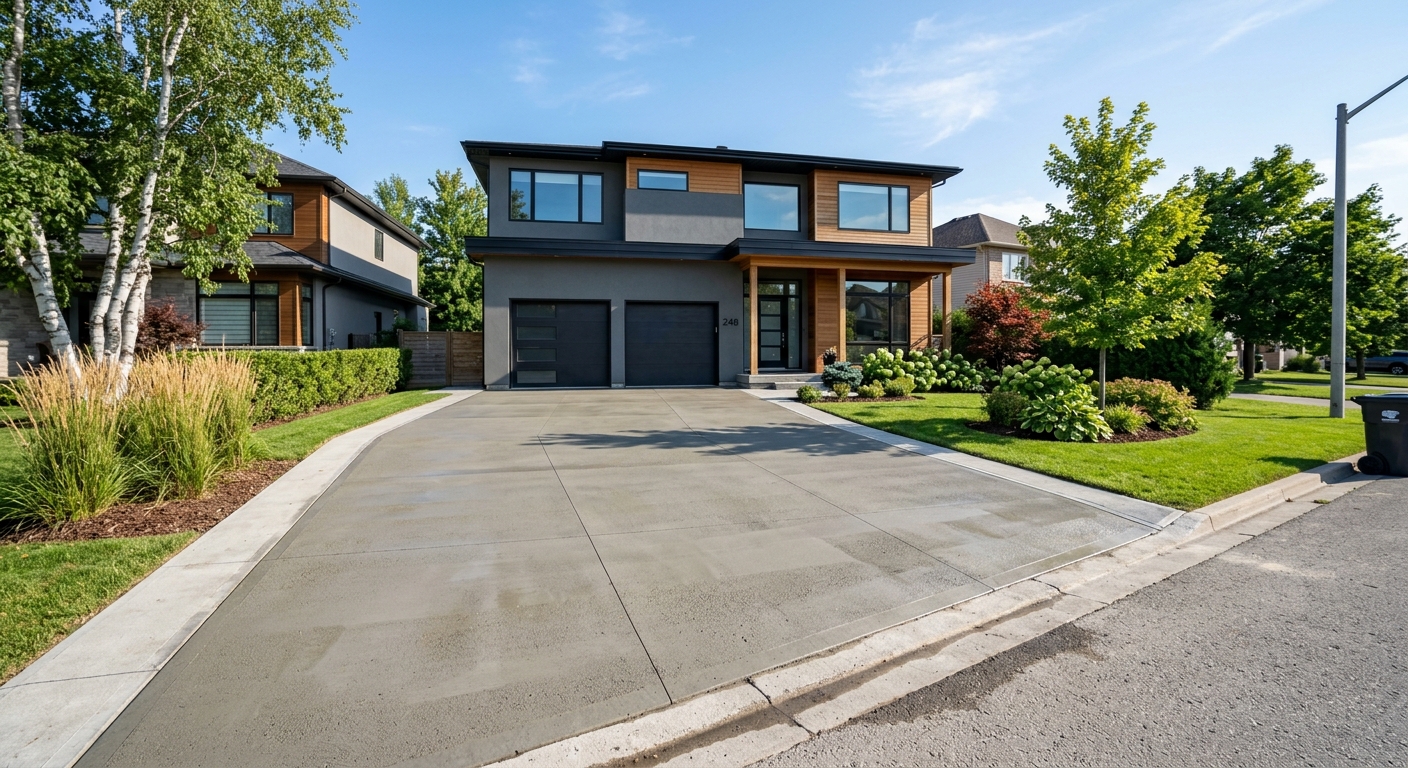
Concrete work options and costs in Whatcom
Whatcom is a busy place for concrete work, from driveways and patios on older lots to new construction where foundations and slabs need to perform year after year. With a population of 10,270 (Statistics Canada, 2021 Census), demand is steady, especially in established neighbourhoods that are frequently resurfaced. In this area, single-detached homes are a common housing type, and they drive a lot of flatwork demand—driveways, walkways, and backyard patios are typically the first “big ticket” exterior projects homeowners tackle before a rainy season or before landscaping goes in.
In the Lower Mainland–Southwest, pricing is shaped by our mild winters but shallow frost line and frequent freeze–thaw cycles. Local practice typically assumes frost depth around 450 mm / 18", so footings, piers, and thickened edges are placed below that to reduce frost heave risk. Even with milder temperatures, saturated soils and coastal rain mean base prep, drainage, and air-entrained mixes are non-negotiable. You’ll also feel this in scheduling: contractors often plan pour dates around prolonged rain, cool nights, and humidity, then use curing blankets and longer cure times to reliably hit design strength.
Here, a lot of concrete crews are in high demand around the Tsawwassen and Ladner areas (and the wider South Delta corridor), where new builds and renovations happen in waves. The result is that “same job” bids can look different depending on whether the quote includes proper subgrade drainage, air-entrainment, and adequate curing. Use the options below as a baseline for comparing quotes, then we’ll dig into what actually drives the cost.
| Application |
Typical Size |
Key Spec |
Finish Option |
Price Range |
| Concrete driveway (standard broom finish) |
16 ft x 20 ft (320 sq. ft.) |
Air-entrained concrete, compacted granular base, control joints |
Broomed |
$5,760 – $8,960 |
| Exposed aggregate driveway |
16 ft x 20 ft (320 sq. ft.) |
Proper curing + surface washing, air-entrained mix |
Exposed aggregate |
$7,040 – $11,520 |
| Stamped concrete driveway or patio |
12 ft x 18 ft (216 sq. ft.) |
Reinforcement as needed + colour hardener, air-entrained exterior mix |
Stamped pattern with release + sealer |
$4,752 – $7,776 |
| Plain concrete patio or walkway |
10 ft x 16 ft (160 sq. ft.) |
Compacted base, air-entrainment, expansion/control joints |
Steel trowel + broom texture as needed |
$2,560 – $4,160 |
| Garage floor (interior slab) |
20 ft x 22 ft (440 sq. ft.) |
Vapour/insulation considerations, reinforcement as required, curing |
Float-finished |
$9,000 – $14,000 |
| Foundation footings (structural, below frost) |
Example: 40 lineal ft of footing |
Excavation, formwork, rebar cage, concrete placed below frost depth |
Structural concrete |
$8,000 – $14,000 |
Prices are estimates only and vary by project scope, site access and material selection.
What affects the price of concrete work in Whatcom
In Whatcom and the broader Lower Mainland–Southwest, quotes for the “same” concrete project can swing 30–50% because the true scope isn’t always obvious. Two crews might price the same driveway size, but one includes proper granular base thickness and drainage, correct reinforcement placement, air-entrained mix design, and curing/blanketing strategy for cool, humid conditions—while another cuts corners that show up as cracking, scaling, or early spalling. That’s also why labour availability and scheduling during the wetter shoulder months can raise rates versus quieter windows. In practice, pricing in this corridor commonly aligns with the regional concrete bands (for example, driveways often land around the $18–$28/sq. ft. backbone and patios around $16–$26/sq. ft.), but the final number changes with how engineered the preparation is.
Frost depth and freeze–thaw cycles dictate specs here. Exterior work must be protected from frost heave, so footings and thickened edges are typically placed below the design frost depth (commonly around 450 mm / 18" in local practice). Every exterior slab should use air-entrained concrete so the mix can withstand repeated wetting and drying plus freeze–thaw. Colder regions shorten the effective pour season and drive up heating/blanket costs, but even in coastal BC we still need to manage cool nights and high humidity—especially to hit minimum strength and durability targets. Also, de-icing salts accelerate surface damage, so sealing becomes an important value add rather than an optional “nice-to-have.”
Concrete choices also change costs. For instance, upgrading from a standard broom driveway to stamped concrete can add surface labour and materials (often moving from the general driveway backbone toward the stamped pricing range of $22–$36/sq. ft.). Conversely, plain patio work with good base prep may stay closer to the $16–$26/sq. ft. band—if reinforcement and jointing are done right. On older Whatcom properties, tight access and uneven settling can require deeper demo and more base build-up, which shows up as extra excavation and disposal costs.
| Price Factor |
Why It Matters |
Cost Impact |
| Frost line depth |
Determines footing depth and form height |
Higher excavation and formwork for structural elements |
| Site preparation |
Excavation, grading, compacted granular base |
Can add significant labour and disposal if subgrade is soft or wet |
| Reinforcement |
Rebar or wire mesh requirement |
Increases material and tying/labour time, but reduces cracking risk |
| Mix design |
Air-entrainment and compressive strength spec |
Special mix delivery can cost more but protects against freeze–thaw scaling |
| Finish type |
Broom vs. stamped vs. exposed aggregate |
Stamped/exposed finishes add materials and surface labour |
| Pour size and concrete truck access to site |
Lineal pump distance vs. short chute placements |
Pumping, wheelbarrowing, and limited access increase labour and time |
| Cold-weather curing precautions |
Heating and blankets |
Blankets/heaters and longer protection time add to the quote |
| Control joint pattern and sealing cost |
Limits random cracking; protects from salt and moisture |
Often a modest line item that prevents costly early repairs |
Permits & regulations in British Columbia
In British Columbia, structural concrete work—such as footings, foundation walls, and grade beams—usually requires a building permit and often engineered drawings that a municipality reviews. For concrete flatwork like patios, walkways, and driveways, a permit is commonly not required unless the work affects lot grading, touches impervious surface coverage limits, or involves changes that impact municipal right-of-way/sidewalk areas. Because requirements can vary by property and scope, always confirm with the local authority before breaking ground.
Before hiring, verify the contractor carries liability insurance and has appropriate WCB coverage (in BC, workers’ compensation is handled under WCB requirements). Ask for references on similar-scale projects and make sure they understand local curing expectations for coastal-wet, freeze–thaw conditions.
How to verify a contractor in BC (step-by-step)
- Ask for their certificate of insurance and confirm it is current for the project location.
- Request proof of workers’ compensation coverage (WCB) for their workers.
- Check their contractor credentials through the appropriate online registry listings (if applicable to their trade category), and ensure the company name matches the insurance documents.
- Get the permit/engineering responsibility clarified in writing: who pulls the permit (if required) and who submits plans.
- Review prior project addresses and ask for photo examples that show exterior exposure (not just interior slabs).
- Confirm that their quote includes site protection, curing methods, and drainage/base prep details.
Getting concrete right in Whatcom's freeze-thaw climate
Concrete fails in Whatcom when the slab or foundation can’t handle water, freezing temperatures, and movement through the ground. The biggest practical risks are (1) inadequate base preparation that leaves voids or weak subgrade, (2) concrete that isn’t properly air-entrained for freeze–thaw cycles, and (3) missed curing and jointing that allow random cracking and moisture pathways. In a coastal-wet climate like the Lower Mainland–Southwest, saturated soils and heavy rainfall mean water management matters as much as the pour itself.
To spec the job correctly, insist on: (1) base preparation with compacted granular sub-base to the right depth for local soil and frost protection; (2) a mix design using air-entrainment—typically 5–7% air content for exterior flatwork—and a minimum 32 MPa compressive strength; (3) control joints placed to limit random cracking (spacing depends on slab thickness and configuration, but the goal is predictable crack control); (4) curing for at least 7 days under proper conditions, with cold-weather precautions when nights are cool; and (5) penetrating sealer applied after cure (often around 28 days) to repel de-icing salts and reduce moisture ingress.
Ask the contractor to explain how they manage rain delays and cool nights. A quality contractor will plan for curing blankets or other protection and won’t rush to finish. For a dollar example: moving from plain broom-finished concrete to stamped concrete might add about $3–$8/sq. ft. depending on colour system and labour. If the extra cost is paid for proper base, reinforcement, and curing, it’s justified. If the stamped bid is cheaper only because it reduces preparation or skips air-entrainment/jointing, that “saving” often turns into early patching—especially with freeze–thaw and salt exposure.
| Spec |
Why It Matters in Whatcom |
What to Ask For |
Impact if Skipped |
| Compacted granular base (depth?) |
Prevents settlement and limits frost-related movement |
Granular type, target thickness, and compaction standard |
Cracking, uneven surfaces, and faster deterioration |
| Air-entrained concrete mix (target air %?) |
Resists freeze–thaw damage and scaling in exterior exposure |
Air content target (commonly 5–7% for exterior flatwork) |
Spalling and surface scaling within a few seasons |
| Compressive strength (MPa rating) |
Helps achieve long-term durability under wetting and temperature swings |
Minimum 32 MPa and mix schedule details |
Low strength increases cracking and surface wear |
| Control joints (spacing per ACI guidelines) |
Controls where cracks happen during shrinkage and temperature changes |
Joint spacing, layout plan, and saw-cut timing |
Random cracks, water infiltration, and patchwork repairs |
| Minimum 7-day curing period |
Reduces early-age cracking and helps reach designed strength |
Protection plan for cool nights and rain (blankets/sealer plan if needed) |
Weak top surface, scaling, and durability loss |
| Penetrating sealer (when applied after cure) |
Helps repel moisture and de-icing salt intrusion |
Application timing (often around 28 days post-pour) and product type |
Faster salt/ice damage and higher maintenance costs |
How to choose a concrete work contractor in Whatcom
When you’re hiring a concrete contractor in British Columbia, start with documentation and consistency. First, verify liability insurance: ask for a certificate of insurance and confirm coverage limits are appropriate for the project. Next, confirm workers’ compensation coverage (WCB) for their crew. If the contractor handles structural elements, request proof they’re properly set up for the scope and that they’ll coordinate permits/engineering requirements where applicable. You can also ask for a clearance letter or direct confirmation from their insurance/wellness documentation—then match the company name and address to the quote and invoice.
Get 2–3 itemised written quotes. The best quotes break down labour and materials (excavation/base, reinforcement, concrete supply/mix, finishing, joints, curing protection, and sealing where included). Avoid vague lump sums where key items are not defined. Carefully review what is excluded: disposal/haul-away, saw-cutting for joints, drainage improvements, and permit pulling (if required). A well-scoped driveway or patio should state whether sealers are included, and when they’ll be applied.
Warranty should be written: workmanship coverage length, what it includes, and any exclusions tied to improper maintenance. Ask whether the manufacturer warranty on admixtures/sealers (if used) is separate and if it’s transferable with the property. Payment should follow a sensible schedule—never more than 10–15% upfront; hold back a portion until the job is complete, cleaned, and meets finish and cure expectations. Finally, insist on a start date and completion estimate in writing so weather-related delays are understood upfront.
- Ask whether the exterior mix is air-entrained and what air target they use.
- Confirm footing/slab details are below local frost expectations (for structural work).
- Verify compaction and granular base thickness are specified, not assumed.
- Require joint layout: spacing, type, and saw-cut timing plan.
- Ask who supplies and applies curing protection in cool/wet conditions.
- Confirm reinforcement placement (rebar mesh location and coverage), if applicable.
- Request a line item for sealing (and the application timeline after curing).
- Check that haul-away/disposal is included if demo is required.
- Ask about access and placement method (chute length, pump, wheelbarrow distance).
- Confirm the contractor is insured and has WCB coverage for their crew.
- Get a written schedule and a rain/temperature contingency plan.
- Review the warranty in writing and ensure it’s signed by the contractor.
Red flags in Whatcom include: skipping air-entrainment on exterior work, not mentioning control joints or curing protection, giving only a “per square foot” number without base/haul-away details, demanding large upfront deposits (more than 10–15%), and refusing to show proof of liability insurance and WCB coverage or providing photos that don’t match your exposure level (salt/rain).
Frequently asked questions — concrete work in Whatcom
What causes concrete to spall in Whatcom winters?
Concrete spalling in Whatcom winters is commonly tied to freeze–thaw damage plus moisture and de-icing salt. When the mix isn’t properly air-entrained (or air content is inconsistent), the freeze–thaw cycles can break down the surface paste, leading to flaking/spalling. Poor drainage and weak base preparation also trap water under or within the slab, which accelerates deterioration during wet coastal periods. In practice, exterior slabs exposed to salt are more vulnerable, which is why we recommend a penetrating sealer after cure (often around 28 days) and good jointing. If you’re comparing quotes, pay attention to the contractor’s mix specs and curing plan; a “cheap” driveway can look close on day one, but spalling can appear after several seasons of freeze–thaw.
What is rebar and when is it required in British Columbia?
Rebar is short for reinforcing steel bars used to strengthen concrete against cracking from tension, shrinkage, and movement. In British Columbia, whether rebar is required depends on the structural design and what’s being built—driveways and patios may use mesh, dowels, or reinforcement depending on slab thickness, soil conditions, and load expectations. For structural work like foundation footings and grade beams, reinforcement is typically engineered and specified below frost depth to meet structural requirements. The key point for homeowners is that reinforcement should never be “guessed.” If the contractor proposes omitting reinforcement to lower cost, ask why that’s acceptable for your thickness and subgrade. A properly detailed foundation footings scope often sits in the $200–$350 per lineal-foot backbone band depending on conditions and rebar complexity.
How long does a concrete project take in Whatcom?
Timing in Whatcom depends on weather, cure planning, and whether there’s demolition/base work. For typical exterior flatwork, the pour day is usually just one day, but the project timeline is longer because of prep and curing protection. Base excavation and forming can take a couple of days, especially if access is tight or if the old concrete needs removal and disposal. Concrete then needs at least 7 days of curing under proper conditions, and you should allow extra time for surface treatments like sealers (often applied closer to 28 days). In the Lower Mainland–Southwest, cool nights, fog, and prolonged rain can extend timelines because contractors use curing blankets and adjust scheduling. For example, a standard broom-finished driveway that’s quoted around the $18–$28/sq. ft. range might take roughly 1 week to 2 weeks from start to ready-for-use, depending on the weather window.
What is a concrete overlay and is it suited to Whatcom?
A concrete overlay is a new concrete layer placed over an existing slab—often to improve appearance and extend service life without full demolition. Overlays can be suited to Whatcom when the existing concrete is still structurally sound, properly prepared, and well-bonded (surface profiling, cleaning, and bonding agents as specified). However, overlays are not a fix for deep structural settlement, major base failure, or significant spalling caused by freeze–thaw and moisture ingress that has been progressing for years. In this coastal-wet, freeze–thaw climate, water management is crucial; if the original drainage is poor, the overlay can fail sooner. If you’re considering an overlay to avoid removal, ask for a condition assessment: check for delamination, movement, and crack patterns. Sometimes full replacement is the better value if the underlying base has issues.
How do I seal concrete to protect it in Whatcom?
To protect concrete in Whatcom, sealing should target moisture and salt intrusion—especially for driveways exposed to de-icing. The typical approach is using a penetrating sealer rather than a film-forming coating. We usually recommend applying penetrating sealer after the slab has fully cured; homeowners are often told to wait until around 28 days post-pour so the concrete is ready to accept the product. Before sealing, the surface must be clean and dry, and joints/edges should be sound to prevent sealing over trapped moisture. After sealing, regular maintenance still matters: keep water flowing away from the slab and avoid overusing salt. When comparing quotes, look for whether sealing is included and whether the contractor specifies the timing and product type; that’s where a lot of early “cheap” bids quietly drop value.
What is the difference between concrete and cement?
Concrete and cement are often used interchangeably, but they aren’t the same. Cement is one component in concrete: a binder powder that, when mixed with water, hydrates and helps create the paste that hardens. Concrete is the full engineered material—cement plus water plus aggregates (sand and gravel) and, for exterior work in British Columbia, admixtures like air-entrainment. That mix design choice is especially important in Whatcom’s freeze–thaw environment, because air-entrainment helps manage freeze–thaw pressure and reduces scaling/spalling risk. So when you see price bands for exterior concrete, you’re really comparing not just labour and finishing, but also the quality of the concrete mix. If your driveway or patio is being quoted near the regional backbone of $18–$28/sq. ft., ask what the mix spec is and whether it’s designed for exterior durability.