Concrete work options and costs in Canoe
Canoe, British Columbia is a small community where concrete flatwork is often part of keeping older homes practical and walkways safe through the region’s damp, freeze–thaw swings. With a population of 1,081 (Statistics Canada, 2021 Census), the local contractor pool is smaller than the Lower Mainland core, so scheduling can tighten during the main pour months. In practice, most demand comes from single-family neighbourhoods and infill lots where homeowners replace aging driveways, build patios, and address settling—typical work that relies on good base prep, air-entrained mix design, and careful curing.
In the Lower Mainland–Southwest market, mild winters and a shallow design frost line still don’t eliminate freeze–thaw. The frost depth used in local practice is often around 450 mm / 18", but footings, piers and thickened edges still need to be placed below that to reduce frost heave risk. Add frequent coastal-wet rainfall and cool nights, and you get higher costs for drainage/compactable base, plus more attention to timing (rain cover, curing blankets, and longer cure windows) for driveways, patios, and foundation work. Those same factors explain why similar jobs can land at different price points even within the same city—access, reinforcement complexity, and whether the crew can pour and cure to spec all matter.
In Canoe, concrete work is especially in demand around the core residential streets where walkways connect to older porches and garages. If you’re comparing options, the table below gives realistic price bands you can use as a baseline for planning and discussions with contractors.
| Application |
Typical Size |
Key Spec |
Finish Option |
Price Range |
| Concrete driveway (standard broom finish) |
20' x 10' (200 sq. ft.) |
Air-entrained exterior mix, compacted granular base, control joints |
Broom finish |
$3,600 – $5,600 |
| Exposed aggregate driveway |
20' x 10' (200 sq. ft.) |
Air-entrained exterior mix, base prep + saw cuts |
Exposed aggregate |
$4,200 – $7,000 |
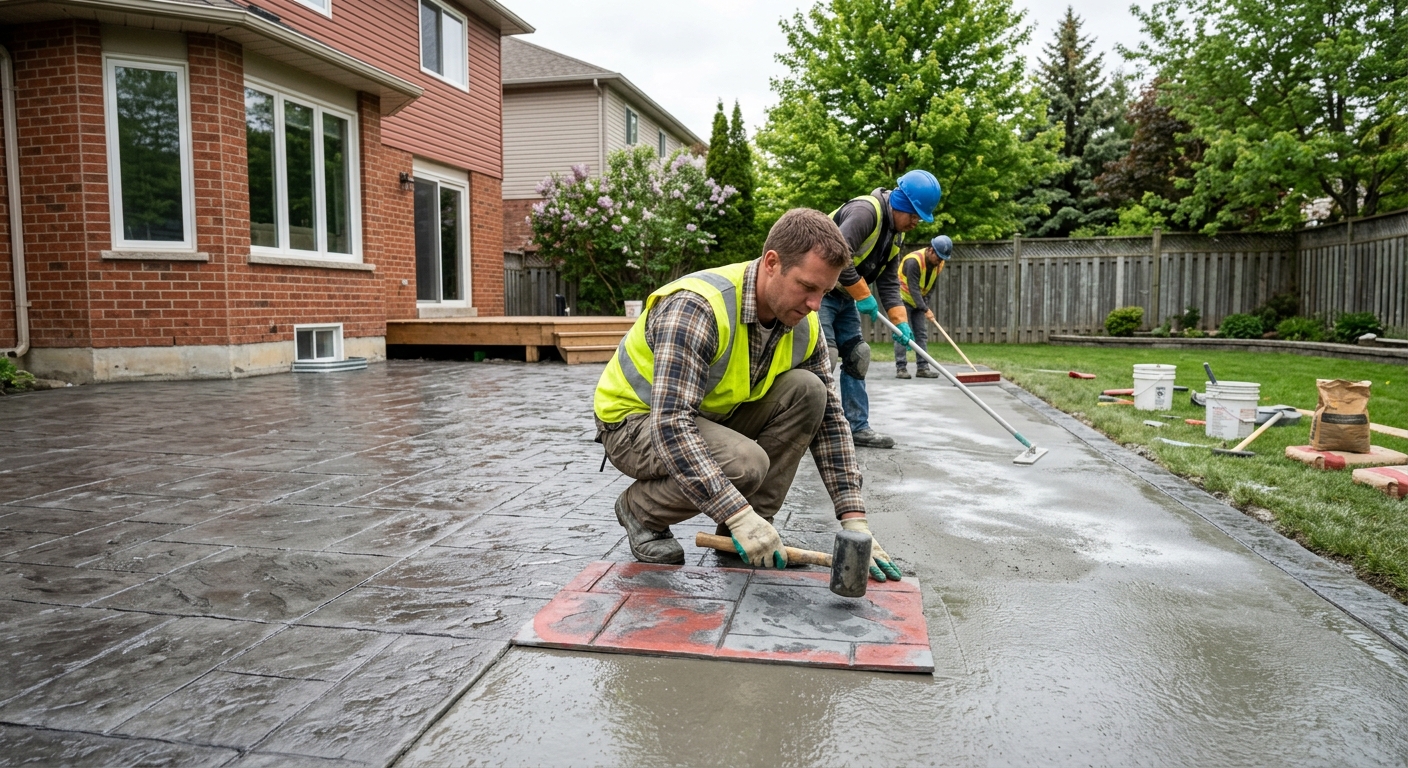
| Stamped concrete driveway or patio |
200 sq. ft. |
Air-entrained mix, integral color (where required), control joints |
Stamped (stone/brick pattern) |
$4,500 – $7,800 |
| Plain concrete patio or walkway |
12' x 12' (144 sq. ft.) |
Compacted base, proper slope, control joints |
Broom or trowel-finish (lightly textured) |
$2,300 – $4,000 |
| Garage floor (interior slab) |
20' x 22' (440 sq. ft.) |
Vapour barrier, insulated edges as needed, steel reinforcement |
Broom or lightly power-trowelled |
$7,500 – $12,500 |
| Foundation footings (structural, below frost) |
Varies (e.g., 8" x 16" continuous footing) |
Excavation + forming + rebar, placed below design frost depth |
Structural concrete |
$6,000 – $12,000 |
Prices are estimates only and vary by project scope, site access and material selection.
What affects the price of concrete work in Canoe
In Canoe and across the Lower Mainland–Southwest region, the same concrete type can price 30–50% differently because the “real work” isn’t just pouring concrete—it’s excavation, drainage, forming, reinforcement, scheduling for weather, and curing to achieve durability in a wet freeze–thaw climate. In British Columbia, costs also shift based on contractor availability and how close you are to the larger labour and material hubs; smaller local crews may book fewer pours at once, and that affects crew mobilization and truck scheduling. If a contractor can’t guarantee good cure conditions (cool nights, prolonged rain), they may include extra blankets, sealers, or rescheduling time, which adds cost.
Frost line depth and freeze–thaw cycles dictate the specs. Even though coastal BC often assumes a frost depth around 450 mm / 18" for design, exterior footings and thickened slab edges are commonly placed below that range to prevent frost heave. Exterior slabs also need air-entrained concrete to survive repeated cycles and scaling. Colder regions require deeper excavations and more cold-weather precautions; while Canoe is milder than interior BC, saturated soils and repeated temperature swings still drive base prep and drainage requirements. De-icing salts also become a factor on driveways—sealing is often recommended to reduce surface deterioration.
Concrete examples from real pricing decisions: an exposed aggregate driveway can cost more than standard broom because it requires additional finishing steps and tighter timing on the wash/expose process. A stamped patio may cost near the $22 – $36 per sq. ft. band for decorative work because of integral colour, stamps, and higher labour intensity. Conversely, plain patios and walkways can stay closer to the basic $16 – $26 per sq. ft. range when excavation is straightforward and access is easy.
Where you’ll feel it most in Canoe is on older lots—if the driveway apron or walkway ties into aged concrete or uneven grade, contractors often need more regrading and drainage corrections. On those jobs, base preparation and reinforcement can add hundreds to thousands to the quote even when the final square footage looks similar.
| Price Factor |
Why It Matters |
Cost Impact |
| Frost line depth |
Determines footing depth and form height below the design frost depth |
Can add significant excavation and forming cost on foundation work |
| Site preparation |
Excavation, grading, and compacted granular base control settlement |
Higher cost with poor access, saturated soils, or extra base material |
| Reinforcement |
Rebar or wire mesh reduces cracking and supports slabs/foundations |
Costs rise when structural steel spacing and tie-in details are required |
| Mix design |
Air-entrainment and specified compressive strength for exterior durability |
Better mix spec increases material cost but reduces future scaling/spalling |
| Finish type |
Broom vs. stamped vs. exposed aggregate changes labour and finishing time |
Decorative finishes typically raise total project cost |
| Pour size and concrete truck access to site |
Impacts how many loads, pump needs, and labour hours are required |
Poor access can add pump/handwork and increases total labour |
| Cold-weather curing precautions |
Heating and insulating blankets protect strength gain in cool, damp weather |
Often adds daily rental and labour time during shoulder seasons |
| Control joint pattern and sealing cost |
Joints guide cracking; sealing helps resist de-icing salt scaling |
Skipped or under-designed joints reduce service life and raise repair costs |
Permits & regulations in British Columbia
In British Columbia, structural concrete work typically needs a building permit, and many projects also require engineered drawings that the municipality reviews for safety and compliance. This includes concrete foundations such as footings, foundation walls, and grade beams. If your scope affects load-bearing elements, drainage tied into foundation performance, or the building envelope at the foundation level, expect permit involvement.
Concrete flatwork—like driveways, patios, sidewalks, and walkway slabs—often does not require a permit by default. That said, permits can come into play when the work changes lot grading, affects drainage patterns, or triggers municipal requirements for impervious surface coverage or work near a right-of-way. Because bylaws can vary based on lot conditions, you should confirm with the local authority before the first excavation.
Step-by-step for Canoe homeowners: (1) ask the contractor for their British Columbia business licence/permit references for the scope and confirm it matches the type of work they’re doing; (2) request a current certificate of liability insurance naming you as certificate holder or additional insured where appropriate, and verify coverage is active for the project dates; (3) confirm they have WCB coverage (WorkSafeBC) for workers—don’t accept “we don’t use subcontractors” without proof; and (4) check online registry records and call the insurer or use the certificate details to confirm validity. For confidence, ask for references on similar footing and slab scopes (same thickness, same drainage approach, same access challenges).
Getting concrete right in Canoe's freeze-thaw climate
Concrete failures in Canoe typically show up as cracking, scaling, and in worst cases spalling—most often when air-entrainment, base preparation, curing, or jointing are rushed or under-spec’d for freeze–thaw and wet coastal conditions. The key is to spec for durability, not just appearance. Start with (1) base preparation: compacted granular sub-base to the correct depth and elevation for your soil and drainage situation. In a wet climate with repeated temperature swings, poor drainage keeps the base saturated, which increases frost heave risk even when the design frost line is relatively shallow. Next, (2) mix design: specify air-entrainment with a target 5–7% air content for exterior flatwork and a minimum 32 MPa compressive strength so the concrete can resist scaling and freeze–thaw stresses. (3) Control joints: spacing should be planned to limit random cracking, then joints should be sealed or detailed appropriately depending on the use area. (4) Curing: in damp, cool periods, plan for at least 7 days of proper curing conditions (and extra protection if cold nights extend). (5) Sealing: apply a penetrating sealer after the concrete has fully cured—commonly around 28 days—so de-icing salts and moisture don’t accelerate surface deterioration.
If you’re comparing options, remember that the cheapest quote can be the most expensive later. For example, a standard broom-finished driveway in Canoe may fit the typical concrete driveway band (often around $18 – $28 per sq. ft. equivalent), while stamped work costs more because of integral colour and labour. The “extra” is justified for aesthetics, but not for shortcuts—if air entrainment or curing protections are missing, you don’t get durability savings. Ask your contractor how they’ll handle cool, rainy stretches and how they’ll achieve the specified air and curing.
| Spec |
Why It Matters in Canoe |
What to Ask For |
Impact if Skipped |
| Compacted granular base (depth?) |
Improves drainage and reduces frost heave risk from saturated soils |
Base thickness, granular type, and compaction method (and proof of level/slope) |
Settlement, cracking, and frost-related damage to the slab edges |
| Air-entrained concrete mix (target air %?) |
Air bubbles provide freeze–thaw protection against scaling and spalling |
Target air content and mix design confirmation for exterior exposure |
Surface deterioration within a few seasons, especially where salts are used |
| Compressive strength (MPa rating) |
Ensures strength gain for durability and load-bearing performance |
Minimum MPa rating (commonly 32 MPa for exterior flatwork per spec) |
Reduced long-term performance and increased cracking potential |
| Control joints (spacing per ACI guidelines) |
Controls where shrinkage cracking occurs in freeze–thaw cycles |
Planned joint spacing, saw-cut timing, and joint sealing detail |
Random cracking and water ingress that accelerates freeze–thaw damage |
| Minimum 7-day curing period |
Strength development is critical in cool, damp conditions |
Curing plan (covers/blankets, weather steps, and timing) |
Weak surface, scaling risk, and reduced durability |
| Penetrating sealer (when applied after cure) |
Repels moisture and limits de-icing salt-driven surface breakdown |
Sealer type and application timing (commonly after full cure) |
Faster wear of driving/parking surfaces and higher maintenance needs |
How to choose a concrete work contractor in Canoe
Choosing the right contractor in Canoe starts with verifying credentials and proof—not promises. For British Columbia, ask for their contractor/business details and confirm the work they’re proposing matches the scope they’re set up to perform. Next, request a current certificate of liability insurance and review the coverage limits and effective dates so you know you’re protected during excavation and pours. Finally, confirm WorkSafeBC coverage (WSIB/WCB equivalent in BC is WorkSafeBC). A reputable contractor can provide the paperwork quickly; if they hesitate, that’s a red flag.
For pricing, get 2–3 itemised written quotes that break down labour and materials (excavation/base, forms, reinforcement, concrete supply, finishing, joints/sealing, and disposal). Avoid lump sums that don’t specify thickness, reinforcement type, or base prep. Read exclusions carefully: is permit pulling included (when required), is haul-off included, and who handles regrading or drainage adjustments?
Warranty matters, too. Ask for a clear workmanship warranty length, what exactly it covers (cracking within limits, scaling, joint performance), and whether any manufacturer product warranty applies to sealers or admixtures—and if it’s transferable if you sell the home. For payment, never pay more than 10–15% upfront. Use a holdback until the work is complete and cured to the agreed standard. Finally, insist on a written timeline with start date and completion estimate, including how weather delays (rain/cool nights) are managed.
- Provide a written scope that states slab thickness, footing size (if applicable), and whether air-entrainment is included.
- List base prep steps: excavation depth, granular type, compaction method, and drainage plan.
- Specify reinforcement: mesh vs. rebar and spacing, especially for driveway areas.
- Describe finish method and texture (broom direction, stamped pattern details, or exposed aggregate process).
- Include control joint timing and spacing, and whether joints are sealed.
- Confirm curing steps for cool/wet weather (blankets/curing compound/cover strategy).
- State whether sealing is included and when it will be applied (after full cure).
- Show how concrete truck access will be managed (pump needed? number of loads?).
- Provide proof of liability insurance with active dates.
- Confirm WorkSafeBC clearance/coverage for their workers.
- Include site cleanup and disposal/haul-off in the quote.
- Set a payment schedule with a holdback and completion checklist.
Concrete red flags in Canoe: contractors who won’t discuss air-entrainment; quotes that omit base thickness/compaction; no clear control joint plan; vague curing promises during rainy cool stretches; and requests for large upfront payments without a signed scope and schedule.
Frequently asked questions — concrete work in Canoe
What is a concrete overlay and is it suited to Canoe?
Concrete overlays are thin concrete (or cementitious) toppings placed over existing concrete to improve appearance or extend service life. In Canoe and across coastal BC, overlays can be suited when the existing slab is structurally sound—no widespread failure, heavy spalling, or deep rocking settlement. The big risk in a freeze–thaw climate is that moisture pathways remain in the original slab; overlays can trap water if preparation isn’t thorough. A proper overlay job includes surface profiling, removal of weak concrete, and usually bonding preparation so the overlay can act as one system. In terms of cost, overlays are often compared to replacement, but they can be less expensive than a full driveway rebuild. For reference, new driveway replacement often sits around the local concrete driveway pricing band (for example, $18 – $28 per sq. ft. equivalent), while overlays vary widely depending on prep.
How do I seal concrete to protect it in Canoe?
In Canoe’s damp, freeze–thaw conditions, sealing is mainly about reducing moisture and salt exposure from de-icing (where used). The correct approach is timing: let the concrete cure fully before sealing, commonly around 28 days, then apply a penetrating sealer designed for exterior exposure. Ask your contractor what product they use and whether it’s appropriate for freeze–thaw and wet climates. Proper sealing doesn’t replace good drainage and air-entrainment—it complements them. On patios and driveways, sealing helps slow surface scaling and keeps water from easily penetrating micro-pores. For the best results, the slab surface must be clean and dry, and any efflorescence or contaminants should be removed first. If your driveway is experiencing early surface flaking, sealing may help, but the contractor should also identify whether the mix design and air content were correct from day one.
What is the difference between concrete and cement?
Concrete is the finished building material you see: a mix of cement, water, and aggregates (sand and gravel), plus sometimes admixtures for workability and durability. Cement is one component inside the concrete—typically Portland cement—responsible for binding the mixture together when it hydrates. Homeowners often hear both terms used interchangeably, but for pricing and performance, the key is the overall concrete mix design. In Canoe and the Lower Mainland–Southwest region, exterior durability depends on factors like air-entrainment and curing, not just “using concrete.” That’s why a properly specified exterior mix that targets air content for freeze–thaw resistance can be the difference between a driveway that weathers for years and one that scales quickly. When you get quotes, ask whether the exterior mix is air-entrained and what compressive strength spec is included.
How much does concrete work cost in Canoe?
Concrete costs in Canoe depend on the application, excavation complexity, and finish level. For basic planning, driveways and slabs are commonly priced in the local per-square-foot bands—concrete driveways often fall around $18 – $28 per sq. ft. equivalent for standard work, while patios and walkways frequently land around $16 – $26. Decorative upgrades add labour and material complexity: stamped or decorative concrete commonly trends higher, with a typical band of $22 – $36. If you’re comparing quotes, look beyond the total and check what’s included—base thickness and compaction, reinforcement (mesh or rebar), control joints, and whether air-entrainment and curing protections are specified. In Canoe’s climate, crews often include extra steps for rain/cool nights, which can move your final number even if the square footage is similar.
How deep must footings be for Canoe's frost line?
Footing depth is based on the design frost depth for your location and soil conditions. In the Lower Mainland–Southwest area, local practice often uses a frost depth around 450 mm / 18", but footings and thickened edges are usually placed below that design depth to reduce frost heave risk from freeze–thaw and saturated soils. The exact depth can vary based on engineering requirements, soil bearing, and whether drainage is improved around the foundation. For homeowners, the practical takeaway is: don’t rely on “average depth” without confirming the required depth for your specific footing design. For permits, engineered plans typically specify footing dimensions and depth; for smaller structural scopes, the engineer/inspector will still expect placements below frost to prevent movement. If you’re doing foundation work in British Columbia, always align the excavation depth with the approved drawings—cheaper “near-surface” excavations are a false economy in a wet freeze–thaw environment.
Why does concrete crack in Canoe and how is it prevented?
Cracking is common in concrete because it shrinks as it cures and moves with temperature changes. In Canoe and across BC’s coastal-wet climate, freeze–thaw can worsen micro-cracking and allow moisture to enter, increasing the chances of scaling or spalling if the surface is vulnerable. The prevention strategy is to design for controlled cracking and durability. That means using the right base preparation and drainage so the slab doesn’t move, specifying air-entrained concrete for exterior freeze–thaw survival, and placing control joints at an appropriate spacing to guide where shrinkage cracks occur. Curing is also critical—cool nights and humidity can slow strength gain, so contractors need to protect the slab for at least 7 days under suitable conditions. Sealing later helps resist moisture and de-icing salts. If you’re seeing early deterioration, it can signal that air-entrainment or curing was under-specified—even if the slab “looks fine” at first.