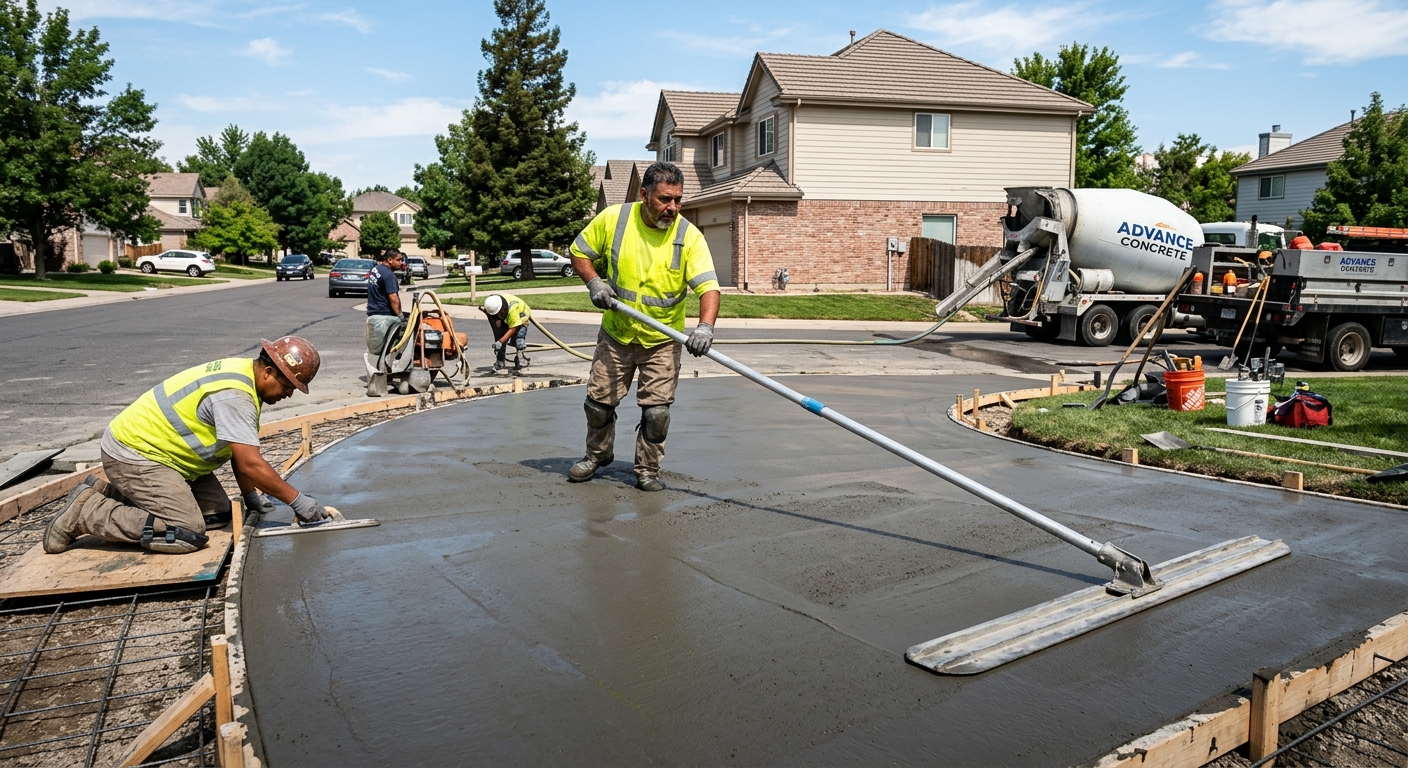
Concrete work options and costs in South Arm
Concrete contractors in South Arm, British Columbia are busiest on driveways, patios and foundations because this area’s homes typically need durable flatwork that can handle our wet coastal conditions and the Lower Mainland–Southwest freeze–thaw cycles. With a local population of 7,503 (Statistics Canada, 2021 Census), South Arm is a smaller market, so scheduling can be tighter when neighbouring cities are busy. Most homeowners looking for new or replacement flatwork are dealing with established neighbourhood streets where upgrades are common after years of freeze–thaw scaling and minor settling. In practice, the most in-demand concrete work is often for detached-home properties, which aligns with the region’s mix of housing stock that uses front driveways and rear yards extensively.
Prices in the Lower Mainland–Southwest corridor are shaped by a shallow but real frost depth (commonly planned around about 450 mm / 18"). That means footings, piers and thickened edges are installed below that level to protect against frost heave, and exterior slabs are built with proper drainage and air-entrained mixes. Coastal-wet weather also affects labour and curing: prolonged rain, cool nights, and high humidity can slow production and add the cost of blankets, sealers, and longer cure times. This is why two quotes can differ even when the finish looks similar—one may include deeper base prep, better mix specs, and correct jointing.
For example, in popular pockets such as the Baynes Sound/Portions of South Arm area, driveways and backyard patios tend to see steady demand from homeowners planning landscaping upgrades and improved drainage. Below is a clear comparison of typical options so you can line up apples-to-apples before you ask for your detailed quote.
| Application |
Typical Size |
Key Spec |
Finish Option |
Price Range |
| Concrete driveway (standard broom finish) |
400 sq. ft. |
Air-entrained mix, compacted base, control joints |
Broom finish, saw-cut joints |
$18,000–$28,000 |
| Exposed aggregate driveway |
400 sq. ft. |
Higher cement paste quality, proper curing and wash timing |
Exposed aggregate with sealer |
$22,000–$33,000 |
| Stamped concrete driveway or patio |
300 sq. ft. |
Air-entrained mix, reinforcement as required, integral colour |
Stamp pattern with release + sealer |
$19,000–$36,000 |
| Plain concrete patio or walkway |
250 sq. ft. |
Drainage slope, compacted granular base, joints |
Float + light broom or trowel finish |
$16,000–$26,000 |
| Garage floor (interior slab) |
480 sq. ft. |
Vapour barrier (if required), reinforcement, proper thickness |
Broom or smooth finish (as specified) |
$18,000–$30,000 |
| Foundation footings (structural, below frost) |
Per project (typical 1–2 storey) |
Excavate to design depth below frost, forms + rebar |
Structural concrete |
$20,000–$40,000 |
Prices are estimates only and vary by project scope, site access and material selection.
What affects the price of concrete work in South Arm
In South Arm and across the Lower Mainland–Southwest, two contractors can quote the “same” driveway and still be off by 30–50%. The big reason isn’t just labour—it’s the engineered details that protect concrete from our wet winters, cool nights and repeated freeze–thaw cycles. Local practice typically assumes exterior work must resist frost heave, so footings and thickened edges are placed below a design frost depth (commonly planned around 450 mm / 18"). On top of that, saturated soils and drainage issues mean base prep usually includes compacted granular and careful slope/drainage work. If one quote includes less granular depth or fewer joints, you may see premature cracking or scaling later.
Colder regions in British Columbia and parts of the province with deeper frost planning can push costs up because excavation and winter protection become more involved, but even within the Lower Mainland–Southwest we still pay for durability specs. Exterior slabs generally require air-entrained concrete mixes, proper control jointing, and longer curing windows. De-icing salts also speed surface spalling—so sealer and correct curing become part of “doing it right,” not an optional upgrade.
In South Arm, small site differences can move pricing noticeably: tighter access for a concrete truck may require more labour for forming and placement, and soft or wet subgrade can increase granular base and compaction time. If you’re comparing finishes, stamped concrete can land higher than broom-finish concrete; for example, a broom-finished driveway may fit typical bands like $18–$28 (per sq. ft.-equivalent pricing backbone), while stamped or decorative options often run toward $22–$36 because of colour, stamps, and more careful finishing. On older properties where drains were added later (or not at all), the drainage correction work can become a larger portion of the budget than homeowners expect—sometimes adding hundreds to thousands depending on excavation and disposal.
| Price Factor |
Why It Matters |
Cost Impact |
| Frost line depth — determines footing depth and form height |
Prevents frost heave and cracking at the foundation interface |
Higher excavation and forming; can move structural costs significantly |
| Site preparation — excavation, grading, compacted granular base |
Bad base leads to settlement and voids under slabs |
More granular and compaction time increases quote |
| Reinforcement — rebar or wire mesh requirement |
Helps control cracking and supports load distribution |
Added material + labour for tying/spacing |
| Mix design — air-entrainment and compressive strength spec |
Air content and strength improve freeze–thaw durability |
Premium mix and tighter batching/control |
| Finish type — broom vs. stamped vs. exposed aggregate |
Finishing method affects timing, labour, and material usage |
Stamped/exposed typically costs more than broom-finished flatwork |
| Pour size and concrete truck access to site |
Placement time and handling affects final quality |
Tighter access can increase labour and equipment needs |
| Cold-weather curing precautions — heating and blankets |
Protects strength gain when nights are cool and humid |
Blankets/thermal protection add daily costs |
| Control joint pattern and sealing cost |
Joints reduce random cracking; sealing improves salt/scaling resistance |
More saw-cut precision and a sealer step increases scope |
Permits & regulations in British Columbia
In British Columbia, structural concrete work—such as footings, foundation walls, grade beams, and other load-bearing structural elements—typically requires a building permit. For many projects, engineered drawings are reviewed as part of the permit process, because reinforcement layouts and foundation dimensions must meet structural requirements. Concrete flatwork like driveways, patios, and walkways often does not need a permit by itself, unless your project affects lot grading, drainage, or impervious surface coverage limits, or involves work near a municipal right-of-way. Always confirm with the local authority before you break ground.
Before you hire anyone for South Arm work, verify the contractor’s coverage and readiness. Step-by-step: (1) ask for their BC business licence/registration details (and confirm you’re dealing with the entity you’d contract with), (2) request a current certificate of liability insurance listing you as a certificate holder where applicable, and (3) confirm WSBC/WCB coverage for workers. A reputable contractor should provide these documents quickly and without pressure.
Next, ask for references on similar-scale projects in the Lower Mainland–Southwest and request photos that show base prep and jointing, not just finished surfaces. That’s often where quality shows up—and where most warranty disputes begin.
Getting concrete right in South Arm's freeze-thaw climate
Concrete failures in South Arm usually come down to one of five things: weak or poorly prepared base, missing or incorrect air-entrainment, poor joint design, inadequate curing, and lack of sealing against de-icing salts. Our Lower Mainland–Southwest conditions mean the ground can saturate, then shift through cool periods with freeze–thaw cycles. When moisture gets into the slab or surrounding soils and the concrete isn’t engineered to handle it, you can see scaling, spalling and random cracking.
To spec the job correctly, start with base preparation: excavate to a depth that supports the right slab thickness and slope, then install a compacted granular sub-base sized to the frost protection requirements for your design. Next is mix design: use air-entrained concrete with a target air content in the range of 5%–7% for exterior flatwork, plus a minimum 32 MPa compressive strength spec (as applicable to your engineered design). Third, control joints should be planned to limit random cracking—especially on wider driveways and long patios. Fourth, curing matters: plan for at least 7 days of proper curing conditions, using blankets or curing protection if nights are cool. Finally, sealing with a penetrating sealer should be applied after full cure (commonly around 28 days) to repel salt and reduce surface deterioration.
Here’s where price differences are justified: if a broom-finish patio is quoted “cheap,” it may omit proper air-entrainment or reduce base prep depth. Skipping those can cost less upfront but leads to repairs sooner—often turning a $16–$26 band project into repeated patching. A stamped driveway can cost more (often toward the $22–$36 backbone) because it requires extra finishing steps and careful curing control, but when sealed and jointed correctly, it holds up better under our coastal-wet, freeze–thaw conditions.
| Spec |
Why It Matters in South Arm |
What to Ask For |
Impact if Skipped |
| Compacted granular base (depth?) |
Prevents settlement and helps drain away moisture before freeze–thaw |
Granular depth to design, compacted in lifts, with drainage slope |
Cracks, rocking slabs, and premature scaling |
| Air-entrained concrete mix (target air %?) |
Air voids give room for expansion during freezing |
Air content targeted at about 5%–7% for exterior flatwork |
Spalling/scaling, especially with wet cycles and salts |
| Compressive strength (MPa rating) |
Strength gain affects durability and surface wear |
Minimum 32 MPa (confirm with your mix design sheet) |
Surface damage and reduced long-term performance |
| Control joints (spacing per ACI guidelines) |
Controls where cracks form so they don’t wander |
Joint plan for your dimensions; saw-cut timing and sealing plan |
Random cracking and water intrusion at edges |
| Minimum 7-day curing period |
Curing drives strength development in cool, humid, rainy stretches |
Protected curing plan; blankets/heaters if temperatures drop |
Lower strength, surface scaling, and higher maintenance risk |
| Penetrating sealer (when applied after cure) |
Reduces water and salt penetration in a coastal-wet environment |
Penetrating sealer applied after full cure (commonly ~28 days) |
More spalling risk and faster appearance deterioration |
How to choose a concrete work contractor in South Arm
Start with verification. In British Columbia, ask for proof of the contractor’s legitimacy and coverage: confirm their business registration, request a current certificate of liability insurance (and verify the policy date isn’t expired), and confirm WSBC/WCB coverage for workers. If a contractor can’t provide documents quickly or provides outdated paperwork, treat that as a serious red flag—especially on excavation-heavy jobs like foundations and footings.
Next, get 2–3 itemised written quotes. Don’t accept only a lump sum—ask for a breakdown of excavation/grading, granular base and compaction, reinforcement (rebar/wire mesh), concrete supply, forming, finishing, control joints, curing protection, and sealing. For South Arm sites, it’s also important to check what’s included for disposal of excess material and whether permit pull (if required for structural work) is handled or excluded. A clear quote prevents surprises when truck access is limited or if the subgrade needs extra stabilization.
Warranty should be clear: workmanship warranty length, whether it covers hairline cracking or only major failures, and whether product/manufacturer warranties apply. Also ask whether the warranty is transferable if you sell the home. For payment, avoid paying more than 10–15% upfront. Use a holdback until the job is fully complete and surfaces have been cured and sealed as specified. Finally, insist on a timeline in writing—start date, concrete pour date, and completion target—because in the Lower Mainland–Southwest, rain delays and cure protection can change schedules quickly.
- Request proof of liability insurance and verify the coverage amount is current.
- Confirm WSBC/WCB coverage for workers (ask for documentation).
- Ask for at least 3 references on driveways/patios or footings at similar scope.
- Insist on itemised pricing (base prep, reinforcement, concrete supply, finishing, curing).
- Confirm control joint spacing and when joints will be cut.
- Ask for the air-entrainment spec and minimum compressive strength (MPa).
- Clarify curing plan for cool nights and rainy periods (blankets/sealers included?).
- Verify sealing type (penetrating vs topical) and application timing after cure.
- Check disposal and trucking access assumptions (who hauls away spoil?).
- Confirm whether rebar/wire mesh is included and at what placement (mid-depth, cover).
- Read exclusions: what happens if subgrade is unstable or water is found?
- Use a payment schedule with a holdback until final acceptance.
Concrete red flags in South Arm include: quotes that don’t mention air-entrainment or joints, “cheap” pricing that skips base depth/compaction details, contractors who avoid discussing curing blankets or sealing timing, lack of proof of insurance/WSBC coverage, and contracts that treat cracking as “normal” without specifying the workmanship warranty or joint plan.
Frequently asked questions — concrete work in South Arm
What is the difference between concrete and cement?
Concrete is the full building material: cement plus water and aggregates (crushed rock and sand), often with admixtures like air-entrainment for durability. Cement is only one component inside concrete—what chemically reacts with water to form strength. In South Arm, British Columbia, the “big” practical difference is that exterior concrete needs the right mix design for our wet coastal conditions and freeze–thaw cycles. A contractor may say they use “good cement,” but what matters to performance is the air content target (commonly 5%–7% for exterior flatwork) and the compressive strength spec (for example, minimum 32 MPa). If those aren’t addressed in your quote, your driveway or patio is more likely to scale or spall over time.
How much does concrete work cost in South Arm?
In South Arm, pricing typically tracks the Lower Mainland–Southwest bands for the kind of flatwork or structure you’re building. For concrete driveways and slabs, homeowners commonly see the backbone range of about $18–$28 (per sq. ft.-equivalent in budgeting), while plain patios and walkways often land around $16–$26. Stamped and decorative work is usually higher—often around $22–$36—because it includes integral colour, stamps, and additional finishing steps. Your final price can move with base prep depth, reinforcement requirements, site access for the concrete truck, and the curing/blanketing plan for cool or rainy weather. Always ask for an itemised quote so you can compare scope line-by-line, not just totals.
How deep must footings be for South Arm's frost line?
South Arm is in the Lower Mainland–Southwest where frost planning is shallow compared with interior or northern BC, but you still must build below the design frost depth to prevent frost heave. Local code/design practice often assumes a frost depth around 450 mm / 18", meaning footings and thickened edges are placed below that depth. In practical terms, structural drawings should specify the exact depth, width, and reinforcement. If the site has challenging soils or drainage issues, engineered requirements may increase excavation or require additional foundation measures. For structural concrete in British Columbia, this kind of foundation detail is usually addressed through permitting and engineered drawings, so the “right” depth should come from your project’s design rather than guesswork.
Why does concrete crack in South Arm and how is it prevented?
Concrete commonly cracks in South Arm due to a combination of shrinkage, temperature swings, and moisture movement through saturated soils during freeze–thaw cycles. Even if the concrete doesn’t move much, it shrinks as it cures, and without a planned restraint and joint strategy it can crack randomly. Prevention is mainly about control joints, proper base prep, and correct mix design. Exterior flatwork should use air-entrained concrete (commonly 5%–7% air content target) and have saw-cut control joints placed to limit cracking to predictable lines. Proper drainage and a well-compacted granular base also reduce settlement-driven cracking. Finally, curing and sealing matter: poor curing lowers strength development, and without sealing, de-icing salts can accelerate surface deterioration.
Stamped vs broom-finish concrete — cost difference?
Stamped concrete in South Arm generally costs more than broom-finish because it’s a multi-step process: integral colour, stamp set-up, careful finishing timing, texture release materials, and usually enhanced sealing. If you’re budgeting using the regional backbone, broom-finish concrete flatwork often falls in the $18–$28 range, while stamped and decorative work is commonly in the $22–$36 range. The exact difference depends on whether the contractor includes reinforced base build-up, correct air-entrainment and jointing, and whether sealing is included as a dedicated step after full cure. A key point: the cheaper “decorative look” option usually cuts corners on base prep or joint plan, which can lead to cracking and early wear under our wet freeze–thaw climate.
When is the best time to pour concrete in South Arm?
For South Arm and the Lower Mainland–Southwest, the best timing is when you can manage curing temperatures and avoid prolonged heavy rain during placement and early set. Mild winters help, but cool nights and frequent coastal wet weather can still cause surface issues if curing protection isn’t used. Most contractors aim for weather windows with stable temperatures and forecastable conditions, then use curing blankets/heating if needed to support strength gain. If you’re scheduling a driveway, patio or walkway, ask your contractor how they handle rain, humidity, and cold snaps—this isn’t “nice to have”; it affects long-term durability. For foundation footings (structural work in British Columbia), scheduling is also tied to inspections and the permit/design timeline.