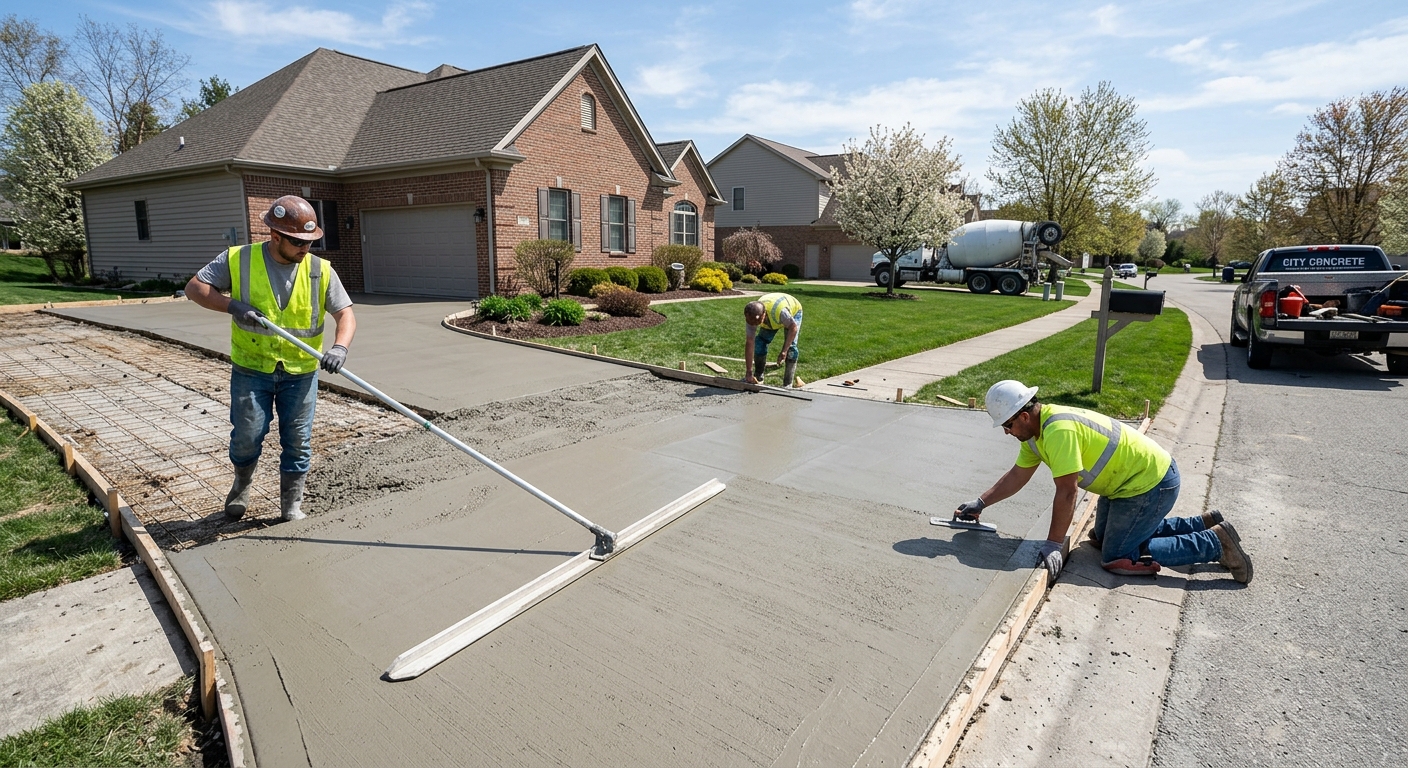
Concrete work options and costs in Keith-Lynn
Concrete work in Keith-Lynn is mostly driven by the day-to-day realities of Lower Mainland–Southwest construction: mild winters with a shallow frost depth, plus coastal-wet weather that brings frequent freeze–thaw cycling, saturated soils, and long damp curing periods. Keith-Lynn is a small community (population 2,595 per Statistics Canada, 2021 Census), so the trades that do flatwork well can book up quickly when rain windows and concrete deliveries align.
Most residential concrete projects here are attached to the kinds of homes people actually build and renovate in the Lower Mainland–Southwest corridor—especially the large proportion of single-detached properties that often call for new driveways, patios, and foundation repairs. The local market also tends to see a lot of infill and replacement work around busy streets and older lots where drainage and base condition aren’t perfect.
In this region, your costs are shaped by specs that protect against frost heave and scaling. Typical practice assumes a frost depth around 450 mm / 18", so contractors place footings, piers, and thickened edges below that. For exterior slabs, air-entrained concrete and correct control joints are critical because surface damage can start even when the average winter feels “mild.” You’ll also often see longer curing and extra surface protection—curing blankets, sealers, and scheduling around prolonged rain—on driveways and patios in Keith-Lynn and nearby areas like the Fraser Highway corridor.
Below is a practical side-by-side comparison of common options so you can match what you want to what your quote should include.
| Application |
Typical Size |
Key Spec |
Finish Option |
Price Range |
| Concrete driveway (standard broom finish) |
400 sq. ft. (approx. 20' x 20') |
Reinforced slab, air-entrained mix, control joints |
Broom finish, simple edging |
$18,000–$28,000 |
| Exposed aggregate driveway |
400 sq. ft. (approx. 20' x 20') |
Air-entrained mix, proper cure + aggregate exposure |
Exposed aggregate with light sealer |
$22,000–$36,000 |
| Stamped concrete driveway or patio |
300 sq. ft. (approx. 15' x 20') |
Air-entrained mix, integral colour or stain system |
Stamping with release + seal coat |
$16,000–$30,000 |
| Plain concrete patio or walkway |
200 sq. ft. (approx. 10' x 20') |
Compact base, air-entrained mix, joints |
Smooth or light broom finish |
$3,200–$5,200 |
| Garage floor (interior slab) |
500 sq. ft. (approx. 20' x 25') |
Vapour control, reinforced slab, proper sub-base |
Plain broom or smooth trowel |
$8,500–$15,000 |
| Foundation footings (structural, below frost) |
Varies by design |
Footings below frost depth, reinforced per engineer |
Construction-grade concrete |
$3,000–$7,500 |
Prices are estimates only and vary by project scope, site access and material selection.
What affects the price of concrete work in Keith-Lynn
In the Lower Mainland–Southwest, it’s common to see quotes for the “same” concrete job swing by 30–50% across British Columbia. The difference usually isn’t just the concrete—it’s the engineering and construction details that address our climate: frost depth allowances, freeze–thaw protection, drainage and base preparation, mix design (air-entrainment), and how long crews must wait between rain and proper curing conditions.
Frost line depth and freeze–thaw cycles dictate almost every spec in this region. Exterior slabs and thickened edges need to be built to perform through repeated wetting and cooling, and footings must extend below the design frost depth (in coastal BC it’s often treated around 0.5–1.2 m depending on conditions). That means more excavation, more forming, and often higher disposal and hauling costs on tougher lots. Air-entrained concrete is also standard for exterior work to survive freeze–thaw cycling and to limit surface scaling. When temperatures drop, contractors may need cold-weather curing precautions—heating, insulating blankets, and scheduling adjustments—which add labour and equipment costs.
De-icing salt accelerates surface spalling if the slab wasn’t spec’d and sealed correctly. That’s why sealing (typically applied after cure) and correct control joint detailing matter.
Concrete costs can rise fast in Keith-Lynn when: the soil is saturated and the base must be rebuilt with deeper compacted granular, the driveway requires thicker edges and stronger reinforcement, or truck access is tight (more time means more crew hours). Costs may be lower when the base already meets grade, sub-drainage is sound, and you choose a simpler finish—so comparing a plain patio around $16–$26 per sq. ft.-type band versus stamped options (often $22–$36 in the stamped/decorative band) helps you see what you’re paying for. For perspective, foundation footings commonly run around the $200–$350 band per linear foot depending on scope and reinforcement needs, and those specs go hand-in-hand with frost protection.
| Price Factor |
Why It Matters |
Cost Impact |
| Frost line depth |
Determines footing depth and form height needed to prevent heave |
More excavation and forming where deeper frost protection is required |
| Site preparation |
Excavation, grading, drainage, and compacted granular base affect slab performance |
Wet or poor soils increase labour, hauled fill, and compaction time |
| Reinforcement |
Rebar or wire mesh helps control cracking and supports loads |
Material and tying time; mesh/wire can be cheaper than rebar cages |
| Mix design |
Air-entrainment and strength targets support freeze–thaw durability |
Exterior air-entrained mixes and testing add incremental cost |
| Finish type |
Broom vs. stamped vs. exposed aggregate requires different labour and materials |
Stamped/exposed typically costs more than standard finishes |
| Pour size and concrete truck access to site |
Equipment access controls how quickly the crew can place and finish |
Pump/extra logistics increase price; easy access reduces it |
| Cold-weather curing precautions |
Heating blankets and controlled curing protect strength gain in cool weather |
Extra equipment rental and labour time in shoulder seasons |
| Control joint pattern and sealing cost |
Joints reduce random cracking; sealing helps repel salts and moisture |
More layout time and sealer materials, but fewer early failures |
Permits & regulations in British Columbia
In British Columbia, structural concrete work generally requires a building permit, and municipalities often expect engineered drawings for foundations such as footings, foundation walls, and grade beams. If your project touches structural elements—adding/altering a foundation, underpinning, replacing load-bearing walls, or building a basement/retaining wall—assume permitting and plan review will be required. For concrete flatwork (driveways, patios, walkway slabs), permits usually aren’t required unless the work changes lot grading, impacts impervious surface limits, or affects something tied to municipal right-of-way conditions. In Keith-Lynn, that means you should still confirm with the local authority if your driveway ties into drainage swales, modifies runoff paths, or involves sidewalk/curb interfaces.
Step-by-step, here’s how homeowners in Keith-Lynn can verify a contractor before any breaking ground:
- Confirm whether the scope needs a permit (contractor should tell you clearly which parts are structural vs flatwork).
- Request the contractor’s certificate of liability insurance and verify the coverage limits on the COI.
- Ask for proof of coverage through WSBC/WCB (and confirm the account is active for the project period).
- Look for references on similar-scale jobs in the Lower Mainland–Southwest, ideally with photos showing base prep and joints.
- If engineered drawings are involved, confirm they will follow the engineer’s rebar placement and inspection requirements.
If something is unclear—especially permit responsibility, inspections, or exclusions—get it in writing before scheduling.
Getting concrete right in Keith-Lynn's freeze-thaw climate
Concrete fails in Keith-Lynn most often through a combo of moisture and temperature cycling: saturated base material, insufficient air-entrainment, weak surface curing, and poor drainage. Even with a shallow frost line (typical coastal BC practice around 450 mm / 18" for design context), freeze–thaw cycling can still lift and crack slabs if the base isn’t properly prepared or if water can’t drain away. The fix is to spec and build the system in layers—base, mix, joints, curing, and sealing—so the slab can tolerate wetting and cooling.
For base preparation, insist on compacted granular to the correct depth for local soil and frost protection, with attention to subgrade drainage. For mix design, exterior flatwork should use air-entrained concrete (commonly around 5–7% air content for exterior exposure) and a minimum 32 MPa compressive strength specification. Then control joints must be laid out so cracking happens where you can live with it, not randomly through the field of the slab. Curing matters just as much: allow a minimum 7 days under proper conditions, using curing blankets or protective measures when nights are cool or rain keeps the slab damp. After cure, a penetrating sealer applied around 28 days post-pour helps repel de-icing salts and moisture-driven scaling.
When you’re comparing quotes, ask the same technical questions: “What’s the air content target?”, “What’s the compressive strength spec?”, “How many days of cure are you planning and how do you protect in cool/rainy windows?”, and “What joint spacing are you following and where?” Spalling is the classic outcome of inadequate air-entrainment and rushed curing—especially on driveways where salts and puddling are common.
On cost justification: choosing a stamped driveway (decorative band often $22–$36) can be worth it when you want a finished look that still uses the same structural base and air-entrained mix. In contrast, paying extra for decorative colour while skipping proper drainage and joints is money wasted—those failures typically show up first within the first winter cycle.
| Spec |
Why It Matters in Keith-Lynn |
What to Ask For |
Impact if Skipped |
| Compacted granular base (depth?) |
Controls settlement and prevents moisture build-up under the slab |
Confirm subgrade condition and granular depth; compaction testing method |
Uneven settling, voids, and early cracking |
| Air-entrained concrete mix (target air %?) |
Helps concrete survive freeze–thaw cycling and scaling from wet exposure |
Target air content (typically 5–7% for exterior flatwork) and mix confirmation |
Spalling and surface scaling in winter seasons |
| Compressive strength (MPa rating) |
Strength gain supports long-term durability under vehicle loads and weather |
Minimum 32 MPa compressive strength spec for the slab |
Reduced durability, increased wear and cracking risk |
| Control joints (spacing per ACI guidelines) |
Shapes where cracks occur, limiting random cracking and water paths |
Joint spacing plan and sawing timing |
Random cracking and water infiltration |
| Minimum 7-day curing period |
Ensures strength development in coastal humidity and cool nights |
How you protect from rain/cold and the curing timeline |
Weak surface, dusting, and durability loss |
| Penetrating sealer (when applied after cure) |
Repels moisture and de-icing salts that drive scaling |
Sealer type and application timing (about 28 days post-pour) |
Faster surface breakdown and staining |
How to choose a concrete work contractor in Keith-Lynn
Choosing the right concrete contractor in British Columbia is mainly about risk control: who will build to spec, handle wet-season scheduling, and stand behind workmanship. Start by verifying licensing and coverage. In practice for homeowners, you want to see clear proof of current liability insurance (request a COI and check the coverage limits and project details) and confirmation that the contractor carries WSBC/WCB coverage for the workers on your site. If a contractor can’t produce documents quickly, that’s a red flag.
Next, get 2–3 itemised written quotes—not just a lump sum. Look for a breakdown that separates labour, materials, base prep (excavation, grading, granular), reinforcement (mesh or rebar), concrete supply, forming, finishing, saw-cut control joints, curing methods, and sealing (if included). Also clarify exclusions: is disposal included? Is permit pulling included if structural work is involved? Are vehicle loads and driveway approach/threshold adjustments included? These details can swing total cost by tens of percent even when the finish looks similar.
Warranty should be in plain language: ask for a workmanship warranty length and what it covers (cracks due to shrinkage vs structural failures, for example), and whether any product/manufacturer warranty is included and transferable if you sell the home. Payment schedule matters too—never pay more than 10–15% upfront, and hold back part of the payment until you’ve received final grading confirmation, curing documentation (if any), and sign-off on completion.
Finally, get a start date and completion estimate in writing. In Keith-Lynn, rain timing can shift schedules, but good contractors communicate early and protect the pour with blankets and proper curing plans.
- Request current COI (liability insurance) and verify it matches your address and project.
- Ask for WSBC/WCB clearance/coverage proof for the period of work.
- Confirm whether a permit is required for your scope and who pulls it.
- Insist on itemised pricing: base prep, reinforcement, finishing, joints, curing, and sealing.
- Ask for the air-entrained mix confirmation for exterior work.
- Ask the compressive strength spec (e.g., minimum 32 MPa for slab work).
- Verify control joint spacing and when joints will be cut/sawn.
- Confirm curing plan for cool nights and rainy stretches (blankets, tarps, re-wetting controls).
- Ask how they handle drainage at the driveway approach and runoff direction.
- Check references for similar Keith-Lynn conditions (wet soil, vehicle load, older base).
- Use a schedule: start date, pour day, finishing day, curing/sealer timing (if included).
- Keep a holdback until the final clean-up, grading, and joint completion are verified.
Concrete red flags in Keith-Lynn include: vague scope details (“we’ll handle the base”), no mention of air-entrainment for exterior slabs, skipping saw-cut control joints or cutting them too late, promising “cured enough” for early sealing/paving, and taking large deposits (over 15%) without a written completion plan.
Frequently asked questions — concrete work in Keith-Lynn
How long does a concrete driveway last?
In Keith-Lynn and the Lower Mainland–Southwest, a well-built concrete driveway commonly lasts 20 to 30 years, sometimes longer, because the climate is mild but the exposure is tough: coastal moisture and freeze–thaw cycling still attack slabs that weren’t built for durability. The biggest longevity drivers are base preparation, correct air-entrainment for exterior exposure, and control joints that manage shrinkage cracking. If de-icing salts are used, sealing after cure (often around 28 days) can help slow scaling and surface spalling.
Cost-wise, you’ll often see driveway options land in the concrete flatwork bands—standard driveways are commonly priced roughly around $18–$28 (per sq. ft.-type equivalent depending on scope), while decorative options like stamped work typically run higher. If a quote is significantly cheaper than the market, ask what was reduced: base depth, reinforcement, or air-entrainment.
What is air-entrained concrete and why does it matter here?
Air-entrained concrete is mixed to include tiny, evenly distributed air bubbles that give freezing water a place to expand without breaking the concrete. That matters in British Columbia’s coastal freeze–thaw cycles because exterior slabs can stay damp, then cool down repeatedly, stressing the surface. Without proper air entrainment, you can get scaling and spalling—flaking at the top—especially on driveways and entry slabs exposed to salt.
In practical quote terms for Keith-Lynn, ask for the target air content (commonly 5–7% for exterior flatwork) and confirm the slab mix is air-entrained. Also ask how joints will be cut and when curing blankets (or protection) will be used in cool or rainy weather. A “looks fine today” slab can still fail early if it wasn’t protected through that first winter cycle.
How do I prepare the base for a concrete slab?
For Keith-Lynn, base preparation is the foundation of a good result. Contractors typically excavate to remove unsuitable topsoil, then place and compact a granular sub-base in lifts to reach the designed elevation. The goal is a stable platform that drains well so water doesn’t stay under the slab during wet periods. If the subgrade is saturated or soft, good contractors rebuild the base deeper and add proper drainage measures before any forming begins.
Ask your contractor what granular depth they plan and how they’ll confirm compaction. Also confirm whether they’re including proper grading to shed water away from the slab. If they skip this or can’t describe it, that’s one of the fastest ways to end up with settled edges or cracked slabs—regardless of whether the surface finish is broom, stamped, or exposed aggregate.
How do I compare concrete quotes?
To compare quotes fairly in Keith-Lynn, make sure each one includes the same scope—not just the same finish name. Ask for an itemised breakdown covering excavation and haul-off (if needed), granular base and compaction, reinforcement type, concrete mix (air-entrainment and strength spec), forming, finishing method, control joint layout and timing, curing approach, and sealing (if included). If one quote mentions sealing and the other doesn’t, that difference can affect how the driveway handles salts and moisture.
Watch for price outliers versus the typical bands. For example, driveway pricing in this tier is often roughly $18–$28, while stamped/decorative options commonly land in the $22–$36 range depending on design and size. If a quote is far lower, ask what they reduced—base prep is the most common cut.
Can concrete be poured in cold weather in Keith-Lynn?
Yes, concrete can be poured in cold weather in Keith-Lynn, but it has to be managed correctly. British Columbia’s coastal conditions can mean cool nights and damp days; even when it’s not “freezing hard,” concrete can struggle to develop strength if it’s too cold or exposed to rain before curing. That’s why good contractors plan for cold-weather precautions like insulating blankets, controlled heating where necessary, and careful scheduling so the pour can set and cure safely.
When quoting, ask what they do if temperatures drop during the curing window. Also ask for the curing timeline—minimum 7 days under proper conditions is a common expectation. A contractor who pours and walks away without a protection plan is more likely to deliver a weaker surface that won’t perform well through the next rain-and-freeze cycle.
How do I maintain concrete in Keith-Lynn's freeze-thaw climate?
Maintenance in Keith-Lynn is mostly about keeping water and salts off the surface and catching issues early. Start with sealing: a penetrating sealer applied after the slab has properly cured (often around 28 days post-pour) helps repel moisture and reduce scaling from de-icing salt. Keep an eye on joint lines—control joints are designed to crack slightly, but they should stay clean and not filled with debris that traps water.
For daily care, rinse off loose salts after winter storms when feasible, and avoid over-salting small patches. If you see early spalling or scaling, address it sooner; waiting usually turns small surface damage into deeper deterioration. Finally, don’t ignore drainage. If the driveway develops puddles, the fix is often grading or drainage correction, not just surface cleaning.