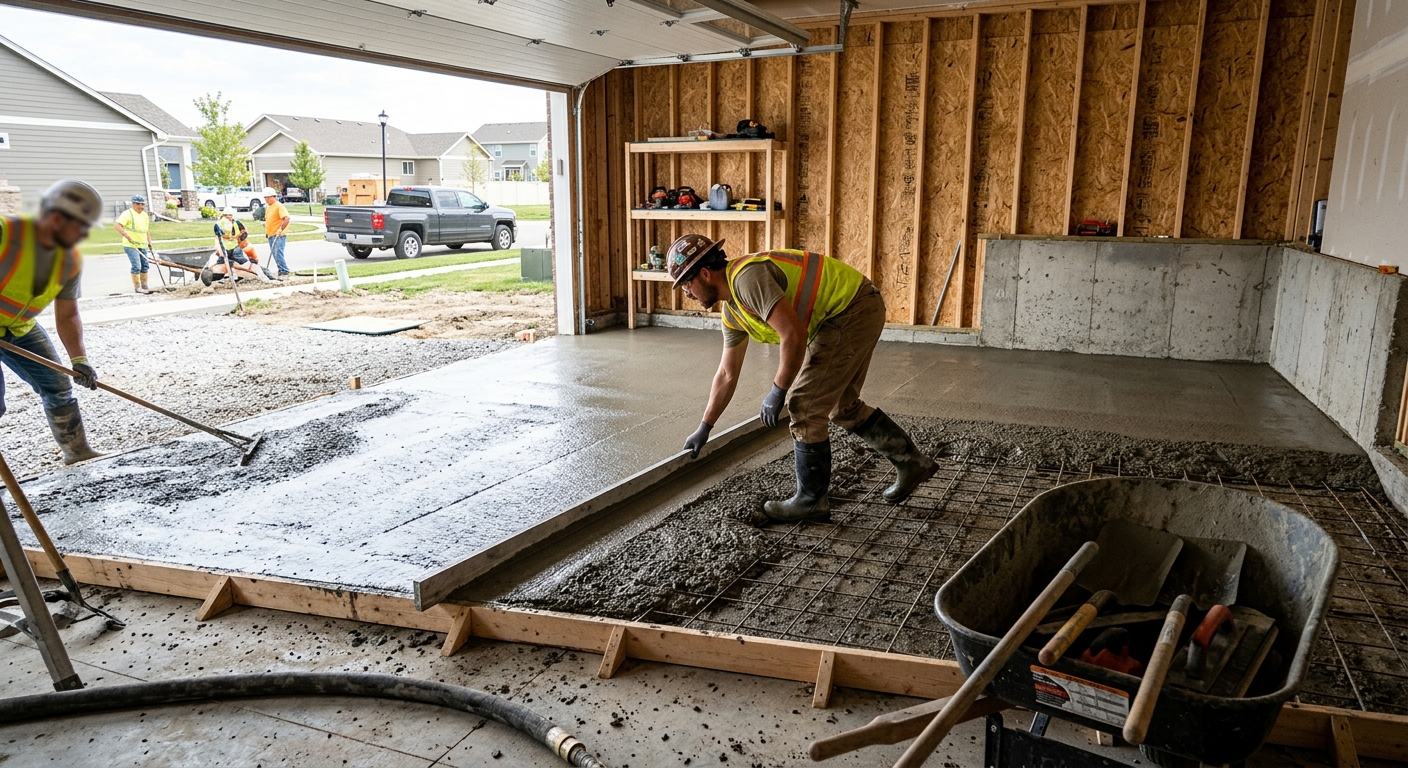
Concrete work options and costs in Saanichton
Concrete work in Saanichton is popular because homeowners want durable, low-maintenance flatwork—especially as many properties sit on well-used driveways, walkways, and patios leading to older neighbourhoods around Royal Bay and Central Saanich border areas. With a small community profile of 1,565 residents (Statistics Canada, 2021 Census), you’ll notice contractor availability is still good, but crews can book out quickly when rain and cold snaps overlap. In practice, most concrete demand comes from single-detached neighbourhoods where driveways and backyard patios are common projects, and the “visible” value of a properly finished slab matters.
On Vancouver Island and the Coast, pricing is shaped by a relatively shallow frost line paired with frequent freeze–thaw cycles. That combination drives the need for footings and foundation work to sit below frost, plus air-entrained concrete mixes for exterior slabs to reduce scaling and cracking. Contractor costs can also move around based on site access (narrow lanes, steep driveways, or long hose distances) and weather scheduling, since cool, saturated soil slows strength gain and increases protection time. Even though our winters are milder than interior BC, repeated wetting and freezing means we typically plan for curing protection, drainage details, and control joints—so costs reflect not just the pour, but the prep and weather management around it.
Below is a practical comparison of common Saanichton options and realistic price ranges. Use this table as a baseline, then we can tighten numbers once we know your site conditions and finish preferences.
| Application |
Typical Size |
Key Spec |
Finish Option |
Price Range |
| Concrete driveway (standard broom finish) |
400 sq. ft. |
Air-entrained mix, compacted base, control joints |
Broom finish |
$6,400–$10,000 |
| Exposed aggregate driveway |
400 sq. ft. |
Air-entrained mix, retarder + washing, sealed surface |
Exposed aggregate |
$8,500–$12,000 |
| Stamped concrete driveway or patio |
300 sq. ft. |
Air-entrained mix, colour hardener, release agent, sealing |
Stamped (texture + colour) |
$7,000–$10,500 |
| Plain concrete patio or walkway |
250 sq. ft. |
Air-entrained mix, proper grading and drainage |
Broom or light trowel |
$3,500–$5,500 |
| Garage floor (interior slab) |
500 sq. ft. |
Vapour barrier, thickened edges, standard reinforcement |
Smooth/screeded finish |
$9,000–$14,500 |
| Foundation footings (structural, below frost) |
Approx. 200 linear ft. |
Below design frost, rebar cage, proper granular bedding |
Structural concrete + reinforcing |
$10,000–$18,000 |
Prices are estimates only and vary by project scope, site access and material selection.
What affects the price of concrete work in Saanichton
In Saanichton, you can easily see quote differences of 30–50% for what looks like the “same” concrete job. Across Vancouver Island and Coast communities, and compared with other parts of British Columbia, contractors price for different site conditions and different weather risk. A few factors can swing labour, material selection, and even cure time: Vancouver Island’s freeze–thaw cycles push exterior durability details, while narrower access and drainage requirements can add hours of excavation, forming, and rework. If you’re comparing a bare-bones bid to one that includes proper base, air-entrainment, and protection, the real scope isn’t identical.
First, frost line depth and freeze–thaw cycles dictate every exterior spec. Even where frost doesn’t run as deep as in interior provinces, footings must still extend below the design frost depth to prevent heave and uneven settlement. Second, all exterior slabs should use air-entrained concrete to survive repeated freezing and thawing—otherwise you’re gambling on long-term scaling and random cracking. Third, cold-weather curing precautions can add cost: insulating blankets, scheduling around cold snaps, and sometimes heating the pour area. Finally, if de-icing salt is used, sealing becomes more than “nice to have,” because de-icing salts accelerate spalling and surface deterioration.
Examples of how local conditions change pricing in Saanichton: (1) Wet, saturated soils after heavy rain can require subgrade remediation and thicker granular base, often moving a patio or walkway toward the higher end of the $14–$22/sq. ft. range. (2) Narrow driveways in older lanes can increase formwork time and rebar placement, pushing driveway costs toward the $16–$25/sq. ft. band even without decorative upgrades. (3) If your foundation excavation needs extra shoring or haul distance, foundation work can expand quickly—especially on sites with older landscaping and drainage paths.
| Price Factor |
Why It Matters |
Cost Impact |
| Frost line depth |
Determines footing depth and form height |
Higher excavation and concrete volume; can add significant structural cost |
| Site preparation |
Excavation, grading, compacted granular base |
More cut/fill and base material increases labour and haulage |
| Reinforcement |
Rebar or wire mesh requirement |
Changes material cost and placement time; increases overall structural reliability |
| Mix design |
Air-entrainment and compressive strength spec |
Better durability mix costs more but reduces failures from freeze–thaw exposure |
| Finish type |
Broom vs. stamped vs. exposed aggregate |
Decorative systems add colour, tools, and sealing; expect higher pricing |
| Pour size and concrete truck access to site |
Impacts batching, pump/boom use, and crew time |
Pump access or extra transfers increase labour and equipment charges |
| Cold-weather curing precautions |
Heating and blankets |
Adds material and monitoring; protects strength gain in cool/cold snaps |
| Control joint pattern and sealing cost |
Limits cracking and protects against de-icing salts |
Proper jointing and sealer are often small line items with big durability payback |
Permits & regulations in British Columbia
In British Columbia, many homeowners assume all concrete work is “permit-free,” but the reality is more specific. Structural concrete work—such as footings, foundation walls, and grade beams—typically requires a building permit and is often tied to engineered drawings that the municipality reviews. That’s because those components support the building load path and must meet safety and inspection requirements.
Concrete flatwork (driveways, patios, and walkways) usually does not require a permit unless it triggers conditions like lot grading changes, impacts impervious surface coverage limits, affects stormwater drainage, or touches the municipal right-of-way (for example, works that involve boulevard/curb areas). In Saanichton, drainage details matter—so if your pour alters how water flows toward foundations or neighbouring properties, expect the need for clarification before excavation.
Step-by-step, verify your contractor’s credentials in British Columbia before work starts: (1) Ask for their liability insurance and confirm the certificate includes your address/jobsite; (2) ask for proof of WCB coverage (WCB/worker coverage) and confirm it’s active; (3) check whether they are registered/licensed as required for their trade category and scope; (4) request clearance letters or updated documents when possible; (5) review references on similar-scale concrete flatwork or structural projects in the region. Then confirm permitting responsibility in writing—who pulls permits, what’s included in the price, and what inspections are expected.
Getting concrete right in Saanichton's freeze-thaw climate
Concrete fails in Saanichton mainly when water gets into weak spots and the freeze–thaw cycle expands it. The result is often surface scaling, random cracking, and—most visibly—spalling from poor air-entrainment. The climate on Vancouver Island and the Coast may be less extreme than interior BC, but repeated wetting and freezing still demands correct base preparation, correct mix, and correct curing protection.
To spec the job correctly: (1) Base preparation matters first. Build a compacted granular sub-base to the design depth for local soil and frost considerations, then ensure proper drainage so water doesn’t pond under the slab. (2) Mix design: for exterior flatwork, require air-entrainment at roughly 5–7% air and a minimum 32 MPa compressive strength (more on projects that are exposed to heavier loads or stricter engineering specs). (3) Control joints should be placed to manage shrinkage cracking—spacing needs to be consistent with ACI-style practice for the slab thickness and exposure. (4) Curing: plan for at least 7 days curing under proper conditions, with extra protection (blankets/insulation) in cool weather so the concrete gains strength before it’s exposed to harsher conditions. (5) Sealing: a penetrating sealer applied after cure helps repel moisture and reduces the impact of de-icing salt.
Ask contractors these practical questions: “What air-entrained mix are you using for exterior slabs?” “What’s your control joint spacing plan for my thickness?” “How will you protect the slab if night temperatures drop?” and “Will you include sealer, and when will it be applied?” A $300–$700 difference for sealing and proper mix selection is often justified compared with the cost of patching scaled edges or replacing a prematurely deteriorating walkway.
| Spec |
Why It Matters in Saanichton |
What to Ask For |
Impact if Skipped |
| Compacted granular base (depth?) |
Controls settlement and reduces water pumping under freeze–thaw |
State granular depth and compaction method; include drainage grade |
More cracking, uneven surface, and premature scaling |
| Air-entrained concrete mix (target air %?) |
Improves freeze–thaw durability and reduces spalling risk |
Target 5–7% air for exterior flatwork; confirm mix design paperwork |
Spalling and scaling within a few winters |
| Compressive strength (MPa rating) |
Ensures adequate strength gain for cool-weather conditions |
Minimum 32 MPa (or higher if required by scope/engineering) |
Surface wear, cracking, and reduced long-term durability |
| Control joints (spacing per ACI guidelines) |
Manages shrinkage cracks in a predictable pattern |
Joint spacing based on slab thickness and design; show joint layout |
Random cracking through the slab and costly repairs |
| Minimum 7-day curing period |
Strength gain is slower in cool, saturated weather |
Protection plan for cold snaps; confirm curing method |
Surface damage and reduced durability |
| Penetrating sealer (when applied after cure) |
Repels moisture and helps protect against de-icing salt exposure |
Apply after cure (commonly around 28 days) and confirm product type |
Faster deterioration, staining, and edge breakdown |
How to choose a concrete work contractor in Saanichton
Choosing the right concrete contractor in Saanichton starts with verification. In British Columbia, ask for three things before any work begins: (1) liability insurance—request a current certificate of insurance showing active coverage; confirm the named insured and that the coverage is appropriate for the jobsite; (2) WCB coverage—get proof their workers are covered; (3) confirm any licensing/registration requirements for their scope (and that they can legally perform the type of work you’re hiring for). If they can’t provide documents promptly, that’s a major warning sign.
Next, get 2–3 itemised written quotes rather than one lump-sum number. An itemised quote should separate labour and materials, and it should clearly list: excavation/grading, granular base, reinforcement (if needed), concrete mix specification (including air-entrainment for exterior), forming, finishing, control joints, curing protection, and sealing scope (if applicable). Make sure exclusions are stated: disposal, trucking/short-pour logistics, repairs to damaged subgrade, permit handling, and any required traffic/boulevard considerations.
Warranty and payment structure should be clear. Look for a workmanship warranty length and confirm whether product/manufacturer warranties apply to the concrete and any specialty coatings/sealers. Don’t pay more than 10–15% upfront, and ask for a holdback until completion and walk-through. Get a start date and an end date estimate in writing, and ask how they’ll manage rain days or cold snaps typical for Vancouver Island and the Coast.
- Ask for proof of liability insurance with your address/jobsite noted where possible.
- Confirm WCB coverage for their workers.
- Require an itemised quote (labour + materials) and compare like-for-like thickness.
- Verify concrete mix spec for exterior work (air-entrainment + strength rating).
- Confirm granular base depth, compaction method, and drainage grade.
- Ask how reinforcement will be installed (and when it’s omitted).
- Require control joint layout and spacing based on slab thickness.
- Ask what curing protection they use if nighttime temperatures drop.
- Confirm whether sealer is included and when it will be applied (after cure).
- Check if disposal/haul-away is included in the quote.
- Clarify who pulls any permits if your project affects grading or drainage.
- Review warranty details in writing and ask what triggers exclusions.
Concrete red flags in Saanichton: (1) vague quotes that don’t state air-entrainment or strength, (2) skipping/underbuilding the granular base, (3) refusing to show joint layout or curing plan, (4) pressuring for large upfront payments, and (5) promising “instant hard” scheduling without weather contingencies for freeze–thaw periods.
Frequently asked questions — concrete work in Saanichton
How do I prepare the base for a concrete slab?
For Saanichton projects, base prep is where durability is won or lost. You want proper excavation to the required depth, then a compacted granular sub-base sized for the slab thickness and local soil conditions. The goal is to eliminate soft spots and reduce water movement under the concrete—because moisture plus freeze–thaw is what drives scaling and cracking on Vancouver Island. Ask your contractor what granular depth they’re using, how they’ll compact (in lifts), and how they’ll maintain drainage grade away from foundations. If a site is saturated or has poor fill, you may need subgrade remediation before any pour. A good base prep plan typically keeps exterior pricing closer to the middle of the $14–$22/sq. ft. patio/walkway range by reducing rework and repairs.
How do I compare concrete quotes?
Compare Saanichton quotes like-for-like, not just by total price. Ask each contractor for an itemised breakdown: excavation/grading, granular base depth, reinforcement (if used), concrete mix details (air-entrainment for exterior, strength rating), thickness, forming, finishing, control joints, curing protection plan, and whether sealing is included. Make sure the finish specification matches—standard broom versus exposed aggregate versus stamped systems can swing costs noticeably. For example, decorative stamped work often prices above plain concrete and can land in the $22–$35/sq. ft. territory, while a standard broom driveway may sit around the $16–$25/sq. ft. band. Also confirm inclusions/exclusions: disposal, permit handling (if grading/drainage is affected), and access constraints. If one quote includes proper weather protection and sealer and the other doesn’t, the “cheaper” bid is often not apples-to-apples.
Can concrete be poured in cold weather in Saanichton?
Yes, concrete can often be poured in cold weather in Saanichton, but it depends on temperatures and the contractor’s cure-protection methods. On Vancouver Island and the Coast, the bigger risk is not always extreme cold—it’s cool, wet conditions that slow strength gain and increase vulnerability during the early cure period. A reputable contractor will outline how they protect the slab: insulating blankets, wind protection, and sometimes heating, plus clear limits on how cold is too cold for finishing and curing. For outside flatwork, proper curing is critical because freeze–thaw cycles can damage surfaces if the concrete hasn’t developed enough early strength. Ask how they schedule pours around heavy rain and cold snaps, and confirm they’ll maintain curing for at least the minimum 7 days under appropriate protection.
How do I maintain concrete in Saanichton's freeze-thaw climate?
Maintenance in British Columbia comes down to keeping water from getting in and protecting the surface from de-icing salt exposure. In Saanichton’s freeze–thaw conditions, routine inspection matters: look for hairline cracks, spalling at edges, and surface scaling, especially after the first cold snaps. Sweep and remove grit regularly to prevent abrasion. If you use de-icing chemicals, use them thoughtfully—then prioritize sealing. For exterior slabs, ask whether your contractor recommends a penetrating sealer after the cure period (often around 28 days), because it helps repel moisture and slows salt-driven deterioration. Also keep drainage patterns correct—downspouts and grading should direct water away from the slab. If you maintain joints (when they’re designed for jointing/sealing), you reduce water migration beneath the surface.
What causes concrete to spall in Saanichton winters?
Concrete spalling in Saanichton is commonly tied to freeze–thaw action and moisture getting into the slab. The most frequent cause is inadequate air-entrainment or mix design that doesn’t match exterior exposure. When water enters and freezes, expansion can push off the surface layer, leading to scaling and spalling. Poor or missing curing protection also contributes—if the concrete surface is damaged before it gains early strength, it becomes more porous and vulnerable. Another contributor is insufficient base prep and drainage, which lets water pond and repeatedly wet the same areas. If your driveway or walkway experiences heavy salt exposure near entrances, sealing becomes even more important. Ask specifically: “What air-entrained concrete mix are you using, and what target air content is in the mix?” That one spec is often the difference between a driveway that survives multiple seasons and one that starts failing early.
What is rebar and when is it required in British Columbia?
Rebar is reinforcing steel that helps control cracking and improves structural capacity by adding tensile strength. In British Columbia, whether rebar is required depends on the engineering design and the project scope—especially slab thickness, load conditions (like vehicle traffic), and soil conditions. Many exterior flatwork slabs use reinforcement (rebar or mesh) when required by design or when homeowners want a longer service life for driveways and thicker slabs. For structural elements like foundations and footings, reinforcing is typically expected because those components carry building loads; those works typically require permits and engineered drawings. For non-structural patios, some contractors reinforce based on thickness and site conditions. The best way to know for your Saanichton job is to ask for the engineered spec (if required) or the contractor’s written justification tying reinforcement to slab thickness, base preparation, and intended use.