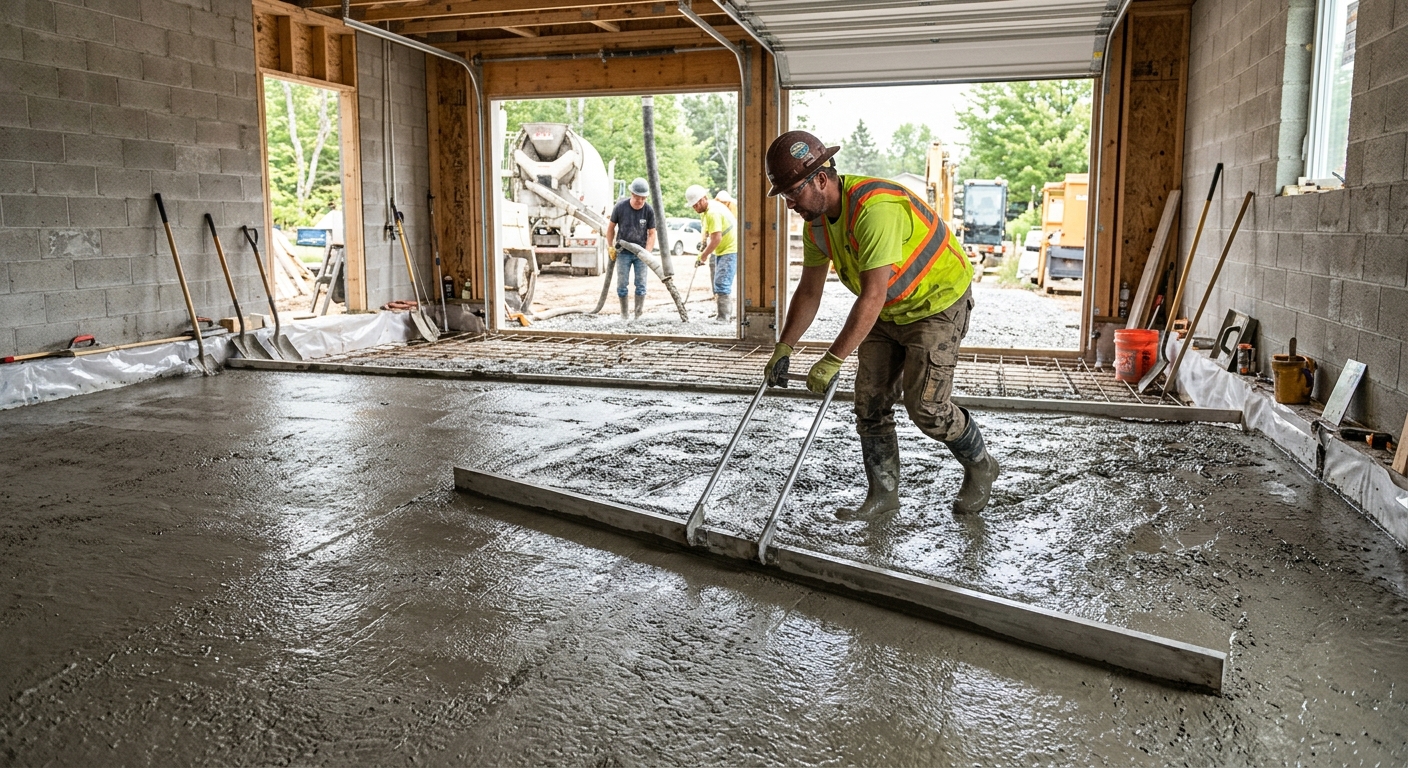
Concrete work options and costs in Blind Bay
In Blind Bay, concrete is a go-to choice for driveways, patios, walkways and foundation work because it handles the area’s coastal-wet weather better than many surface alternatives. Blind Bay’s housing base is anchored by single-detached homes, and with a population of 2,369 (Statistics Canada, 2021 Census), you’ll often see repeated rebuild and renovation cycles—especially along Sorrento area access routes and lakeside properties where seasonal ground moisture matters. In the Lower Mainland–Southwest, mild winters and a shallow frost line still require proper frost protection: local practice commonly assumes frost depth around 450 mm / 18". That means exterior footings and thickened edges are placed below that zone to reduce freeze–thaw heave risk, and exterior slabs are typically air-entrained to manage scaling and surface pop-outs. Rainy stretches also affect scheduling and curing; contractors often plan pours around cool nights and high humidity, using curing blankets, sealers, and longer cure times to reach durability targets—this can add labour and indirect costs compared with drier stretches of the year.
Trade demand tends to run highest in established neighbourhood pockets closer to the main road corridors, where residents value quick, low-maintenance access improvements before wet seasons. Because availability and seasonal workload can tighten in these windows, quotes can differ even for similar projects. Use the table below to compare typical applications and finish levels, then we can refine numbers after a site visit and base/drainage assessment.
| Application |
Typical Size |
Key Spec |
Finish Option |
Price Range |
| Concrete driveway (standard broom finish) |
400–600 sq. ft. |
Air-entrained exterior mix; compacted granular base; control joints |
Broom finish |
$18,000–$28,000 |
| Exposed aggregate driveway |
400–600 sq. ft. |
Air-entrained mix; proper base drainage; broom/aggregate curing plan |
Exposed aggregate (washed) |
$22,000–$34,000 |
| Stamped concrete driveway or patio |
300–500 sq. ft. |
Air-entrained mix; thicker edges/thickened perimeter where required |
Stamped + colour hardener + release agent |
$22,000–$40,000 |
| Plain concrete patio or walkway |
200–350 sq. ft. |
Compacted granular base; air-entrained; control joints |
Plain finish (steel trowel optional) |
$16,000–$26,000 |
| Garage floor (interior slab) |
300–500 sq. ft. |
Vapour barrier where applicable; reinforced slab; floor finish |
Float/steel trowel |
$14,000–$24,000 |
| Foundation footings (structural, below frost) |
Varies by design |
Reinforced concrete; footing depth below design frost |
Structural concrete (not decorative) |
$200,000–$350,000 |
Prices are estimates only and vary by project scope, site access and material selection.
What affects the price of concrete work in Blind Bay
In the Lower Mainland–Southwest region, it’s common to see the same concrete project priced 30–50% apart across BC and even between similar BC communities. The reasons usually aren’t the “concrete” itself—they’re the base prep, frost protection, mix specs, and the seasonal realities that drive labour time. Frost depth and freeze–thaw cycles dictate every key spec in this market: exterior footings must extend below the design frost depth (about 450 mm / 18" in local Lower Mainland–Southwest practice). Where slabs and edges sit closer to the frost zone, contractors must increase thickness, improve drainage, and use air-entrained mixes so water can freeze without immediately damaging the concrete surface. Also, exterior slabs require air-entrained concrete and control joint detailing to limit cracking and scaling in repeated wet/dry cycles.
When the weather turns damp and cold at night, crews may need curing blankets and longer curing windows so the slab reaches design strength before it’s exposed to moisture and temperature swings. De-icing salt use on driveways adds another layer: sealing is strongly recommended to slow surface deterioration. In Blind Bay, where wet ground conditions can persist around the lake and low-lying areas, excavation and granular base work can take longer than homeowners expect—especially if the subgrade is soft or saturated. A standard broom-finish driveway might land closer to the $18–$28 pricing band when base prep is straightforward. If you upgrade to stamped or decorative work, the finish labour and materials (forms, texture mats, release, and careful finishing) can push toward the $22–$36 range for decorative concrete—worth it when you want curb appeal and you’re committed to proper sealing and jointing.
Example: If a patio base is already well-drained and firm, you may see lower costs within the $16–$26 band. If drainage is poor and the contractor must over-excavate to reach stable granular and install additional drainage, that “foundation-level” effort shows up directly in the final number—even for an otherwise simple walkway.
| Price Factor |
Why It Matters |
Cost Impact |
| Frost line depth |
Determines footing depth and form height to reduce frost heave |
More excavation and rebar if below-frost elevations are deeper than assumed |
| Site preparation |
Excavation, grading, and compacted granular base control settlement and drainage |
Soft/saturated soils increase haul, disposal, and compaction time |
| Reinforcement |
Rebar or wire mesh helps control cracking and supports loads |
Material and labour add cost, especially for thicker slabs |
| Mix design |
Air-entrainment and target strength improve freeze–thaw durability |
Specialty load/air settings can raise per-yard concrete costs |
| Finish type |
Broom vs. stamped vs. exposed aggregate changes labour and materials |
Stamped and decorative work increases crew time and consumables |
| Pour size and concrete truck access to site |
Access affects pumping/placing speed and labour planning |
Long hose runs or pump requirements raise equipment and labour |
| Cold-weather curing precautions |
Heating/blankets protect early-age concrete in cool nights |
Adds blanket rentals, labour hours, and schedule constraints |
| Control joint pattern and sealing cost |
Jointing manages shrinkage cracks; sealing helps resist salt scaling |
Better joint layout and sealer add line items but reduce long-term repairs |
Permits & regulations in British Columbia
In British Columbia, structural concrete work—such as footings, foundation walls, grade beams, and other load-bearing elements—typically requires a building permit, and municipalities often expect engineered drawings to support the design. For concrete flatwork like patios, walkways and driveways, a permit is usually not required on its own unless the work affects lot grading, changes drainage patterns, increases impervious surface coverage beyond local thresholds, or impacts municipal right-of-way areas (for example, work near a roadway edge or within specified setbacks). Because rules can differ based on site conditions, always confirm with the local authority before breaking ground.
Before you hire anyone in Blind Bay, verify the contractor is properly covered. Step one is licences/registration: check whether the contractor is registered/eligible for the scope you’re hiring (and whether their company name matches their documentation). Step two is liability insurance: request a current Certificate of Insurance showing general liability limits appropriate for concrete work. Step three is worker coverage: in BC, ask for proof of coverage for their workers through the applicable worker protection program (and/or the clearance letter they can provide). Step four is evidence of experience: request references and photos from similar-size exterior slabs and foundation work in coastal-wet conditions. If they can’t clearly explain the curing and drainage approach, that’s a red flag—especially in a freeze–thaw environment where water management protects the slab.
Getting concrete right in Blind Bay's freeze-thaw climate
Concrete failures in Blind Bay usually trace back to water, temperature swings, and early-age protection. When exterior concrete isn’t designed for repeated freeze–thaw cycles, it can spall (flaking) and scale, even if it initially looks fine. The fix starts with proper base preparation: use compacted granular sub-base to the depth needed for the local soil and frost protection strategy, then grade for drainage so water doesn’t pond near the slab edge. Next, spec the mix correctly—exterior flatwork should use air-entrainment (commonly 5–7% air content for durability in freeze–thaw exposure) and a minimum 32 MPa compressive strength so the concrete resists surface damage rather than only meeting “looks good on day one.”
Control joints matter too: they’re your planned crack locations, so spacing must be designed for the slab size and movement. Then comes curing. In the Lower Mainland–Southwest, cool nights and high humidity can slow strength gain; use a minimum 7-day curing period under proper conditions. Finally, apply penetrating sealer after cure (often 28 days post-pour) to help repel de-icing salts and reduce the rate of salt-driven surface deterioration.
Here’s where costs can make sense: choosing air-entrained mix and correct base/drainage is typically a small portion of the total, but it prevents costly rework. For example, a broom-finish driveway can land near the $18–$28 band when the base is well-prepped. If decorative/stamped work is chosen, you might be closer to the $22–$36 range—just ensure your air-entrainment, joints, and sealing are included. Skimping on those items is how expensive finishes end up failing early.
| Spec |
Why It Matters in Blind Bay |
What to Ask For |
Impact if Skipped |
| Compacted granular base (depth?) |
Supports the slab and reduces moisture and settlement under freeze–thaw movement |
Granular type and compacted depth for your site conditions |
Premature cracking, uneven settlement, and accelerated edge breakdown |
| Air-entrained concrete mix (target air %?) |
Protects against freeze–thaw scaling and spalling in exterior exposure |
Target air content (commonly 5–7% for exterior flatwork) |
Surface scaling and flaking, especially where de-icing salt is used |
| Compressive strength (MPa rating) |
Ensures adequate strength development and durability through seasonal cycles |
Minimum 32 MPa compressive strength spec |
Lower long-term performance and higher risk of surface damage |
| Control joints (spacing per ACI guidelines) |
Controls where cracks form as the slab shrinks and expands |
Joint spacing plan matched to slab dimensions |
Random cracking and wider repairs later |
| Minimum 7-day curing period |
Builds early strength so concrete survives cool, wet conditions |
Concrete cure method and protection plan if nights are cold |
Weak early concrete and higher failure risk |
| Penetrating sealer (when applied after cure) |
Helps repel water and de-icing salts that drive surface deterioration |
Penetrating sealer application schedule (commonly after 28 days cure) |
Faster scaling and more frequent maintenance |
How to choose a concrete work contractor in Blind Bay
Start by confirming the contractor’s standing in British Columbia. Ask for their company registration/licence details for the work you’re hiring, and request proof of liability insurance showing current coverage and sufficient limits for a concrete project. Then verify worker protection coverage—ask for documentation for their crews and whether they can provide a clearance letter upon request. If a contractor can’t produce these documents promptly, or their insurance certificate doesn’t match the business doing the work, move on.
Next, get 2–3 itemised written quotes rather than one lump-sum number. You want labour and materials broken down by excavation/site prep, granular base, reinforcement (if any), concrete supply/mix design, forms, finishing, joints, curing materials, and sealing. Read the exclusions carefully: is permit pulling included (when needed), is disposal included for over-excavation, and what happens if rain delays the pour? A solid contractor will state assumptions (access limitations, soil condition, drainage expectations) up front.
For warranty, ask for two things: a workmanship warranty length and the product/manufacturer warranty (if products like sealers or admixtures are specified). Clarify whether any warranty is transferable if you sell the home. For payment, never pay more than about 10–15% upfront; hold back a portion until the job is complete and cleaned up. Finally, get a written timeline: proposed start date, pour day, curing protection windows, and completion estimate.
- Provide your scope in writing: size, thickness, finish, and jointing plan
- Ask if they include air-entrainment for exterior work
- Confirm granular base type and compaction requirements
- Request examples/photos of similar projects in coastal-wet BC conditions
- Verify liability insurance is current and names the right contracting party
- Ask for worker coverage proof and/or clearance letter
- Check whether reinforcement is included where required
- Confirm whether sealing is included and the application timing
- Ask about rain-day scheduling and cure protection blankets
- Make sure disposal/haul-off for excess material is specified
- Get a schedule that includes cure time before traffic/load
- Ensure the quote states what’s not included (hidden “extras” reduce trust)
Concrete red flags in Blind Bay include: no clear discussion of air-entrainment and joints, vague quotes that don’t address base drainage/compaction, promises to “pour in any weather” without cure protection, refusal to show insurance/coverage documents, and missing line items for sealing and curing materials that protect the slab in our wet-freeze cycles.
Frequently asked questions — concrete work in Blind Bay
Stamped vs broom-finish concrete — cost difference?
In Blind Bay and across the Lower Mainland–Southwest, stamped concrete typically costs more than a standard broom finish because it adds materials (release agents, colour hardener or integral colour) and labour time for texturing and pattern alignment. A straightforward broom-finish driveway usually falls around the $18–$28 band depending on size and base prep complexity. Stamped concrete is often closer to the $22–$36 band, especially when crews need extra attention to thickness, edge detailing, and controlled joint locations to keep the pattern clean and the slab durable. The best comparison isn’t only the finish: make sure both options include air-entrainment, proper control joint spacing, and the same approach to curing and sealing—those details protect against freeze–thaw scaling in our coastal-wet conditions.
When is the best time to pour concrete in Blind Bay?
The best time is typically late spring through early fall when crews can manage curing temperatures and limit prolonged rain. In British Columbia, you can still pour in shoulder seasons, but contractors may need extra protection—curing blankets, heaters, and longer cure windows—so the concrete reaches design strength before it’s hit with cool nights and heavy moisture. In Blind Bay, schedule flexibility matters because wet stretches can slow base drying and increase site prep time (especially around drainage areas). If you’re aiming for exterior flatwork like a driveway or patio, plan around dry weather forecasts and allow time for curing. A reliable contractor will give you a pour date and a written cure/protection plan rather than assuming the forecast will cooperate.
How long does concrete take to cure?
Concrete curing has two “timelines”: strength gain and readiness for use. For exterior flatwork in Blind Bay, crews typically treat curing as at least 7 days of proper protection under suitable conditions, because early-age concrete is sensitive to temperature and moisture. Full design strength often takes longer, and that’s why finishing steps like sealing are usually scheduled after cure—commonly around 28 days post-pour for penetrating sealers. Weather in the Lower Mainland–Southwest can slow strength development (cool nights and high humidity), so curing may require blankets or other protection to stay on schedule. Ask your contractor how they’ll protect the slab during the first week and when you can safely drive on it or place heavy loads.
Do I need a permit for concrete work in British Columbia?
In British Columbia, structural concrete work—such as footings, foundation walls, and grade beams—typically requires a building permit and often engineered drawings reviewed by the municipality. For concrete flatwork like patios, walkways, and driveways, a permit is often not required unless the work changes lot grading, affects drainage, increases impervious surface coverage beyond local limits, or impacts the municipal right-of-way. Because Blind Bay situations vary by lot grading and proximity to road/servicing, the safest approach is to confirm with the local authority before the pour. Also, confirm the contractor has proper coverage and can document the scope clearly in case a permit is required for your specific site.
Concrete vs pavers for a patio in Blind Bay?
Concrete and pavers can both work well in Blind Bay, but freeze–thaw and drainage are the deciding factors. Pavers offer a more “repairable” approach—individual units can be swapped if a section settles. Concrete is usually simpler and faster to install with fewer joints, but it must be correctly designed with compaction, air-entrainment, and control joints to prevent cracking and scaling. On cost, plain concrete patios and walkways commonly land in the $16–$26 band depending on size and base prep. Decorative finishes (stamped) can increase cost. If your patio area has poor drainage or you expect heavy water flow toward the slab, pavers sometimes tolerate minor movement better, but only if the bedding and edging are done properly. Either way, ask how they manage water and what sealing (if any) is included for concrete.
How long does a concrete driveway last?
A well-built concrete driveway in British Columbia can last 25–40 years or more, but that depends heavily on base preparation, mix design, jointing, and ongoing surface protection. In Blind Bay’s freeze–thaw and coastal-wet conditions, the biggest drivers are water management (compacted granular base and drainage) and the use of air-entrained concrete so the surface doesn’t scale when freezing cycles hit. De-icing salt can accelerate spalling, which is why penetrating sealer applied after cure—commonly around 28 days—matters. In practical terms, homeowners who invest around the typical broom-finish driveway band (often $18–$28 for many projects) and insist on air-entrainment, correct joints, and sealing generally see much better longevity than those who choose only for price. Ask to see prior driveway work and the contractor’s approach to curing and sealing.