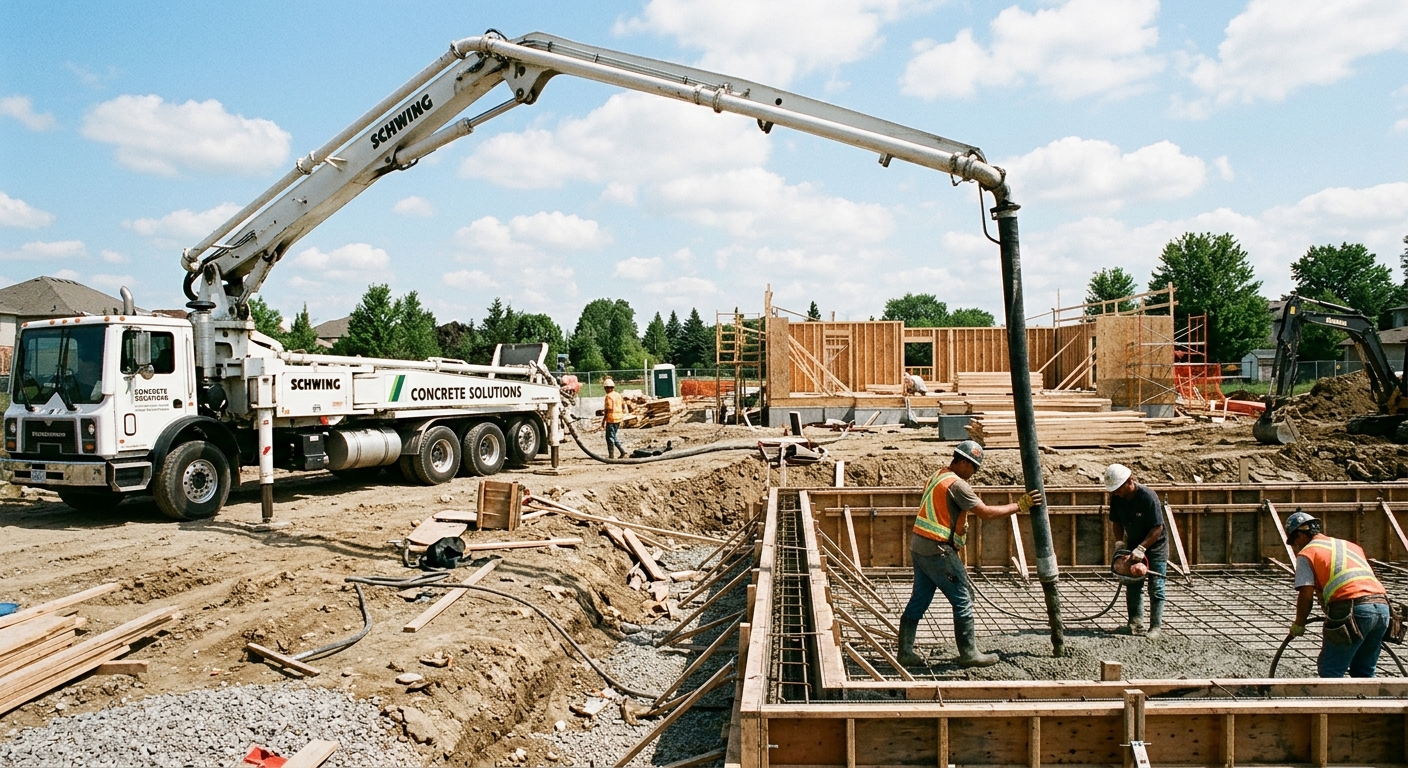
Concrete work options and costs in Meadowbrook
Concrete work in Meadowbrook is mostly about building the right slab for local soil, rainfall, and freeze–thaw. Meadowbrook’s population was 1,969 in 2021 (Statistics Canada, 2021 Census), and the neighbourhood mix is very consistent with what contractors see across the Lower Mainland–Southwest: many homes are single-detached, which drives steady demand for driveways, patios, and walkways. In fact, communities like this tend to concentrate concrete flatwork where families expand kitchens, add garages, or update aging outdoor surfaces—often in areas such as the Meadowbrook core and surrounding residential streets where access is straightforward for trucks and finishing crews.
Lower Mainland–Southwest pricing is shaped by a shallow but real frost concern and frequent freeze–thaw cycles. Even with mild winters, we still design footings and thickened edges below the local design frost depth (commonly assumed around 450 mm / 18") to limit freeze heave. Wet weather also affects scheduling and curing: cool nights, high humidity, and periods of rain can slow set and surface finishing, so contractors plan around protected curing and longer cure windows for durable driveways and patios. That’s why you’ll often see quotes differ—same “square footage” can cost meaningfully more if the base, air-entrainment, and cure protection have to be upgraded due to soil conditions and the timing of the pour.
Use the table below as a practical comparison starting point for Meadowbrook, then we’ll cover what actually moves your quote up or down.
| Application |
Typical Size |
Key Spec |
Finish Option |
Price Range |
| Concrete driveway (standard broom finish) |
400–600 sq ft |
Compacted granular base, air-entrained mix, control joints |
Broom finish |
$7,200–$14,000 |
| Exposed aggregate driveway |
400–600 sq ft |
Compacted base, air-entrained mix, proper curing for aggregate exposure |
Exposed aggregate |
$10,800–$18,000 |
| Stamped concrete driveway or patio |
300–500 sq ft |
Compacted base, air-entrained mix, integral colour, sealer |
Stamped with colour and sealer |
$8,500–$17,500 |
| Plain concrete patio or walkway |
200–400 sq ft |
Compacted base, air-entrained mix, edging and joints |
Float/trowel with light broom texture |
$3,200–$10,400 |
| Garage floor (interior slab) |
400–600 sq ft |
Vapour barrier (if required), reinforcement, proper curing |
Standard interior finish |
$7,800–$18,000 |
| Foundation footings (structural, below frost) |
Varies by foundation plan |
Excavation, forms, rebar, and pour below design frost depth |
Structural concrete (no decorative finish) |
$9,000–$25,000 |
Prices are estimates only and vary by project scope, site access and material selection.
What affects the price of concrete work in Meadowbrook
Even when two contractors price the “same” concrete job in Meadowbrook, the final cost can vary by 30–50% in the Lower Mainland–Southwest and across British Columbia. The biggest reasons are site prep complexity and how the contractor designs for freeze–thaw, drainage, and curing. A low quote often assumes a standard base and a basic mix; a higher quote may include deeper excavation, more granular bedding, better drainage, extra reinforcement, and curing protection that’s needed when cool nights and rain delay finishing.
In our region, frost design drives more than just footings. Exterior slabs require specifications that manage freeze–thaw cycles and saturated soils. In coastal BC, designers commonly plan around roughly 0.5–1.2 m of frost depth depending on soil and exposure, and practical field work often aims for footings/thickened edges below the design frost concern (commonly around 450 mm / 18" for many slabs/edges). That means form height, excavation quantity, and rebar placement change your labour and equipment time. Exterior flatwork should also use air-entrained concrete to help reduce scaling and spalling risk. When pours happen in cool weather, crews may need curing blankets and more controlled temperatures, which adds cost. Finally, de-icing salts accelerate surface wear, so sealing after cure is a common durability upgrade.
Here are a few Meadowbrook examples of cost movement. If your driveway subgrade is wet or soft, base prep (extra compacted granular and improved drainage) can add several thousand dollars but prevents settlement and rapid surface deterioration. If you choose stamped concrete at about $22–$36 per sq ft, the stamp mats, labour, integral colouring, and meticulous surface finishing justify the premium versus plain patio pricing. Conversely, a straightforward broom-finished driveway (often closer to $18–$28 per sq ft for typical scopes) can remain near the budget end if access is good and excavation isn’t heavy.
| Price Factor |
Why It Matters |
Cost Impact |
| Frost line depth |
Determines footing depth and form height |
More excavation and rebar length can add thousands on structural work |
| Site preparation |
Excavation, grading, compacted granular base |
Wet/soft soils can increase granular volume and labour time |
| Reinforcement |
Rebar or wire mesh requirement |
Higher-strength steel placement and tie-in time raises material/labour |
| Mix design |
Air-entrainment and compressive strength spec |
Correct air content and design strength can add material cost but reduces failures |
| Finish type |
Broom vs. stamped vs. exposed aggregate |
Decorative work typically increases labour and includes extra steps (colour, texture) |
| Pour size and concrete truck access to site |
Distance to place and number of pours |
Poor access can mean more crew time or multiple truck trips |
| Cold-weather curing precautions |
Heating and blankets |
Often increases costs in shoulder months when nights are cool and damp |
| Control joint pattern and sealing cost |
Controls cracking and protects from salts and moisture |
Sealing plus correct jointing can add a noticeable but worthwhile premium |
Permits & regulations in British Columbia
In British Columbia, structural concrete work generally requires a building permit and often engineered drawings reviewed by the municipality. That means projects such as footings, foundation walls, grade beams, and other below-grade structural elements typically fall under the permit process. For concrete flatwork—like driveways, patios, and walkways—permits are often not required unless your work affects lot grading, stormwater/drainage, impervious surface coverage limits, or the municipal right-of-way. Because by-laws vary by circumstance, always confirm with the local authority before breaking ground.
For contractors, verify you’re protected. Ask for proof of liability insurance and coverage consistent with workers on site (WSIB/WCB). Then, follow this practical checklist: (1) confirm the company’s business details and trade/contracting profile using the province’s online registry tools; (2) request a current certificate of insurance that lists your address (or provides coverage details you can forward to your insurer); (3) obtain a clearance/coverage verification if applicable to their work category; (4) ask for references from similar-size jobs (Meadowbrook driveways and patios, plus at least one foundation/structural project if that’s on your scope).
If a contractor won’t provide insurance documents or tries to quote without clarifying structural vs flatwork permitting needs, treat that as a warning sign.
Getting concrete right in Meadowbrook's freeze-thaw climate
Concrete failures in Meadowbrook typically come from one or more of these: weak base support, incorrect mix design, poor jointing, and curing problems during cool, wet spells. In a freeze–thaw environment, water gets into the surface and micro-cracks; if your concrete doesn’t have the right air-entrainment and the base drains properly, you’ll see scaling and eventual spalling. The Lower Mainland–Southwest market also battles schedule pressure: rain and high humidity can keep surfaces damp longer, and finishing too late (or without curing protection) can reduce surface durability even if the slab looks “fine” at first.
To spec the job correctly, focus on five things. (1) Base preparation: compacted granular to the depth required for your soil and frost protection needs—especially for exterior slabs and driveway edges. (2) Mix design: exterior work should target 5–7% air content (typical field expectation) with minimum 32 MPa compressive strength. (3) Control joints: plan joint spacing so cracking happens where you want it, not randomly through the slab. (4) Curing: plan for at least 7 days under proper conditions; in cool weather, crews often extend protection with blankets to reach strength safely. (5) Sealing: apply a penetrating sealer after the proper cure window (commonly around 28 days) to help repel de-icing salts and moisture-driven deterioration.
Here’s where price differences are justified. A stamped concrete driveway is often priced around the $22–$36 per sq ft band because of colouring, stamps, and careful finishing. But if that premium is paired with correct air-entrained mix, jointing, and curing protection, you’re paying for durability as much as aesthetics. If instead you go “plain” and skip sealer or compromise base prep, you may save upfront (closer to the $18–$28 per sq ft band) and still get premature surface wear in just a few winters.
Ask the right technical questions: “What air content are you targeting for exterior freeze–thaw?” and “What’s your curing plan if it’s cool or rainy the day of the pour?” Those answers usually determine whether you avoid spalling headaches.
| Spec |
Why It Matters in Meadowbrook |
What to Ask For |
Impact if Skipped |
| Compacted granular base (depth?) |
Controls settlement and frost/water movement under the slab |
Granular type and compacted depth to match soil and exposure |
Uneven settling, cracking, and faster deterioration |
| Air-entrained concrete mix (target air %?) |
Reduces scaling and spalling during freeze–thaw cycles |
5–7% air content for exterior flatwork |
Surface scaling/spalling in wet winters |
| Compressive strength (MPa rating) |
Achieves durability and structural reliability |
Minimum 32 MPa for typical exterior work |
Lower strength gain and weaker long-term performance |
| Control joints (spacing per ACI guidelines) |
Manages where and how cracking forms |
Joint layout and spacing designed for your slab dimensions |
Random cracks and difficult-to-fix cold joints |
| Minimum 7-day curing period |
Strength development is slower in cool, damp conditions |
Protection method and cure timeline for the pour date |
Surface damage, weak wear layer, reduced durability |
| Penetrating sealer (when applied after cure) |
Repels moisture and de-icing salt exposure |
Sealer type and application around after proper cure (often ~28 days) |
Accelerated surface wear and staining |
How to choose a concrete work contractor in Meadowbrook
Choosing the right concrete contractor in Meadowbrook starts with verification and clarity. In British Columbia, confirm the contractor’s credentials and protections: (1) check licensing/registration details using the province’s online registry tools relevant to the contractor’s trade category; (2) request a certificate of liability insurance and ensure the policy is current; (3) confirm workers’ coverage consistent with provincial requirements (WSIB/WCB or equivalent coverage depending on the work category). Then ask for references on comparable projects—driveways and patios in the Lower Mainland–Southwest are a good fit because the climate and scheduling challenges are similar.
Next, get 2–3 itemised written quotes. You want a breakdown that separates labour, formwork, excavation/base prep, reinforcement, concrete supply, finishing, curing/blankets (if needed), joints, and sealing (if included). Avoid true lump sums with no scope. Make sure the quote states what’s excluded: disposal of removed material, sawcut timing, and any permit-related items if your job triggers approvals.
Also protect yourself with warranty and payment terms. Ask for the workmanship warranty length and whether any manufacturer warranty (for sealers or membranes, if used) applies and is transferable to you. For payment, never pay more than 10–15% upfront; a holdback until completion (and ideally until sealer cures) is a reasonable expectation. Finally, insist on a written timeline: start date and estimated completion, including weather contingency for curing in Meadowbrook’s damp shoulder seasons.
- Provide a written scope with concrete thickness assumptions and base prep steps.
- Specify exterior air-entrainment and curing protection in cool/rainy conditions.
- Include joint layout (where joints will be cut or formed) and sealing plan.
- Confirm reinforcement details: rebar/wire mesh grade and placement support (chairs/ties).
- List disposal costs for removed soil/asphalt or excavation spoils.
- Describe protection for landscaping and any impacts to existing grading.
- Show how they manage truck access and concrete placement time.
- Use written pricing: labour and materials separated, not one blended line item.
- Provide start and completion dates plus rain-day/curing-weather contingency.
- Include warranty terms in plain language, including what triggers warranty service.
- Ask whether sealing is included and when it will be applied after cure.
- Verify they carry liability insurance and workers’ coverage documentation.
Concrete red flags in Meadowbrook include contractors who (1) won’t discuss air-entrainment for exterior freeze–thaw, (2) quote “thin slabs” without base prep details, (3) ask for large upfront payments, (4) skip control joints or leave joint spacing vague, and (5) can’t provide insurance paperwork or references for similar-size flatwork.
Frequently asked questions — concrete work in Meadowbrook
When is the best time to pour concrete in Meadowbrook?
The best time to pour concrete in Meadowbrook is typically during the milder, drier windows of the year—late spring through early fall—when temperatures support consistent curing and finishing. In the Lower Mainland–Southwest, winters are milder than interior BC, but freeze–thaw and heavy rainfall still affect scheduling. Even a “normal” broom-finished driveway can be priced differently if the contractor expects rain delays or needs curing blankets to protect the slab through cool nights. If your project timeline allows, schedule pours when crews can protect curing for at least 7 days. For homeowners receiving quotes, ask whether the mix is air-entrained for exterior exposure and how the crew will handle damp conditions on the day of placement and for the first week after.
How long does concrete take to cure?
Concrete has two timelines: setting time and curing to gain strength. It typically sets within hours, but meaningful strength development continues for days and weeks. For Meadowbrook exterior work, you should plan for at least a minimum 7-day curing period under proper conditions to support strength gain and reduce surface problems. In cool or rainy weather, crews often extend protection using curing blankets and careful scheduling to reach design strength safely. Even after curing, durability improves over time, and surface treatments like penetrating sealer are commonly applied after cure (often around 28 days) so salts and moisture are kept out longer. When comparing quotes, look for whether curing protection (labour and materials) is included—not just the pour date.
Do I need a permit for concrete work in British Columbia?
In British Columbia, structural concrete like footings, foundation walls, and grade beams generally requires a building permit and may require engineered drawings for municipal review. Concrete flatwork—such as driveways, patios, and walkways—often does not require a permit, unless your project changes lot grading, affects stormwater/drainage, or triggers right-of-way or impervious surface rules. Meadowbrook homeowners should confirm with the local authority before work starts, especially if you’re altering drainage paths or raising/reshaping the yard. A good contractor will tell you whether your scope looks like structural vs flatwork and will coordinate permit responsibilities if applicable. If the quote is missing any mention of approvals when needed, ask directly.
Concrete vs pavers for a patio in Meadowbrook?
Both concrete and pavers can work well in Meadowbrook’s wet, freeze–thaw climate, but they fail differently. Concrete patios (plain or broom-finished) rely on correct base prep, air-entrainment, joints, and curing; when done right, they’re durable and easier to maintain. Pavers can be flexible in the sense that individual units may be replaced if there’s movement, but they depend heavily on proper base compaction and edge restraint to prevent shifting and weed growth. In cost comparisons, plain concrete patios commonly land in the $16–$26 per sq ft band depending on size and site access, while decorative concrete options (like stamping) sit higher. If you want a smoother, uniform finish with fewer gaps to manage, concrete is often the straightforward choice—especially when sealing and jointing are included.
How long does a concrete driveway last?
A well-built concrete driveway in the Lower Mainland–Southwest often lasts many years, and sometimes decades, but the lifespan depends on preparation and detailing. In Meadowbrook’s climate, the driveway’s durability is strongly influenced by air-entrainment, proper subgrade drainage, and control joints. Sealing after the correct cure window helps protect against de-icing salts and moisture-related scaling. If a contractor uses a sound granular base and the right mix, you’re reducing freeze–thaw damage that causes surface spalling. Pricing also reflects this: a broom-finished driveway is commonly budgeted around $18–$28 per sq ft, while exposed aggregate or decorative work will cost more. A lower quote that skips sealing or minimizes base prep may “look fine” at first, then show wear sooner after a few wet winters.
What is air-entrained concrete and why does it matter here?
Air-entrained concrete is a mix designed with microscopic air bubbles that provide space for water to expand when it freezes. That matters in Meadowbrook and across British Columbia’s Lower Mainland–Southwest because freeze–thaw cycles and saturated soils can drive scaling and spalling if the concrete doesn’t have the right air content. Exterior slabs and driveways should typically use air-entrainment (often targeting roughly 5–7% air content for exterior flatwork) so the surface can better resist winter damage. When you ask contractors questions, make sure the quote confirms the air-entrained mix for exterior exposure and not just “standard concrete.” This spec is one of the most important predictors of long-term performance, and it’s also a common reason bids differ by 30–50% when one contractor designs for durability and the other doesn’t.