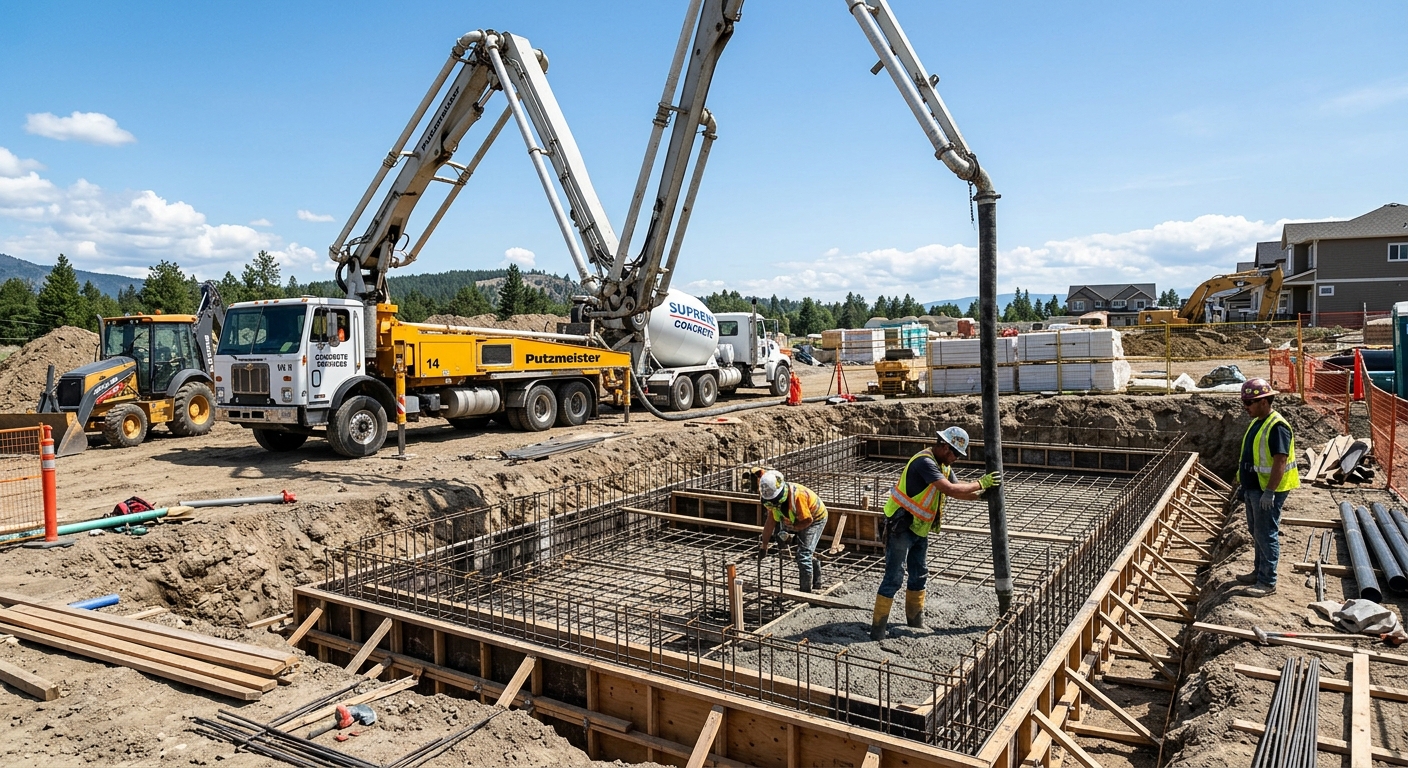
Concrete work options and costs in North Park
North Park, British Columbia is a small community (population 3,725 per the Statistics Canada, 2021 Census) where most homeowners expect concrete flatwork—driveways, patios, and walkways—to handle wet weather and the region’s repeated freeze–thaw cycling. In this part of the Lower Mainland–Southwest, concrete work is especially common in neighbourhoods like North Park / King George area, where older homes and new builds both need durable slab-on-grade surfaces and solid entrances.
We also see steady demand because the local housing mix is dominated by single-detached homes, and that typically means more exterior hardscape and more foundation detailing than townhome or condo properties. Even with mild winters, Lower Mainland–Southwest pricing is driven by a shallow frost-line design assumption (commonly around 450 mm / 18"), plus the fact that saturated soils and coastal rainfall demand careful base prep and drainage. That’s why contractor availability and scheduling can affect cost: after prolonged rain, forming and compaction work slows, and we may need curing blankets and longer cure times to protect the surface.
For homeowners comparing options, the finish choice (broom, exposed aggregate, or stamped) changes material and labour, while structural items (like footing depth below frost) change excavation and forming scope. Use the table below as a practical way to line up typical North Park budgets before you talk to contractors.
| Application |
Typical Size |
Key Spec |
Finish Option |
Price Range |
| Concrete driveway (standard broom finish) |
400–500 sq ft |
4" slab, compacted granular base, air-entrained mix |
Broom finish, simple control joints |
$7,500–$13,500 |
| Exposed aggregate driveway |
400–500 sq ft |
4" slab, air-entrained mix, proper bond/retarder control |
Exposed aggregate (washed surface) |
$10,000–$18,000 |
| Stamped concrete driveway or patio |
300–450 sq ft |
4" slab, air-entrained mix, release agent + base texture |
Stamped pattern with colour hardener/sealer |
$9,500–$16,500 |
| Plain concrete patio or walkway |
200–350 sq ft |
4" slab, compacted base, control joints as needed |
Plain trowel or broom, light edging |
$3,500–$8,500 |
| Garage floor (interior slab) |
300–500 sq ft |
4" slab, vapour control if required, reinforcement |
Float/trowel finish, minimal sealer optional |
$6,000–$14,000 |
| Foundation footings (structural, below frost) |
Per project (often 300–1,000 linear ft) |
Footings set below design frost, reinforced concrete |
Structural formed concrete |
$8,000–$35,000 |
Prices are estimates only and vary by project scope, site access and material selection.
What affects the price of concrete work in North Park
In the Lower Mainland–Southwest, it’s common to see quotes for the “same” job differ by 30–50% across British Columbia because concrete cost isn’t just the slab—it’s what goes underneath and what weather requires. Two contractors can both pour a 4" driveway, but one may include deeper excavation for drainage, higher-quality compacted granular, air-entrained concrete designed for exterior exposure, and longer curing practices for wet/cool conditions. Another may price faster scheduling and less rigorous base prep, and homeowners often pay later through cracking or surface scaling.
The Lower Mainland–Southwest frost depth assumption (commonly around 450 mm / 18") still shapes every exterior foundation detail: footings and thickened edges need to extend below the design frost to prevent frost heave. Exterior slabs should be air-entrained because freeze–thaw cycling plus saturated soils is where scaling and spalling start. In colder regions, contractors face a shorter pour season and add cold-weather precautions like insulating blankets or heating; while North Park is milder than interior/northern BC, cool nights and prolonged coastal rain still affect curing and can add labour for blankets, sealing readiness, and schedule buffer. Also, de-icing salts increase surface damage—so a proper sealer plan matters.
Here are a few concrete examples that move the needle in North Park: a broom-finish driveway priced near the $18–$28 per sq ft band can rise when drainage is reworked or when reinforcement is increased for poor subgrade; stamped concrete that starts in the $22–$36 per sq ft range becomes justified when colour hardener, good release technique, and proper finishing timing are included (otherwise the stamp pattern won’t stay crisp). Older soil conditions and established landscaping can also raise excavation and disposal costs by hundreds to thousands.
| Price Factor |
Why It Matters |
Cost Impact |
| Frost line depth — determines footing depth and form height |
Footings must sit below the design frost to reduce frost heave risk |
Higher excavation/forming can add significant labour and material |
| Site preparation — excavation, grading, compacted granular base |
Proper base creates stable support and limits pumping and settlement |
Extra hauling/compaction time often increases the budget |
| Reinforcement — rebar or wire mesh requirement |
Reinforcement helps control cracking in slabs exposed to movement and loads |
Material cost plus placement labour |
| Mix design — air-entrainment and compressive strength spec |
Air-entrainment improves freeze–thaw durability of exterior concrete |
Higher-spec concrete typically costs more per cubic yard |
| Finish type — broom vs. stamped vs. exposed aggregate |
Texture demands different labour, timing, and specialty materials |
Stamped and exposed aggregate usually carry higher labour/material premiums |
| Pour size and concrete truck access to site |
Large placements may need staging; narrow access can require smaller loads |
Truck/placement logistics can raise cost |
| Cold-weather curing precautions — heating and blankets |
Cool nights and damp conditions can slow strength gain and surface protection |
Additional labour and rental/blanket materials |
| Control joint pattern and sealing cost |
Joints guide where cracking happens and sealing reduces salt scaling |
Sealers and saw-cut timing add cost but protect the surface |
Permits & regulations in British Columbia
In British Columbia, homeowners usually don’t need a building permit for typical concrete flatwork like patios, walkways, and driveways—unless the work affects lot grading, triggers impervious surface coverage limits, or impacts drainage requirements near the right-of-way. However, structural concrete work typically does require a building permit and is often tied to engineered drawings reviewed by the municipality. That includes foundation walls, grade beams, footings for new or altered foundations, and structural beams/columns. If you’re underpinning, moving/altering foundation elements, or adding a structural support, assume a permit is required.
To verify a contractor in North Park, BC step-by-step: first, ask for a clear certificate of insurance (liability) and confirm the policy is active for the project dates. Second, ask whether they carry the required provincial workplace coverage for their workers and request proof/clearance documentation (commonly provided as a clearance letter or equivalent proof). Third, confirm their licensing/registration status through the relevant provincial contractor registry online—use the company name exactly as shown on their quote and invoice. Finally, ask for references from similar-scale projects (driveways and footings are different trades of complexity), and request photos taken in similar coastal-wet conditions.
Getting concrete right in North Park's freeze-thaw climate
Concrete fails in North Park when water gets under or onto a slab, freezes, and expands—especially through freeze–thaw cycles that occur when the surface stays damp. The fix is specification, not shortcuts. Start with (1) base preparation: excavate to the right depth for local soil and frost considerations, then place compacted granular in layers and confirm proper drainage. Next, (2) mix design: for exterior flatwork, require air-entrainment (typically 5–7% air content) and a minimum 32 MPa compressive strength spec so the concrete can resist scaling/spalling. Then (3) control joints: joint spacing must control where shrinkage cracking happens, rather than letting random cracks form. (4) Curing: minimum 7 days curing under workable conditions—cool nights and high humidity can slow strength gain, so we plan around rain and may use curing blankets. (5) Sealing: apply a penetrating sealer after the cure window (commonly around 28 days) to help repel de-icing salts.
Ask contractors directly: “What’s your air-entrainment target? How deep is the granular base? Where are the joints and what’s the sealing plan?” Those answers determine whether you get long-term durability. A quick budget example: a sealed, broom-finish driveway may land around the lower end of the exterior slab market (often corresponding to roughly the $18–$28 per sq ft band). The same driveway without correct air-entrainment and joints can look fine for a season or two, then show early scaling—turning maintenance into another round of cost.
| Spec |
Why It Matters in North Park |
What to Ask For |
Impact if Skipped |
| Compacted granular base (depth?) |
Stable support reduces settlement and helps manage moisture near the slab |
Confirm excavation depth, granular thickness, and compaction method |
Cracking, pumping, and premature surface failure |
| Air-entrained concrete mix (target air %?) |
Air bubbles provide freeze–thaw durability in coastal-wet conditions |
Specify target air content (commonly 5–7% for exterior flatwork) |
Higher risk of scaling/spalling |
| Compressive strength (MPa rating) |
Design strength supports durability and long-term load performance |
Require minimum 32 MPa |
Surface wear, reduced durability, and variability after curing |
| Control joints (spacing per ACI guidelines) |
Controls where shrinkage cracks occur under temperature change |
Ask for joint layout/spacing plan before the pour |
Random cracking through the finished surface |
| Minimum 7-day curing period |
Ensures strength gain despite cool nights and humidity |
Confirm curing method and who monitors conditions |
Weak surface, increased cracking and scaling |
| Penetrating sealer (when applied after cure) |
Reduces salt and water penetration from freeze–thaw cycles |
Apply after cure (commonly after 28 days), and specify sealer type |
Faster deterioration where salts accumulate |
How to choose a concrete work contractor in North Park
Start by verifying concrete contractors are properly set up to work in British Columbia. Ask for their liability insurance certificate and confirm it covers the nature of your project (driveway vs. foundation work). For worker coverage, request proof of the contractor’s workplace coverage status and clearance documentation if available—don’t rely on verbal assurance. Then check their licensing/registration through the correct provincial online registry using the exact legal business name on the quote.
Next, get 2–3 itemised written quotes rather than one lump sum. Each quote should break out labour, concrete supply, excavation/forming, reinforcement, finishing, saw cutting/control joints, disposal/hauling, and any sealers. Also confirm inclusions and exclusions: is the permit (if required) included, is traffic control included, and is waste disposal part of the price? For warranty, look for a workmanship warranty length in writing and ask whether there’s a manufacturer/product warranty for the sealer or admixtures—plus whether it’s transferable if you sell the home. Payment schedule matters: never accept more than 10–15% upfront, and hold back payment until the job is complete and any punch-list items are addressed. Finally, request a start date and a realistic completion estimate in writing, including weather contingency for coastal rain and cool curing conditions.
- Verify liability insurance and confirm project-date coverage on the certificate.
- Confirm workplace coverage proof/clearance for workers (ask for documentation).
- Check company name in the provincial registry; match it to the quote and invoice.
- Get itemised quotes (labour, materials, excavation, reinforcement, disposal, finishing).
- Confirm whether drainage corrections are included if the site is saturated.
- Ask for the air-entrainment target and concrete compressive strength spec (e.g., 32 MPa).
- Ask how control joints will be laid out and saw-cut timing.
- Ask about curing plan (blankets/sealer readiness if cool nights occur).
- Confirm sealing scope (type and when it’s applied after cure).
- Review protection and access: how they protect landscaping and sidewalks/edges.
- Warranty terms in writing: workmanship and any product/manufacturer warranty.
- Payment terms: keep upfront to 10–15% and hold back until punch list is done.
Red flags in North Park: (1) quotes with no mention of air-entrained mix or curing, (2) vague “we’ll pour and finish” scopes with no joint/sealing plan, (3) payment schedules asking for large upfront deposits, (4) no insurance documentation provided, and (5) workmanship promises without a written warranty or references for similar freeze–thaw exposure.
Frequently asked questions — concrete work in North Park
Do I need a permit for concrete work in British Columbia?
In North Park and across British Columbia, typical driveways, patios, and walkways usually don’t require a permit unless the work affects lot grading, drainage, or impervious surface rules, or impacts municipal right-of-way conditions. Where you do need a permit is structural concrete—think footings, foundation walls, and grade beams—which typically involves engineered drawings reviewed by the municipality. The practical step is to ask your contractor if the scope is “flatwork only” or structural, and then confirm with the local authority before you break ground. A reputable contractor should also be comfortable explaining which parts of your plan are exempt and which are not, and they’ll coordinate any required documentation.
Concrete vs pavers for a patio in North Park?
Concrete and pavers both can look great in North Park, but concrete usually wins on long-term uniformity when the base is done right. With our Lower Mainland–Southwest freeze–thaw cycling, the bigger issue isn’t just appearance—it’s water management and slab durability. Concrete flatwork priced around the local exterior range (for example, patios/sidewalks often align with a $16–$26 band per sq ft-equivalent budgeting) can be a better value if you include proper compacted granular base, control joints, and sealing. Pavers can outperform when you want easy local repairs, but they still require correct bedding and drainage. If your yard is frequently saturated after rain, the right base and drainage detailing matter more than the surface choice.
How long does a concrete driveway last?
A well-built concrete driveway in British Columbia can last decades, but “lasts” depends on the details. In North Park’s coastal-wet environment, the slab survives best when it’s air-entrained for freeze–thaw durability, built on stable compacted granular base, and installed with proper control joints. Sealing helps reduce salt-related surface scaling, especially if you use de-icing products. You can’t judge durability by the first season—problems like scaling or random cracking often show up after repeated wet/cold cycles. If you’re planning a new driveway, it’s reasonable to target the local driveway market pricing (commonly around $18–$28 per sq ft-equivalent budgeting) and insist on joints, air content, curing practices, and a sealing plan. Those choices are what make the difference over the long term.
What is air-entrained concrete and why does it matter here?
Air-entrained concrete is mixed with tiny, evenly distributed air bubbles. Those bubbles provide space for water to expand during freeze–thaw cycles, reducing internal damage that leads to scaling and spalling. In North Park and the Lower Mainland–Southwest, even though winters are mild, you still get enough cold nights and freeze–thaw action around damp surfaces to make air content a critical durability spec for exterior slabs. That’s why good quotes should specify an air-entrained mix with a target air content (often 5–7% for exterior flatwork) and require a minimum compressive strength such as 32 MPa. If a contractor doesn’t mention air-entrainment or uses a “standard mix” without explaining durability, treat that as a major technical omission—because it’s exactly the kind of shortcut that shows up a year or two later.
How do I prepare the base for a concrete slab?
Base preparation in North Park starts with excavation to the correct depth based on site soil and local frost/design considerations, then placing a compacted granular base in layers. The goal is to create stable support, minimize pumping, and manage moisture before it reaches the slab. Your contractor should plan for drainage (especially if the area stays saturated after rain) and confirm compaction testing or at least documented compaction methods. Reinforcement placement (when required) and correct formwork height also depend on the base being level and properly set. A good spec discussion includes: base thickness, the granular material type, compaction approach, and how they’ll protect the subgrade before the pour. If you want durable exterior concrete pricing, base prep is part of the “real cost” behind the typical exterior slab budget (often aligned with the $18–$28 driveway range).
How do I compare concrete quotes?
When you compare concrete quotes in British Columbia, don’t compare only the final number—compare what’s inside the scope. Ask for itemised breakdowns (excavation, granular base, reinforcement, concrete supply, finishing, saw cutting/control joints, disposal/hauling, and sealing). Confirm technical specifications: air-entrainment for exterior work, minimum compressive strength (commonly 32 MPa), and curing practices (including coverage/blankets if cool nights or prolonged rain are expected). Check exclusions like permit handling, drainage corrections, and site access or truck logistics. For pricing fairness, understand finish premiums: standard broom driveway work often fits the $18–$28 per sq ft-equivalent range, while stamped and decorative options often align higher, commonly near the $22–$36 band. Finally, verify contractor credentials (insurance and workplace coverage proof) and ensure payment terms match best practice, with only 10–15% upfront.