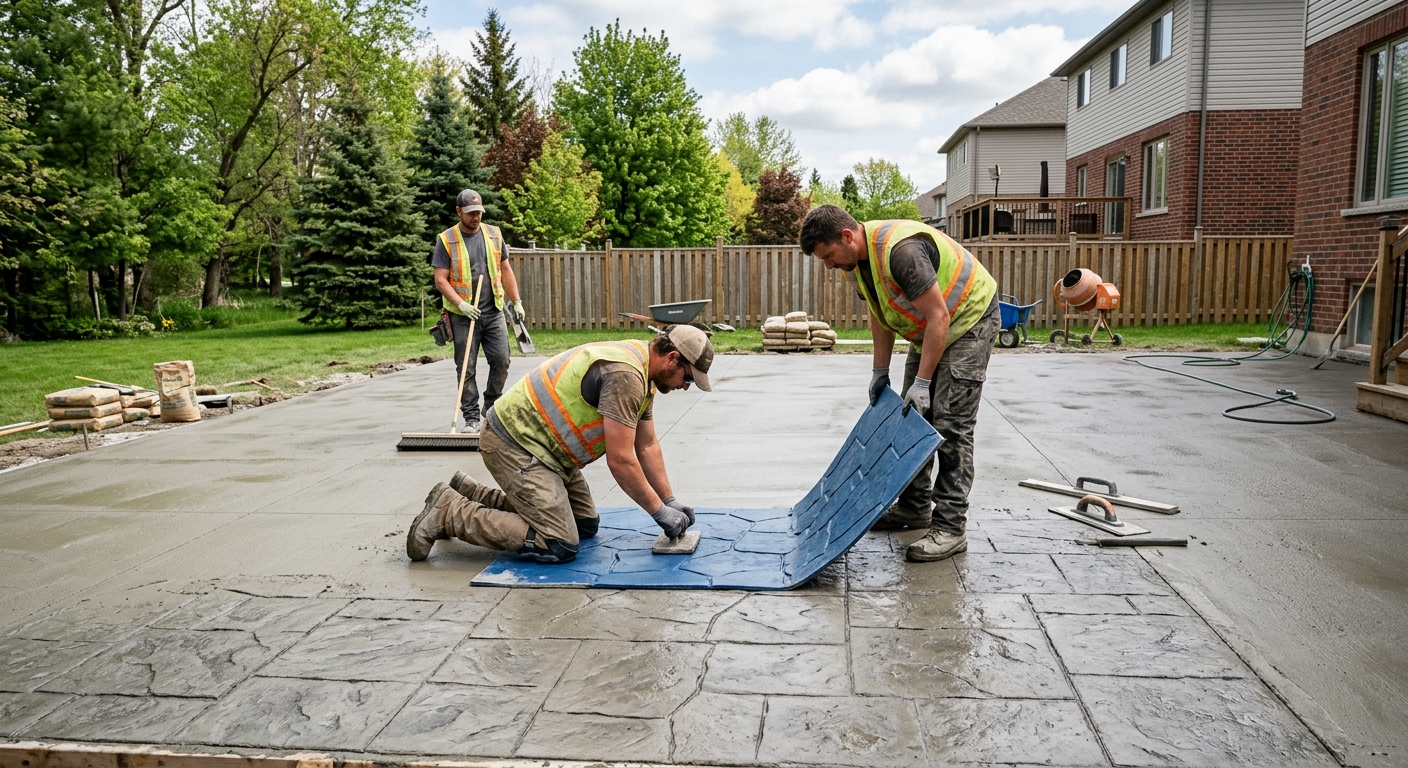
Concrete work options and costs in Glenbrooke North
In Glenbrooke North, British Columbia, most homeowners start with the same question: what concrete option fits the site, and what will it cost to do it right. Glenbrooke North is a mature, family-oriented community with a lot of single-detached homes and frequent driveway and patio upgrades. With a population of 4,882 (Statistics Canada, 2021 Census), demand is steady, and that’s why you’ll see concrete crews booked during the dry spells of spring and early fall. You’re also competing against the Lower Mainland–Southwest market, where mild winters and a shallow frost line don’t eliminate freeze–thaw concerns—coastal rain and temperature swings still saturate soils, then cycle back to cold nights.
That climate directly affects pricing because contractors must protect slabs and foundations from freeze–thaw damage. In this region, typical design practice assumes a frost depth around 450 mm (18"), so footings and thickened edges are commonly placed below that to reduce frost heave risk. Exterior work also requires air-entrained concrete, proper drainage, and jointing to manage cracking and surface scaling. Scheduling matters too: cool nights, high humidity, and prolonged rain can slow curing, which may increase labour and labour scheduling costs (and sometimes adds curing blankets or sealers).
If you’re in areas like the pockets around Sussex Avenue and the surrounding residential streets, driveways and backyard flatwork are especially in demand due to ongoing renovations. Below is a realistic side-by-side range to help you compare contractor quotes before you move to more detailed measurements.
| Application |
Typical Size |
Key Spec |
Finish Option |
Price Range |
| Concrete driveway (standard broom finish) |
400 sq. ft. (approx. 20’ x 20’) |
Air-entrained mix, compacted granular base, control joints |
Broom finish with sealer (optional) |
$7,200 – $11,200 |
| Exposed aggregate driveway |
400 sq. ft. (approx. 20’ x 20’) |
Air-entrained mix, proper curing to support wash/exposure |
Exposed aggregate (acidless wash) style |
$9,200 – $14,400 |
| Stamped concrete driveway or patio |
350 sq. ft. (approx. 25’ x 14’) |
Air-entrained mix, integral colour, release agent, joints |
Stamped pattern (e.g., slate/wood-grain look) |
$10,500 – $17,500 |
| Plain concrete patio or walkway |
250 sq. ft. (approx. 25’ x 10’) |
Air-entrained mix, compacted base, joints as required |
Straight-edge finish / light broom |
$4,000 – $6,500 |
| Garage floor (interior slab) |
480 sq. ft. (approx. 20’ x 24’) |
Vapour control as needed, compacted base, reinforcement |
Plain trowel finish (or broom if preferred) |
$8,500 – $14,000 |
| Foundation footings (structural, below frost) |
Typical 1,000 sq. ft. footprint |
Excavation, rebar cage, concrete below frost depth, engineering |
Structural concrete |
$8,000 – $18,000 |
Prices are estimates only and vary by project scope, site access and material selection.
What affects the price of concrete work in Glenbrooke North
In the Lower Mainland–Southwest region, two quotes for the “same” concrete job can swing 30–50% because the scope underneath the surface is never identical. One contractor may include proper granular base, drainage, and air-entrained mix; another may under-spec thickness, reinforcement, or curing, which can be costly in the long run. Labour availability also changes seasonally—while winters are milder than interior BC, coastal rain and cool nights still affect production and finishing time. Overhead is higher in the Vancouver–Surrey–Abbotsford corridor because many crews are competing for the same driving-distance jobs.
The biggest technical cost drivers are freeze–thaw cycles and frost depth practice. Exterior slabs and footings must be built below the design frost depth to prevent frost heave, and Lower Mainland work typically assumes around 450 mm (18") frost depth. That means footings, piers, and thickened edges still require real excavation and formwork, even if the frost line is shallower than inland provinces. Exterior concrete also needs air-entrainment to survive repeated saturation and temperature swings. Cold nights and high humidity can slow strength gain, so contractors may add curing blankets or extended curing measures to protect the surface. Finally, de-icing salt and winter meltwater can accelerate spalling, so sealing and surface durability practices matter.
In Glenbrooke North, excavation depth can raise costs by a few thousand dollars when soil conditions are saturated and require additional drainage and granular replacement. Conversely, a straightforward 250 sq. ft. patio with clear truck access may land near the lower end of the $16–$26/sq. ft. patio range, while a 400 sq. ft. driveway upgraded with exposed aggregate often pushes toward the $18–$28/sq. ft. band because of mix handling, exposure timing, and finishing care.
| Price Factor |
Why It Matters |
Cost Impact |
| Frost line depth — determines footing depth and form height |
Footings must extend below design frost to reduce frost heave risk |
Higher excavation and concrete volume; can add thousands on foundation work |
| Site preparation — excavation, grading, compacted granular base |
Bad base leads to settlement and cracking; granular must be compacted correctly |
Soil removal/replacement can noticeably change total cost |
| Reinforcement — rebar or wire mesh requirement |
Controls cracking and improves slab performance under loads |
Material and labour increase, especially for thicker reinforced slabs |
| Mix design — air-entrainment and compressive strength spec |
Air-entrainment helps resist freeze–thaw scaling and spalling in exterior exposure |
Often small per-yard cost but meaningful for durability and spec compliance |
| Finish type — broom vs. stamped vs. exposed aggregate |
Complex finishes need timing, dedicated tools, and extra steps |
Stamped/exposed typically costs more per square foot than broom-finish |
| Pour size and concrete truck access to site |
Small staging areas increase labour for forming, pumping, or wheelbarrowing |
Access constraints can add haul/pumping and crew time |
| Cold-weather curing precautions — heating and blankets |
Protects strength development in cool nights and damp conditions |
Blankets/heaters and longer cure scheduling can add cost |
| Control joint pattern and sealing cost |
Joints reduce random cracking; sealing improves surface resistance |
Sealer materials and additional labour for clean, dry application |
Permits & regulations in British Columbia
In British Columbia, structural concrete work typically requires a building permit and often engineered drawings reviewed by the municipality. That means foundation elements such as footings, foundation walls, and grade beams are generally part of the permitting pathway. For most homeowners in Glenbrooke North, the permit step matters because inspections and engineered requirements directly affect how deep the excavation goes (below design frost practice), the reinforcement placement, and the concrete mix requirements.
Concrete flatwork—driveways, patios, and walkways—usually does not require a permit unless your project affects lot grading, changes drainage patterns, or triggers impervious surface coverage limits, or involves municipal right-of-way considerations. Even when a permit isn’t required, it’s still smart to confirm with the local authority before breaking ground because utility locations, drainage tie-ins, and sidewalk/curb interfaces can change the process.
To verify a contractor properly, start by asking for a current Certificate of Insurance (liability) and proof of workers’ coverage where applicable. Next, confirm the contractor is properly registered/licensed for the work scope in BC using the relevant online registry (your contractor should be able to provide their business details). Then ask for documentation of clearance/coverage status and speak to references on similar projects: flatwork with correct air-entrainment and jointing, and any foundation work that required a permit.
Getting concrete right in Glenbrooke North's freeze-thaw climate
Concrete fails in Glenbrooke North most often when water gets into the slab or foundation system and then freezes, expanding enough to pop aggregate, scale the surface, or widen cracks. In our Lower Mainland–Southwest conditions, you’ll commonly see deterioration accelerate when drainage is poor, the base isn’t compacted, or the mix isn’t properly air-entrained for freeze–thaw exposure. To spec the job correctly, focus on five areas: (1) base preparation—use compacted granular sub-base to the right depth for the local soil and frost practice; (2) mix design—air-entrainment is essential for exterior flatwork, typically targeting 5–7% air content, with a minimum 32 MPa compressive strength; (3) control joints—install joints early enough and space them to limit random cracking; (4) curing—plan for a minimum 7-day cure under proper conditions, and in cool/wet stretches use curing blankets or protect the pour to keep temperature and moisture within a workable range; (5) sealing—apply a penetrating sealer after the concrete cure (commonly around 28 days) to repel meltwater and reduce salt/water-driven surface damage.
Here’s where homeowners can avoid paying twice: a plain broom-finish patio may look “similar” to a more expensive option, but the durability difference comes from spec compliance. For example, it’s common for a 250 sq. ft. patio to fall within the $16–$26/sq. ft. band. If a quote is far below that and skips air-entrainment or correct base depth, you may save a few hundred dollars now and lose the surface in a few winters. Ask technical questions about air-entrainment, curing protection, and joint layout to prevent spalling caused by inadequate air-entrainment.
| Spec |
Why It Matters in Glenbrooke North |
What to Ask For |
Impact if Skipped |
| Compacted granular base (depth?) |
Reduces settlement and prevents water pooling that fuels freeze–thaw damage |
Base depth, granular type, proof of compaction (lift thickness and compaction method) |
Early cracking, uneven slab, and faster surface scaling |
| Air-entrained concrete mix (target air %?) |
Helps the concrete survive freeze–thaw cycling and coastal wetting |
Air content target (typically 5–7% for exterior flatwork) and confirmation it’s air-entrained |
Spalling and scaling, especially after winter salt exposure |
| Compressive strength (MPa rating) |
Ensures long-term durability under load and moisture exposure |
Minimum 32 MPa and curing plan that protects strength gain |
Surface wear, dusting, and reduced durability in damp cycles |
| Control joints (spacing per ACI guidelines) |
Manages where cracks happen to protect appearance and water intrusion |
Planned joint spacing, sawcut timing, and edge detailing |
Random cracking and more water penetration at cracks |
| Minimum 7-day curing period |
Cold nights and humidity can slow curing in Glenbrooke North |
Protection method during cool/wet weather and minimum 7 days curing before trafficking |
Weaker early-age concrete and increased cracking risk |
| Penetrating sealer (when applied after cure) |
Improves resistance to meltwater and salt-driven scaling |
Penetrating sealer type and schedule (commonly around 28 days post-pour) |
Faster deterioration and higher maintenance costs |
How to choose a concrete work contractor in Glenbrooke North
Choosing a concrete contractor in Glenbrooke North comes down to verifying paperwork, comparing itemized scopes, and making sure the technical specs match BC’s real-world freeze–thaw needs. First, verify British Columbia licensing/registration for the trade scope you’re hiring (a legitimate contractor won’t resist providing business details). Next, ask for liability insurance—request a current Certificate of Insurance showing active coverage—and confirm workers’ coverage where applicable. How to check: look for the policy number, effective dates, and insured party name on the COI; confirm the coverage aligns with the work you’re paying for; and request a clearance/status letter if the contractor provides one for their workers’ coverage.
For pricing, get 2–3 itemised written quotes. You want a labour + materials breakdown (not just a lump-sum line), including excavation depth/base prep, reinforcement (if required), concrete mix spec (air-entrainment statement), finishing type, joints, and curing/sealing. Read exclusions carefully: is permit pull included, is site disposal/hauling included, and are there allowances for concrete sawcutting and patching? Make sure the quote specifies the finished thickness and any reinforcement details, not just “concrete slab”.
On warranty, ask for a workmanship warranty length and what it covers (typically surface issues and cracking within reason). Clarify whether the product/manufacturer warranty is provided and if it’s transferable to future owners.
- Ask for proof of current insurance (liability) before signing.
- Confirm workers’ coverage status where applicable.
- Request at least 2–3 references from recent local flatwork/foundation jobs.
- Get 2–3 itemised quotes: labour, materials, excavation, and disposal.
- Require the quote to state the concrete is air-entrained for exterior work.
- Verify base preparation includes granular type, lift compaction method, and depth.
- Confirm reinforcement plan (mesh/rebar) matches the slab thickness and use.
- Ask how joints will be installed (timing for sawcuts or tool joints).
- Get curing protection details for cool/wet periods (blankets, curing compound, access control).
- Ask when sealer is applied and whether it’s penetrating sealer after cure.
- Never pay more than 10–15% upfront; use a holdback until completion.
- Require a written start date and completion timeframe.
Concrete red flags in Glenbrooke North: contractors who refuse to state air-entrainment in writing, skim on base depth or compacted granular, quote by square footage without thickness or joint details, start work without discussing drainage and water management, or ask for large upfront payments with no schedule/holdback terms.
Frequently asked questions — concrete work in Glenbrooke North
How long does concrete take to cure?
In Glenbrooke North and across the Lower Mainland–Southwest, curing time depends on temperature and moisture, but planning should always assume at least 7 days of curing for early strength. Concrete keeps gaining strength beyond that; full strength is typically achieved over 28 days. If you pour during cool nights or rainy spells, contractors often use curing blankets and maintain moisture to protect early-age strength gain. That’s why you’ll see some driveways and patios scheduled for access restrictions after the first week even if the surface looks “dry.” For durability in BC’s freeze–thaw cycles, rushing the process is one of the most common reasons for early scaling and minor cracking. A quality contractor will explain protection steps and when you can load or traffic the slab.
Do I need a permit for concrete work in British Columbia?
In British Columbia, structural concrete work like foundation footings, foundation walls, and grade beams generally requires a building permit and often engineered drawings that the municipality reviews. For concrete flatwork—driveways, patios, and walkways—permits are often not required unless your project affects lot grading, drainage, impervious surface coverage limits, or involves municipal interfaces such as right-of-way or sidewalks. Because requirements can vary based on how the work changes drainage and surfaces, it’s best to confirm with the local authority before excavation. Regardless of permits, you should still verify the contractor’s insurance and workers’ coverage status and ask for references on similar-scale projects. When foundation work is involved, permitting is not optional—your quote should clearly distinguish flatwork vs structural scope.
Concrete vs pavers for a patio in Glenbrooke North?
Concrete is often the better value in Glenbrooke North when you want a monolithic surface that matches your driveway look and requires fewer joints than typical paver installs. A broom-finished concrete patio commonly lands in the $16–$26/sq. ft. range in the Lower Mainland–Southwest. Pavers can be a good choice if you want easier localized repairs or a more decorative look, but they still need correct base drainage and compaction to prevent weed growth and uneven settlement. Freeze–thaw and rain don’t “skip” pavers; standing water under units and insufficient base can cause movement. Concrete’s durability usually comes from proper air-entrained mix, correct base, and well-planned control joints. If your subgrade is variable or you have heavy tree roots, a contractor may recommend pavers with better drainage detailing—or advise concrete with deeper base and careful jointing.
How long does a concrete driveway last?
A well-built concrete driveway in British Columbia commonly lasts 20–30 years, and sometimes longer when the design addresses freeze–thaw and water management. In Glenbrooke North’s coastal-wet climate, longevity depends heavily on correct base preparation, air-entrained mix, and control joints that limit random cracking. Sealing after full cure can also improve surface resistance to meltwater and de-icing salt. If a driveway is poured in cool/wet conditions without adequate curing protection, it may look fine at first but can show surface scaling earlier in winter cycles. Cost-wise, a standard broom-finish driveway typically fits within the $18–$28 per square foot band, while exposed aggregate driveways generally cost more due to extra steps. If you’re seeing small cracks already, ask about drainage first—fixing water flow often prevents the problem from expanding.
What is air-entrained concrete and why does it matter here?
Air-entrained concrete is mixed with microscopic air bubbles that help the hardened cement paste survive freeze–thaw cycles. In Glenbrooke North, even though winters are milder than inland BC, the problem isn’t just deep frost—it’s repeated wetting and cooling followed by thawing. Water expands when it freezes, and without proper air content, that expansion can push off paste and create scaling or spalling over time. That’s why exterior work should specify an air-entrained mix (commonly targeting about 5–7% air content for exterior flatwork) and a minimum compressive strength (often 32 MPa). Ask your contractor to state in writing that the mix is air-entrained and match it to your exposure level (driveways, patios, steps). If a quote doesn’t mention air-entrainment, treat it as a major red flag.
How do I prepare the base for a concrete slab?
Base preparation is where concrete performance is won or lost in British Columbia’s freeze–thaw environment. For Glenbrooke North slabs, the contractor should excavate to the correct depth, remove organic/soft material, and place a compacted granular sub-base in lifts. The goal is a firm, uniformly compacted base that prevents settlement and reduces water accumulation beneath the slab. Drainage detailing matters too—especially on sites with saturated soils and heavy coastal rainfall. You should expect proof of compaction approach (lift thickness and equipment used) and clear confirmation of base type and depth. For exterior flatwork, correct base depth and air-entrained concrete work together with control joints to manage cracking. If a contractor quotes without discussing excavation depth, compaction, or granular placement, you’re missing the core specs that protect the slab over multiple winters.