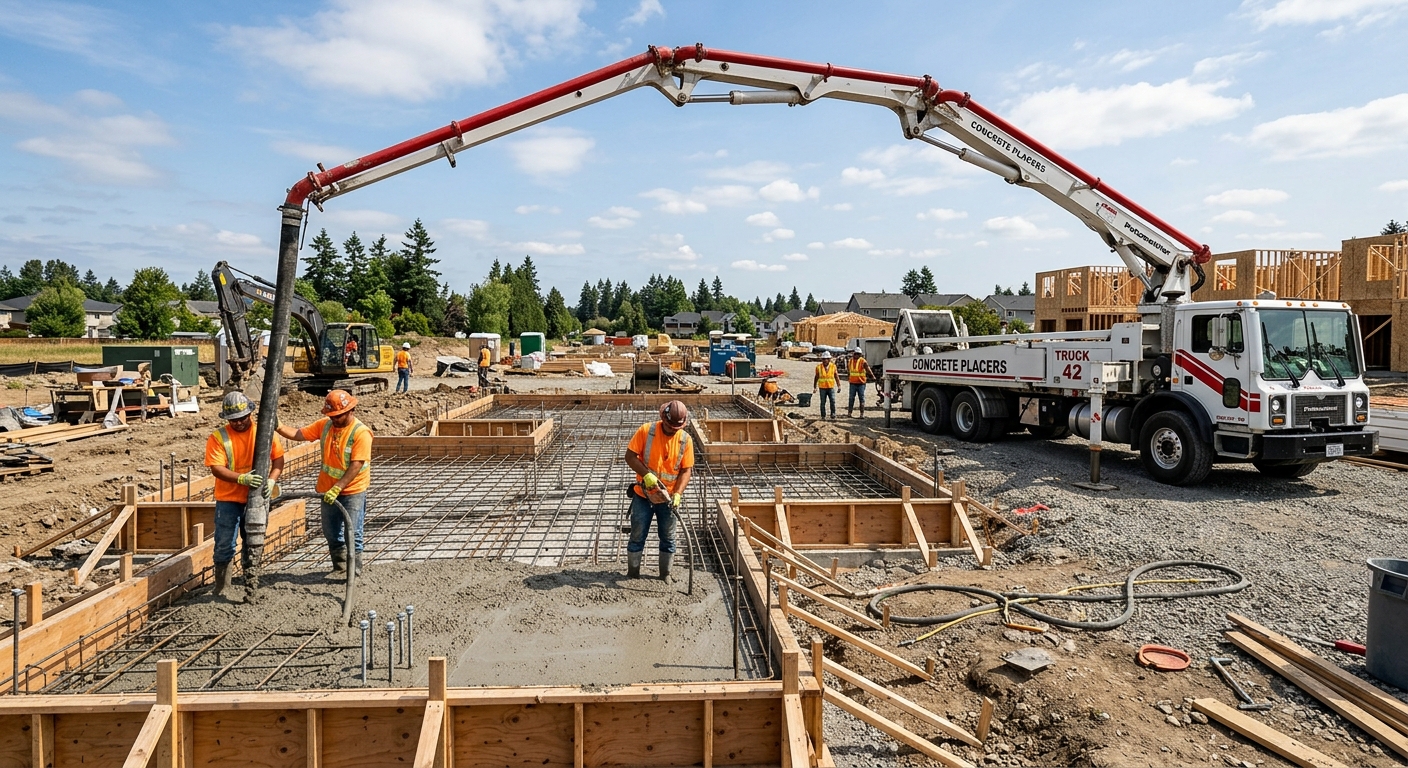
Concrete work options and costs in Cascade Heights
In Cascade Heights, concrete is one of those upgrades homeowners notice every day—especially for driveways, patios and walkways where freeze–thaw cycles and coastal rainfall quickly show workmanship. With a population of 7,449 (Statistics Canada, 2021 Census), the area’s steady mix of owner-occupied homes means concrete contractors are often busiest around the main service corridors and established neighbourhood pockets where exterior flatwork is regularly refreshed. In the Lower Mainland–Southwest, the climate is generally mild, but the frost depth is still treated as a design driver (practices commonly target about 450 mm / 18"). That means footings, piers and thickened edges are typically placed below that depth to reduce frost heave, and exterior slabs are built with air-entrained mixes, engineered base prep and proper jointing.
Because we routinely schedule pours around prolonged rain, cool nights and high humidity, curing practices (blankets, sealers and longer cure times) influence both labour and material costs. It also affects availability: during wet stretches, crews may reschedule crews and equipment, which can widen quote ranges even for the same finish. In and around the Cedar Ridge area of Cascade Heights, driveway replacements and patio extensions are particularly common as homeowners update curb appeal and improve drainage around their homes.
Below is a practical comparison of common concrete options, with typical sizes and specs for Cascade Heights—use it as a starting point before you request itemised quotes.
| Application |
Typical Size |
Key Spec |
Finish Option |
Price Range |
| Concrete driveway (standard broom finish) |
240 sq. ft. (e.g., 20' x 12') |
4" slab on compacted granular base; air-entrained mix; control joints |
Broom finish + light edging |
$12,800–$18,900 |
| Exposed aggregate driveway |
240 sq. ft. (e.g., 20' x 12') |
4" slab; air-entrained mix; stronger surface wear; jointing plan |
Exposed aggregate (washed/surface retarder) |
$15,800–$22,600 |
| Stamped concrete driveway or patio |
180 sq. ft. (e.g., 15' x 12') |
4" slab; reinforcement per design; air-entrained mix |
Stamped + release + colour (integral or topical) |
$20,000–$30,900 |
| Plain concrete patio or walkway |
120 sq. ft. (e.g., 12' x 10') |
4" slab on compacted base; air-entrained; joints to control cracking |
Float/skim + broom or smooth finish |
$2,400–$5,700 |
| Garage floor (interior slab) |
400 sq. ft. (e.g., 20' x 20') |
Typical 4" slab; reinforced as required; vapour considerations if needed |
Standard trowel finish |
$9,200–$17,100 |
| Foundation footings (structural, below frost) |
Varies (e.g., 200 linear ft.) |
Below frost depth; engineered layout; rebar + concrete mix per design |
Structural concrete (not decorative) |
$40,000–$70,000 |
Prices are estimates only and vary by project scope, site access and material selection.
What affects the price of concrete work in Cascade Heights
In the Lower Mainland–Southwest, it’s common to see quotes for the “same” concrete job vary by 30–50%. The big reason is that concrete isn’t just a material—it’s excavation, drainage design, base compaction, reinforcement detailing, mix selection, finishing technique and curing. In British Columbia, our coastal-wet schedule also shifts labour: crews can’t always pour or finish in the middle of sustained rain, so crews may add manpower for protected curing or re-sequence other work while you wait.
Every spec in Cascade Heights is influenced by frost depth and freeze–thaw cycles. Even with a shallow frost line (commonly ~450 mm / 18" in local practice), footings and thickened edges are placed below the design depth to prevent frost heave. Exterior slabs are typically built with air-entrained concrete mixes to manage freeze–thaw scaling and surface spalling, plus properly planned control joints. Colder regions generally require deeper excavations and shorter pour seasons, and while Cascade Heights is milder than interior BC, we still use cold-weather curing precautions when nights get cool—blankets, cure monitoring and sometimes mix temperature management—adding cost when compared with a summer pour.
Two examples that change your price in Cascade Heights: (1) a driveway that ties into existing grades and needs drainage corrections often costs more because of additional excavation, granular base and slope adjustments; (2) a stamped patio may cost an extra premium because it needs more surface prep, more colour/material handling and careful curing to prevent colour blotching. If your project is a standard broom driveway, it often lands closer to the regional backbone range (for example, $18–$28 per sq. ft.). If you move to stamped & decorative, the same footprint frequently pushes upward toward $22–$36 per sq. ft. because of labour intensity and materials.
| Price Factor |
Why It Matters |
Cost Impact |
| Frost line depth — determines footing depth and form height |
Footings must sit below the design frost depth to reduce heave risk |
Higher excavation/formwork increases labour and equipment time |
| Site preparation — excavation, grading, compacted granular base |
Drainage and subgrade compaction prevent settlement and surface failure |
Wet/soft soils and extra hauling raise costs noticeably |
| Reinforcement — rebar or wire mesh requirement |
Controls cracking and improves slab performance under loads |
Materials + labour for placement, chairs/ties and inspections |
| Mix design — air-entrainment and compressive strength spec |
Air-entrainment improves freeze–thaw durability for exterior concrete |
Specialty mix and tighter batching can raise material costs |
| Finish type — broom vs. stamped vs. exposed aggregate |
Finishing technique affects labour hours and material handling |
Stamped and exposed aggregate typically cost more per sq. ft. |
| Pour size and concrete truck access to site |
Small or tight-access sites may need pumps/chutes and more crew time |
Access constraints can add equipment or extra labour hours |
| Cold-weather curing precautions — heating and blankets |
Cool nights slow strength gain; curing protection maintains performance |
Blankets, heaters and monitoring add direct costs |
| Control joint pattern and sealing cost |
Joints manage cracking; sealers help repel de-icing salts and water |
Additional saw cuts, labour and sealant materials |
Permits & regulations in British Columbia
In British Columbia, structural concrete work generally needs a building permit. That includes foundation walls, footings, and grade beams (anything that forms part of the structural support of the building). Many of these projects also require engineered drawings reviewed through the municipal process. Concrete flatwork—such as driveways, patios and walkways—typically does not require a permit unless it affects lot grading, drains, or impervious surface coverage limits, or impacts a municipal right-of-way. In practice, the permit need can depend on how your work ties into site drainage or changes runoff patterns, so it’s smart to confirm before the first shovel hits the ground.
For Cascade Heights homeowners verifying a contractor, start with the basics: ensure the contractor carries liability insurance and has WCB/WCB coverage (workers’ compensation) for their workers. Step-by-step: (1) request a copy of their certificate of insurance and verify the policy limits; (2) ask for proof of WCB clearance/coverage status; (3) confirm licensing/registration through the appropriate provincial business registry and any trade-specific listing the contractor provides; (4) request references for similar driveway/patio or foundation-scale work in the Lower Mainland–Southwest; and (5) confirm the permit responsibility in your written scope (who pulls it, who schedules inspections, what’s included). If any item can’t be provided quickly and clearly, that’s a red flag.
Getting concrete right in Cascade Heights's freeze-thaw climate
Concrete fails in Cascade Heights mainly because water gets into the surface and at the edges, then freeze–thaw expands that moisture. You’ll also see issues when base prep is rushed or when mix design and jointing don’t match our climate. The correct approach is a full-system spec: (1) base preparation with compacted granular sub-base to the right depth for local soils and frost protection; (2) mix design with air-entrainment for exterior flatwork—commonly 5–7% air content for freeze–thaw durability—and a minimum 32 MPa compressive strength; (3) control joints spaced to limit random cracking; (4) curing long enough to build strength—minimum 7 days, with extra protection when nights are cool; and (5) sealing after the cure window so de-icing salts and wet coastal air don’t punch holes into the surface.
In the Lower Mainland–Southwest, rain and high humidity can delay surface drying even when temperatures are “not that cold.” That’s why we plan around weather and sometimes use curing blankets or sealers to maintain durability. If you want to avoid spalling—the pitting/flaking that shows inadequate air-entrainment—ask your contractor to specify the air content and show the curing plan. A simple question like “What target air % is in the mix for this exterior slab, and how will you protect curing if we get cool nights?” will separate experienced crews from catch-all proposals.
Cost-wise, the cheapest quote isn’t always the best value. For example, if a standard broom driveway quote lands around the lower end of the $18–$28 per sq. ft. range, but the scope omits proper drainage corrections and sealing, you may pay again. Spending the small premium on air-entrained mix, proper jointing and a proper 28-day post-pour sealer (when required) is usually justified compared with later repairs.
| Spec |
Why It Matters in Cascade Heights |
What to Ask For |
Impact if Skipped |
| Compacted granular base (depth?) |
Controls settlement and keeps water from undermining the slab in wet coastal conditions |
“What depth of compacted granular base, and how many lifts?” |
Uneven slabs, cracking and premature edge failures |
| Air-entrained concrete mix (target air %?) |
Improves durability through freeze–thaw cycles |
“What target air content (5–7%) will you place for exterior?” |
Spalling/scaling and surface breakdown |
| Compressive strength (MPa rating) |
Strength gain supports durability and load performance |
“Minimum 32 MPa—what’s the strength spec on the ticket?” |
Low strength surfaces that wear and crack sooner |
| Control joints (spacing per ACI guidelines) |
Directs shrinkage cracking so cracks don’t go random and wide |
“What joint spacing and depth will you use for this slab size?” |
Random cracking and water ingress at uncontrolled cracks |
| Minimum 7-day curing period |
Ensures proper strength development despite cool nights/high humidity |
“How do you plan curing protection if temperatures drop or rain arrives?” |
Weak concrete, increased scaling risk and reduced life |
| Penetrating sealer (when applied after cure) |
Repels water and helps protect from de-icing salt exposure |
“What sealer, and will you apply it after the cure (often ~28 days)?” |
Greater water penetration and faster surface deterioration |
How to choose a concrete work contractor in Cascade Heights
Choosing a contractor in Cascade Heights comes down to verification and clarity. First, verify British Columbia licensing/registration information and confirm liability insurance—your certificate should name you as a certificate holder (or at least show the insurer and policy limits). Next, confirm WCB coverage (workers’ compensation) for their crews. Step-by-step: (1) ask for their WCB clearance/coverage proof; (2) request insurance documentation before you pay anything; (3) ensure their name matches the documents and the quote; and (4) look for references on similar-scale driveway and patio work in the Lower Mainland–Southwest. You should also be comfortable that they can explain base prep, mix design (air content for exterior) and jointing without hand-waving.
When you request quotes, get 2–3 itemised written quotes that break down labour + materials. Avoid lump-sum-only pricing where drainage corrections, reinforcement, saw cuts and curing protection are “assumed.” Read what’s excluded: is disposal included? Is permit handling included if required for grading or structural work? Will they supply rebar chairs, compacted base depths and joint spacing? Ask about warranty: a workmanship warranty for concrete flatwork (and the date it starts) should be in writing, and separate from any product/manufacturer warranty. Finally, payment schedule matters—never pay more than 10–15% upfront, and hold back until the job is complete and surfaces are cured per spec. Get a written start date and a completion estimate, especially because weather can shift timelines in coastal BC.
- Ask for itemised quotes (labour, concrete supply, reinforcement, excavation/base prep, finishing, curing, sealing).
- Confirm whether the quote includes drainage corrections and granular base compaction to specified depth/lifts.
- Verify air-entrainment and minimum strength are stated for exterior slabs.
- Request their control joint plan (spacing and where joints will be placed).
- Check insurance: liability coverage documentation before scheduling.
- Check WCB/WCB clearance proof for their workforce.
- Look for references with photos of driveways/patios in similar coastal freeze–thaw conditions.
- Ensure disposal/hauling and access constraints are clearly addressed.
- Confirm permit responsibility in writing if lot grading or structural elements are involved.
- Ask for a curing plan that matches the expected temperature/rain window.
- Understand warranty: workmanship length, what is covered, and how it’s handled if you sell your home.
- Use a payment schedule with a small deposit (10–15%), and holdback until inspection-ready completion.
Concrete red flags in Cascade Heights include: quotes that don’t specify air content for exterior work, no written plan for base prep depth/compaction, “cheap” removal/grade assumptions, skipping or rushing control joints, and payment terms that ask for large upfront deposits without a clear schedule and scope.
Frequently asked questions — concrete work in Cascade Heights
Why does concrete crack in Cascade Heights and how is it prevented?
Concrete cracks are normal when shrinkage and temperature changes can’t release safely—especially outdoors where coastal wetness and freeze–thaw cycles repeatedly move water in and out of the slab and edges. In Cascade Heights, the most common drivers are inadequate control joints, poor base preparation, and reinforcement that doesn’t match the slab design. Prevention starts with a properly compacted granular base, correct air-entrained exterior mix, and a joint plan that limits random cracking. We also recommend saw-cut control joints on schedule so cracks form where you want them. If your driveway is in the exterior zone, skip any “one-size-fits-all” mix and ask for the air-entrainment target. That’s one reason properly specified broom-finish work often lands in the $18–$28 per sq. ft. range, while poorly specified concrete may look okay at first and then scale or crack faster.
Stamped vs broom-finish concrete — cost difference?
In Cascade Heights and the wider Lower Mainland–Southwest, stamped concrete costs more than a broom finish because it requires extra labour time and materials: colour systems, release agents, stamp timing, and careful finishing to keep patterns crisp in humid conditions. A broom-finished driveway is typically priced closer to the base backbone range (commonly $18–$28 per sq. ft.), while stamped & decorative work typically pushes upward toward $22–$36 per sq. ft. The exact gap depends on footprint size, reinforcement needs, and whether the scope includes drainage grading corrections and post-pour sealing. If your site is tight or truck access is difficult near the neighbourhood edges where crews stage equipment, both options can increase—but stamped is more sensitive to weather and curing handling. The best value is usually when your stamped area is well-defined and the contractor provides an itemised quote that separates base prep and finishing labour.
When is the best time to pour concrete in Cascade Heights?
The “best” time is when temperatures support proper curing without aggressive cold-weather measures and when rain exposure can be managed. In British Columbia’s Lower Mainland–Southwest, late spring through early fall often makes planning easier because nights are warmer and you can reduce reliance on heating blankets. That said, experienced contractors still pour year-round by adjusting the curing plan—using blankets, monitoring set times and protecting surfaces when cool nights arrive. Weather interruptions are the reason you might see quote changes between seasons even for the same scope. For exterior slabs, prolonged rain can slow surface drying and increase finishing risk, so crews may schedule around forecast windows. If you’re aiming for stamped or exposed aggregate finishes, timing matters even more because surface readiness affects pattern sharpness and appearance. A well-written schedule in your contract is the practical solution: ask for start/finish estimates in writing and a curing protection plan for wet forecasts.
How long does concrete take to cure?
Concrete curing is about achieving enough strength and durability, not just “drying.” For most residential slabs in Cascade Heights, we follow a minimum 7-day curing period under proper conditions, with longer cure protection when weather is cool or damp. During cold or rainy stretches, crews may use curing blankets and additional cover so the concrete gains strength as intended. While you may be able to walk on it sooner, full durability—especially for exterior performance against freeze–thaw—depends on proper cure. Sealing is typically done after the concrete has cured sufficiently; for penetrating sealers, a common target is around 28 days post-pour (once the surface is ready). If you rush traffic or washout conditions, you can compromise the surface and create pathways for water ingress. This is one reason high-quality exterior pours often include time for curing protection and don’t rely on “quick strip-and-go” scheduling.
Do I need a permit for concrete work in British Columbia?
In British Columbia, structural concrete work such as footings, foundation walls, and grade beams generally requires a building permit, often with engineered documentation reviewed through the municipal process. Concrete flatwork like driveways, patios and walkways typically does not require a permit unless it affects lot grading, impervious surface limits, or drainage/outflow patterns, or involves work within a municipal right-of-way. In Cascade Heights, the permit question often comes down to whether your concrete changes how water leaves the property or how it ties into existing site grading. The practical approach: confirm with your local authority before breaking ground. Also confirm in your contractor’s written scope who is responsible for the permit (if required). A good contractor should be able to point to the relevant work type and explain how their plan aligns with municipal requirements.
Concrete vs pavers for a patio in Cascade Heights?
Concrete and pavers both work well in Cascade Heights, but they behave differently in our wet coastal freeze–thaw climate. Concrete patios typically offer better long-term uniformity when built with the right base prep, air-entrained mix (for exterior exposure), proper joints and curing. A plain concrete patio often sits near the regional backbone pricing (for example, $16–$26 per sq. ft. for common flatwork finishes). Pavers can look more “modular” and are easier to replace individual stones if one section fails—but they still need excellent base preparation and jointing details to avoid heaving or weed growth. If your priority is a clean, continuous slab with fewer surface seams, concrete is usually the straightforward choice. If your priority is visual variety and future replaceability, pavers can win. Either way, ask both bidders how they handle drainage and joint spacing, because water management is what drives durability in Lower Mainland–Southwest weather.