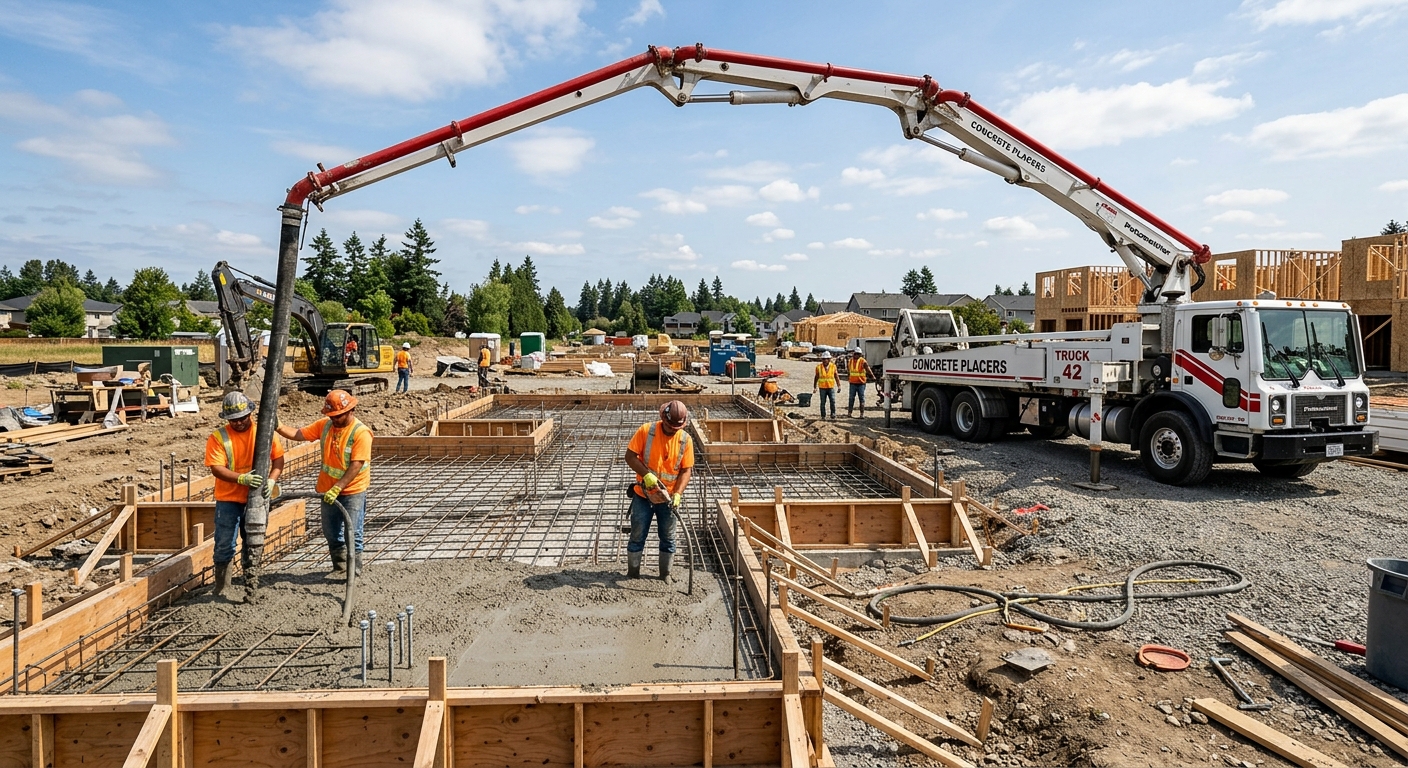
Concrete work options and costs in Taylor
Taylor, British Columbia is a small community where concrete flatwork is a practical upgrade—especially for the many homes that rely on durable exterior surfaces through winter. With 41.7% of dwellings being single-detached houses and 420 homeowner households (77.1% ownership), most concrete demand centers on driveways, patios and walkway repairs rather than large commercial work. In the Northeast BC market around Dawson Creek/Fort St. John, contractors also stay busy with foundation and footing work for homeowners responding to settlement or moisture issues.
Concrete pricing in Taylor is shaped by long, cold winters and frequent freeze–thaw cycles. Footings must be set below frost depth to prevent frost heave and slab cracking, and that often means deeper excavation than in milder parts of Canada. The short pour season compresses crews into warmer months, and cold-weather curing precautions (blankets/insulation and controlled curing) add labour and materials costs when temperatures dip. If your site is wind-exposed or moisture-prone, proper granular base prep and drainage become non-negotiable, and those steps show up in the quote.
In Taylor, trades tend to be especially in demand in the areas where older homes are more common—since 28.4% of homes were built before 1981, many owners address aging driveways, porch steps and minor foundation issues alongside renovations.
Below are realistic starting price ranges for common jobs in Taylor, so you can compare proposals before your final site measurement.
| Application |
Typical Size |
Key Spec |
Finish Option |
Price Range |
| Concrete driveway (standard broom finish) |
480 sq. ft. (20 ft x 24 ft) |
Air-entrained mix for exterior; compacted base; control joints |
Broom finish, sealed |
$18,000–$26,000 |
| Exposed aggregate driveway |
480 sq. ft. (20 ft x 24 ft) |
Proper aggregate selection; base drainage; joint pattern for freeze–thaw |
Exposed aggregate with sealer |
$22,000–$32,000 |
| Stamped concrete driveway or patio |
300 sq. ft. (15 ft x 20 ft) |
Air-entrained exterior mix; release agents; reinforced placement |
Stamp pattern + colour hardener options |
$9,000–$15,000 |
| Plain concrete patio or walkway |
200 sq. ft. (10 ft x 20 ft) |
Grade correction; compacted base; edge forms; joints |
Steel trowel or broom edge, sealed |
$3,000–$5,000 |
| Garage floor (interior slab) |
520 sq. ft. (22 ft x 24 ft) |
Vapour barrier; reinforced or fibre option; proper curing |
Plain finish, densifier option |
$12,000–$20,000 |
| Foundation footings (structural, below frost) |
1 basement wall run (approx. 1,000 sq. ft. total footing area varies) |
Excavation to frost depth; rebar; engineered specs |
Structural concrete only |
$55,000–$90,000 |
Prices are estimates only and vary by project scope, site access and material selection.
What affects the price of concrete work in Taylor
Even when you’re comparing “the same” concrete job in Taylor and across Northeast British Columbia, quotes can swing by 30–50%. The reason is that the concrete price bands only tell part of the story—your total cost is driven by what has to happen before the truck arrives: excavation depth, granular base and drainage, steel reinforcement, mix design and cold-weather curing. In freeze–thaw country, spec compliance isn’t optional; it’s what prevents premature cracking and spalling.
Start with frost line depth. Exterior footings must extend below the design frost depth to reduce frost heave and slab movement. In milder Canadian regions, that depth can be less demanding, but in Northeast BC we’re dealing with deeper excavations and more backfill. That pushes costs upward because excavation, hauling, and compaction take time and equipment. Next, air-entrained concrete mixes are required to survive freeze–thaw cycling. Finally, the short pour season means pours often land near cold snaps; that triggers cold-weather curing precautions—insulation blankets and longer protected curing—which add labour and sometimes additional materials.
De-icing salt is another Northeast reality. It accelerates surface wear and can contribute to spalling if the surface concrete isn’t properly air-entrained and protected. For example, a plain broom-finish driveway can fall into the $18–$28 per sq. ft. range, but spending at the higher end is often justified when your contractor includes deeper base prep and better drainage. Likewise, stamped or exposed aggregate can jump into the $25–$40 per sq. ft. band because of colour, finishing time and higher material cost—worth it when you’ll maintain the surface with sealing.
Housing age also matters. With 28.4% of Taylor homes built before 1981, upgrades often include regrading tied to older drainage patterns, which can add scope and disposal. A stronger base and corrected slope can raise the price, but it usually reduces recurring repairs—especially when freeze–thaw has already started to show.
| Price Factor |
Why It Matters |
Cost Impact |
| Frost line depth |
Determines footing depth and form height |
Higher excavation and backfill; can materially raise foundation/footing budgets |
| Site preparation |
Excavation, grading, compacted granular base |
More time/equipment; base corrections often add labour before any pour |
| Reinforcement |
Rebar or wire mesh requirement |
Materials + placement labour; necessary for driveways exposed to loading and thermal stress |
| Mix design |
Air-entrainment and compressive strength spec |
Premium mix and quality control; crucial for freeze–thaw durability |
| Finish type |
Broom vs. stamped vs. exposed aggregate |
Stamped/exposed finishes cost more due to labour, colour materials and detailing |
| Pour size and concrete truck access to site |
Access constraints affect equipment and batching time |
Narrow drives or long carries increase crew time and sometimes surcharge costs |
| Cold-weather curing precautions |
Heating and blankets |
Adds labour and insulating materials; often needed near the end of the season |
| Control joint pattern and sealing cost |
Controls cracking and protects from de-icing salt |
More layout time and sealer materials; improves service life in Northeast winters |
Permits & regulations in British Columbia
In British Columbia, the key distinction is whether your concrete work changes structural elements or affects lot compliance. Structural concrete work—such as footings, foundation walls and grade beams—typically requires a building permit and often engineered drawings that the municipality reviews before construction. That’s because the design must account for loads and site conditions, including frost and drainage.
Concrete flatwork like driveways, patios and walkways usually does not require a permit. The exception is when the work changes lot grading, alters drainage in a way that affects runoff, or impacts municipal rules tied to impervious surface coverage or right-of-way. In Taylor, it’s smart to confirm whether any proposed tie-in to existing grades or drainage work triggers a review.
Step-by-step, here’s how a homeowner in Taylor can verify a contractor properly in BC: (1) ask for their contractor details and search the appropriate online registry for licensing status; (2) request a current certificate of insurance showing liability coverage—make sure it’s active for your project dates; (3) confirm their WCB/coverage for workers (in practice this is often provided as proof of clearance or coverage documentation); (4) ask for references on similar-scale concrete jobs in your region so you can validate finish quality and durability.
Getting concrete right in Taylor's freeze-thaw climate
Concrete fails in Taylor when freeze–thaw movement isn’t controlled. The most common problems I see are random cracking, spalling (surface flaking), and settlement-related ridges that collect water. The fix starts at the ground level: (1) base preparation—use a compacted granular sub-base to the correct depth for local soils and frost conditions, plus proper drainage so water doesn’t sit under the slab; (2) mix design—spec air-entrainment and minimum compressive strength so the concrete can tolerate repeated freezing cycles; for exterior work we typically call for 5–7% air content and at least 32 MPa. (3) control joints—tight, deliberate joint patterns limit where cracks occur and keep them manageable; (4) curing—don’t rush it. In cold Northeast seasons, minimum 7-day curing under protected conditions is critical, and in cooler stretches crews often use insulation blankets to prevent early freezing; (5) sealing—apply a penetrating sealer after the concrete cure (commonly around 28 days) to reduce moisture and help resist damage from de-icing salts.
When homeowners compare options, the price difference is usually justified by durability specs rather than by appearance alone. For instance, moving from standard broom-finish concrete in the $18–$28 per sq. ft. band to stamped concrete in the $25–$40 per sq. ft. band may cost more, but you’re paying for extra finishing time, colour hardener/release materials and careful finishing sequences—not just stamps. If your priority is long-term performance, don’t cut corners on air-entrainment, base compaction and curing to “save a few dollars.”
Ask your contractor: “What air content are you placing? What curing method will you use if temperatures drop at night? What joint spacing are you following for this slab thickness?” Those answers are where most differences in real-world longevity show up in Taylor’s climate.
| Spec |
Why It Matters in Taylor |
What to Ask For |
Impact if Skipped |
| Compacted granular base (depth?) |
Prevents slab movement and frost-related distortion in deep-winter conditions |
Base depth and compaction method; drainage plan |
Settlement, cracking, and water pooling that accelerates freeze–thaw damage |
| Air-entrained concrete mix (target air %?) |
Air bubbles provide freeze–thaw tolerance for exterior slabs |
Target 5–7% air content for exterior flatwork and confirmation of air testing |
Spalling and surface scaling within a few winters |
| Compressive strength (MPa rating) |
Ensures the concrete achieves design durability under cold-season stresses |
Minimum 32 MPa (and documented mix design) |
Weakened surface and faster deterioration under de-icing salts and impacts |
| Control joints (spacing per ACI guidelines) |
Controls where cracks form to avoid random cracking through the slab |
Joint spacing based on slab dimensions and thickness |
Widespread cracking and difficult repairs that don’t stop water intrusion |
| Minimum 7-day curing period |
Cold weather slows strength gain and increases freeze risk |
How they will protect curing; blankets/insulation if needed |
Early freezing can severely weaken slabs and exposed driveways |
| Penetrating sealer (when applied after cure) |
Reduces moisture uptake from wet seasons and salt exposure |
Sealing schedule—typically after full cure (around 28 days) |
More moisture absorption, faster spalling and staining |
How to choose a concrete work contractor in Taylor
Choosing the right contractor in Taylor is mostly about verifying three things: (1) they’re properly licensed/authorized to do the work, (2) they’re insured for liability, and (3) they have worker coverage so you’re not stuck with risk if something goes wrong. In British Columbia, start by requesting their business details and licence information, then ask for a current certificate of insurance. For worker coverage, ask for proof of WCB coverage/clearance documentation. If they can’t provide these promptly, that’s a red flag.
Next, get 2–3 itemised written quotes, not just a lump sum. You want line items showing labour and materials for excavation, granular base, forms, reinforcement, concrete supply, finishing and sealing. Confirm whether the quote includes disposal of excess material and any required protection of landscaping. Ask if they’ll pull permits where needed—structural footings/foundations often require permits and engineered review, while most flatwork doesn’t unless grading/drainage compliance is affected.
Warranty matters too. Ask: how long is the workmanship warranty, what does it cover (cracks at joints vs. random cracking), and whether the manufacturer/product warranty is separate. Clarify whether warranties are transferable if you sell your home.
Payment schedules should be conservative. Don’t pay more than about 10–15% upfront. Hold back a portion until the slab is finished, cleaned, joints are done correctly, and any sealing steps are completed. Finally, insist on a written timeline with a start date and estimated completion date, because winter scheduling in Northeast BC can affect finishing and curing.
- Verify licensing/authorization for the scope in British Columbia before signing.
- Request certificate of insurance and confirm it covers your project period.
- Ask for proof of worker coverage (WCB/clearance documentation).
- Insist on itemised labour and materials (not just one number).
- Confirm excavation depth and granular base thickness/compaction requirements.
- Ask for air-entrainment and compressive strength specs for exterior slabs.
- Review joint layout: spacing, control joint pattern and sealing plan.
- Clarify cold-weather curing approach (blankets/insulation/heating if needed).
- Check whether drainage/grading tie-ins are included to prevent water pooling.
- Confirm disposal and site clean-up are included.
- Ask about curing protection duration and when sealing will occur.
- Get warranty terms in writing, including workmanship and product coverage.
Concrete red flags I see in Taylor include: contractors who won’t discuss air content or joint spacing, quotes that skip or minimize base prep and compaction, crews who pour when freezing is likely without curing protection, no written scope for disposal and drainage tie-ins, and payment demands that exceed 10–15% upfront without a clear schedule.
Frequently asked questions — concrete work in Taylor
Stamped vs broom-finish concrete — cost difference?
In Taylor, stamped concrete usually costs more than a basic broom finish because it requires extra materials and finishing steps (release agents, colour options, and careful timing). For context, standard exterior concrete often falls around the $18–$28 per sq. ft. band, while stamped concrete is commonly priced in the $25–$40 per sq. ft. band due to labour and materials. The climate makes both options sensitive to the same durability specs: air-entrained mix, proper base prep and curing, and correct control joints. A stamped driveway that’s built to the same freeze–thaw standard as broom-finish concrete will last, but it still needs proper sealing and joint maintenance—especially with de-icing salt in Northeast BC.
When is the best time to pour concrete in Taylor?
The best time in Taylor is during consistently milder weather—typically late spring through summer—when crews can finish, cure, and protect the slab without early freezing risk. Northeast BC’s short pour season means even small schedule delays can push work toward colder nights, and cold-weather curing precautions (blankets/insulation and sometimes heating) add cost. If temperatures are dropping at night, ask your contractor exactly what curing protection they’ll use and how they confirm the concrete isn’t freezing during the early strength gain period. For exterior flatwork like driveways and patios, planning ahead helps keep you in the most cost-effective window and reduces the risk of weak surfaces or premature spalling.
How long does concrete take to cure?
Concrete curing is a staged process. For practical use, many contractors will not allow heavy use immediately after finishing, but the key point in Taylor’s freeze–thaw climate is that the concrete still needs proper early strength gain. A minimum 7-day curing period under protected conditions is commonly required for exterior performance, especially if there’s any cold-weather exposure. Full design strength development generally continues for longer—often around 28 days—when you also plan sealing. Sealing is important in Northeast BC because de-icing salts and moisture cycles can worsen surface damage if the slab remains unprotected. If your contractor tells you curing is “just a day or two,” that’s a major concern in this region.
Do I need a permit for concrete work in British Columbia?
In British Columbia, it depends on what you’re building. Structural concrete work—such as footings, foundation walls and grade beams—usually requires a building permit and often engineered drawings reviewed by the municipality. Concrete flatwork like driveways, patios and walkways typically does not require a permit unless it affects lot grading, drainage, impervious surface limits, or impacts a municipal right-of-way. For a homeowner in Taylor, the simplest approach is to ask your contractor what triggers a permit for your exact scope, then confirm with the local authority before excavation. Also verify the contractor has liability insurance and appropriate worker coverage—so you’re protected regardless of whether a permit is required.
Concrete vs pavers for a patio in Taylor?
Both concrete and pavers can work well in Taylor if the base is built correctly, but concrete typically wins on long-term uniformity when you’re optimizing for freeze–thaw resistance and lower maintenance. A plain concrete patio often lands around the $15–$25 per sq. ft. range, while pavers vary widely depending on edging, base depth and the pattern system. Concrete patios still need control joints and proper curing to manage cracking; pavers need a well-graded granular base and correct setting bed so they don’t heave or settle. If you’re dealing with older drainage patterns (common in homes built before 1981) a contractor should address grading and drainage either way. If you want a smooth, monolithic surface and fewer joints to maintain, concrete is usually the more straightforward choice.
How long does a concrete driveway last?
In Northeast BC conditions, a well-built concrete driveway commonly lasts 20–30 years, and sometimes longer, when it’s designed for freeze–thaw: air-entrained concrete, compacted base prep, correct joint spacing, and protected curing. Sealing helps too—typically after full cure (around 28 days)—because de-icing salt and moisture cycles increase the risk of surface scaling and spalling. The biggest drivers of lifespan in Taylor are not the colour or finish alone, but whether the contractor followed the right specs and included the right drainage and base depth. If your existing driveway is already showing flaking near edges or random cracks, it’s often better to fix the base and joints now rather than patch repeatedly during each freeze–thaw season.