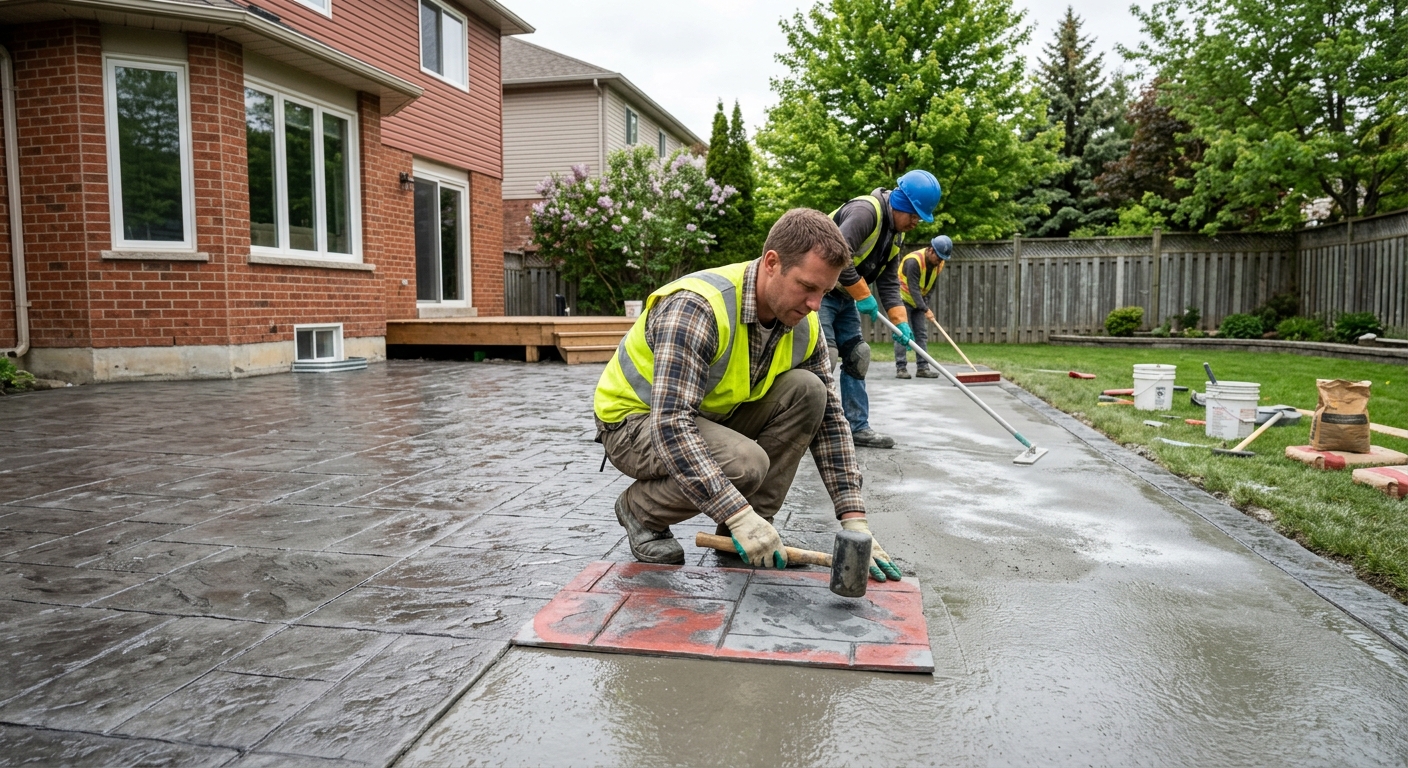
Concrete work options and costs in Maywood
Maywood homeowners typically start concrete projects for driveways, patios, walkways, and foundation-related work because flatwork is one of the most visible upgrades—and one of the most exposed to Maywood’s wet coastal winters. With a 2021 population of 19,650 in the area (Statistics Canada, 2021 Census), the Lower Mainland–Southwest market is active, and trades availability can tighten when neighbourhoods like Guildford and the wider corridor see multiple simultaneous footing-and-flatwork builds. In this part of the Lower Mainland–Southwest, concrete pricing is shaped less by “frozen” ground and more by the freeze–thaw cycles, saturated soils, and the way our practice protects slabs from frost damage. Local standards and typical designs assume a frost depth around 450 mm / 18", so footings and thickened edges are usually set below that to reduce frost heave risk.
Because of frequent wet weather, your base preparation and drainage details are where crews spend time—often including compacted granular and air-entrained mixes with proper jointing. Curing also matters: cool nights and humidity can extend the time crews need to achieve safe finishing and adequate strength, particularly for exterior slabs. That’s also why two “same-size” driveway quotes can differ—one contractor may include better subgrade prep, drainage, and curing measures that reduce cracking and scaling.
Below is a practical comparison of common Maywood options and typical price ranges to help you line up the apples-to-apples scope before you request bids.
| Application |
Typical Size |
Key Spec |
Finish Option |
Price Range |
| Concrete driveway (standard broom finish) |
400 sq. ft. |
Air-entrained exterior mix, control joints |
Broom finish, seal-ready |
$7,200 – $11,200 |
| Exposed aggregate driveway |
400 sq. ft. |
Air-entrained mix, retarder + washing plan |
Exposed stone, non-slip surface |
$9,200 – $14,000 |
| Stamped concrete driveway or patio |
300 sq. ft. |
Air-entrained exterior mix, integral colour |
Stamp pattern + release agent + sealer |
$10,000 – $18,000 |
| Plain concrete patio or walkway |
250 sq. ft. |
Compacted base, air-entrained mix |
Broom finish or light trowel |
$4,000 – $6,500 |
| Garage floor (interior slab) |
480 sq. ft. |
Vapour considerations, mesh or fibre as specified |
Broom finish or smooth float |
$7,500 – $14,000 |
| Foundation footings (structural, below frost) |
Varies by house |
Excavation, forming, rebar, concrete below frost depth |
Structural concrete to engineered spec |
$16,000 – $26,000 |
Prices are estimates only and vary by project scope, site access and material selection.
What affects the price of concrete work in Maywood
In Maywood and the broader Lower Mainland–Southwest region, the same “concrete job” can come in 30–50% apart because concrete pricing is a chain of decisions—excavation and drainage, sub-base thickness and compaction, mix design, reinforcement, finish type, and curing/seasonal precautions. When crews price flatwork, they’re also accounting for how often they’ll have to stop and re-schedule in coastal rain, how long cold, humid nights slow finishing, and how much labour is needed to protect the slab while it gains strength. That’s why you’ll sometimes see a basic broom-finish driveway land near the $18–$28 per sq. ft. range for the market band, while upgraded surfaces like stamped or exposed aggregate can climb toward the higher end.
Frost depth and freeze–thaw cycles dictate many specs. Exterior footings must sit below the design frost depth (coastal BC practice is often around 0.5–1.2 m depending on site conditions) to prevent frost heave. All exterior slabs exposed to moisture should use an air-entrained mix to survive freeze–thaw cycles and reduce scaling. Colder regions usually have shorter pour seasons and higher cost for heating and insulating blankets; even here in coastal BC, prolonged cool snaps still add curing attention, especially for decorative work. Finally, de-icing salts accelerate surface spalling in winter—so contractors that include sealing (and do it at the right time) can prevent early surface breakdown.
In Maywood, cost rises when your soil is saturated or when grades need correction for drainage. For example, adding a properly compacted granular base and drainage measures can add several thousand dollars to a driveway, but it often prevents early cracking that would cost you similar money later. Conversely, a smaller patio with good access and simple removal/haul-away can be a “tight” scope—keeping your concrete patio near the typical $16–$26 band. In older homes with tighter lanes and more removal (common in the Maywood area’s established streets), labour and disposal can push budgets upward more than the concrete itself.
| Price Factor |
Why It Matters |
Cost Impact |
| Frost line depth |
Determines footing depth and form height |
Higher excavation and concrete volume; can meaningfully lift foundation budgets |
| Site preparation |
Excavation, grading, compacted granular base |
Often a top driver for freeze–thaw performance and total cost |
| Reinforcement |
Rebar or wire mesh requirement |
Adds material and labour, especially where engineered spec calls for it |
| Mix design |
Air-entrainment and compressive strength spec |
Exterior air-entrained mixes support durability but may slightly raise material cost |
| Finish type |
Broom vs. stamped vs. exposed aggregate |
Decorative work requires more labour/time; typically higher per sq. ft. |
| Pour size and concrete truck access to site |
Impacts labour and whether extra equipment is needed |
Tight access can increase hours or require additional handling |
| Cold-weather curing precautions |
Heating and blankets to reach strength |
Can add direct labour/materials during cool periods |
| Control joint pattern and sealing cost |
Jointing limits random cracking; sealing repels moisture/salt |
May look “optional” but usually protects surface life and limits callbacks |
Permits & regulations in British Columbia
In British Columbia, structural concrete work—such as footings, foundation walls, and grade beams—typically requires a building permit, and municipalities often expect engineered drawings to be reviewed prior to construction. Concrete flatwork like driveways, patios, and walkways usually does not require a separate permit on its own, unless the project affects lot grading, impervious surface coverage, or municipal right-of-way or driveway approach rules.
For Maywood homeowners, the safest approach is to confirm requirements with the local authority before you break ground. Also verify your contractor carries proper coverage: ask for proof of liability insurance and workers’ coverage (WSIB/WCB-type coverage for their workforce). Request references for similar-scale Maywood exterior and foundation work, not only interior pours.
Step-by-step verification you can do before signing:
- Ask the contractor for their certificate of insurance and check that it matches the job location and includes liability adequate for your scope.
- Confirm workers’ coverage paperwork (WSIB/WCB coverage documentation) for the crew assigned to your project.
- Check their licensing/registration through the appropriate provincial business/contractor listing resources available online, then match the legal business name on the quote to the certificate.
- Verify they will use engineered details for footing/foundation work when required and will provide documentation you can keep with your building records.
- Get the permit responsibility in writing: who pulls it, who pays, and what happens if requirements change.
Getting concrete right in Maywood's freeze-thaw climate
Concrete failures in Maywood are usually less about “bad concrete” and more about bad site preparation, wrong mix, or poor jointing/curing for our freeze–thaw, wet-soil reality. In the Lower Mainland–Southwest, base preparation needs to be properly excavated and compacted granular sub-base to the right depth for drainage and frost protection. The mix should be air-entrained (commonly 5–7% air content for exterior flatwork) to create the micro-bubbles that give water somewhere to expand during freeze–thaw cycles. If air-entrainment is off, your slab is more vulnerable to spalling—the flaking and scaling that you’ll notice first around edges, expansion areas, and the surface line where de-icing salts collect.
To spec the job correctly, ask for a clear plan for control joints (so cracking happens in the right place), and insist on appropriate curing. Even though Maywood is milder than interior BC, cool nights and high humidity mean crews must allow proper curing time. For durability, plan sealing: apply a penetrating sealer after the slab has cured (typically 28 days post-pour) so the surface resists moisture and salt intrusion.
Price differences can be justified. For example, if a plain broom-finish patio lands near the lower end of the market band and a stamped option lands closer to the $22–$36 per sq. ft. decorative band, you’re paying for added labour (forms, stamping, curing attention, and colour/sealer workflow). If the contractor skips air-entrainment or weakens the base, though, paying extra for an “aesthetic” finish won’t prevent spalling—your durability spec must come first.
| Spec |
Why It Matters in Maywood |
What to Ask For |
Impact if Skipped |
| Compacted granular base (depth?) |
Supports drainage and reduces freeze–thaw movement |
Documented base thickness matched to soil and slab thickness |
Settling and cracking; edge breakdown |
| Air-entrained concrete mix (target air %?) |
Resists freeze–thaw scaling and spalling in wet winters |
Specify target air content (commonly 5–7% for exterior flatwork) |
Surface flaking and scaling, especially near joints |
| Compressive strength (MPa rating) |
Ensures design strength and better long-term durability |
Minimum 32 MPa compressive strength as stated in the scope |
Soft/weak surface; higher wear and early deterioration |
| Control joints (spacing per ACI guidelines) |
Directs shrinkage cracking where it’s least visible |
Joint spacing plan tied to slab dimensions and thickness |
Random cracking and water pathways |
| Minimum 7-day curing period |
Builds strength for finishing and early performance |
Confirm curing method and protection in cool/wet conditions |
Reduced strength gain; surface damage risk |
| Penetrating sealer (when applied after cure) |
Repels moisture and helps resist de-icing salt intrusion |
Sealer applied after adequate cure (often after 28 days) |
Faster staining, scaling, and salt-related spalling |
How to choose a concrete work contractor in Maywood
Start with verification. In British Columbia, confirm the contractor’s business details and licensing/registration through the appropriate online listings available to the public, and ensure the legal name on your quote matches what you see on their certificate documents. Ask for liability insurance and read the coverage limits—insufficient coverage is a common issue when problems occur. For workforce coverage, ask for documentation of WSIB/WCB-type coverage (as applicable to their company and crew). If they won’t provide proof up front, that’s a major warning sign.
Next, get 2–3 itemised written quotes, ideally with labour and materials broken out (excavation and disposal, granular base, reinforcement, concrete mix, forms, finishing, curing/sealer). Be strict about the scope: confirm what’s excluded (haul-away, saw-cutting, drainage corrections, concrete removal, permits/engineering if needed) and whether disposal is included. For foundations/footings, make sure engineered requirements are included where structural work requires them.
Warranty matters too. Ask for the length of workmanship warranty, what it covers (cracks vs. surface scaling), how long the claim window is, and whether the warranty is tied to the property or only the original customer (transferability). For payment, avoid large deposits—keep initial payment to about 10–15% and hold back until completion. Finally, insist on a written start date and completion estimate, because wet weather can disrupt scheduling; a contractor with a plan for curing protection is typically more reliable.
- Provide proof of liability insurance before you sign.
- Provide workers’ coverage documentation (WSIB/WCB-type).
- Match the quote scope to a written site-access plan (where trucks pump/ready-mix can reach).
- Confirm air-entrained mix for exterior work is included in writing.
- Require a base prep thickness and compaction approach, not just “we prep the base.”
- Ask about joint layout and confirm control joints will be cut/specified on schedule.
- Ask how they handle rain/cool nights during curing (blankets, sealer timing, protection).
- Get disposal/haul-away included or listed as an add-on.
- Ask whether the quote includes saw-cut control joints and final edge finishing.
- Request a written product/spec list for decorative work (integral colour, stamp workflow, sealer type).
- Demand an itemised breakdown (labour, materials, finishing, curing, sealing).
- Confirm warranty terms and whether they apply to future owners.
Concrete red flags specific to Maywood contractors include: vague wording like “standard mix” with no air-entrainment specified, no plan for rain-cool weather curing protection, skipping or postponing sealing after adequate cure time, quotes that under-include excavation/disposal while still claiming tight tolerances, and pressure for large upfront deposits (beyond 10–15%).
Frequently asked questions — concrete work in Maywood
What causes concrete to spall in Maywood winters?
In Maywood and the wider Lower Mainland–Southwest, spalling (flaking/scaling) is usually tied to freeze–thaw damage plus moisture getting into the concrete’s surface pores and cracks. If the concrete isn’t air-entrained to the right target for exterior exposure (commonly 5–7% for exterior flatwork), the water expands during freezing and weakens the surface over repeated cycles. Coastal wet weather keeps surfaces saturated longer, and de-icing salts accelerate surface breakdown in areas where winter maintenance uses salt. Another contributor is inadequate base prep or drainage, which allows water to pond near edges and joints. The right fix is preventative: specify air-entrainment, proper control joints, and plan penetrating sealer after cure (often around 28 days).
What is rebar and when is it required in British Columbia?
Rebar is steel reinforcement installed inside concrete to help control cracking and improve structural capacity. In British Columbia, whether rebar is required depends on what you’re building and the design/engineered requirements. Structural work such as footings, foundation walls, and grade beams is typically engineered and often includes rebar, because it must carry loads and resist movement. For flatwork like driveways and garage slabs, reinforcement may be required based on slab thickness, soil conditions, and design loads (for example, heavier vehicles), and some contractors specify wire mesh or fibres instead of—or alongside—rebar. The best approach in Maywood is to ask for the reinforcement spec written into your scope and confirm it matches the engineered design where applicable. If the contractor can’t explain what steel (or alternatives) is included and why, get that clarified before you pour.
How long does a concrete project take in Maywood?
The “calendar time” and the “work time” are different in Maywood because curing and weather pauses matter. For an exterior patio or walkway, the typical crew time on site may be one to three days (demo/removal, forming, pour, finishing), but the project isn’t fully finished until curing is complete and the surface can be sealed properly. Curing depends on temperature and humidity—Lower Mainland coastal conditions often mean longer protective curing than homeowners expect. Many contractors plan at least 7 days of curing before heavy use, and sealing is usually scheduled after adequate cure (often around 28 days) to get the best protection from moisture and de-icing salt exposure. Decorative work like stamped concrete also needs careful timing to manage cool/wet conditions and consistent finishes. A well-prepared contractor should give you a written schedule with weather contingencies.
What is a concrete overlay and is it suited to Maywood?
A concrete overlay is a new cementitious layer placed over an existing slab after surface preparation (often grinding and patching). It can be suited to Maywood when the original slab is still structurally sound—no major settlement, widespread failure, or deep subgrade issues. The key limitation is that overlays don’t “fix” problems coming from below; they mainly address surface wear and appearance. If the old slab is already spalling from inadequate air-entrainment or failed joints, the overlay can crack or fail at the interface, especially in wet winters with freeze–thaw cycles. If you’re considering an overlay, ask the contractor to assess the slab for movement, drainage issues, and soundness, then explain whether control joints will be re-established or whether new joints will be planned. If the project is more than cosmetic—or if water is pooling—you may get a longer service life with full-depth replacement, which typically aligns better with your concrete durability goals.
How do I seal concrete to protect it in Maywood?
Sealing helps in Maywood because it reduces how easily moisture and de-icing salts penetrate the surface. The most common mistake is sealing too early. For best results, wait until the slab has cured sufficiently—often around 28 days post-pour for exterior flatwork—then apply a penetrating sealer that’s compatible with exterior concrete. The contractor should also address jointing and surface conditions before sealing; sealers work only if the concrete surface is clean and properly cured. In practice, a sealed driveway or patio generally holds up better against winter splash/salt exposure than unsealed concrete. When comparing bids, make sure sealing is actually included (product and timing), not just mentioned. If your driveway option is in the standard price band near $18–$28 per sq. ft., ask whether the quote includes the sealer workflow and whether they plan for wet weather curing protection.
What is the difference between concrete and cement?
Concrete is the final construction material you see and build with. Cement is one ingredient inside concrete. In simple terms, concrete is made from cement (the binder) plus water, sand, gravel/aggregate, and sometimes admixtures like air-entrainment agents and plasticizers. In Maywood’s coastal wet climate, the details of the concrete mix design matter: for exterior flatwork, air-entrainment helps manage freeze–thaw cycling, while the specified compressive strength (commonly at least 32 MPa in many flatwork scopes) supports surface durability. Cement alone doesn’t tell the full story—two mixes with the same cement content can perform very differently depending on aggregate quality, water-cement ratio, and air-entrainment. When you request quotes, focus on the concrete specifications (air content, strength, curing plan, sealing timing) rather than just asking for “cement.”