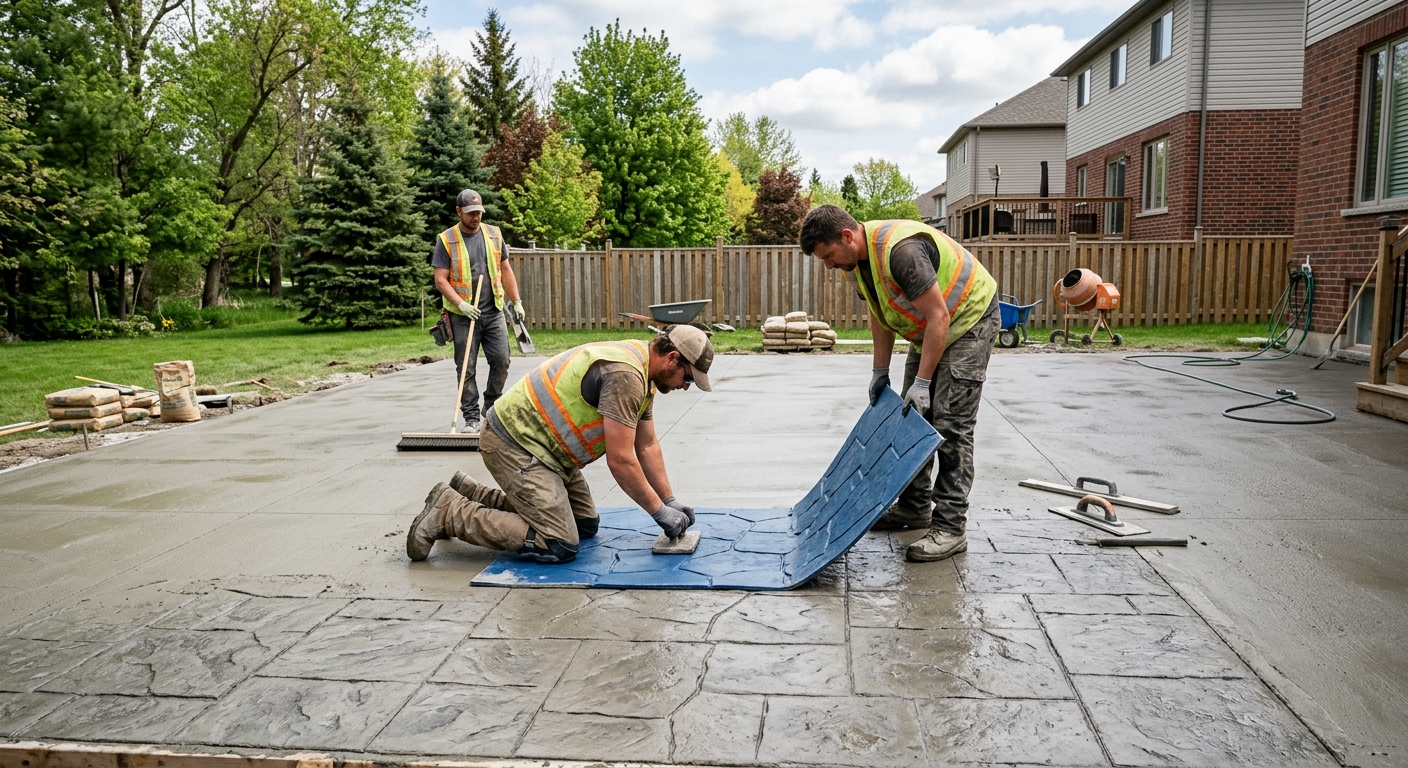
Concrete work options and costs in Brentwood Bay
In Brentwood Bay, concrete flatwork is a staple of local homes and renovations, and the right option usually comes down to durability, curb appeal, and how much freeze–thaw and coastal moisture your slab has to resist. With a population of 7,581 (Statistics Canada, 2021 Census), Brentwood Bay is smaller than nearby urban centres, so most concrete trades and suppliers rely on the wider Vancouver–Surrey–Abbotsford market for crew availability and dispatching ready-mix trucks. That can be great for quality consistency, but it also means scheduling windows can tighten during busy stretches.
Brentwood Bay’s housing stock leans toward single-family living, which drives steady demand for driveways, patios, and walkways—these are typically where homeowners want both performance and appearance. In the Lower Mainland–Southwest, mild winters and a shallow frost line around 450 mm / 18" help, but we still get freeze–thaw cycles, saturated soils, and heavy coastal rainfall. Those conditions directly affect pricing because exterior work must be built over a properly compacted granular base, with air-entrained concrete, correct control jointing, and weather-aware curing (often using blankets and longer cure times after cool, wet pours).
One area where this trade is especially active is around Brentwood Bay proper and the surrounding waterfront neighbourhoods—homes there commonly see driveway and patio replacements tied to drainage improvements and landscaping updates.
Below is a practical comparison of common concrete options and current price bands for this region, so you can align quotes to the same scope before making a decision.
| Application |
Typical Size |
Key Spec |
Finish Option |
Price Range |
| Concrete driveway (standard broom finish) |
300–400 sq. ft. |
Air-entrained exterior mix, compacted granular base, control joints |
Broom finish with sealer option |
$8,000–$11,200 |
| Exposed aggregate driveway |
300–400 sq. ft. |
Air-entrained exterior mix, proper curing, surface hardener/lift system |
Exposed aggregate (pebble/cashmere blend) |
$10,500–$14,500 |
| Stamped concrete driveway or patio |
200–350 sq. ft. |
Reinforced slab, colour integral or hardener system, controlled joints |
Stamped patterns (slate/wood/stone look) |
$11,000–$18,500 |
| Plain concrete patio or walkway |
150–300 sq. ft. |
Air-entrained mix, compacted base, edge forms, joints |
Float/finish with broom or trowel-lite |
$3,200–$6,600 |
| Garage floor (interior slab) |
400–700 sq. ft. |
Interior mix, vapour control where specified, saw cuts for control |
Standard trowel/finish |
$8,000–$16,500 |
| Foundation footings (structural, below frost) |
Per linear foot (typ. 40–80 ft.) |
Excavation, forms, rebar as required, engineered wall/beam connections |
Structural concrete, below frost depth |
$8,000–$28,000 |
Prices are estimates only and vary by project scope, site access and material selection.
What affects the price of concrete work in Brentwood Bay
In Brentwood Bay and the wider Lower Mainland–Southwest region, you can see quote-to-quote swings of roughly 30–50% for what looks like the “same” concrete job. The reason is that concrete pricing is less about pouring a slab and more about everything around it: how deep we excavate, how we build drainage, whether we need thicker edges or piers, what reinforcement is required, and how we manage curing when the weather turns cool and wet. Availability also plays a role—busy stretches can affect truck scheduling and crew turnaround time in the Vancouver–Surrey–Abbotsford corridor.
Frost protection is the biggest technical driver that affects both labour and materials. In our area, typical design practice assumes a frost depth around 450 mm / 18", but footings and thickened edges are still placed below that to reduce frost heave risk. Exterior slabs also need air-entrained concrete to survive freeze–thaw cycles and keep scaling/spalling down. In colder provinces, deeper frost and longer curing precautions (sometimes including heating and insulating blankets) can raise costs significantly. In coastal BC, our cold-weather work is usually more about timing and curing control than extreme depths, but we still see cost adders from prolonged rain, saturated soils, and the need for better drainage prep.
Here are examples of how local conditions change the number on your estimate. A driveway built over saturated, clayey fill will often require extra granular base and drainage work, which can move a job from a $18–$28 per sq. ft. type range toward the higher side, especially when we’re also adding reinforcement. Meanwhile, a stamped driveway can add labour-intensive finishing and extra material costs; it’s not just “pretty”—it’s justified when you want curb appeal without sacrificing weather durability, typically aligning with the $22–$36 per sq. ft. stamped price band.
Finally, housing age affects what we uncover. Older properties often have mismatched subgrades, missing drainage swales, or buried landscaping debris—those issues can create excavation waste and extra base work, sometimes adding thousands even if the visible concrete area stays the same.
| Price Factor |
Why It Matters |
Cost Impact |
| Frost line depth — determines footing depth and form height |
Footings must be below the design frost depth to prevent frost heave |
Can increase excavation and forming time; often the biggest structural cost swing |
| Site preparation — excavation, grading, compacted granular base |
Proper base reduces settlement and cracking; drainage controls saturation |
More granular/compaction and haul-away increases labour and equipment charges |
| Reinforcement — rebar or wire mesh requirement |
Controls cracking and supports loads (especially driveways and garage slabs) |
Extra material + tying/install time; labour can rise if access is tight |
| Mix design — air-entrainment and compressive strength spec |
Exterior air content helps resist freeze–thaw scaling/spalling |
Higher-spec mix costs more and may require more careful finishing sequencing |
| Finish type — broom vs. stamped vs. exposed aggregate |
Finishes dictate extra steps, form/texture materials, and crew experience |
Stamped/exposed typically add labour hours and material handling |
| Pour size and concrete truck access to site |
Smaller pours can mean multiple loads; tight sites can require pumping |
Pumping, wait time, and extra mobilization can add significant cost |
| Cold-weather curing precautions — heating and blankets |
Cool, wet conditions slow strength gain and increase surface defects |
Blankets/heaters and scheduling delays add crew time and material costs |
| Control joint pattern and sealing cost |
Joints manage shrinkage cracking; sealing protects against moisture and de-icing salts |
More saw cuts and sealer application add line items but reduce future failure risk |
Permits & regulations in British Columbia
In British Columbia, whether you need a permit depends on the type of concrete work. Structural concrete—such as footings, foundation walls, and grade beams—typically requires a building permit, and engineered drawings are often part of the process for review by the municipality. For concrete flatwork like patios, walkways, and driveways, permits are commonly not required unless the work affects lot grading, impervious surface coverage limits, or impacts municipal right-of-way conditions (for example, tie-in at a curb, drainage routing, or changes to slopes that direct water onto adjacent property).
Before breaking ground in Brentwood Bay, confirm the requirement with the local authority. Also verify your contractor is properly insured and covered. Ask for proof of liability insurance and WSIB/WCB coverage (BC uses provincial coverage through WCB/coverage structures), and request references from similar-scale projects—driveways and shallow foundation work that matches your site’s drainage and soil conditions.
Step-by-step homeowner checks:
- Licence/credentials: Ask the contractor for their BC registration/licence number (and any applicable trade registration) and ensure it’s current.
- Liability insurance: Request a valid Certificate of Insurance and confirm it names you appropriately as additional insured where your contract requires it.
- WSIB/WCB coverage: Ask for proof of worker coverage (or equivalent documentation) so you’re not left responsible for injury claims.
- Clearance letter (if applicable): For insured work documentation, request the latest clearance letter or status report.
- References: Verify at least 2–3 nearby installations with comparable weather exposure (exterior flatwork in coastal-wet conditions).
Getting concrete right in Brentwood Bay's freeze-thaw climate
Concrete failure in Brentwood Bay is usually a “system problem,” not a single bad pour. The coastal-wet climate brings heavy rainfall and saturated ground, while winter freeze–thaw cycles push water through hairline cracks and weak edges. When that water freezes, it expands—leading to spalling (surface flaking), scaling, and premature cracking. The way to avoid it is to spec the job like an exterior exposure product: build the base correctly, use the right mix, control cracking, and cure and seal properly.
1) Base preparation: Use compacted granular sub-base to the required depth for your soil and drainage conditions. If we find soft spots or poor drainage, we adjust the base and add drainage measures rather than “hoping the slab fixes it.”
2) Mix design: For exterior flatwork, specify air-entrained concrete (commonly 5–7% target air content for exterior work) and a minimum 32 MPa compressive strength. This air helps concrete tolerate freeze–thaw without losing surface integrity.
3) Control joints: Plan saw-cut joints (or scored joints where appropriate) to control where cracks occur—don’t leave it to random shrinkage.
4) Curing: Plan for at least 7 days of proper curing under suitable conditions. In cool, wet stretches, cure protection (blankets/covering) is often needed so strength keeps developing.
5) Sealing: Apply a penetrating sealer after the slab has cured (often around 28 days post-pour) to repel moisture and reduce de-icing salt impact.
Concrete spalling is the classic failure homeowners notice—usually from inadequate air-entrainment or poor curing. For example, upgrading a driveway from a lower-spec mix to a properly air-entrained exterior mix often costs less than people expect, and the “savings” from cutting corners show up as repairs sooner. Paying for correct specs is one of the best ways to justify why a stamped or exposed option sits higher within the region’s bands (for example, stamped projects commonly align with the $22–$36 per sq. ft. range) without compromising durability.
| Spec |
Why It Matters in Brentwood Bay |
What to Ask For |
Impact if Skipped |
| Compacted granular base (depth?) |
Prevents settlement and limits water holding under the slab in coastal-wet conditions |
Granular type, target compaction method, and base depth to suit soil and drainage |
Cracking, uneven settling, and accelerated wear |
| Air-entrained concrete mix (target air %?) |
Freeze–thaw cycles require adequate air voids to resist scaling and spalling |
Air content target (commonly 5–7% for exterior flatwork) and confirmation of exterior exposure mix |
Spalling/scaling within a few winters |
| Compressive strength (MPa rating) |
Ensures the slab reaches strength for load and durability |
Minimum 32 MPa for exterior flatwork unless otherwise engineered |
Surface damage, reduced service life, and poor curing outcomes |
| Control joints (spacing per ACI guidelines) |
Controls shrinkage cracking in a climate with moisture cycles |
Joint spacing plan and saw-cut timing |
Random cracks and water ingress into the slab edges |
| Minimum 7-day curing period |
Cold nights and high humidity slow strength gain |
How curing will be protected if temps are cool or rain is forecast |
Weak surface, dusting, and premature deterioration |
| Penetrating sealer (when applied after cure) |
Repels moisture and reduces de-icing salt damage in freeze–thaw winters |
Sealer type and target application timing (commonly around 28 days post-pour) |
Faster scaling/spalling and more frequent maintenance |
How to choose a concrete work contractor in Brentwood Bay
Choosing the right contractor in Brentwood Bay is mostly about verification and scope clarity. Start with licensing/coverage checks. Ask for the contractor’s current credentials, then request:
- Liability insurance: Get a current Certificate of Insurance. Make sure it covers concrete work and is valid for the project period.
- WSIB/WCB coverage: Ask for proof of worker coverage (documentation that shows workers are covered). This helps protect you if an accident happens on site.
- Clearance letter (if applicable): Request the most current status letter if the contractor provides it as part of their standard practice.
- References: Look for recent similar jobs—driveways and patios built for exterior exposure, not just interior slabs.
Next, get 2–3 itemised written quotes. You want the breakdown to show labour and materials separately (and how they handle base prep, reinforcement, joints, curing, and sealing), not a vague lump-sum that hides exclusions. Read scope carefully: is excavation and disposal included? Will they protect landscaping? Is a permit pull included if required for foundation work? Will they schedule around rain and cold nights?
Warranty matters. Ask for a written workmanship warranty length and clarify whether it covers surface cracking, spalling, joint failure, and sealer-related workmanship. Also ask about manufacturer product warranties if sealers are supplied—warranties may be tied to application timing and installer credentials.
Payment schedule should be conservative: never pay more than 10–15% upfront. Hold back a portion until the job is complete and inspected. Finally, insist on a start date and completion estimate in writing—concrete crews often mobilize based on weather and dispatching, so timelines should be stated explicitly.
- Confirm exterior air-entrainment spec and joint plan in writing.
- Ask who is supplying the concrete and whether the mix is specified for exterior freeze–thaw exposure.
- Verify base prep depth and compaction method (not just “we’ll prep it”).
- Confirm reinforcement (mesh/rebar) requirements for your slab type and load.
- Check whether sealing is included (and when, typically after cure).
- Ensure excavation, disposal/haul-away, and protection of existing drainage are included.
- Ask about truck access and whether pumping is planned if needed.
- Request curing protection plan for cool or rainy forecasts.
- Review exclusions: do they exclude lawn restoration, forms removal, or saw-cutting?
- Get product and workmanship warranty terms in writing (what’s covered, for how long).
- Confirm payment terms and retainage/holdback amount before signing.
- Confirm debris cleanup and site restoration at completion.
Red flags in Brentwood Bay concrete contracts: “low price” quotes with no mention of air-entrained mix or control joints, vague wording like “standard curing,” no proof of liability/coverage, skipping disposal/haul-away details, or pushing full payment upfront. If they won’t show you an itemised breakdown and a written spec plan, treat it as a warning—not a bargain.
Frequently asked questions — concrete work in Brentwood Bay
How do I maintain concrete in Brentwood Bay's freeze-thaw climate?
Maintenance in Brentwood Bay is about controlling moisture and protecting the surface during freeze–thaw. Keep the slab clean so salts, grime, and debris don’t stay in contact with the concrete for long periods. Use gentle de-icing practices when snow/ice arrives—avoid over-salting, since de-icing salts can accelerate spalling. If your contractor included a penetrating sealer, you’ll typically need to re-evaluate it after a few seasons depending on exposure (driveways see more traffic and wear). For patios and walkways, clear standing water and ensure nearby landscaping isn’t directing runoff onto the slab. If you notice small cracks, address them early—sealed joints and proper drainage reduce water pathways that freeze and expand.
What causes concrete to spall in Brentwood Bay winters?
Spalling happens when water gets into the concrete and then freezes, expanding and breaking the surface paste. In Brentwood Bay’s Lower Mainland–Southwest conditions, saturated soil from heavy rainfall and repeated freeze–thaw cycles are the main contributors. The most common spec issues behind spalling are inadequate air-entrainment for exterior exposure, insufficient curing protection during cool periods, and missing or poorly located control joints that allow random cracking and water ingress. Sometimes the base is also the culprit—if the granular base and drainage aren’t set up correctly, the slab stays wetter longer. That’s why exterior work may be priced around the driveway band (for example, concrete driveway work often starts around $18–$28 per sq. ft., depending on specs), because correct mix and base prep protect the slab.
What is rebar and when is it required in British Columbia?
Rebar (reinforcing steel) is steel bars placed inside concrete to improve strength and control cracking in tension. In British Columbia, when rebar is required depends on the structure and engineering design—not just on “guessing what’s stronger.” For foundation walls, grade beams, and many footing configurations, engineered drawings commonly specify reinforcement size, spacing, cover, and lap lengths. For exterior flatwork like driveways and garage slabs, reinforcement requirements depend on slab thickness, reinforcement design (mesh vs. rebar), soil conditions, and expected loads. Some projects may use wire mesh; others require rebar—especially where loads are heavier or where the design calls for it. If your quote doesn’t clearly state reinforcement and slab thickness (and whether it’s designed for the expected traffic), ask questions before signing.
How long does a concrete project take in Brentwood Bay?
Timelines vary with scope and weather, but in Brentwood Bay you can usually think in phases: prep, pour, and cure/finish. Site preparation (excavation, base, forms, and reinforcement) can take several days depending on access and how much existing material must be removed and hauled away. The pour itself is usually one day for typical driveways and patios, but crews may schedule multiple loads or a longer day if there are access constraints. Curing is the real constraint—concrete reaches strength over time, and while it may look “done” quickly, workmanship-grade finishing and safe use depend on curing conditions. Cooler, wetter weather can extend timelines because curing blankets, sealers, and protective measures may be needed. If you’re planning work in a tight window, ask the contractor to include a weather contingency plan.
What is a concrete overlay and is it suited to Brentwood Bay?
A concrete overlay is an additional concrete layer placed over an existing slab to improve appearance and level out minor surface issues. Overlays can work when the original concrete is structurally sound (not badly cracked, delaminated, or lifting) and when bonding conditions are prepared correctly (often including cleaning, profiling, and sometimes adhesives/primers depending on the system). In Brentwood Bay’s freeze–thaw climate, overlays are sometimes a good solution for surface-level deterioration, but they’re not a fix-all for water intrusion or foundation movement. If moisture is coming from below or the base is failing, an overlay may hide the problem temporarily. For homeowners, the decision should be made after an on-site assessment of cracks, drainage, and slab soundness—especially because exterior freeze–thaw demands high-performance detailing. If you’re weighing options, compare to full replacement pricing so you don’t spend overlay money without solving the root cause.
How do I seal concrete to protect it in Brentwood Bay?
Sealing helps protect exterior concrete in Brentwood Bay by repelling moisture and reducing the impact of de-icing salts during winter. The key is timing and product choice. You generally want to apply a penetrating sealer after the concrete has properly cured—often around 28 days post-pour—so the concrete is dry enough for good penetration and so you don’t trap moisture under the surface. Before sealing, the slab should be clean and free of dust, grease, and construction residue; water test and surface prep matter. After sealing, keep an eye on joint sealing and drainage—sealer won’t compensate for cracked, leaking joints or poor base drainage. If you’re planning a stamped patio or driveway, ask your contractor how they’ll protect the texture during prep and whether sealing is included in the quote’s scope and schedule.