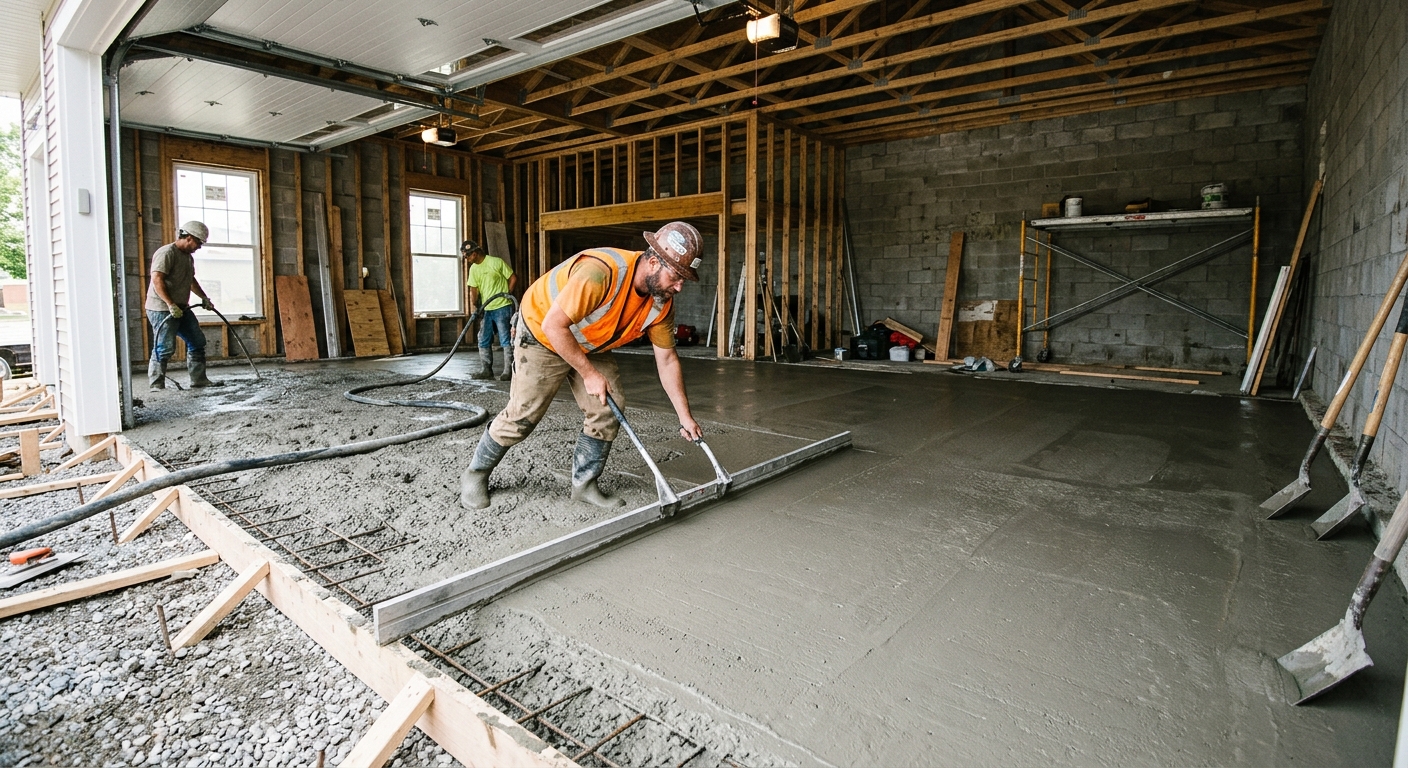
Concrete work options and costs in Dallas
Concrete work in Dallas, British Columbia is driven by a small but active housing market: the City profile for the 2021 Census shows a population of 4,479 residents (Statistics Canada, 2021 Census). That matters because Dallas sees steady demand for durable flatwork—especially driveways and patios—tied to the area’s mix of detached and family homes. In the Lower Mainland–Southwest, contractors also tend to stay busy in neighbourhood pockets where renovations cluster, and that seasonal consistency affects both scheduling and pricing.
Across the Lower Mainland–Southwest, mild winters and a shallow frost line still require disciplined foundation and slab specs. In practice, we design around an assumed frost depth of about 450 mm / 18", which means exterior footings, thickened edges, and any structural work are placed below that to reduce freeze–thaw damage. The coastal-wet climate adds another cost driver: frequent freeze–thaw cycles, saturated soils, and heavy rainfall mean base prep, drainage attention, and longer curing/seasonal planning are built into most quotes.
Basement entryways, driveways, and side-yard replacements are especially common in areas like Chemainus Road and the surrounding residential corridors where access is straightforward and municipal drainage considerations come up often. If you’re comparing options, it helps to start with typical project “packages” before you talk to a contractor about your exact site constraints, base depth, reinforcement, and finish selection. Use the table below as a baseline for what homeowners in Dallas usually see for labour and materials in our region.
| Application |
Typical Size |
Key Spec |
Finish Option |
Price Range |
| Concrete driveway (standard broom finish) |
400–600 sq. ft. |
Air-entrained exterior mix, compacted granular base, control joints |
Broom finish, saw-cut joints |
$18,000–$28,000 |
| Exposed aggregate driveway |
400–600 sq. ft. |
Air-entrained mix, proper curing, wash/retarder process control |
Exposed aggregate (standard 1–2 colour blend) |
$22,000–$34,000 |
| Stamped concrete driveway or patio |
250–500 sq. ft. |
Air-entrained mix, reinforced areas where needed, release agent and curing plan |
Stamped pattern + sealer |
$18,000–$40,000 |
| Plain concrete patio or walkway |
200–400 sq. ft. |
Compacted base, air-entrained exterior mix, proper edging |
Broom or smooth-trowel with broom slip texture |
$4,000–$10,400 |
| Garage floor (interior slab) |
400–650 sq. ft. |
Vapour barrier/insulation as needed, fibre or mesh, sealed jointing |
Float/steel trowel, optional sealer |
$9,000–$16,000 |
| Foundation footings (structural, below frost) |
Per foundation scope |
Concrete below design frost depth, engineered rebar cage, proper bearing and drainage |
Structural formwork, formed/finished top as required |
$3,200–$7,000 |
Prices are estimates only and vary by project scope, site access and material selection.
What affects the price of concrete work in Dallas
In Dallas, British Columbia, two quotes for what looks like the same concrete job can legitimately differ by 30–50% across the Lower Mainland–Southwest and the broader province because the “hidden work” changes—especially base prep, frost protection, drainage, and concrete mix design. Even when the surface finish is simple, exterior concrete must be spec’d to handle repeated freeze–thaw cycles and wet coastal conditions. That means air-entrained concrete, correct subgrade compaction, and a crack-control joint plan are standard for driveways and patios.
Frost-line depth directly dictates footing and form height in our region: footings must extend below the design frost depth (about 0.5–1.2 m in coastal BC) to prevent frost heave. When a contractor has to excavate deeper, form higher, and manage wetter soils, costs rise. The calendar also plays a role. Cooler stretches shorten pour windows; contractors may need cold-weather curing precautions (blankets and insulated protection) to reach target strength, which adds labour and material.
Concrete sealing is another factor. De-icing salt (on driveways and steps) can accelerate spalling if surfaces aren’t protected—so proper sealing and surface prep can be the difference between a driveway that scales in a few winters versus one that holds up. In practical terms, you’ll often see a plain patio come in closer to the $16–$26 band for typical work, while stamped work trends higher because of additional labour and materials (moulds, colour/texture set-up, and sealer). If your project needs exposed aggregate or wider reinforced edges, costs can move further into the upper tiers.
In Dallas specifically, older lots with unknown fill and tighter access corridors can push excavation and truck set-up time up quickly—sometimes by hundreds to a few thousand dollars—while clean, accessible sites with stable bearing can keep you near the lower end of the bands.
| Price Factor |
Why It Matters |
Cost Impact |
| Frost line depth — determines footing depth and form height |
Footings and thickened edges must sit below frost to limit heave |
Higher excavation/formwork can add several thousand dollars |
| Site preparation — excavation, grading, compacted granular base |
Stable base reduces settlement and cracking |
Wet, soft, or unknown soils can increase base material and labour |
| Reinforcement — rebar or wire mesh requirement |
Controls cracking and supports load paths |
Mesh/rebar tying and extra lift time adds cost |
| Mix design — air-entrainment and compressive strength spec |
Air entrainment helps resist freeze–thaw scaling |
Higher-spec exterior mixes and testing/QA add a premium |
| Finish type — broom vs. stamped vs. exposed aggregate |
Labour and workflow complexity increase with decorative finishes |
Stamped/exposed typically move you toward upper driveway/patio bands |
| Pour size and concrete truck access to site |
Smaller pours can cost more per sq. ft.; limited access raises handling time |
Extra labour/hosing/pumping or waiting time increases total |
| Cold-weather curing precautions — heating and blankets |
Strength gain is slower in cool conditions |
Added blankets/heaters and longer scheduling to protect the pour |
| Control joint pattern and sealing cost |
Joints manage cracks; sealing protects from water and salts |
More saw cuts/plan changes plus sealer materials and labour |
Permits & regulations in British Columbia
In British Columbia, many concrete items are treated differently depending on whether they’re structural or just flatwork. Structural concrete work—such as footings, foundation walls, grade beams, and any concrete that’s part of the structural system—usually requires a building permit and often engineered drawings that the municipality reviews. Concrete flatwork (patios, walkways, and driveways) typically does not require a separate permit by default, unless it affects lot grading, drainage, impervious surface coverage limits, or the municipal right-of-way. In Dallas, always confirm with your local authority before breaking ground, especially if you’re changing drainage patterns, raising the elevation near foundations, or working close to ditches and swales.
Step-by-step, here’s how a homeowner can protect themselves and verify a contractor in British Columbia. First, ask for their business registration and proof they can legally perform the work (and request the exact licence number if applicable). Next, request a current certificate of liability insurance showing the policy’s effective dates and coverage amounts. For workers and jobsite risk, ask for proof of WSBC/WCB coverage (or the applicable clearance letter). Then, confirm they can provide references for similar-scale concrete projects in the region—driveways and exterior slabs with air entrainment, correct base prep, and drainage details. Finally, ensure the scope aligns with what will be inspected, if any inspection is required for your structural components.
Getting concrete right in Dallas's freeze-thaw climate
Concrete failures in Dallas are most often related to water and expansion—especially when the base isn’t compacted correctly, drainage is poor, or the mix isn’t designed for freeze–thaw. In a coastal-wet climate, saturated soils and repeated temperature swings stress the slab and edges. To spec the job correctly, start with (1) base preparation: compacted granular sub-base to the right depth for the soil and frost-protection needs, with attention to drainage and proper grading away from foundations. (2) mix design: exterior slabs should use air-entrained concrete with target air content typically around 5–7% for freeze–thaw resistance, plus a minimum 32 MPa compressive strength so the slab achieves durability. (3) control joints: place joints to encourage cracking in the right lines, rather than letting random cracks spread. (4) curing: plan for at least 7 days of curing under proper conditions; in cool nights and high humidity, curing blankets and surface protection help the concrete reach strength. (5) sealing: apply a penetrating sealer after the slab has cured (often around 28 days post-pour) to repel water and reduce damage from de-icing salts.
Here’s an example of where price differences are justified: a broom-finish driveway might land near the $18–$28 range, while stamped concrete can add significant labour and materials. If your contractor cuts corners on air entrainment or curing to save money, you can end up paying more later for crack repairs and rework—especially on exterior surfaces where scaling from freeze–thaw is the long-term issue. The right mix and curing plan may cost more upfront, but it’s what keeps the finish looking good and the slab performing.
| Spec |
Why It Matters in Dallas |
What to Ask For |
Impact if Skipped |
| Compacted granular base (depth?) |
Stable support reduces settlement and cracking in wet, freeze–thaw conditions |
State required granular thickness for your soil and frost-protection approach; confirm compaction |
Early cracking, uneven surface, and edge deterioration |
| Air-entrained concrete mix (target air %?) |
Air voids control freeze–thaw scaling and surface damage |
Ask for exterior air content around 5–7% and confirm it’s air-entrained |
Spalling and scaling within a few seasons |
| Compressive strength (MPa rating) |
Strength gain supports durability and surface wear resistance |
Minimum 32 MPa for exterior slabs; confirm mix design documentation |
Lower durability and weaker abrasion resistance |
| Control joints (spacing per ACI guidelines) |
Controls where cracks form to keep the slab tight and predictable |
Ask for joint spacing plan and saw-cut timing |
Random cracking and wider crack widths |
| Minimum 7-day curing period |
Cold/wet conditions can slow strength gain without protection |
Confirm curing method (blankets/protection) for cool nights |
Reduced strength and higher risk of surface defects |
| Penetrating sealer (when applied after cure) |
Repels water and helps protect against de-icing salt effects |
Ask for sealer application timing—commonly after ~28 days cure |
More water absorption, faster scaling, and staining |
How to choose a concrete work contractor in Dallas
Choosing the right concrete contractor in Dallas, British Columbia comes down to proof and clarity. Start by verifying BC coverage and risk protection. Ask for a current certificate of liability insurance (so you’re not left holding the bag if something goes wrong), and confirm WSBC/WCB coverage with a clearance letter or proof of enrollment. If they’re doing structural concrete scope, request details of engineered design coordination where applicable and ask for references on similar work in the region.
Next, get 2–3 itemised written quotes. You want line items that break labour and materials apart—excavation and disposal, granular base, reinforcement, formwork, concrete supply, finish labour, curing protection, and sealing if included. Avoid “lump sum only” quotes unless the scope is extremely detailed. Read what’s excluded: is permit pulling included (for structural work), is disposal of excess material included, and are costs for pumping/hosing included if access requires it? A good quote clearly states the base thickness and reinforcement approach, not just “concrete and finish.”
Warranty matters too. Ask for the workmanship warranty length, whether product/manufacturer warranties apply to sealer or admixtures, and whether any coverage is transferable to future owners. For payments, never let the schedule ask for more than about 10–15% upfront; hold back a portion until completion. Finally, insist on a start date and completion estimate in writing—seasonal scheduling in the Lower Mainland–Southwest is real, and weather disruptions affect curing and surface quality.
- Confirm WSBC/WCB coverage with documentation.
- Request a current certificate of liability insurance.
- Get a written scope with base prep thickness and compaction requirements.
- Confirm the mix is air-entrained for exterior slabs.
- Ask for minimum strength spec (typically 32 MPa for exterior work).
- Require a joint/control plan (spacing and saw-cut timing).
- Ask how they handle prolonged rain and cool nights (curing blankets/protection).
- Make sure concrete truck access and any pumping/hosing is included or quoted.
- Clarify rebar/mesh type, placement, and tie-wire labour.
- Confirm drainage/grading away from foundations is included.
- Verify disposal/haul-off is included in the price or clearly excluded.
- Set a payment schedule with a holdback until finish work and cleanup are complete.
Dallas red flags: contractors who won’t discuss air entrainment or joint spacing, quotes that omit base preparation and compaction details, crews that pour during cold snaps without curing protection, vague timelines with no start/completion dates, and payment schedules asking for large upfront deposits (well above 10–15%).
Frequently asked questions — concrete work in Dallas
Why does concrete crack in Dallas and how is it prevented?
In Dallas and throughout coastal BC, concrete cracking is often about shrinkage and restraint, but freeze–thaw makes water management more critical. The slab can move slightly as moisture conditions change, and if the base isn’t compacted properly or drainage isn’t corrected, micro-movements widen cracks. The biggest prevention steps are base preparation (compacted granular to the right depth), using the correct exterior mix (including air entrainment for freeze–thaw), and placing control joints on an engineered spacing plan so cracking happens where you want it. Proper curing is also key—cold nights and long damp periods can slow strength gain. A well-built driveway or walkway that follows these specs will typically hold up much better; pricing commonly lands in bands like $18,000–$28,000 for standard exterior driveways depending on size and access.
Stamped vs broom-finish concrete — cost difference?
Stamped concrete costs more because it adds labour-intensive steps: pattern setup, release agent, careful finishing to avoid surface tearing, and sealing for durability. A broom-finish driveway is usually a simpler workflow—place, screed, finish with broom texture for slip resistance, then cut control joints. In the Lower Mainland–Southwest, stamped work can move into the upper part of the driveway/patio pricing because timing and curing consistency affect quality. For homeowners, a plain driveway often aligns with the region’s typical driveway band (for example, $18,000–$28,000 for standard broom-finish scope), while stamped options commonly run higher due to decorative finish labour and materials. If you’re comparing quotes, make sure both include the same base prep, air-entrained mix, and joint/control plan—otherwise you’re not comparing like-for-like.
When is the best time to pour concrete in Dallas?
The best time to pour in Dallas is when temperatures are workable and crews can protect curing. In the Lower Mainland–Southwest, mild winters help, but cold snaps and prolonged wet weather still happen, and they affect surface durability and strength gain. Contractors typically plan for stable daytime temperatures, avoid heavy rain on fresh concrete when possible, and use curing blankets or insulated protection during cool nights. Even though the frost depth is often around 450 mm / 18" in this region, exterior durability still depends on curing conditions—especially for the first several days. If your driveway or patio schedule slips into the cooler, wetter periods, a reputable crew will adjust with curing protection rather than rush. That added protection can change the quote, but it’s part of building a durable slab that resists scaling and freeze–thaw damage.
How long does concrete take to cure?
Concrete curing has two “clocks”: early strength gain and longer-term durability. For most slabs, you’ll see minimum 7-day curing as a practical threshold for protection and safe handling, but full design strength and surface durability typically develop over about 28 days. In Dallas’s wet, cool conditions, curing may require extra protection—like curing blankets—so the slab reaches strength consistently. If it rains heavily, stays damp, or gets chilled at night, the contractor should actively manage curing conditions instead of assuming normal weather will take care of it. For sealing, many homeowners plan for penetrating sealer after the curing period—often around 28 days—so the sealer can penetrate effectively and help repel water and de-icing salt effects. This is why good contractors schedule curing protection, not just the pour day.
Do I need a permit for concrete work in British Columbia?
In British Columbia, it depends on what you’re building. Structural concrete work—like footings, foundation walls, and grade beams—usually needs a building permit and often engineered drawings reviewed by the municipality. Concrete flatwork (patios, walkways, and driveways) often does not require a permit, unless the work changes lot grading, affects drainage, triggers impervious surface coverage limits, or impacts municipal right-of-way considerations. For Dallas homeowners, the safest approach is to confirm with the local authority before start, especially if you’re raising elevation near the foundation or altering drainage patterns. Also, verify the contractor’s insurance and coverage: ask for a current liability certificate and WSBC/WCB proof/clearance letter so you know you’re protected during structural or exterior work.
Concrete vs pavers for a patio in Dallas?
Both can look great, but concrete typically wins on long-term performance and predictable maintenance in Dallas’s freeze–thaw and wet coastal conditions—provided the concrete is built correctly with air entrainment, proper base compaction, and a sound joint plan. Pavers can perform well too, but they’re more sensitive to base preparation consistency and joint sand performance over time when soils stay saturated. Concrete patios also offer a wider range of finishes: plain broom-texture or smooth-trowel with slip resistance, and decorative stamped finishes. In terms of budget bands, a plain patio or walkway often sits around $4,000–$10,400 depending on size and site access, while stamped decorative work can move higher due to labour and sealing. The best choice usually comes down to your site conditions, how much drainage correction is required, and how much maintenance you want to plan for in future wet winters.