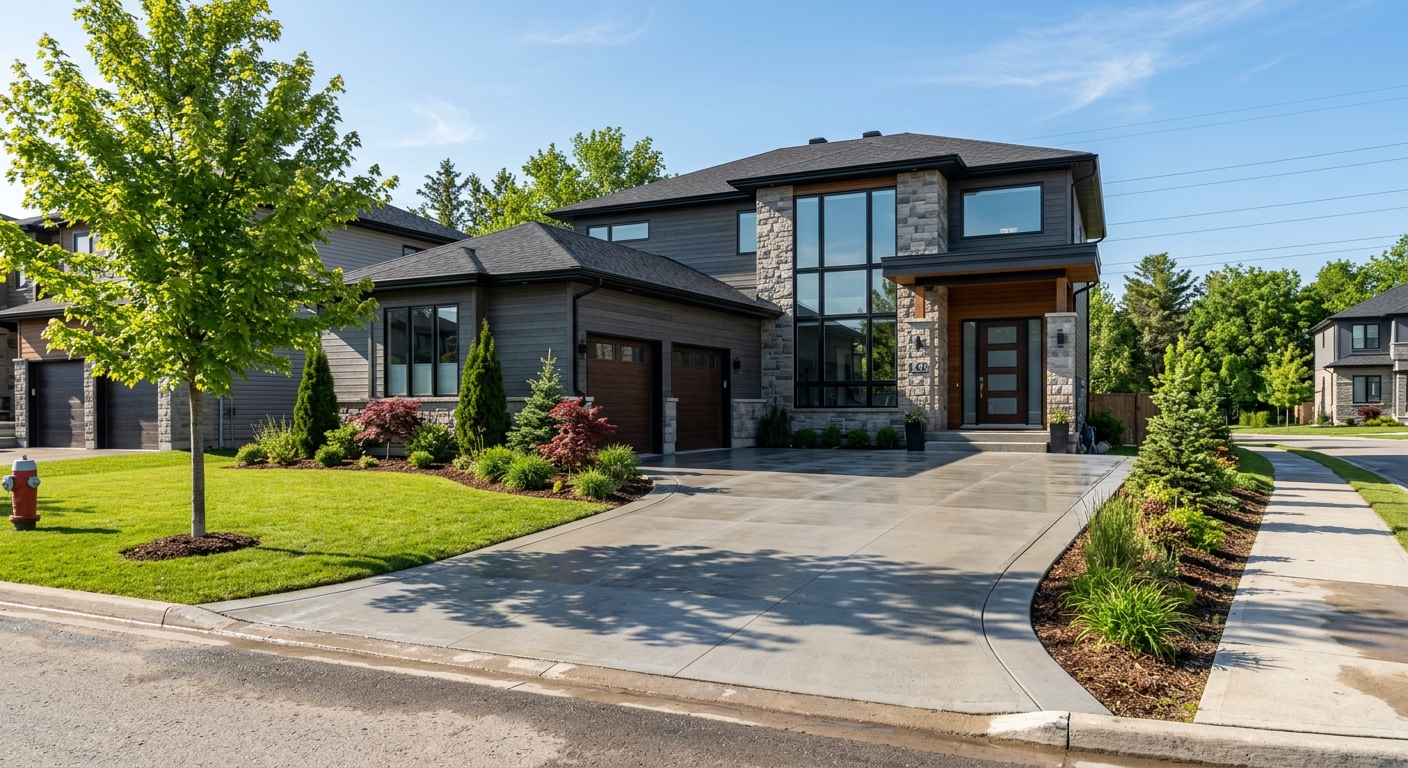
Concrete work options and costs in Downtown Eastside
Concrete work is a common upgrade in Downtown Eastside, British Columbia—especially for older properties where driveways, patios, and walkways take a beating from wet weather and traffic. With a 2021 Census population of 18,477, the neighbourhood has a steady demand for durable, low-maintenance flatwork and foundation repairs. Single-detached housing remains a meaningful part of the surrounding local stock, and that’s the segment that most often needs new driveways and porch slabs.
In the Lower Mainland–Southwest, mild winters and a shallow frost line still drive concrete design and pricing because we have to protect slabs and foundations from freeze–thaw damage and heavy coastal rainfall. Local codes and practice typically assume a frost depth around 450 mm / 18", so footings and thickened edges are set below that to avoid frost heave. Add saturated soils and drainage issues near lane access and older lanes, and base preparation costs can climb quickly. At the same time, the Vancouver–Surrey–Abbotsford corridor has strong contractor availability for broom-finished slabs, while stamped or exposed-aggregate work can involve longer lead times for forms and finishing crews.
Because of this mix of weather risk and labour/material scheduling, two bids for the “same” flatwork can land far apart—especially once you factor in air-entrained mix, compacted granular base depth, joint layout, and curing/blanketing. Use the ranges below as a realistic starting point, then we’ll unpack what drives the differences.
| Application |
Typical Size |
Key Spec |
Finish Option |
Price Range |
| Concrete driveway (standard broom finish) |
320–480 sq. ft. |
Air-entrained mix, compacted base, control joints |
Broom finish |
$18,000–$28,000 |
| Exposed aggregate driveway |
320–480 sq. ft. |
Air-entrained mix, proper base drainage, careful curing |
Washed/exposed aggregate |
$22,000–$34,000 |
| Stamped concrete driveway or patio |
240–420 sq. ft. |
Air-entrained mix, stamping release, sealant |
Stamped pattern + colour |
$26,000–$42,000 |
| Plain concrete patio or walkway |
120–300 sq. ft. |
Air-entrained mix, compacted granular base, joints |
Broom or light trowel finish |
$16,000–$26,000 |
| Garage floor (interior slab) |
320–520 sq. ft. |
Minimum 32 MPa mix, vapour considerations as needed |
Standard trowel + sealer (optional) |
$20,000–$30,000 |
| Foundation footings (structural, below frost) |
Varies by foundation plan |
Engineered rebar, excavation below frost, concrete to spec |
Structural concrete |
$12,000–$28,000 |
Prices are estimates only and vary by project scope, site access and material selection.
What affects the price of concrete work in Downtown Eastside
In the Lower Mainland–Southwest, it’s not unusual to see quotes for the “same” driveway or patio swing by 30–50% across British Columbia. The biggest reasons are the specs that protect the concrete in our climate (frost depth, freeze–thaw durability, drainage and air-entrainment), and the hidden labour of good base prep—excavation, granular placement, compaction and forming—especially on sites with limited truck access. Where you’ll often see the spread is not the concrete itself, but the total package: excavation haul-away, reinforcement, finish complexity, and how carefully contractors schedule curing around rain and cool nights.
Frost depth and freeze–thaw cycles dictate every spec here. Footings must extend below the design frost depth (in coastal BC, often around 0.5–1.2 m depending on design conditions), and exterior slabs require air-entrained concrete to survive repeated wetting and freezing. When temperatures drop, colder regions need cold-weather curing precautions (heating, insulation blankets), and while our winter is mild compared with inland BC, cool nights and prolonged rain still push contractors to use blankets/longer curing windows on exterior work—adding labour time. De-icing salt can also accelerate surface spalling, so sealing and proper finishing become more than “cosmetic.”
In Downtown Eastside, costs often rise for properties with older subgrades that need extra granular and regrading, or where drainage repairs are required before concrete. Conversely, pricing can drop when the site is open and access is straightforward. As a ballpark, a broom-finished driveway typically sits in the $18–$28 band, while stamped concrete often lands closer to the $22–$36 band because of added materials, labour and curing discipline.
| Price Factor |
Why It Matters |
Cost Impact |
| Frost line depth |
Determines footing depth and form height |
Higher excavation and deeper pours increase labour and disposal; can add thousands on foundation work |
| Site preparation |
Excavation, grading, compacted granular base |
Bad subgrade or poor drainage can add significant trucking, granular and compaction time |
| Reinforcement |
Rebar or wire mesh requirement |
Material cost plus labour to place and support mesh properly |
| Mix design |
Air-entrainment and compressive strength spec |
Correct mix reduces freeze–thaw scaling risk; wrong mix can cause premature failure |
| Finish type |
Broom vs. stamped vs. exposed aggregate |
Stamped/exposed requires additional steps, tools and skilled finishing crew time |
| Pour size and concrete truck access to site |
Placement speed and hose/boom needs |
Long carries, limited access, or multiple placements raise labour and sometimes truck surcharges |
| Cold-weather curing precautions |
Heating and blankets |
More crew hours and materials in cool, wet conditions—even when temperatures aren’t extreme |
| Control joint pattern and sealing cost |
Crack management and surface protection |
Proper joints and sealers add line-item cost but prevent water ingress and spalling |
Permits & regulations in British Columbia
In British Columbia, structural concrete work—such as footings, foundation walls, and grade beams—typically requires a building permit, and it’s common for engineered drawings to be reviewed by the municipality before construction starts. For concrete flatwork (patios, walkways, and driveways), permits usually aren’t required unless the work affects lot grading, stormwater/impervious surface requirements, or the municipal right-of-way (for example, ties into a curb, sidewalk cut, or drainage connections). In Downtown Eastside, where access and water management can be tricky, it’s smart to confirm whether any drainage modifications or curb/sidewalk interfaces trigger additional approvals.
To protect yourself, verify the contractor’s credentials before breaking ground. First, check that they carry liability insurance and appropriate worker coverage; ask for certificates of insurance and look for a clearance letter or active coverage documentation. Second, confirm they can legally carry out the scope you’re hiring for (a reputable contractor should be able to provide licence details and references on similar-scale work in the Lower Mainland–Southwest corridor). Third, ask for permit responsibility in writing: who pulls it, who pays, and what drawings/specs they’ll follow.
Step-by-step for a homeowner in Downtown Eastside: (1) ask the contractor for their certificate of insurance and coverage confirmation, (2) check their business/contractor registration details through the province’s online contractor verification resources (where available), (3) request their WCB/clearance documentation, and (4) confirm in your contract that the work matches the approved engineered drawings or applicable standard details.
Getting concrete right in Downtown Eastside's freeze-thaw climate
Concrete failures in Downtown Eastside almost always trace back to water and temperature: poor drainage and insufficient base compaction allow pumping and settlement, while freeze–thaw cycles attack the surface when the concrete isn’t correctly air-entrained or properly cured. In the Lower Mainland–Southwest, you’re dealing with frequent wetting, saturated soils, cool nights and coastal rainfall, so the job needs the right “system”—base, mix, joints, curing and sealing—rather than just placing concrete.
To spec the job correctly, start with (1) base preparation: compacted granular sub-base to the design depth for local soil conditions, with attention to slope and drainage so water can’t sit under or beside the slab. (2) Mix design: exterior flatwork should use air-entrained concrete with target air content typically around 5–7% for durability, and a minimum 32 MPa compressive strength specification. (3) Control joints: layout and spacing must limit random cracking—especially where the slab meets edges, steps or garage openings. (4) Curing: plan for at least 7 days of proper curing conditions; in damp/cool periods, curing blankets or a controlled approach help reach design strength. (5) Sealing: apply a penetrating sealer after the recommended cure window (commonly 28 days post-pour) to repel de-icing salt and reduce surface scaling.
Here’s a practical example: if one quote is only slightly lower on a driveway but leaves out air-entrainment verification and proper curing/blanketing, the “savings” can be wiped out quickly by spalling repairs. Paying the higher end of the $18–$28 driveway band is often justified when it buys you correct mix spec, reinforced base prep and proper sealing rather than a rushed pour.
| Spec |
Why It Matters in Downtown Eastside |
What to Ask For |
Impact if Skipped |
| Compacted granular base (depth?) |
Stops settlement and reduces water trapping under slabs |
Granular type and compacted depth stated; proof of compaction method |
Uneven cracking, pumping, and accelerated breakdown in wet seasons |
| Air-entrained concrete mix (target air %?) |
Improves freeze–thaw scaling resistance in coastal-wet conditions |
Air content confirmation (commonly 5–7%) and exterior durability spec |
Surface scaling/spalling and early failure even if the slab “looks fine” |
| Compressive strength (MPa rating) |
Ensures long-term load and abrasion resistance |
Minimum 32 MPa stated for exterior flatwork |
Lower durability and higher risk of damage from traffic and salt |
| Control joints (spacing per ACI guidelines) |
Controls where cracks occur rather than allowing random cracking |
Joint layout plan and saw-cut timing |
Random cracking, water ingress, and joint deterioration |
| Minimum 7-day curing period |
Strength gain depends on time and temperature |
How curing is handled during rain/cool nights (blankets/sealers) |
Weaker surface, higher early cracking risk |
| Penetrating sealer (when applied after cure) |
Repels salt and moisture, reducing scaling in freeze–thaw cycles |
Sealer type and application timing (commonly after ~28 days) |
Faster surface breakdown and easier staining |
How to choose a concrete work contractor in Downtown Eastside
Choosing the right contractor matters more in Downtown Eastside than most places because our freeze–thaw and coastal-wet conditions punish shortcuts. Start by verifying British Columbia credentials and coverage. Ask for (1) business/contact registration details (and licence scope where applicable), (2) a current certificate of liability insurance showing the insured contractor’s name and effective dates, and (3) proof of worker coverage and a clearance letter or equivalent documentation for their current status. Don’t rely on a verbal promise—ask for documentation before scheduling the pour.
Next, get 2–3 itemised written quotes. You want labour and materials broken down by line items (excavation, granular base, reinforcement, concrete supply/mix spec, forming, finish, joints, curing/blankets, and sealing). A lump sum is fine only after the scope is clearly identical. Read the scope carefully: what is excluded? Is permit pulling included where required? Is disposal/haul-away included? Are drainage adjustments part of base prep or treated as a separate add-on?
Warranty should be explicit: workmanship warranty length, product/manufacturer warranty (if any), and whether it’s transferable to future owners. For payment, never pay more than 10–15% upfront; keep a holdback until key milestones are complete (base inspection, reinforcement placement, pour completion, and final curing/sealer—if included). Finally, insist on a written timeline with a start date and completion estimate.
- Ask the contractor to list the concrete mix spec for exterior durability and air-entrainment.
- Request the planned compacted granular base depth and slope/drainage approach.
- Confirm reinforcement details (mesh vs rebar) and how it’s supported during placement.
- Get a joint layout plan (locations and intended spacing) and saw-cut timing.
- Ask how they handle rain and cool nights (blankets, curing method, tarps).
- Require sealing scope in writing and when it will be applied (timing after cure).
- Ensure truck access plan is stated (hose/boom distance, number of placements).
- Have them quote haul-away/disposal separately if site conditions are unknown.
- Check their insurance certificate dates are current and match the contracting name.
- Verify worker coverage status and request a clearance letter (documentation).
- Request examples/photos of similar Downtown Eastside or Lower Mainland jobs.
- Make sure the warranty terms cover cracking/spalling related to workmanship and curing.
Concrete red flags in Downtown Eastside: (1) they can’t clearly explain air-entrainment and joint curing, (2) they quote “cheaper concrete” without stating mix specs, (3) they dismiss drainage/base prep as optional, (4) they avoid providing insurance/coverage documentation, and (5) they ask for a large upfront payment before base inspection.
Frequently asked questions — concrete work in Downtown Eastside
How long does a concrete driveway last?
In Downtown Eastside, a well-built concrete driveway often lasts decades, but longevity depends heavily on base preparation, air-entrainment, jointing, and how the surface is protected from wetting and de-icing salts. In the Lower Mainland–Southwest climate, freeze–thaw cycles and persistent moisture are what drive premature scaling and spalling if the mix and curing aren’t right. A driveway built with compacted granular base, correctly air-entrained concrete, proper control joints and a penetrating sealer after cure generally performs far better than one finished quickly after a rainy day. Pricing often reflects that quality: a standard broom driveway typically falls around the $18,000–$28,000 band, while premium options like stamped surfaces cost more because of extra labour and sealing discipline.
What is air-entrained concrete and why does it matter here?
Air-entrained concrete is mixed with microscopic air bubbles designed to give freeze–thaw pressure a safe path to expand and contract. In British Columbia’s coastal-wet environment, the concrete repeatedly gets wet and then experiences temperature swings, which can lead to surface scaling if the concrete doesn’t have enough air. That’s why reputable contractors in the Lower Mainland–Southwest specify air-entrainment for exterior flatwork and target durable performance (commonly with exterior air content around 5–7%). If a contractor can’t confirm the mix spec, you’re taking a real risk: spalling can start at the surface even when the slab “looks solid” at first. Always ask how they verify air content and what curing steps they use during cool, rainy conditions.
How do I prepare the base for a concrete slab?
Base preparation is the part homeowners can’t easily see, but it controls whether your slab stays flat. For projects in Downtown Eastside, contractors typically excavate to the required depth, remove soft material, then place a compacted granular sub-base to the design level. Proper drainage matters because saturated soils under the slab increase the freeze–thaw stress on the surface. A good contractor will describe the granular material, compaction method, and whether they’re adjusting slope away from the house or into an approved drainage path. After base work, they should set forms accurately and confirm reinforcement placement before the pour. If a quote skips base depth and compaction details, it often underestimates the true cost of longevity—even if the concrete price looks attractive.
How do I compare concrete quotes?
To compare concrete quotes in Downtown Eastside fairly, make sure the scope and specs match line-for-line. Ask each bidder for an itemised breakdown (excavation, granular base, reinforcement, concrete mix spec, forming, finish, joints, curing/blankets, and sealing). Confirm the finish type: broom versus stamped versus exposed aggregate can change labour and cure handling. Next, check what’s excluded—common omissions are disposal/haul-away, drainage corrections, permit responsibilities (where required), and sealing. Also compare how each contractor plans for rain and cool nights: a “cheap” quote that rushes curing can cost more later through surface scaling repairs. As a reference point, driveways often land in the $18,000–$28,000 range, with stamped work typically higher. Don’t just pick the lowest number—pick the best-matched scope and durability spec.
Can concrete be poured in cold weather in Downtown Eastside?
Concrete can be poured in cold weather in British Columbia, but it must be protected to reach the required strength and durability. In Downtown Eastside and the Lower Mainland–Southwest, winters are mild compared to inland BC, yet cool nights and wet conditions are common, and curing can be delayed. Contractors may use insulated curing blankets, cover systems, and temperature control to support proper strength gain—especially during damp/cold stretches. The key is whether the contractor has a cold-weather curing plan and can explain timing for form removal and jointing. If a project is near the “shoulder season,” ask how they’ll manage temperature, rainfall exposure, and curing duration. A responsible crew will also coordinate scheduling so the slab isn’t left vulnerable while early strength develops.
How do I maintain concrete in Downtown Eastside's freeze-thaw climate?
Maintenance in Downtown Eastside is about keeping water and salts from attacking the surface. Start with a quality penetrating sealer applied after the cure window (often around 28 days post-pour, depending on the product). Sweep debris regularly so it doesn’t hold moisture against the surface. If you use de-icing products, apply sparingly and avoid harsh repeated blasting—salt can increase surface wear when the concrete isn’t properly sealed. Watch for early signs: small surface scaling, hairline cracking that grows, or joint gaps. If joints open up, re-sealing/re-grouting the joints (not just patching the surface) helps prevent water entry and freeze–thaw damage. For any new slab or driveway built with correct air-entrainment, joints and curing, maintenance can be simple—but ignoring sealing and drainage leads to faster deterioration.