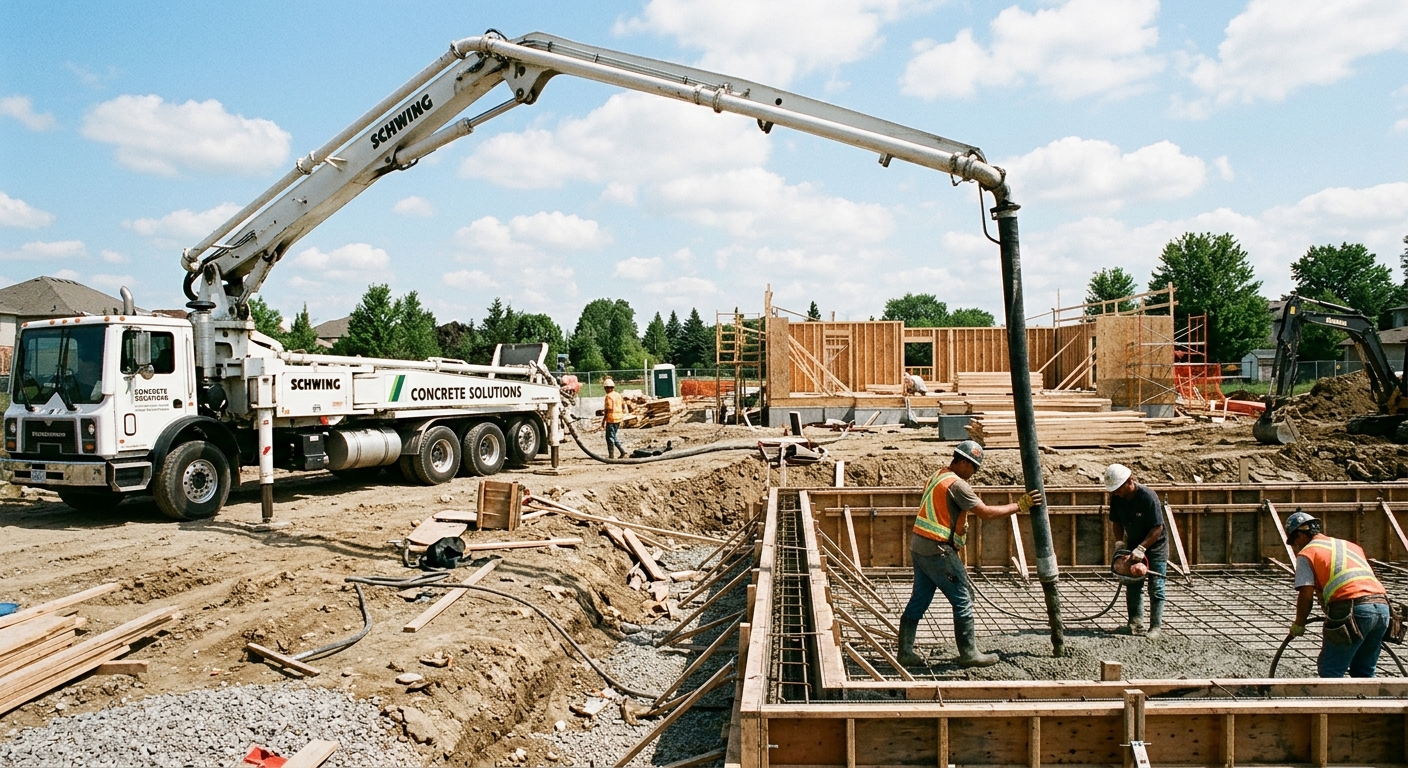
Concrete work options and costs in Steinhauer
Steinhauer, Alberta is a small community (population 1,867 as of the 2021 Census) where homeowners and contractors plan concrete projects around long winter conditions and frequent freeze–thaw. In this area, concrete flatwork—driveways, patios, and walkways—tends to be the most common exterior upgrade, especially for properties near the established residential pockets around Steinhauer Village/Olds-area access routes where access and drainage matter. Calgary’s cold continental climate and the Calgary-region construction cadence also shape availability: the best crews book earlier in spring, while exterior pours slow down as temperatures drop, which can affect scheduling and pricing.
On the housing side, Steinhauer’s broader Calgary economic region is heavily influenced by owner-occupied development patterns; that means many projects are upgrades rather than first-time construction, and that drives demand for both standard broom-finished slabs and more decorative options. Prices reflect the region’s engineered specs: design frost depth is about 1.2 m (roughly 4 ft), so foundations and any structural elements must bear below that depth to manage frost heave. For driveways and exterior slabs, contractors typically use air-entrained mixes, granular base prep, and well-spaced control joints to reduce cracking and surface damage.
Below are practical cost bands you can use to compare contractor quotes in Steinhauer. If your quote differs widely, it’s usually because of footing depth, base thickness, reinforcement density, and whether winter-grade curing steps are included.
| Application |
Typical Size |
Key Spec |
Finish Option |
Price Range |
| Concrete driveway (standard broom finish) |
18 ft x 20 ft (360 sq ft) |
4 in slab, air-entrained mix, compacted base |
Broom finish with control joints |
$12,000–$18,000 |
| Exposed aggregate driveway |
18 ft x 22 ft (396 sq ft) |
Air-entrained mix, exposed surface treatment |
Exposed aggregate with sealed finish |
$14,000–$21,000 |
| Stamped concrete driveway or patio |
20 ft x 20 ft (400 sq ft) |
Reinforced slab, air-entrained mix |
Stamped pattern + release agent + seal |
$15,000–$26,000 |
| Plain concrete patio or walkway |
10 ft x 16 ft (160 sq ft) |
4 in slab (patio/sidewalk style), compacted base |
Broom finish or light trowel |
$5,000–$9,000 |
| Garage floor (interior slab) |
22 ft x 22 ft (484 sq ft) |
Vapour barrier (as applicable), fibre or mesh reinforcement |
Float/trowel finish (often with light broom edges) |
$10,000–$16,000 |
| Foundation footings (structural, below frost) |
Typical house footing scope |
Excavate to design frost depth; reinforced concrete |
Structural concrete (not decorative) |
$28,000–$45,000 |
Prices are estimates only and vary by project scope, site access and material selection.
What affects the price of concrete work in Steinhauer
In Steinhauer and the broader Calgary region, two quotes for the “same” concrete project can easily differ by 30–50% because the scope details that matter most—excavation depth, granular base thickness, reinforcement, and winter curing—aren’t always written clearly. With cold continental conditions, contractors also price conservatively: they’re engineering around freeze–thaw and frost heave, not just pouring concrete and hoping for the best.
Here’s the core reason: the design frost depth is about 1.2 m (roughly 4 ft). That means structural footings and any frost-susceptible elements must extend below that depth to reach undisturbed soil. Exterior slabs and driveway approaches still need granular base prep and air-entrained concrete to survive freeze–thaw cycles. Calgary-area crews also face a shorter effective pour season for exterior work; if a late-fall or early-spring pour is unavoidable, cold-weather curing precautions—insulated blankets and temporary heat to protect early-age strength—add labour and material costs.
De-icing salt is another price driver. Salt doesn’t just “affect appearance”—it accelerates surface scaling and spalling if the slab isn’t air-entrained and properly finished. For a homeowner, that’s why sealing is often recommended after curing, which can be bundled into a decorative package (like stamped or exposed aggregate).
Concrete scope can swing pricing quickly in Steinhauer. For example, going from a basic broom-finished driveway budget near $12,000–$18,000 to a stamped or more decorative system can justify the step-up because of additional placement time, pattern stamps, and finishing labour typically tied to the region’s frost-safe specs. Similarly, foundation footing scopes can shift within $28,000–$45,000 depending on footing excavation volume and reinforcement requirements driven by site conditions and soil profile.
| Price Factor |
Why It Matters |
Cost Impact |
| Frost line depth |
Determines footing depth and form height |
Deeper excavation and more concrete can add a major portion of structural cost |
| Site preparation |
Excavation, grading, compacted granular base |
Hard-to-access yards or poor subgrade increase truck time and base material |
| Reinforcement |
Rebar or wire mesh requirement |
More steel coverage raises material cost and affects labour time |
| Mix design |
Air-entrainment and compressive strength spec |
Air-entrained mixes and higher-strength specs cost more, but reduce freeze–thaw failures |
| Finish type |
Broom vs. stamped vs. exposed aggregate |
Decorative finishing adds steps, curing care, and sealant system work |
| Pour size and concrete truck access to site |
Scheduling and pumping/placement logistics |
Limited access can require extra labour or alternate placement methods |
| Cold-weather curing precautions |
Heating and blankets |
Winter-grade protection can add significant costs during shoulder-season weather |
| Control joint pattern and sealing cost |
Controls cracking and improves durability against salts |
Better joint planning and a quality sealer typically reduce long-term maintenance |
Permits & regulations in Alberta
In Alberta, it’s common to need a building permit for structural concrete elements, especially when the work is part of a foundation system. Typically, footings, foundation walls, and grade beams require a permit, and you may also see engineered drawings reviewed as part of the permit process. For concrete flatwork—driveways, patios, and walkways—a permit is often not required by default. However, you should expect a check when the project affects lot grading, stormwater drainage, or impervious surface coverage limits, and when work encroaches toward municipal right-of-way areas. Bottom line: confirm with the local authority before excavation, especially if you’re changing elevations, adding drainage, or tying into existing foundations.
Before signing, verify your contractor is set up to do the work safely and legally in Alberta. Here’s a step-by-step homeowner approach:
- Confirm contractor licensing/registration details using the relevant provincial contractor information channels (search the company name and “licence/registration”).
- Request a Certificate of Liability Insurance and confirm it’s current and includes adequate coverage for the scope (driveway and excavation work can be high-risk).
- Ask for proof of WSIB/WCB coverage documentation and ensure it matches the company doing the work.
- Request references on projects of similar scale in the Calgary area (ask specifically about winter curing practices and crack/control joint outcomes).
- Keep copies of everything with your quote and contract package.
Getting concrete right in Steinhauer's freeze-thaw climate
Concrete in Steinhauer can fail in predictable ways when the specs don’t match the freeze–thaw reality. The big culprits are inadequate base preparation, incorrect mix air content, poor curing, and skipping control joints—each of which can lead to cracking, scaling, or spalling when temperatures swing. In this Calgary region, the engineering assumption is frost protection down to about 1.2 m (roughly 4 ft) for structural elements, and exterior slabs still need air-entrained concrete plus properly compacted granular base.
To spec a job correctly, focus on five areas. First, base prep: compacted granular sub-base to the correct depth for your soil conditions and slab type, so the slab doesn’t pump during freeze cycles. Second, mix design: for exterior flatwork, use air-entrainment (typically 5–7% air content) and a minimum compressive strength of 32 MPa to build early durability. Third, control joints: add enough joints, with correct timing, to limit random shrinkage cracking. Fourth, curing: allow a minimum 7-day curing period under proper conditions; if you’re pouring near cold weather, contractors should protect early-age concrete with curing blankets and, when required, temporary heat. Fifth, sealing: apply a penetrating sealer after curing (commonly around 28 days post-pour) to help repel de-icing salts.
A practical example: if a basic broom-finished driveway quote lands near $12,000–$18,000, it may look “close” to an exposed aggregate option. But the price difference is often justified when the decorative option includes stricter curing protection, better sealing systems, and additional finishing labour needed to maintain a durable surface under salt exposure. The cheapest quote can be the most expensive in the long run if air-entrainment and curing protection aren’t clearly specified.
| Spec |
Why It Matters in Steinhauer |
What to Ask For |
Impact if Skipped |
| Compacted granular base (depth?) |
Reduces movement and supports the slab through freeze–thaw cycles |
Base thickness and compaction method for your soil/subgrade |
Settlement, cracking, and uneven slab movement |
| Air-entrained concrete mix (target air %?) |
Protects against freeze–thaw damage and helps prevent surface scaling/spalling |
Air content range and confirmation it’s air-entrained for exterior exposure |
Higher risk of spalling in Alberta winters |
| Compressive strength (MPa rating) |
Ensures durability and adequate early-age strength for curing timelines |
Minimum 32 MPa spec on exterior work |
Lower long-term performance and increased cracking |
| Control joints (spacing per ACI guidelines) |
Limits uncontrolled shrinkage cracking under seasonal temperature swings |
Planned joint layout and saw-cut timing |
Random cracking patterns and water infiltration |
| Minimum 7-day curing period |
Lets concrete gain strength safely in cold conditions |
Curing plan for shoulder-season temperatures |
Surface weakness, scaling, and premature deterioration |
| Penetrating sealer (when applied after cure) |
Helps repel salt and reduce damage from de-icing exposure |
Sealer type and timeline (often around 28 days post-pour) |
Faster surface wear and increased spalling risk |
How to choose a concrete work contractor in Steinhauer
Choosing a concrete contractor in Steinhauer is mostly about verifying three things: competency, coverage, and clarity. In Alberta, start by confirming the contractor’s licensing/registration details (using the appropriate provincial registry/process for contractors) and obtain proof of liability insurance that matches the work scope. For employment-related coverage, ask for documentation showing WSIB/WCB coverage for the individuals working on your site. If a contractor can’t provide current certificates promptly, that’s a major warning sign.
Next, don’t accept a vague number. Get 2–3 itemised written quotes that break out labour and materials (for example, excavation/base, reinforcement, concrete supply, finishing, sealing, and any cold-weather protection). Read the scope carefully for what’s excluded: permit pull responsibility, disposal/haul-away, saw-cutting and joint sealing, removals (existing slab/demo), and drainage adjustments. In winter-sensitive work, ask whether the price includes curing blankets/heating when needed.
Warranty matters too. Look for a workmanship warranty length and confirm whether any product/manufacturer warranty is included and whether it is transferable to future owners. Finally, payment schedules should be fair: never pay more than 10–15% upfront, and hold back a portion until the work is complete and any finishing/sealing steps are done.
- Ask for a written start date and completion estimate.
- Confirm the crew size and whether the same team works through finishing and jointing.
- Request mix details: air-entrainment and minimum 32 MPa for exterior work.
- Verify base thickness and compaction method (and whether they test/track compaction).
- Confirm reinforcement approach (mesh vs rebar vs fibres, based on slab use).
- Require a control joint layout (spacing plan) before the pour.
- Ask how long they cure and how they protect concrete during cold snaps.
- Clarify sealing: product type and timing (often around 28 days after pour).
- Ask about disposal: is haul-away included in the quote?
- Confirm access plan for the concrete truck and equipment on your driveway/yard.
- Review drawings or site photos for drainage tie-ins and grading changes.
- Ensure the contract states what happens if temperatures drop during the pour window.
Concrete red flags in Steinhauer include: vague “concrete and labour” wording with no base/reinforcement/mix specs, skipping air-entrainment on exterior slabs, promising a pour “anytime” without a cold-weather curing plan, demanding a large upfront payment, and failing to provide proof of liability insurance and WSIB/WCB coverage.
Frequently asked questions — concrete work in Steinhauer
How do I maintain concrete in Steinhauer's freeze-thaw climate?
In Steinhauer and the Calgary region, maintenance is about managing moisture movement and protecting the surface from de-icing salts. Start with safe, consistent cleaning: sweep off grit and sand so you’re not grinding particles into the surface. Use a sealer approach after the slab is fully cured (often around 28 days post-pour) because salts can accelerate scaling and spalling if the surface isn’t protected. Also watch for small issues early—hairline cracking, joint gaps, or minor surface scaling should be addressed before water works its way in. If you’re using salt-heavy products, consider switching to calcium chloride blends used in winter maintenance programs. Concrete durability improves a lot when the slab was built with air-entrained concrete and proper control joints in the first place.
What causes concrete to spall in Steinhauer winters?
Spalling usually comes from freeze–thaw damage plus trapped moisture and salt exposure. The most common technical cause is inadequate air-entrainment or using the wrong mix for exterior exposure, so the concrete can’t manage the expansion from freezing water. Base and drainage problems also contribute: if water collects at the edges or the slab settles, micro-cracks form and allow more moisture penetration. In Alberta winters, de-icing salts can intensify surface deterioration, turning minor scaling into flaking/spalling over time—especially on driveways and patios. The fix begins at the spec stage: confirm the contractor uses an air-entrained mix for exterior flatwork and a proper control joint pattern. In Steinhauer, a driveway that fits the typical band of $12,000–$18,000 should still include these durability steps; if not, you’ll pay later.
What is rebar and when is it required in Alberta?
Rebar is steel reinforcement placed within concrete to control cracking and improve strength under load. When it’s required depends on the slab’s purpose, thickness, and design loads. For typical exterior flatwork like driveways and many garage floors, reinforcement may be mesh, rebar, fibres, or a combination—chosen based on engineering and expected wheel loads. For structural foundation elements such as footings and foundation walls (the jobs that generally require permitting and engineering review in Alberta), reinforcement is almost always specified by design drawings. In Steinhauer, reinforcement and base prep matter even more because freeze–thaw cycles encourage movement; steel alone doesn’t fix poor base compaction or an incorrect mix, but it’s a key part of a properly engineered system. When reviewing a quote, ask whether the reinforcement plan is based on slab design and whether it matches the stated thickness and air-entrained mix requirements.
How long does a concrete project take in Steinhauer?
Timelines depend on scope and season, especially in the Calgary climate zone. For interior slabs (like a garage floor), the active work might be a day or two, but curing still matters for when finishes and loads are allowed. For exterior flatwork—driveways, patios, and walkways—site prep (demo/removal, grading, and compacted base installation) is often the longest portion, followed by forming, placing, finishing, and joint cutting. Even when the pour itself is fast, curing and weather protection drive the schedule in colder periods. If you’re working in late fall or early spring, a contractor may need additional steps like insulating blankets and cold-weather protection, which affects calendar time. A driveway project often falls within a short work window once materials are scheduled, but “time to usable” depends on curing conditions and the contractor’s protection plan. Always ask your contractor for both a start date and a completion/usable timeline in writing.
What is a concrete overlay and is it suited to Steinhauer?
A concrete overlay is a new cement-based layer installed over an existing concrete surface to restore appearance or add a new surface profile without removing the entire slab. In Steinhauer, overlays can work well when the existing slab is structurally sound—meaning it doesn’t have major settlement, widespread delamination, or severe cracking that indicates movement. Overlays generally help with cosmetic wear and minor surface deterioration, but they don’t “fix” ongoing freeze–thaw movement if water is getting into joints or the base is failing. Salt and moisture can lift or degrade overlays if prep and bonding aren’t correct. A contractor should inspect the slab, assess crack patterns, and specify surface preparation (often scarifying/grinding) and a suitable bonding system. In many driveway cases, a full replacement may land near $12,000–$18,000, while overlays can cost less initially, but only when the substrate meets the right conditions.
How do I seal concrete to protect it in Steinhauer?
Sealing helps protect concrete from de-icing salts and moisture penetration—two things that matter a lot in Steinhauer winters. The key is timing: most sealers should be applied only after the concrete has fully cured (commonly around 28 days post-pour, assuming proper curing conditions). Before sealing, the surface needs to be clean and dry, free of dust, curing compounds, oil, and salts. A penetrating sealer is typically preferred for exterior flatwork because it works below the surface rather than sitting as a surface film. Ask your contractor for the product type and coverage rate, and make sure joint areas are handled correctly so water can’t get trapped. Re-sealing timelines vary by product and traffic, but in our climate, maintenance planning is smart—especially for driveways and patios exposed to snow removal and salt.